Indiana Claim Allowance Form
Overview of this form
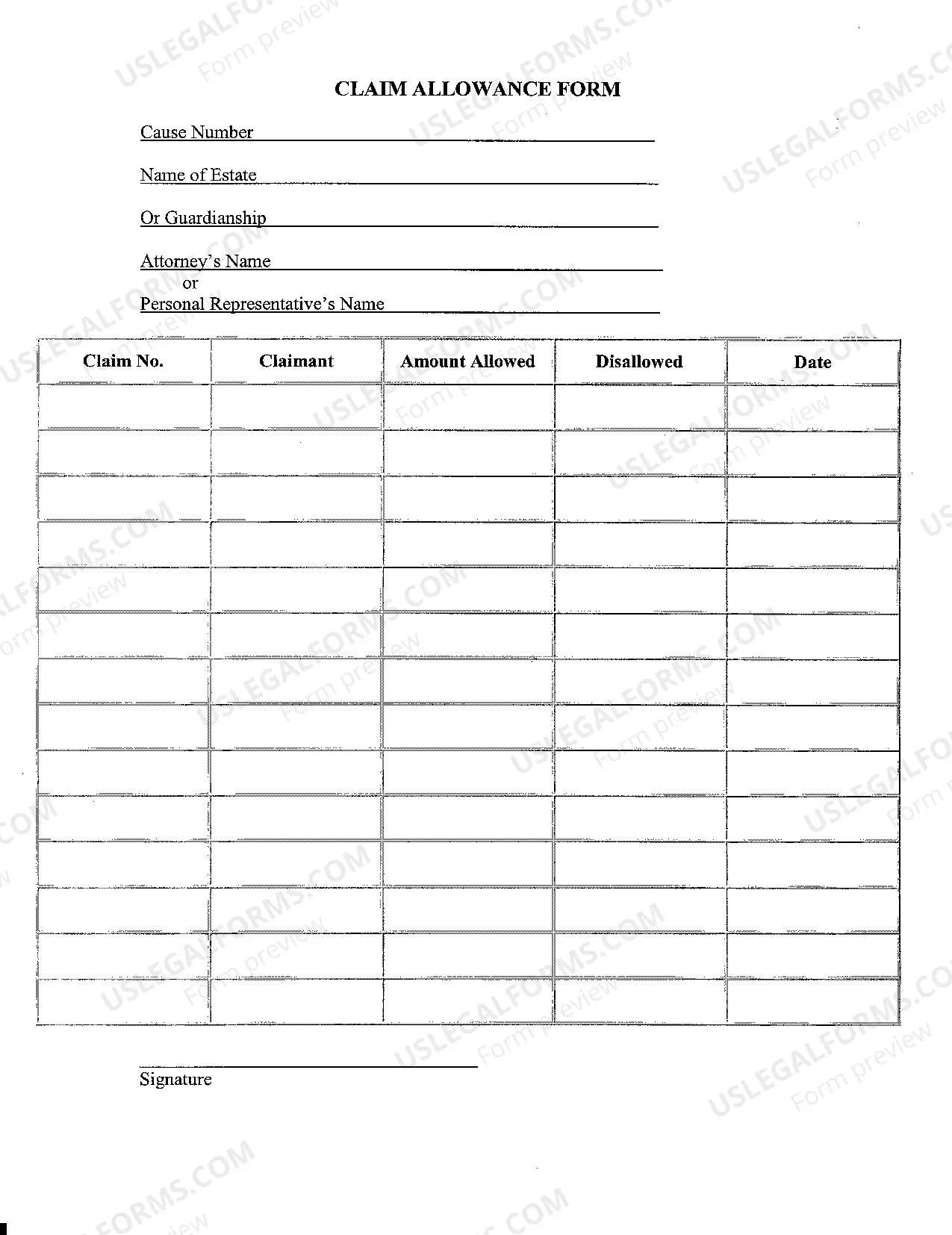
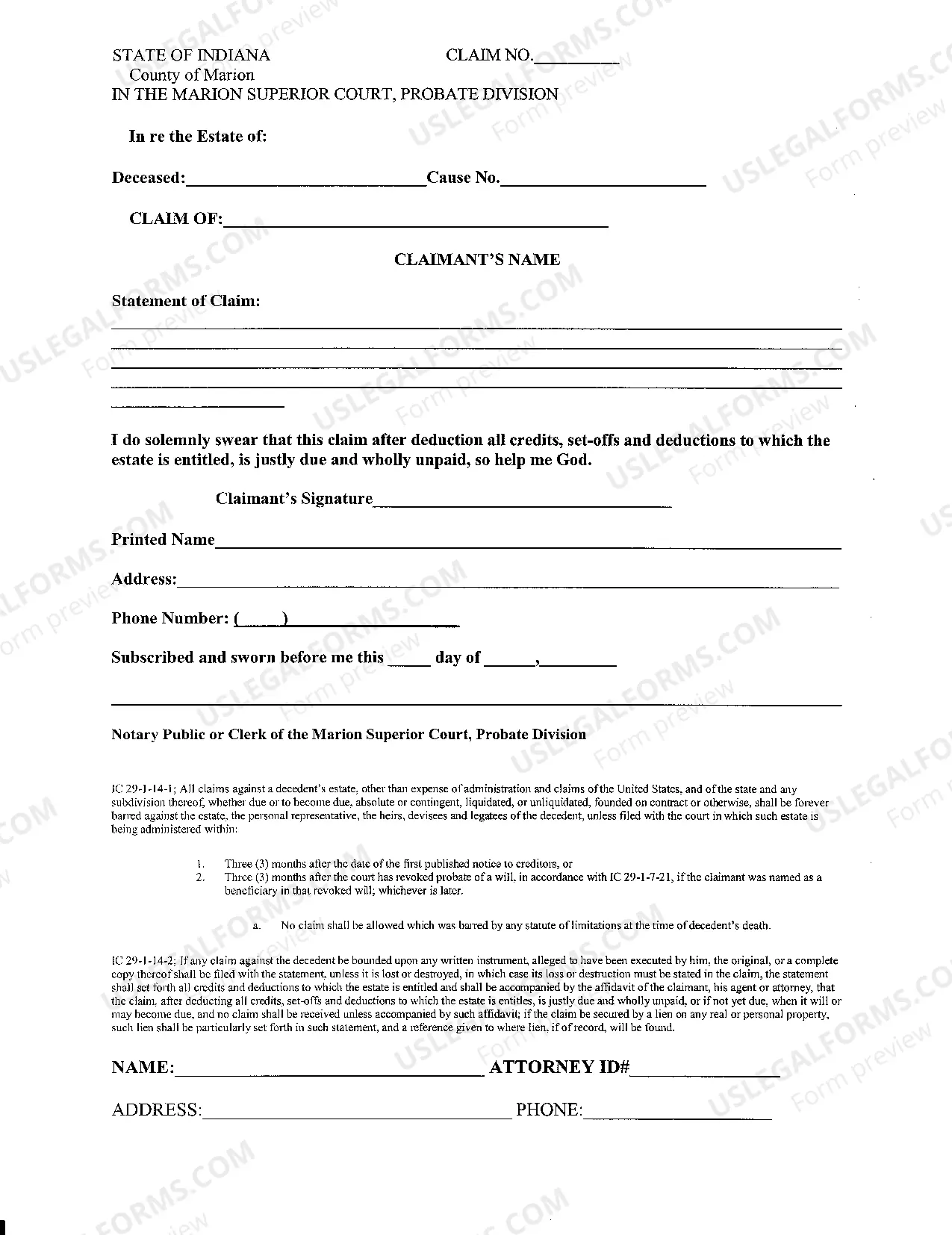
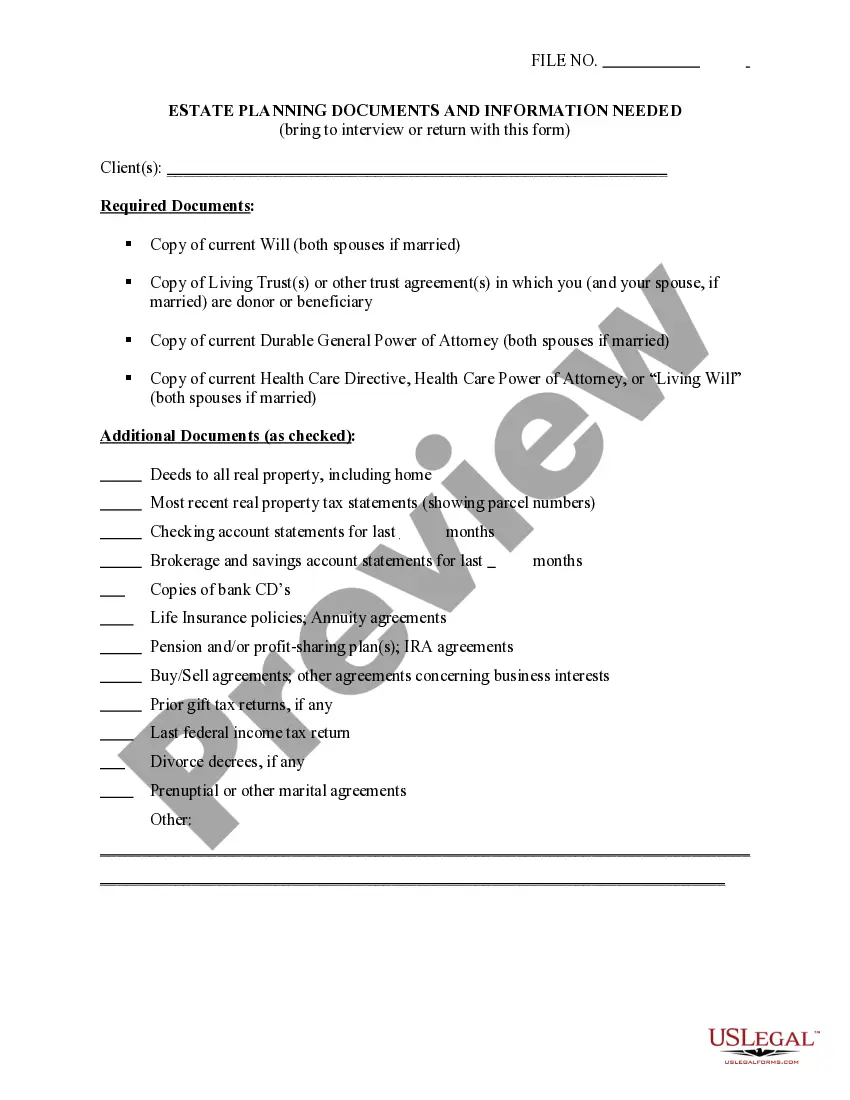
The Claim Allowance Form is a legal document used to formally request the allowance of a claim against an estate. It differs from similar forms by specifically focusing on claims made by creditors or other interested parties in the probate process. This form is essential in ensuring that claims are processed legally and appropriately in a court of law.
Main sections of this form
- Identification of the claimant providing their full name and contact information.
- Details of the claim, including the reasons for the claim and the amount sought.
- Any supporting documentation required to substantiate the claim.
- Signature of the claimant, affirming the accuracy of the information provided.
- Notarization section, if required, to validate the form.
When to use this form
This form is needed when a creditor seeks to recover a debt from the estate of a deceased individual. It is typically used during the probate process, especially when an estate is being settled and the executor is handling various claims from creditors. Submitting this form ensures that the claim is officially recognized and can be considered for approval or denial by the probate court.
Who this form is for
- Creditors seeking compensation for debts owed by the deceased.
- Individuals or entities with a legal claim against the estate.
- Executors or administrators handling estate matters who need to document claims.
Instructions for completing this form
- Identify the claimant by providing full name and address.
- Clearly specify the details of the claim, including the amount and basis for the claim.
- Attach any necessary documentation to support the claim submission.
- Sign the form in the designated area to verify the information is accurate.
- If required, arrange for notarization before submitting the form.
Is notarization required?
This form does not typically require notarization unless specified by local law. However, depending on the circumstances surrounding the claim, notarization may enhance the credibility of the submission.
Get your form ready online
Our built-in tools help you complete, sign, share, and store your documents in one place.
Make edits, fill in missing information, and update formatting in US Legal Forms—just like you would in MS Word.
Download a copy, print it, send it by email, or mail it via USPS—whatever works best for your next step.
Sign and collect signatures with our SignNow integration. Send to multiple recipients, set reminders, and more. Go Premium to unlock E-Sign.
If this form requires notarization, complete it online through a secure video call—no need to meet a notary in person or wait for an appointment.
We protect your documents and personal data by following strict security and privacy standards.

Make edits, fill in missing information, and update formatting in US Legal Forms—just like you would in MS Word.

Download a copy, print it, send it by email, or mail it via USPS—whatever works best for your next step.

Sign and collect signatures with our SignNow integration. Send to multiple recipients, set reminders, and more. Go Premium to unlock E-Sign.

If this form requires notarization, complete it online through a secure video call—no need to meet a notary in person or wait for an appointment.

We protect your documents and personal data by following strict security and privacy standards.
Typical mistakes to avoid
- Failing to provide essential supporting documentation.
- Leaving out critical information about the claimant or claim details.
- Not signing the form or obtaining proper notarization when needed.
Advantages of online completion
- Convenience of accessing and completing the form from anywhere at any time.
- Easy to edit and revise information as needed before final submission.
- Reliable templates drafted to meet legal standards, ensuring compliance.
Legal use & context
- The Claim Allowance Form is enforceable in probate court once accepted.
- Claims must be filed within specific time frames as dictated by state laws.
- Providing false information on this form can lead to legal consequences.
Looking for another form?


Form popularity
FAQ
Collection Allowance: The collection allowance is available when the payment is remitted timely. The deduction allows a retail merchant to retain a percentage of the amount due on sales tax and the tire fee. This is 0.83 percent of the sales tax due (it was reduced from 1 percent in 2002).
Lines 1 & 2 - You are allowed to claim one exemption for yourself and one for your spouse (if he/she does not claim the exemption for him/herself). If a parent or legal guardian claims you on their federal tax return, you may still claim an exemption for yourself for Indiana purposes.
Indiana state tax debt has a 10-year statute of limitations. Federal tax debt ? money owed to the IRS ? also has a 10-year statute of limitations (with some notable exceptions). After the 10 years is up, the IRS and Indiana must stop their tax collection efforts.
Generally, a business has nexus in Indiana when it has a physical presence there, such as a retail store, warehouse, inventory, or the regular presence of traveling salespeople or representatives.
The tax rate for the pass-through entity level tax is equal to the Indiana individual income tax rate under Indiana Code section 6-3-2-1(b) applicable for that taxable year, which is currently 3.23% for taxable years beginning after December 31, 2016, and before January 1, 2023.
If you sell goods or tangible personal property into Indiana, you will be required to be registered if you meet Indiana's sales threshold of 200 or more separate transactions or receive gross revenue from sales of more than $100,000 into Indiana in the current calendar year or the preceding calendar year.
IN ST-103 Information All Businesses in Indiana must file for any sales activities include retail, wholesale, manufacturing, and out?of- state sales. Use tax is due on any purchase(s) where no sales tax was paid and the property was not held for resale or for another exempt purpose.
If you were a part-year resident and received income while you lived in Indiana, you must file Indiana Form IT-40PNR, Part-Year Resident or Nonresident Individual Income Tax Return.