California On Duty Meal Period Agreement
Understanding this form
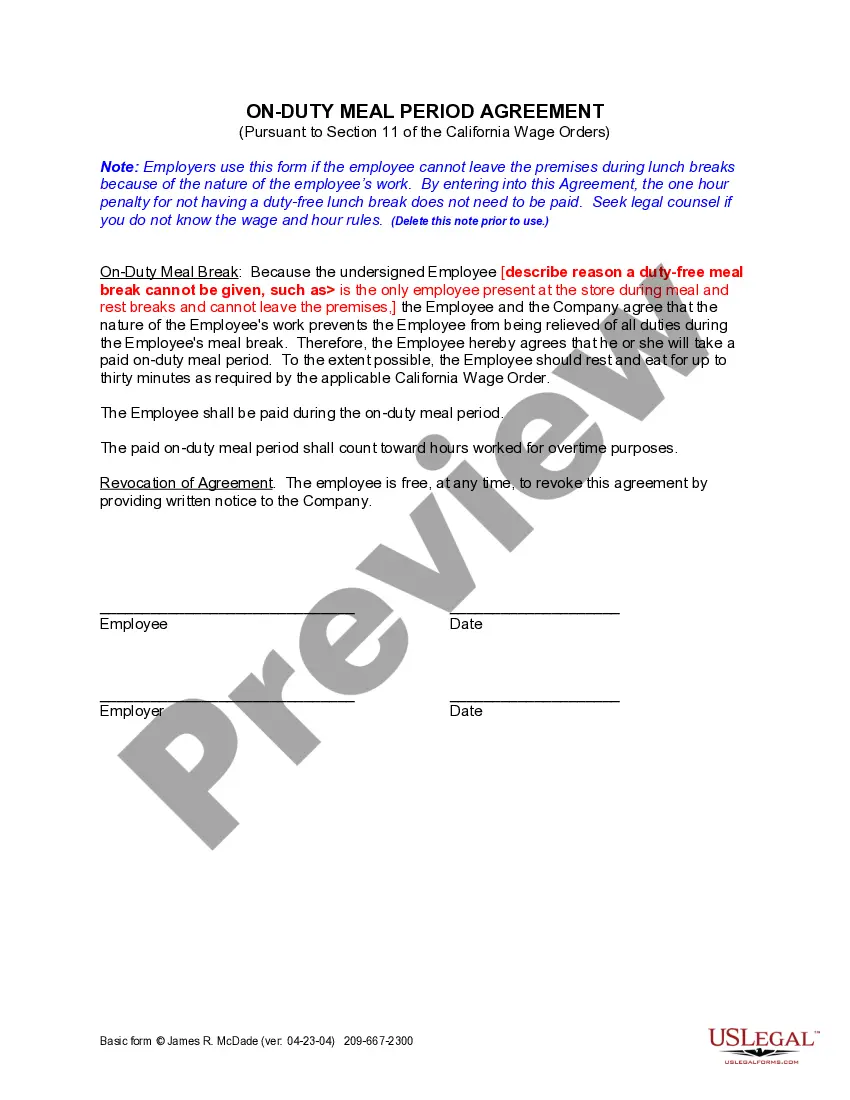
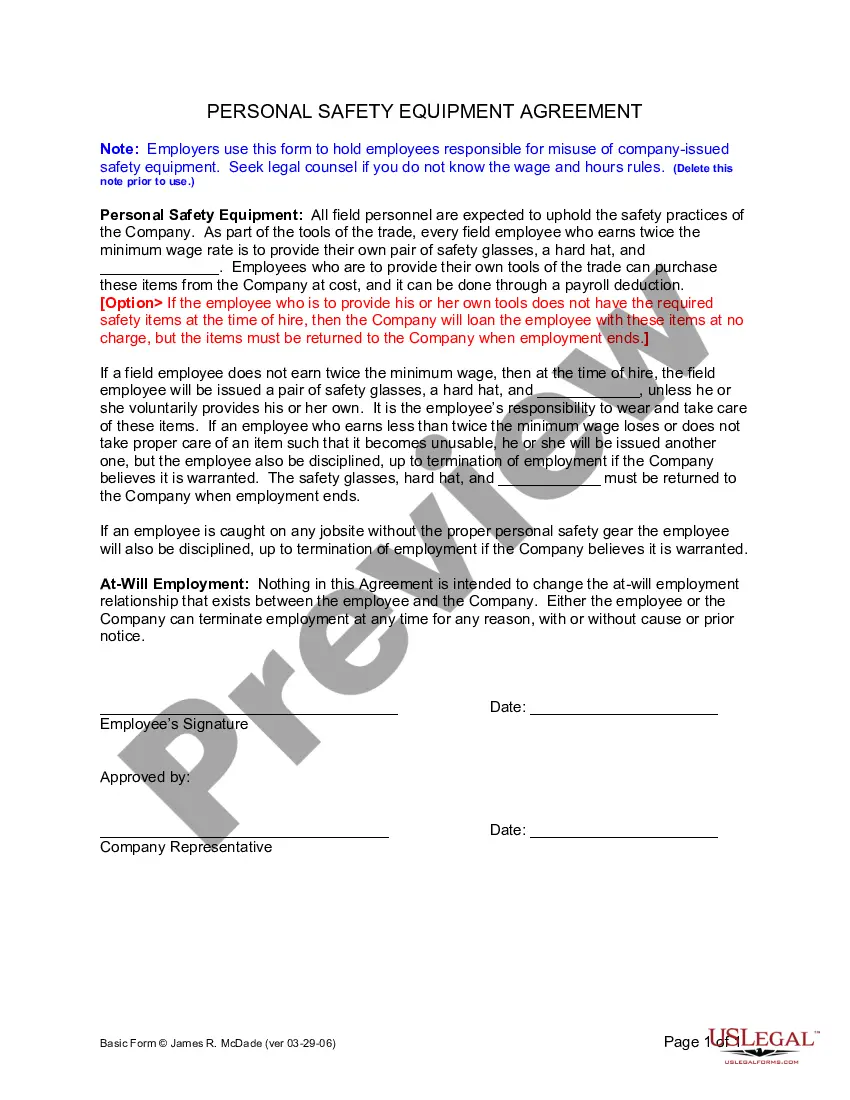
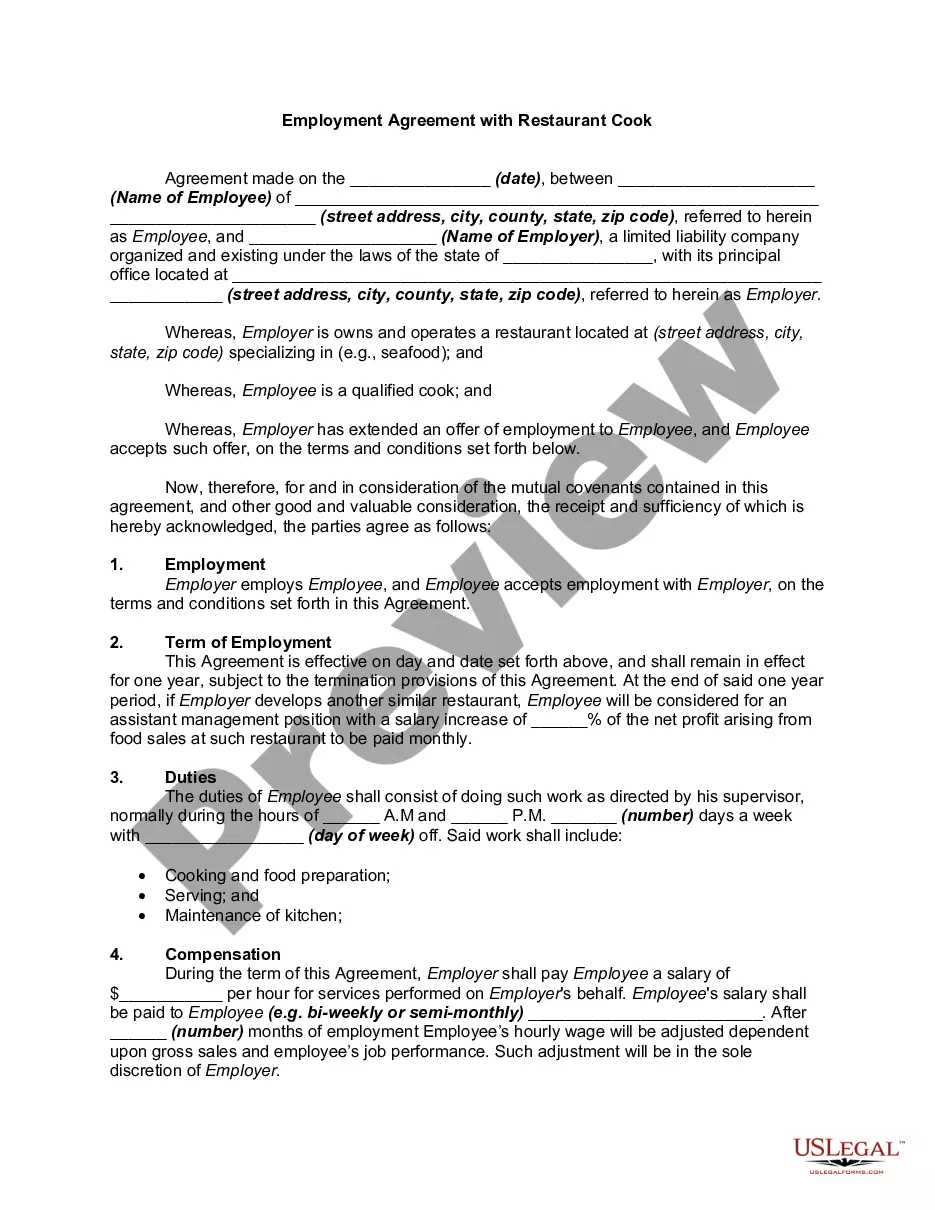
The On Duty Meal Period Agreement is a legal document used by employers in California to outline the conditions under which an employee will take a paid meal break while remaining on duty. This agreement is particularly relevant for employees who cannot leave their workplace during meal breaks due to their work responsibilities. Unlike a standard meal break arrangement, this agreement allows the employee to be compensated during the meal period without incurring penalties related to duty-free lunch breaks.
Form components explained
- Employee's explanation of why a duty-free meal break is not possible.
- Agreement by the employee to take a paid on-duty meal period.
- Specification of the time allocated for the meal break (up to thirty minutes).
- Understanding that the paid meal period counts towards hours worked for overtime calculations.
- Provision for the employee to revoke the agreement with written notice.
- Signatures and dates from both the employee and employer acknowledging the agreement.
When to use this document
This form is necessary in situations where an employee, such as a sole worker at a location, cannot leave the premises during their meal break without impacting business operations. Businesses in retail, healthcare, or critical services may find this agreement useful when employees are required to be present during breaks.
Who this form is for
- Employers in California who have employees required to remain on duty during meal breaks.
- Employees who cannot leave their work premises during scheduled meal periods.
- Businesses that need to comply with Californiaâs wage and hour laws concerning meal periods.
Instructions for completing this form
- Identify the parties involved by entering the employee's name and the employer's name.
- Have the employee provide a clear explanation of why they cannot take a duty-free meal break.
- Specify the agreement for a paid on-duty meal period as outlined in the contract.
- Include the duration of the meal break and clarify payment conditions.
- Ensure both parties sign the agreement and date it to confirm acceptance.
Notarization requirements for this form
This form does not typically require notarization unless specified by local law.
Get your form ready online
Our built-in tools help you complete, sign, share, and store your documents in one place.
Make edits, fill in missing information, and update formatting in US Legal Forms—just like you would in MS Word.
Download a copy, print it, send it by email, or mail it via USPS—whatever works best for your next step.
Sign and collect signatures with our SignNow integration. Send to multiple recipients, set reminders, and more. Go Premium to unlock E-Sign.
If this form requires notarization, complete it online through a secure video call—no need to meet a notary in person or wait for an appointment.
We protect your documents and personal data by following strict security and privacy standards.

Make edits, fill in missing information, and update formatting in US Legal Forms—just like you would in MS Word.

Download a copy, print it, send it by email, or mail it via USPS—whatever works best for your next step.

Sign and collect signatures with our SignNow integration. Send to multiple recipients, set reminders, and more. Go Premium to unlock E-Sign.

If this form requires notarization, complete it online through a secure video call—no need to meet a notary in person or wait for an appointment.

We protect your documents and personal data by following strict security and privacy standards.
Common mistakes
- Not adequately documenting the reason for the on-duty meal period.
- Failing to have both parties sign and date the agreement.
- Overlooking the need to inform employees about their right to revoke the agreement.
- Neglecting updates to the agreement if business operations change.
Why complete this form online
- Convenient access to customizable legal forms anytime, anywhere.
- Easy download options allowing for immediate use and printing.
- Reliable templates drafted by licensed attorneys ensuring legal compliance.
- Editability to tailor the form to specific business needs.
- The agreement allows employers to provide a paid meal period while meeting legal obligations.
- It is crucial for employees to understand their rights regarding meal breaks and the potential for revocation at any time.
Summary of main points
- The On Duty Meal Period Agreement allows employees to remain on-site during meal breaks while still being compensated.
- Employers must ensure compliance with California wage laws when using this agreement.
- Both employees and employers have the right to revoke the agreement at any time with written notice.
Looking for another form?
Form popularity
FAQ
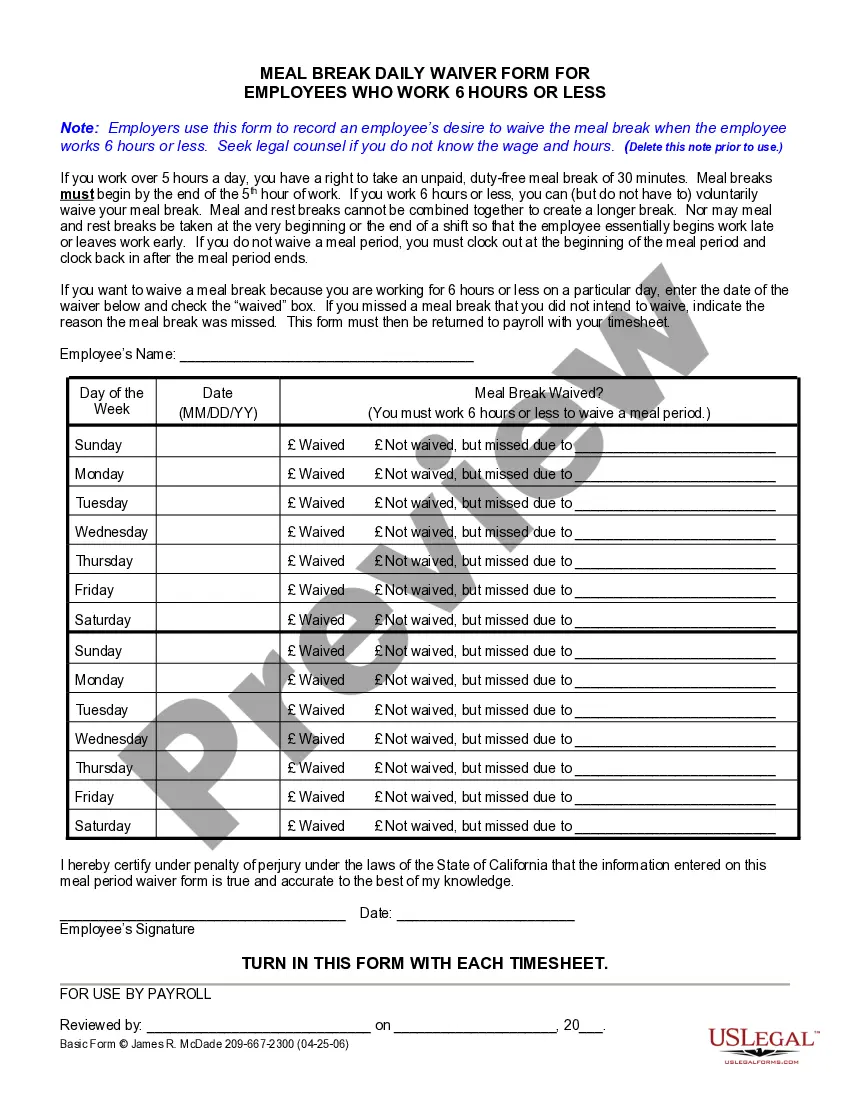
You can waive a meal period in California, but only if the conditions are met. Employees must agree to waive their meal breaks, and this must be outlined in a California On Duty Meal Period Agreement. It is critical for both parties to understand their rights and responsibilities, ensuring that any waiver is voluntary and properly documented.
California law mandates that employees receive a meal break under certain circumstances, typically after five hours of work. The state law specifies that a meal period lasts at least 30 minutes. Having a clear California On Duty Meal Period Agreement helps employers comply with these laws while ensuring that employees understand their rights regarding meal breaks.
Yes, meal waivers are legal in California under specific conditions. Employees must voluntarily agree to waive their meal periods, and this agreement should be documented in a California On Duty Meal Period Agreement. It is essential for employers to ensure that the waiver does not pressure employees and that they have the right to take a meal break if they choose.
The new lunch break law in California mandates that employees receive meal breaks according to specific guidelines, fostering a better work-life balance. Employees working more than five hours are entitled to a 30-minute meal break, which can be waived in specific cases. Understanding and adhering to this law can help organizations create effective California On Duty Meal Period Agreements to ensure compliance and promote a supportive workplace environment.
An on-duty meal period in California allows employees to work through their meal breaks under certain conditions. In this arrangement, employees remain available for work while eating and are compensated for this time. However, to implement an on-duty meal period, you need to have a California On Duty Meal Period Agreement that outlines the terms, ensuring all parties are aware of the expectations involved.
Generally, in California, if you work more than five hours, you must take a meal break of at least 30 minutes. Therefore, working eight hours without a lunch break is typically not permissible unless you have a valid on-duty meal period agreement in place. Such agreements need to be clear and properly executed to protect both employee rights and employer responsibilities.
The new California meal break law emphasizes the importance of meal breaks, requiring employers to provide uninterrupted breaks to employees. According to this legislation, employees working over five hours must receive a 30-minute meal break and those working ten hours are eligible for a second meal break. This law supports employee well-being while ensuring compliance with the California On Duty Meal Period Agreement.
In California, you cannot simply waive your right to a meal period unless it falls within specific exceptions outlined in the law. For example, if you work less than six hours, you may not need to take a meal break. However, if you choose to waive a meal period in a California On Duty Meal Period Agreement, it must be documented properly and acknowledged by both employer and employee.
In California, the rules for meal waivers are outlined in the California On Duty Meal Period Agreement. An employee can only waive their meal period if they work no more than 12 hours and have taken their first meal break. Additionally, both the employer and employee must consent to the waiver and keep a written record of this agreement. Familiarizing yourself with these regulations ensures compliance and protects both parties.
An example of a meal waiver would be an employee working a 10-hour shift who agrees to forgo their meal period because their work does not allow for a break. With a proper California On Duty Meal Period Agreement in place, both the employer and employee must document this waiver. It’s a practical way to manage labor needs while still respecting employee rights. This mutual understanding is key to maintaining a harmonious workplace.