California Safety Equipment Agreement
Overview of this form
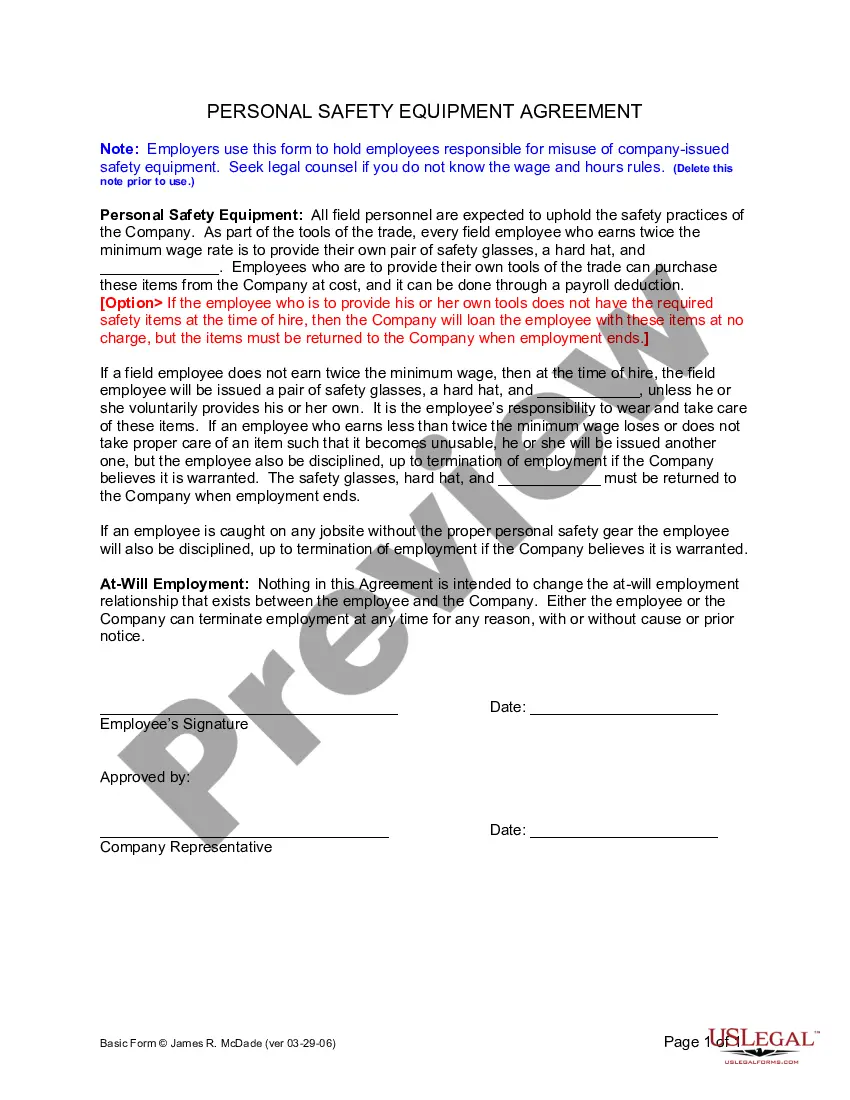
The Safety Equipment Agreement is a legal document used by employers to clarify the responsibilities of employees regarding the use and care of company-issued safety equipment. This agreement helps ensure that employees understand their obligations to maintain safety gear, such as hard hats and safety glasses, while also outlining the consequences of misuse. Unlike other employment agreements, this form specifically focuses on safety equipment roles and responsibilities, ensuring a safer workplace environment.
Main sections of this form
- Responsibility clauses detailing employee obligations for safety equipment care.
- Provisions for employees earning twice the minimum wage to supply their own equipment.
- Terms for the company to loan safety equipment to eligible employees.
- Disciplinary actions for improper care or failure to use safety equipment.
- At-will employment declaration confirming the nature of the employment relationship.
When to use this document
This form should be used during the hiring process when employees are required to use or maintain safety equipment as part of their job responsibilities. It is essential in scenarios where the employee must supply their own safety gear, or when the employer provides equipment that must be returned upon termination of employment. Additionally, it applies to environments where workplace safety is a priority, ensuring that all parties understand the regulations governing personal protective equipment.
Intended users of this form
- Employers in industries requiring safety equipment for their employees.
- Human resources personnel managing employee onboarding and safety compliance.
- Employees hired for positions where safety equipment is mandatory.
Instructions for completing this form
- Identify the employee who is receiving the safety equipment.
- Specify the types of safety equipment being issued (e.g., safety glasses, hard hat).
- Fill out the date of completion and the employee's signature.
- Have the company representative sign and date the agreement.
- Ensure copies are distributed to both the employee and the employer for records.
Notarization guidance
This form usually doesn’t need to be notarized. However, local laws or specific transactions may require it. Our online notarization service, powered by Notarize, lets you complete it remotely through a secure video session, available 24/7.
Get your form ready online
Our built-in tools help you complete, sign, share, and store your documents in one place.
Make edits, fill in missing information, and update formatting in US Legal Forms—just like you would in MS Word.
Download a copy, print it, send it by email, or mail it via USPS—whatever works best for your next step.
Sign and collect signatures with our SignNow integration. Send to multiple recipients, set reminders, and more. Go Premium to unlock E-Sign.
If this form requires notarization, complete it online through a secure video call—no need to meet a notary in person or wait for an appointment.
We protect your documents and personal data by following strict security and privacy standards.

Make edits, fill in missing information, and update formatting in US Legal Forms—just like you would in MS Word.

Download a copy, print it, send it by email, or mail it via USPS—whatever works best for your next step.

Sign and collect signatures with our SignNow integration. Send to multiple recipients, set reminders, and more. Go Premium to unlock E-Sign.

If this form requires notarization, complete it online through a secure video call—no need to meet a notary in person or wait for an appointment.

We protect your documents and personal data by following strict security and privacy standards.
Common mistakes to avoid
- Failing to have both parties sign the agreement, which can render it unenforceable.
- Not clarifying which types of safety equipment are covered under the agreement.
- Overlooking to provide a copy of the signed agreement to employees.
Why use this form online
- Convenience of immediate access and download from anywhere.
- Editability to customize the agreement as needed for individual employee roles.
- Reliability of using a template drafted by licensed attorneys, ensuring legal integrity.
Looking for another form?

Form popularity
FAQ
You should report incidents to Cal OSHA immediately if they involve serious injuries, fatalities, or violations of safety regulations. Prompt reporting is crucial to ensure quick remediation and to uphold safety in the workplace. If you feel your California Safety Equipment Agreement is not being upheld, it’s critical to act swiftly. Reporting ensures that issues are addressed before they escalate into more severe problems.
Employers must report any work-related fatalities, serious injuries, or illnesses within specific time frames to Cal OSHA. This includes incidents that require hospitalization, amputation, or result in permanent disability. If your workplace operates under a California Safety Equipment Agreement, you should ensure that safety equipment is functioning correctly to prevent reportable incidents. Proper reporting helps maintain a safe working environment.
Cal OSHA typically conducts inspections based on complaints, referrals from the public, or reports of work-related accidents and fatalities. Additionally, certain industries or job sites may be prioritized for inspections due to their risk levels. If there are concerns regarding compliance with a California Safety Equipment Agreement, it can serve as a catalyst for an inspection. It's vital to maintain safety standards to avoid these scenarios.
To file an OSHA complaint in California, you can submit it online, by phone, or through mail. The process is straightforward, and you will need to provide details about the safety violation. If you reference the California Safety Equipment Agreement when filing, it can strengthen your complaint by demonstrating a breach of safety protocols. This ensures that your concerns are taken seriously and addressed promptly.
You should file a complaint with OSHA when you believe there are serious hazards in your workplace or if your employer fails to address your safety concerns. Complaints can be filed anonymously, making it easier for workers to report issues. If your workplace compromises safety measures outlined in your California Safety Equipment Agreement, it's essential to take action. Taking steps to ensure safety can prevent accidents and protect employees.
In California, employers must report serious work-related injuries, illnesses, or fatalities to Cal OSHA. This includes incidents that require hospitalization, result in amputation, or lead to a loss of an eye. Additionally, any event that involves a hazardous substance spill may also need reporting. Understanding the California Safety Equipment Agreement can help you identify such reportable events and ensure compliance.
OSHA does require a written hot work program for activities involving open flames or sparks. This program ensures that necessary precautions are taken to prevent fires and other hazards during hot work operations. By integrating such a program into your California Safety Equipment Agreement, you further protect your employees and property. Ensuring all safety measures are documented helps streamline compliance with OSHA regulations and promotes overall safety awareness.
Not all OSHA standards specifically require a written plan, but many do for compliance and safety reasons. Standards related to safety programs, hazard communication, and emergency response typically involve documented plans. By including these plans as part of your California Safety Equipment Agreement, you ensure that all staff are aware of safety procedures and protocols. This clarity ultimately helps prevent incidents and fosters a safer working atmosphere.
Yes, OSHA mandates that contractors develop a comprehensive safety program to manage workplace hazards. This program not only outlines safety procedures but also defines roles and responsibilities for all team members. Incorporating your safety measures into the California Safety Equipment Agreement strengthens your approach to meeting OSHA's requirements. This proactive strategy promotes worker safety while enhancing your company’s reputation.
In construction, OSHA requires several written programs to ensure safety compliance. This includes programs for fall protection, hazard communication, and respiratory protection. By implementing these programs within your California Safety Equipment Agreement, you establish clear safety protocols that protect your workers and minimize risks on-site. Keeping these documents in place builds a culture of safety and accountability.