California Arbitration Agreement and Policy
Understanding this form
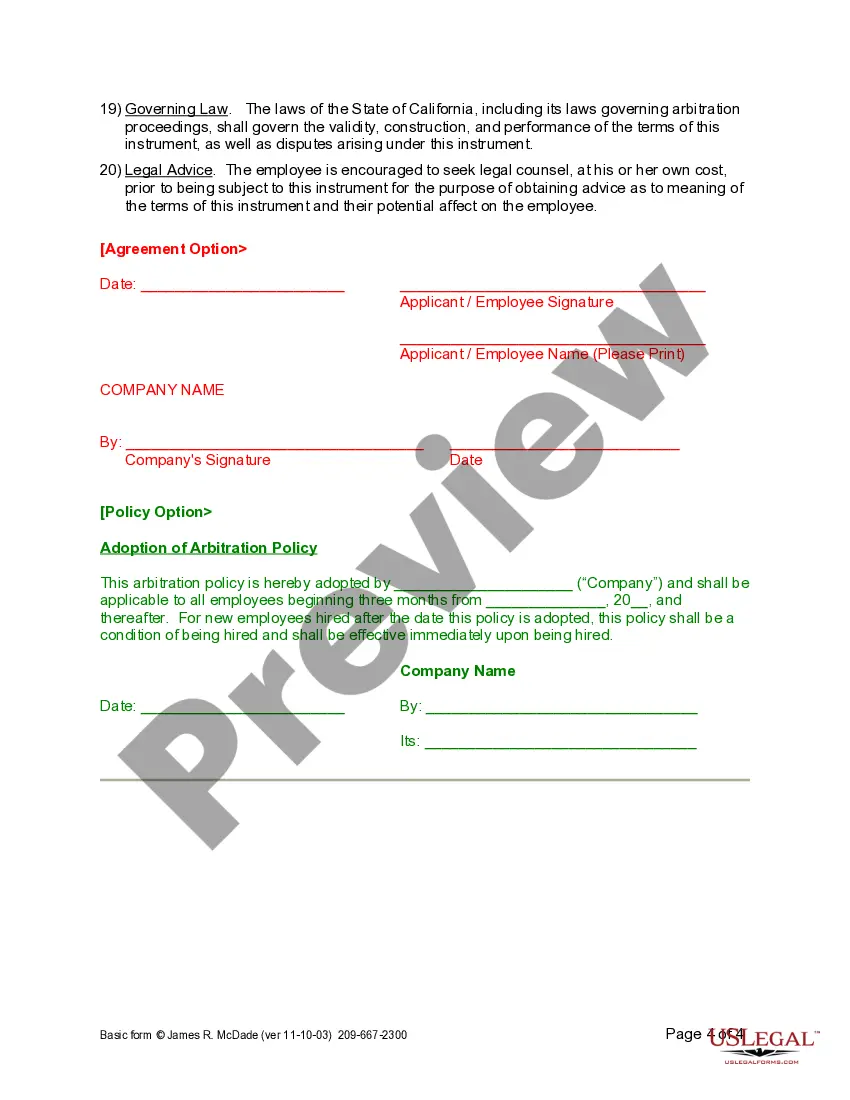
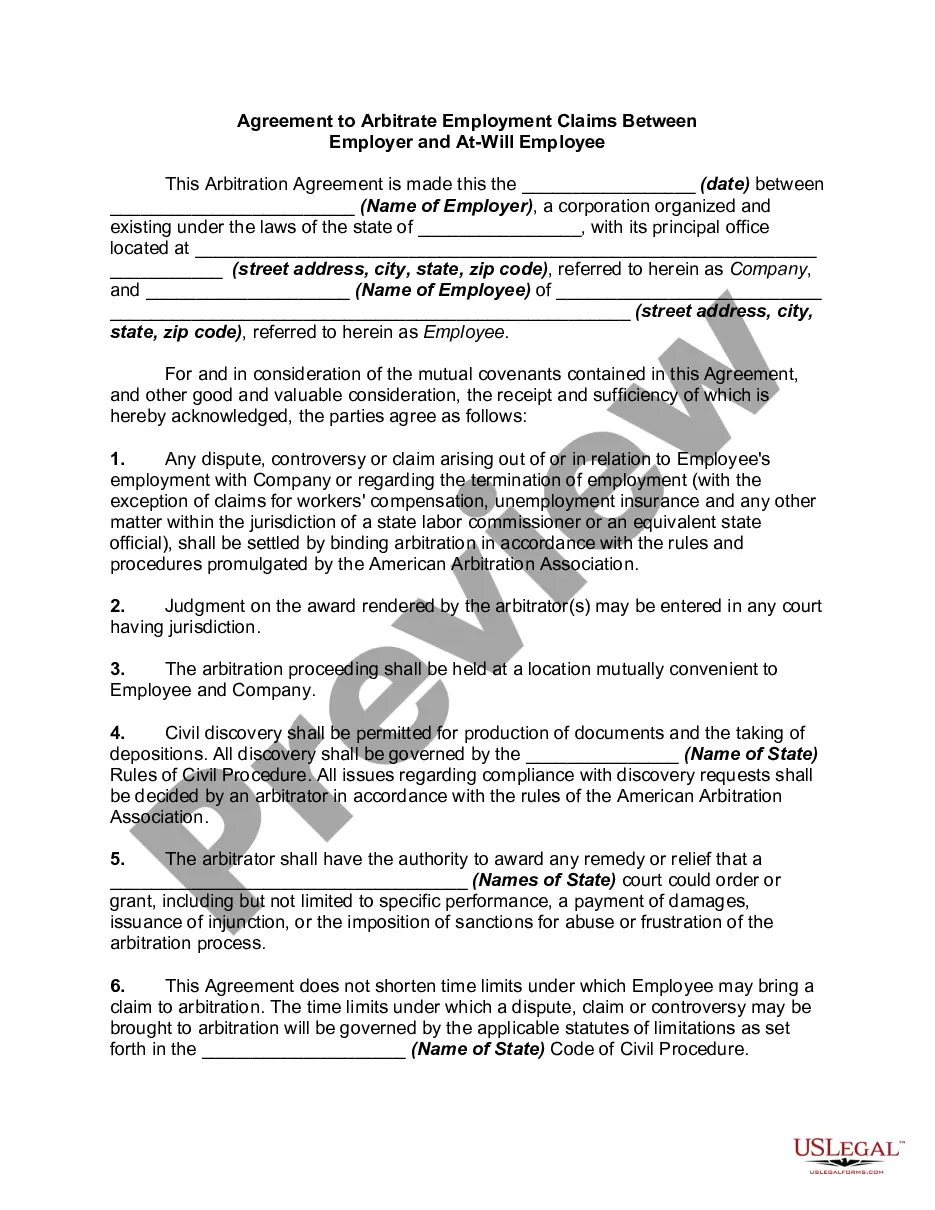
The Arbitration Agreement and Policy is a legal document that outlines the terms under which disputes between an employer and employee will be resolved through arbitration instead of going to court. This agreement helps clarify the arbitration process and the types of claims that will be covered, ensuring both parties have a mutual understanding of their rights and obligations.
Form components explained
- Identification of parties: Names of the Company and the Employee.
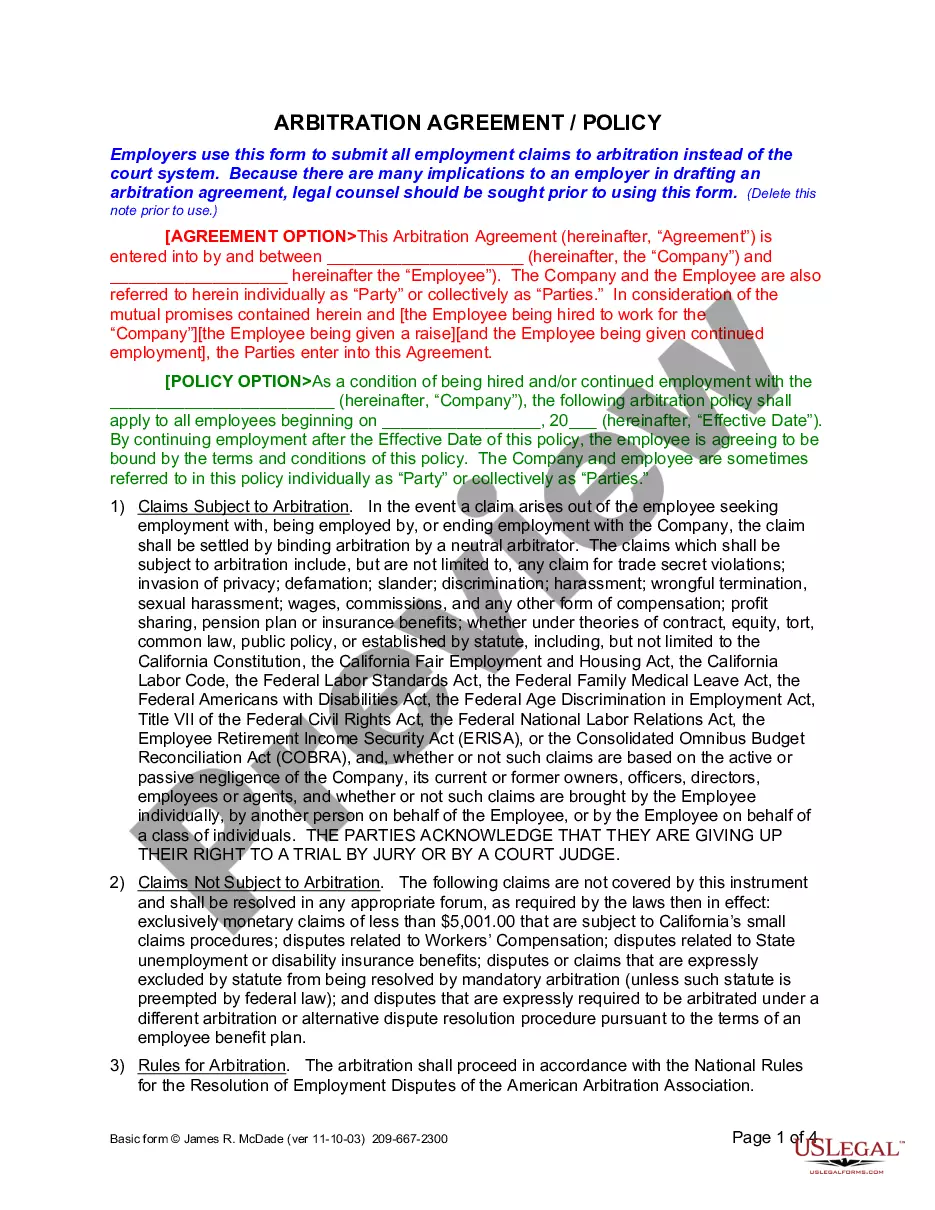
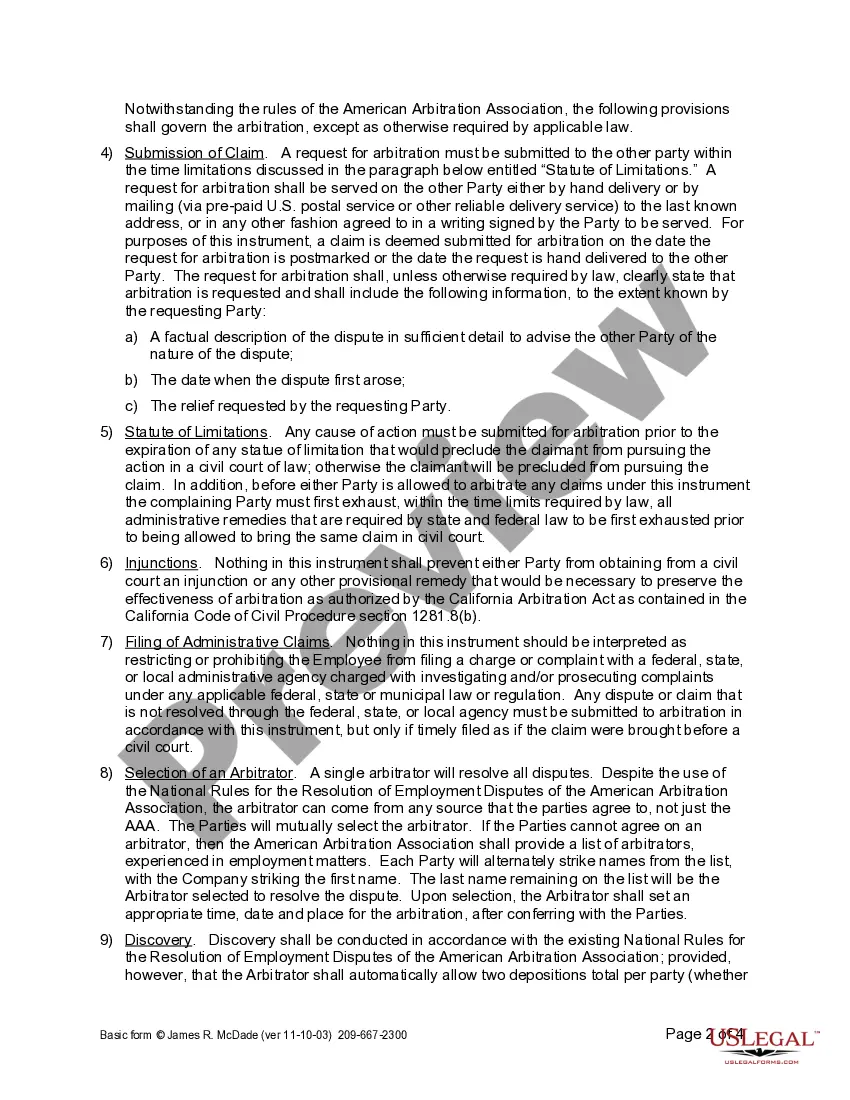
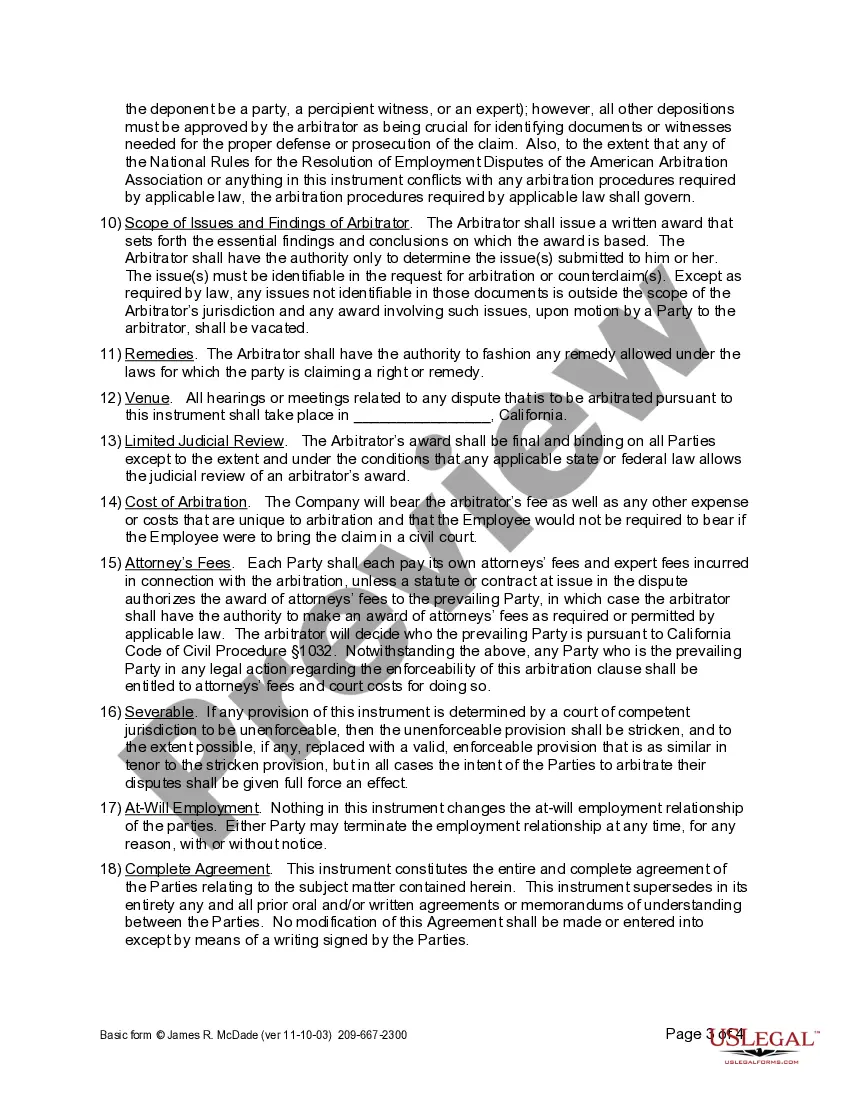
- Claims subject to arbitration: Types of disputes covered under the agreement.
- Claims not subject to arbitration: Specific claims excluded from the arbitration process.
- Rules for arbitration: Guidelines governing the arbitration proceedings.
- Cost of arbitration: Responsibility for arbitration-related expenses.
- Legal advice recommendation: Encouragement for the Employee to seek legal counsel.

When this form is needed
This form should be used when an employer wants to establish a binding arbitration process for resolving employment disputes. It is particularly relevant when hiring new employees or updating existing employee agreements to include arbitration provisions. Using this form helps mitigate the risks and costs associated with litigation.
Who needs this form
- Employers looking to implement a formal dispute resolution process.
- Human resources professionals responsible for employee agreements.
- Businesses seeking to minimize legal exposure and litigation costs.
- Employees who are entering into new employment agreements or joining a company that requires arbitration.
Completing this form step by step
- Identify the parties involved by filling in the names of the Company and the Employee.
- Specify the Effective Date in the designated section to indicate when the agreement takes effect.
- Outline the claims subject to arbitration to ensure clarity on what disputes will be resolved through this process.
- Include the location of the arbitration hearings as applicable.
- Obtain signatures from both the Company representative and the Employee to formalize the agreement.
Does this document require notarization?
This form does not typically require notarization to be legally valid. However, some jurisdictions or document types may still require it. US Legal Forms provides secure online notarization powered by Notarize, available 24/7 for added convenience.
Get your form ready online
Our built-in tools help you complete, sign, share, and store your documents in one place.
Make edits, fill in missing information, and update formatting in US Legal Forms—just like you would in MS Word.
Download a copy, print it, send it by email, or mail it via USPS—whatever works best for your next step.
Sign and collect signatures with our SignNow integration. Send to multiple recipients, set reminders, and more. Go Premium to unlock E-Sign.
If this form requires notarization, complete it online through a secure video call—no need to meet a notary in person or wait for an appointment.
We protect your documents and personal data by following strict security and privacy standards.

Make edits, fill in missing information, and update formatting in US Legal Forms—just like you would in MS Word.

Download a copy, print it, send it by email, or mail it via USPS—whatever works best for your next step.

Sign and collect signatures with our SignNow integration. Send to multiple recipients, set reminders, and more. Go Premium to unlock E-Sign.

If this form requires notarization, complete it online through a secure video call—no need to meet a notary in person or wait for an appointment.

We protect your documents and personal data by following strict security and privacy standards.
Mistakes to watch out for
- Failing to specify all claims that are covered under the arbitration agreement.
- Inadequately explaining the role and authority of the arbitrator.
- Not obtaining the required signatures to validate the agreement.
- Neglecting to update the agreement when laws change or new claims types arise.
Advantages of online completion
- Convenience of instant download and completion from any location.
- Editability to customize the agreement to fit specific needs before printing.
- Reliability from approved templates drafted by licensed attorneys.
Legal use & context
- The agreement establishes an alternative dispute resolution method, promoting efficiency.
- It aims to limit the costs and time associated with traditional court proceedings.
- Employers may have specific legal requirements to disclose this agreement to employees.
Main things to remember
- The Arbitration Agreement and Policy allows employers and employees to resolve disputes without court intervention.
- This form is especially useful for ensuring mutual agreement on arbitration for future disputes.
- It is advisable for both parties to seek legal advice before finalizing the agreement.
Looking for another form?

Form popularity
FAQ
California law recognizes arbitration agreements as binding contracts, provided they meet specific legal standards under the California Arbitration Act. The law mandates that these agreements must be fair, transparent, and not unconscionable. Understanding these legal requirements is vital to ensure that your California Arbitration Agreement and Policy can withstand scrutiny in court. Consulting resources like US Legal Forms can provide additional insight and assistance.
For a California Arbitration Agreement and Policy to be valid, it must be voluntary, clear, and mutually agreed upon by both parties. Additionally, it must specify the scope of arbitration and outline the process to be followed. It’s crucial that neither party is placed under undue pressure to sign. Ensuring these conditions are met can help prevent disputes over the arbitration's validity.
To conduct arbitration in California, start by referring to the agreed-upon arbitration agreement and the defined rules within it. Next, select a neutral arbitrator, and establish a timeline for the proceedings. The process involves submitting relevant documents, presenting evidence, and allowing for arguments from both parties. Utilizing a reliable service like US Legal Forms can help you navigate this process smoothly and ensure all legal standards are met.
The new law regarding California Arbitration Agreement and Policy emphasizes greater transparency and fairness in arbitration processes. It mandates that arbitration clauses must be clearly written and must not impose undue burdens on consumers or employees. This law aims to protect individuals by ensuring they understand the rights they waive when entering into an arbitration agreement. Keeping abreast of these changes is essential for compliance.
To draft a California Arbitration Agreement and Policy, you should first outline the parties involved, the scope of disputes covered, and the governing rules. It’s crucial to ensure clarity in terms and to explicitly state that arbitration is the preferred method of dispute resolution. Additionally, considering any relevant state laws will help ensure enforceability. Using a platform like US Legal Forms can simplify this process by providing templates and guidance.
Writing an arbitration agreement requires a clear structure where you state that both parties agree to resolve disputes through arbitration, according to the California Arbitration Agreement and Policy. Define the specific terms, including arbitration rules, dispute scope, and venue, to ensure mutual understanding. Finalize the agreement with signatures from all parties involved to confirm compliance.
An arbitration agreement may be considered invalid in California if it lacks mutual consent, lacks essential terms, or is overly broad in scope. Additionally, if it is found to be unconscionable or if one party did not have a fair opportunity to understand the terms, this may render the agreement unenforceable. Clarity and fairness in drafting will help in maintaining the agreement’s validity.
To write an arbitration agreement, start by clearly stating the intent to arbitrate disputes, in alignment with the California Arbitration Agreement and Policy. Include provisions such as the scope of disputes, the arbitration process, and the parameters of arbitration, including the location and governing rules. Ensuring both parties sign the agreement completes the process.
A good arbitration clause within a California Arbitration Agreement and Policy should explicitly state that disputes will be resolved through a specified arbitration organization, such as the American Arbitration Association. The clause should outline the process, the scope of disputes covered, and the rules that will govern the arbitration. This level of detail helps prevent misunderstandings between the parties.
In California, an arbitration agreement must be written, mutual, and contain a clear statement that both parties agree to resolve disputes through arbitration. It must also be signed by both parties for the California Arbitration Agreement and Policy to be enforceable. Clarity in the terms will help avoid ambiguity and increase validity.