General Questionnaire for Potential Nominees to Boards Of Directors
Understanding this form
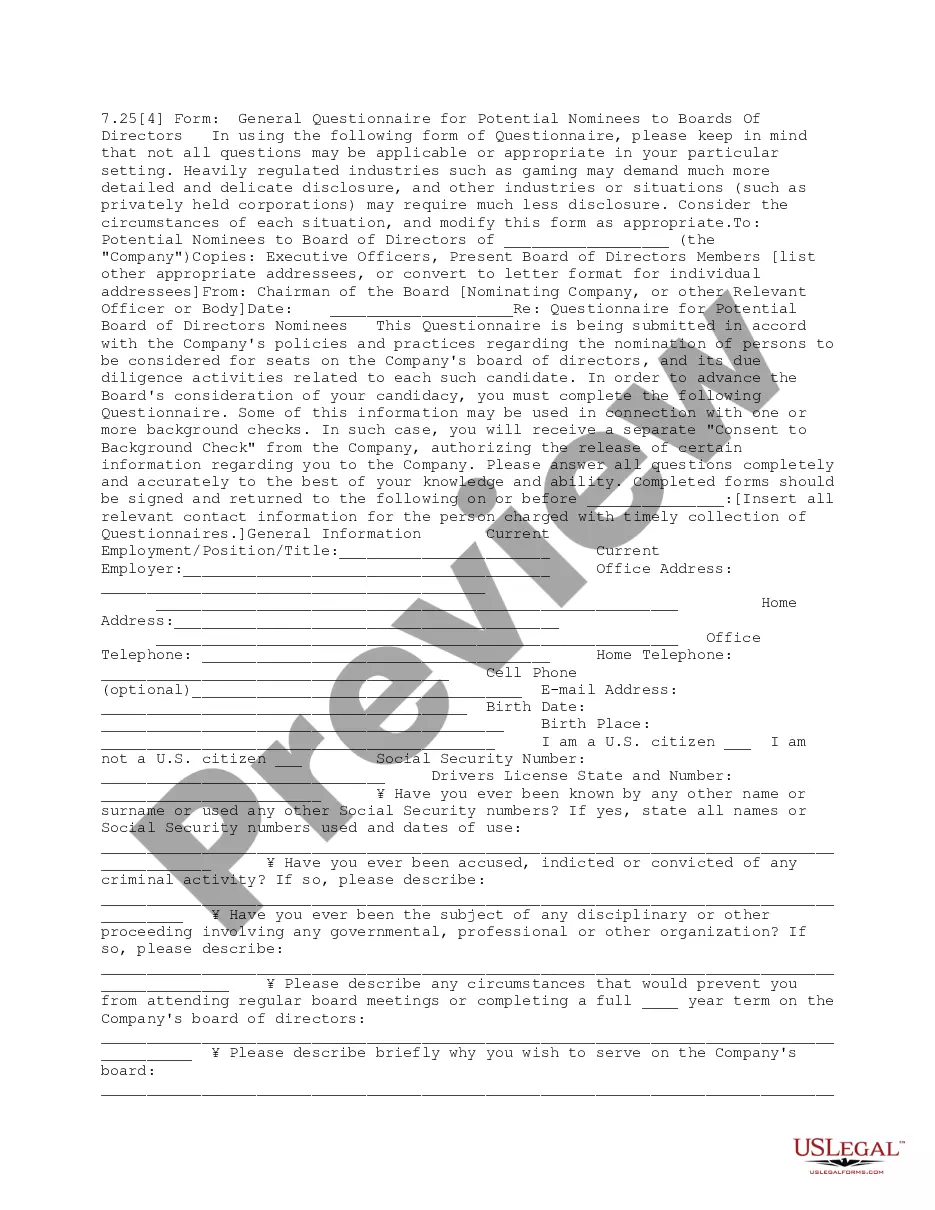
The General Questionnaire for Potential Nominees to Boards of Directors is a structured document designed to collect essential information from individuals considered for board positions. This form enables companies to conduct due diligence, ensuring that nominees meet specific qualifications and suitability standards. Unlike other legal forms, this questionnaire is tailored specifically for the nomination process, focusing on both personal and professional backgrounds of potential directors.
Key components of this form
- General information about the nominee, including current employment and contact details.
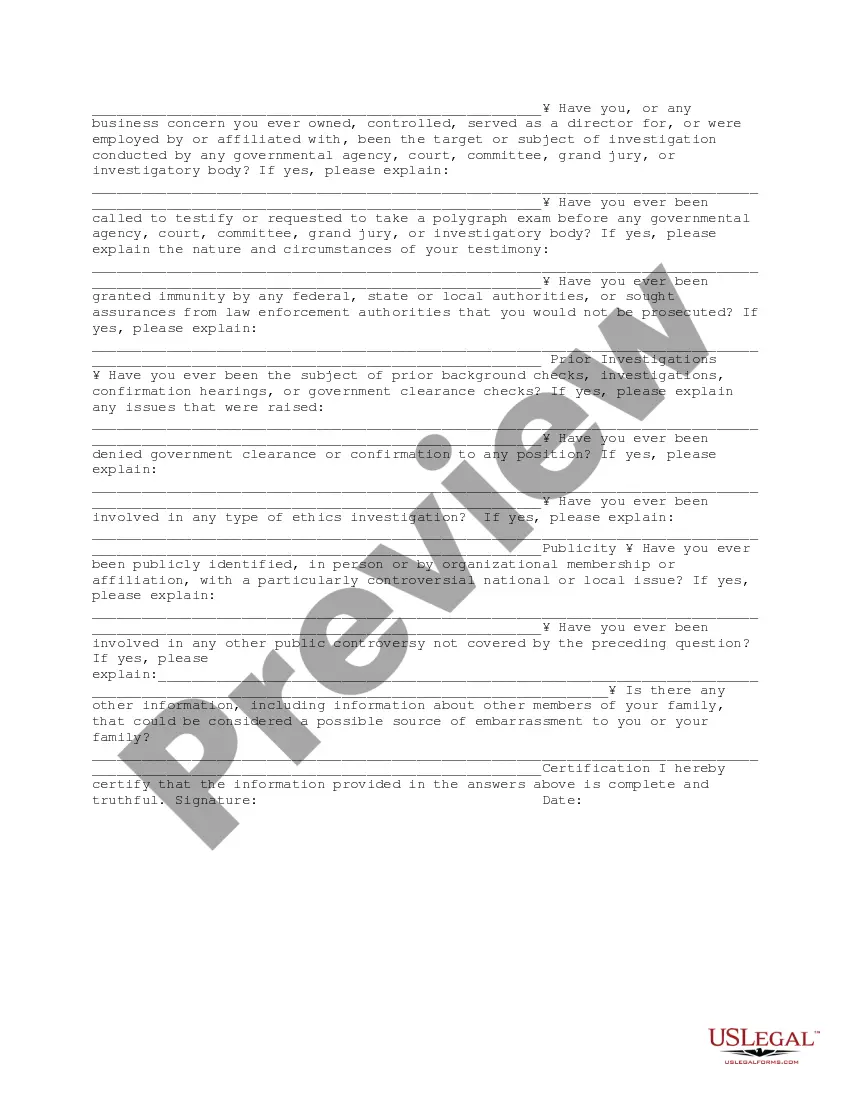
- Disclosure of any criminal activity or disciplinary actions.
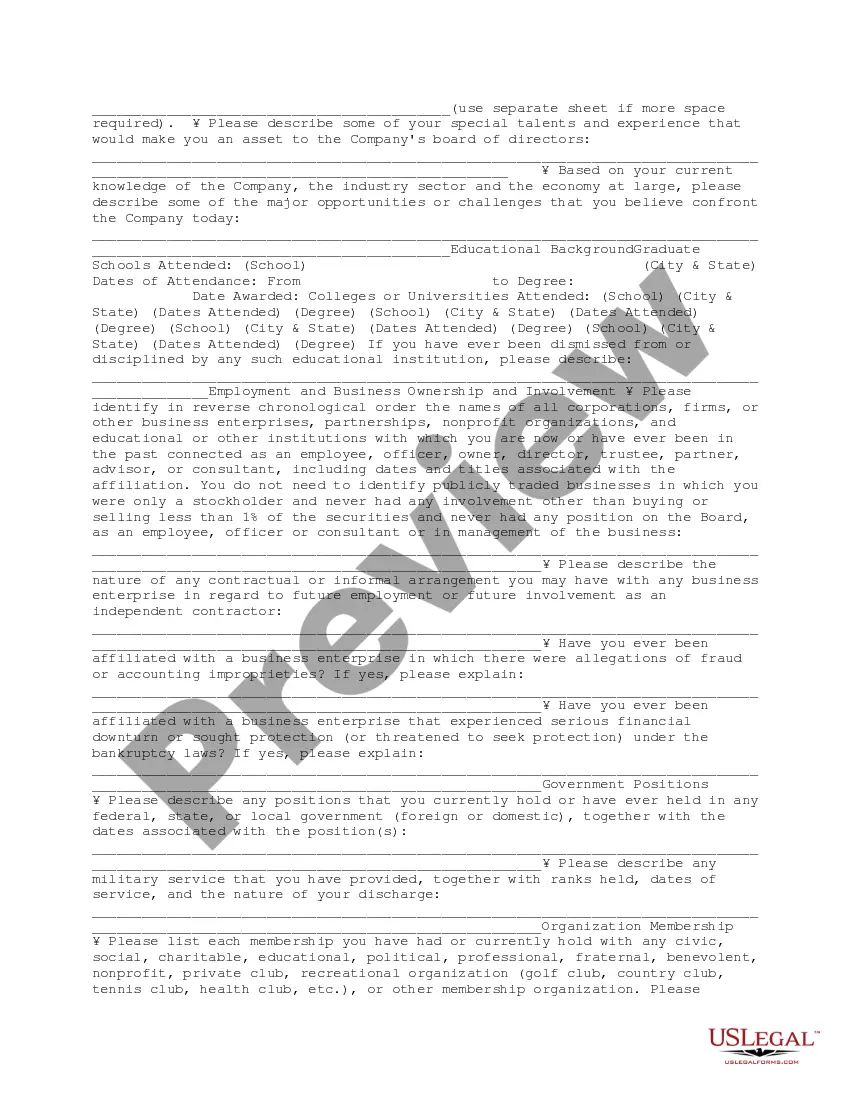
- Background on the nominee's educational qualifications.
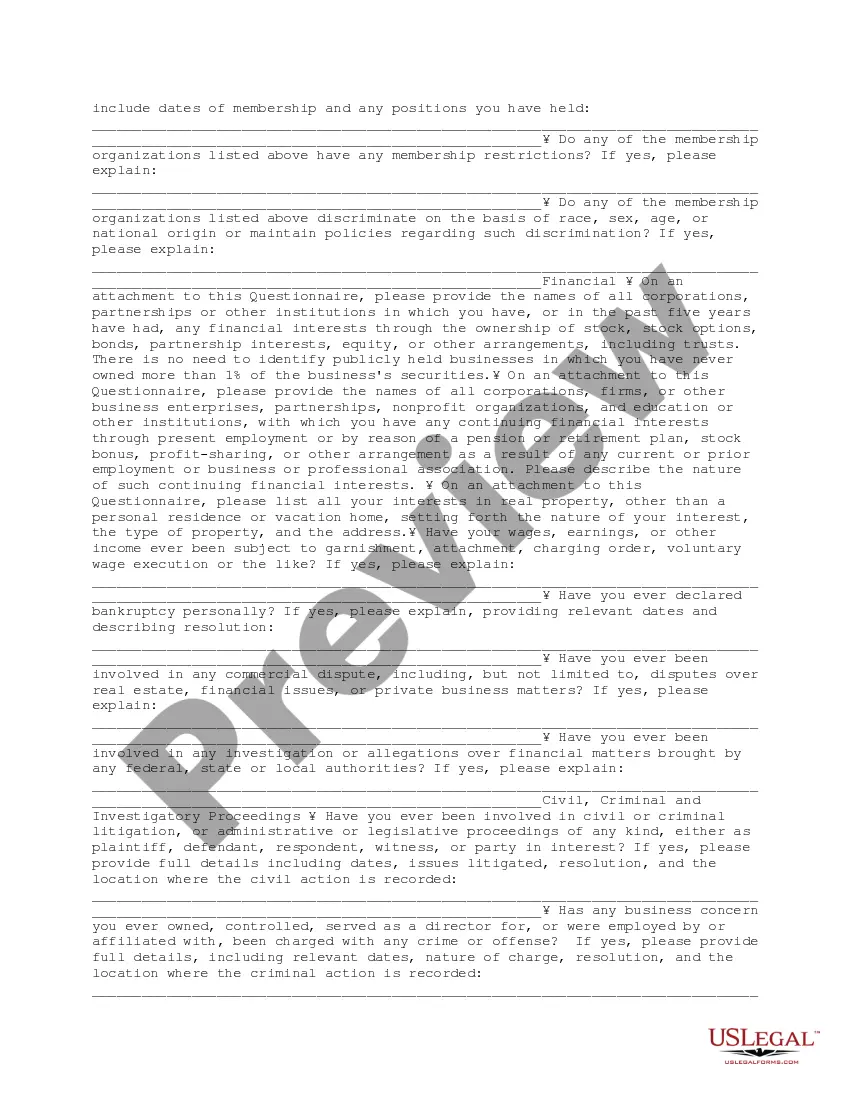
- Details about prior employment, business ownership, and organizational involvement.
- Information regarding financial interests and any bankruptcy declarations.
- Certification of the accuracy and completeness of the provided information.
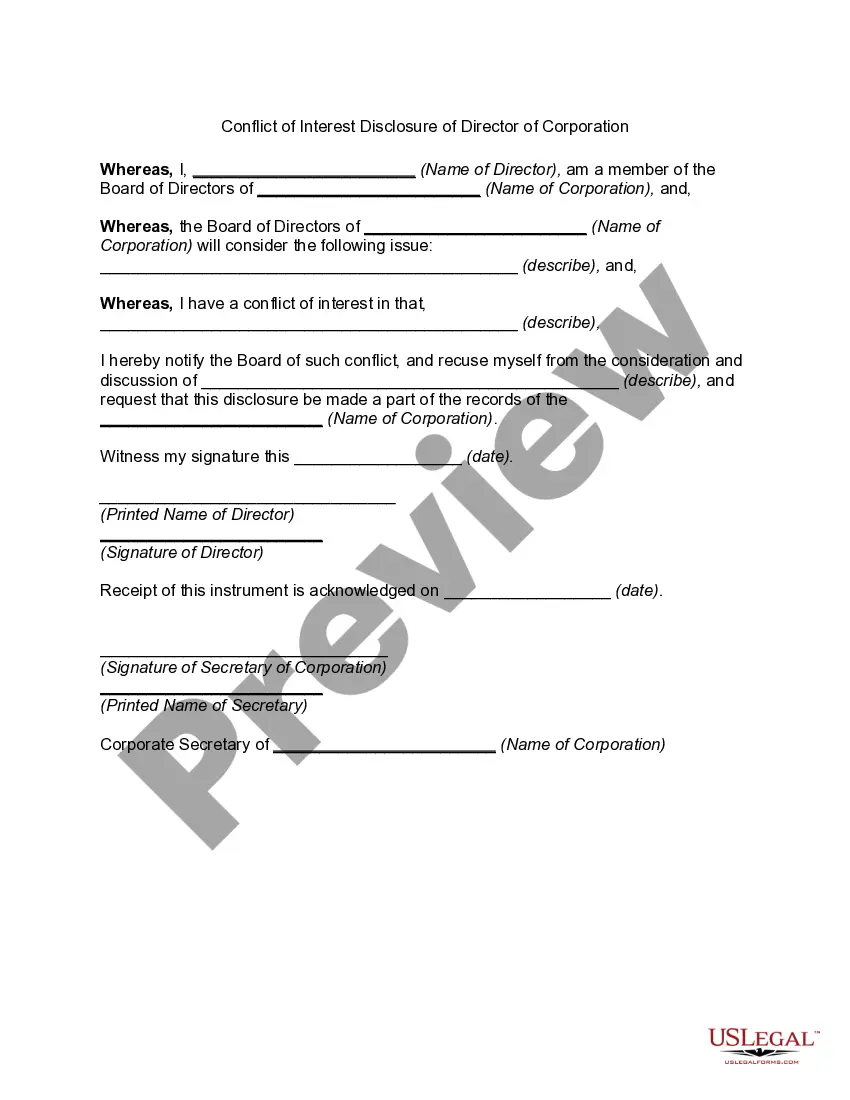




When to use this document
This questionnaire should be used when a company is considering candidates for its board of directors. It is particularly important for organizations in regulated industries that may require more extensive disclosures. Use this form to facilitate the nomination process and ensure thorough evaluation of each candidate's background and qualifications.
Who this form is for
- Companies seeking to nominate individuals to their board of directors.
- Corporate secretaries or executives responsible for overseeing board nominations.
- Individuals interested in being nominated for a position on a board of directors.
How to complete this form
- Provide personal and contact information in the general information section.
- Answer all questions honestly, particularly those regarding criminal history and financial interests.
- Detail educational background, including institutions attended and degrees earned.
- List all relevant employment history, highlighting positions held and affiliations.
- Complete the certification section by signing and dating the form.
Notarization requirements for this form
This form does not typically require notarization unless specified by local law. Ensure you check any specific state regulations that may apply to the nomination process for directors.
Get your form ready online
Our built-in tools help you complete, sign, share, and store your documents in one place.
Make edits, fill in missing information, and update formatting in US Legal Forms—just like you would in MS Word.
Download a copy, print it, send it by email, or mail it via USPS—whatever works best for your next step.
Sign and collect signatures with our SignNow integration. Send to multiple recipients, set reminders, and more. Go Premium to unlock E-Sign.
If this form requires notarization, complete it online through a secure video call—no need to meet a notary in person or wait for an appointment.
We protect your documents and personal data by following strict security and privacy standards.

Make edits, fill in missing information, and update formatting in US Legal Forms—just like you would in MS Word.

Download a copy, print it, send it by email, or mail it via USPS—whatever works best for your next step.

Sign and collect signatures with our SignNow integration. Send to multiple recipients, set reminders, and more. Go Premium to unlock E-Sign.

If this form requires notarization, complete it online through a secure video call—no need to meet a notary in person or wait for an appointment.

We protect your documents and personal data by following strict security and privacy standards.
Typical mistakes to avoid
- Not answering all questions completely or accurately.
- Failing to disclose prior names or aliases when applicable.
- Leaving out relevant employment or educational details that could impact the evaluation.
- Not submitting the form by the specified deadline.
Benefits of using this form online
- Convenient access to the questionnaire from anywhere, ensuring quick completion.
- Ability to easily edit and update responses before final submission.
- Reliable formatting that complies with legal standards for board nominations.
Looking for another form?
Form popularity
FAQ
Why are you interested in our organization? What do you know about us? What experience do you have that is related to our mission? What fundraising experience do you have? What connections or contacts can you contribute?
Explain to the recipient why you are extending an invitation to join your board. For example, As a leader in our industry, we would greatly appreciate your leadership and expertise, or, Given your long-standing support of this organization, we would like you to become an official member of our board of directors.
How do you see the company changing in two years, and how do you see yourself creating that change? Pitch our service as you would in a sales meeting. Give me one word that describes you the best. What are your goals? What Are Your 3 Biggest Accomplishments? What other CEOs do you look up to?
Know exactly what you included in your board bio and be prepared to elaborate on it. Do your homework on the company and their board members. Recognize the reasons why you are there. What is the board's vision for the future? What is the company's financial position? What are the board's dynamics?
Post your "Great Board Member Wanted" ad on free websites that match people seeking boards to join with nonprofits seeking board members. Place a "Help Wanted--Volunteer Board Member" ad on your lobby bulletin board, in your newsletter, in the neighborhood newspaper, or in the alumni newsletter of a local college.
Essentially it is the role of the board of directors to hire the CEO or general manager of the business and assess the overall direction and strategy of the business. The CEO or general manager is responsible for hiring all of the other employees and overseeing the day-to-day operation of the business.
In simple terms, the CEO is the top senior executive over management while the board chairperson is the head of the board of directors.The CEO reports directly to the board of directors. By contrast, the board chairperson of a company is the head of its board of directors.
Board members steer or manage corporations. For instance, business partners with technical know-how might recruit a board member with the financial or marketing experience they lack. Directors in this role serve as business advisers. They do not need to be stock holders, but often are in for-profit companies.
The board of directors has more power than the CEO because the board can fire the CEO. However, there is one more group that has more power than the CEO or the board of directors. That's right2026 The investors have the most power, more than the CEO and more than the board of directors, in any company.