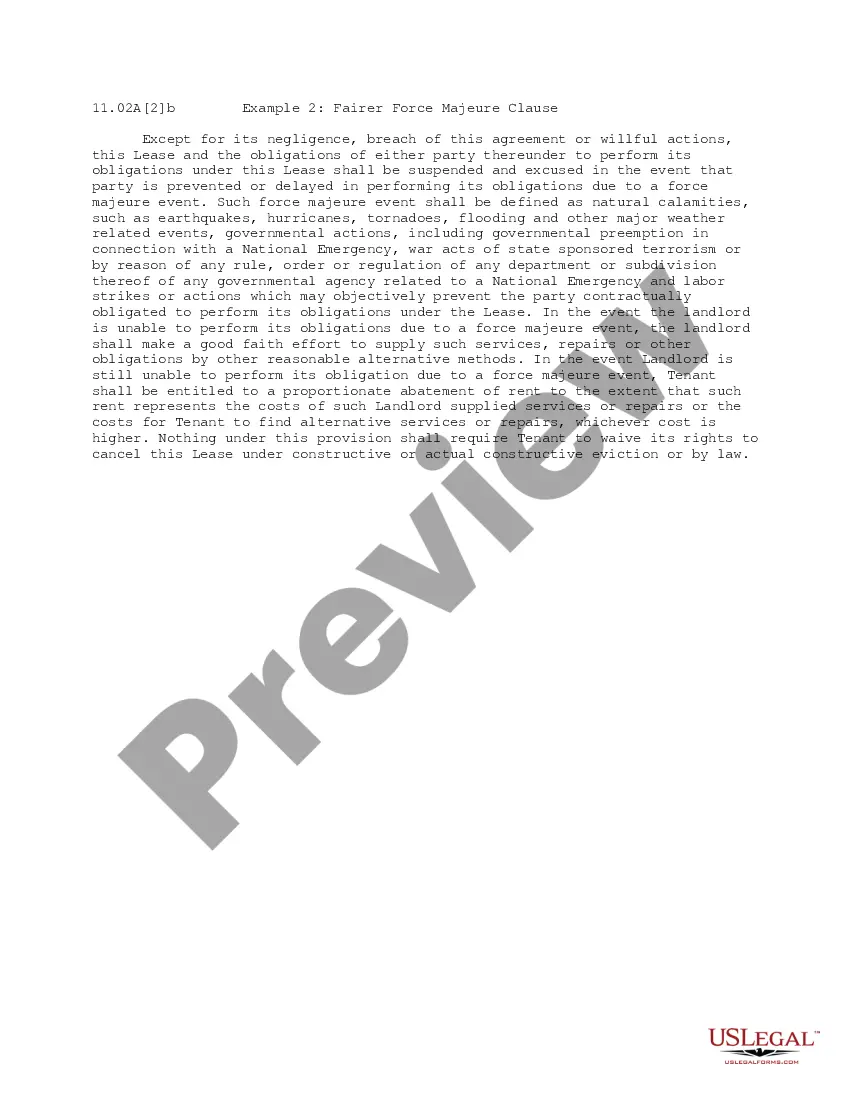
Fairer Force Majeure Clause
Understanding this form
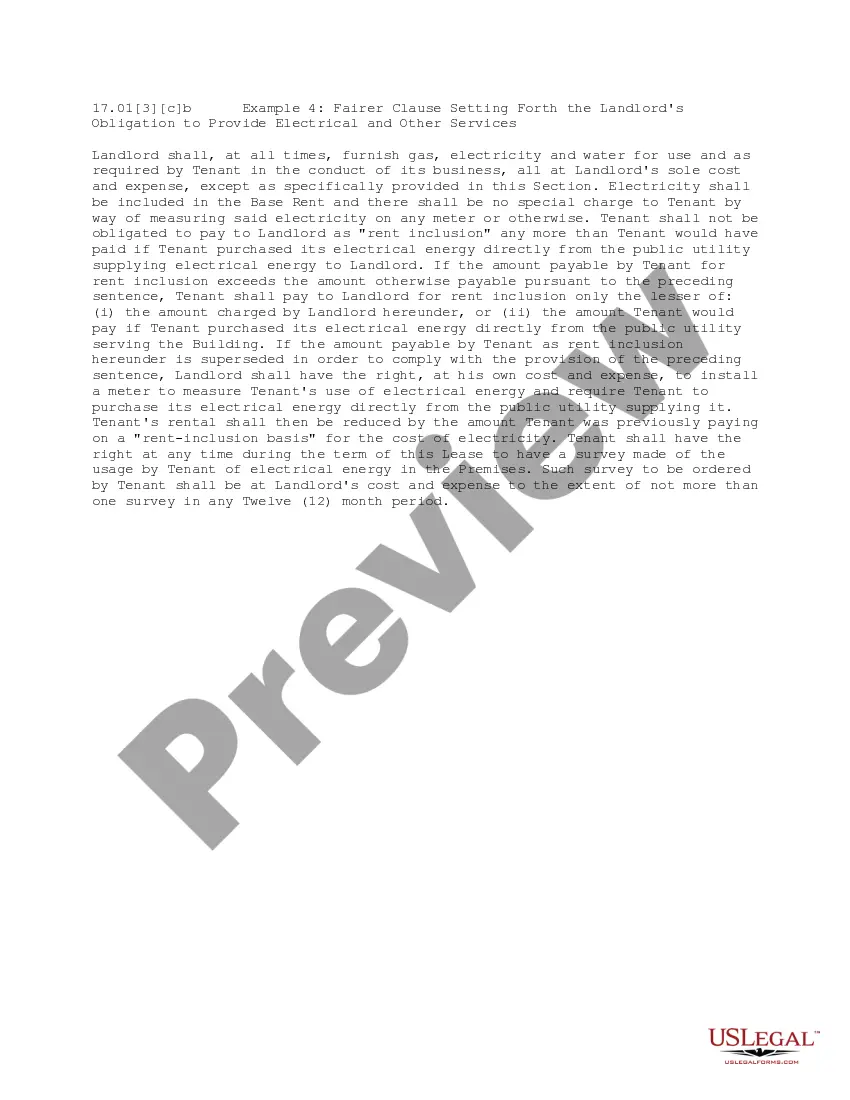
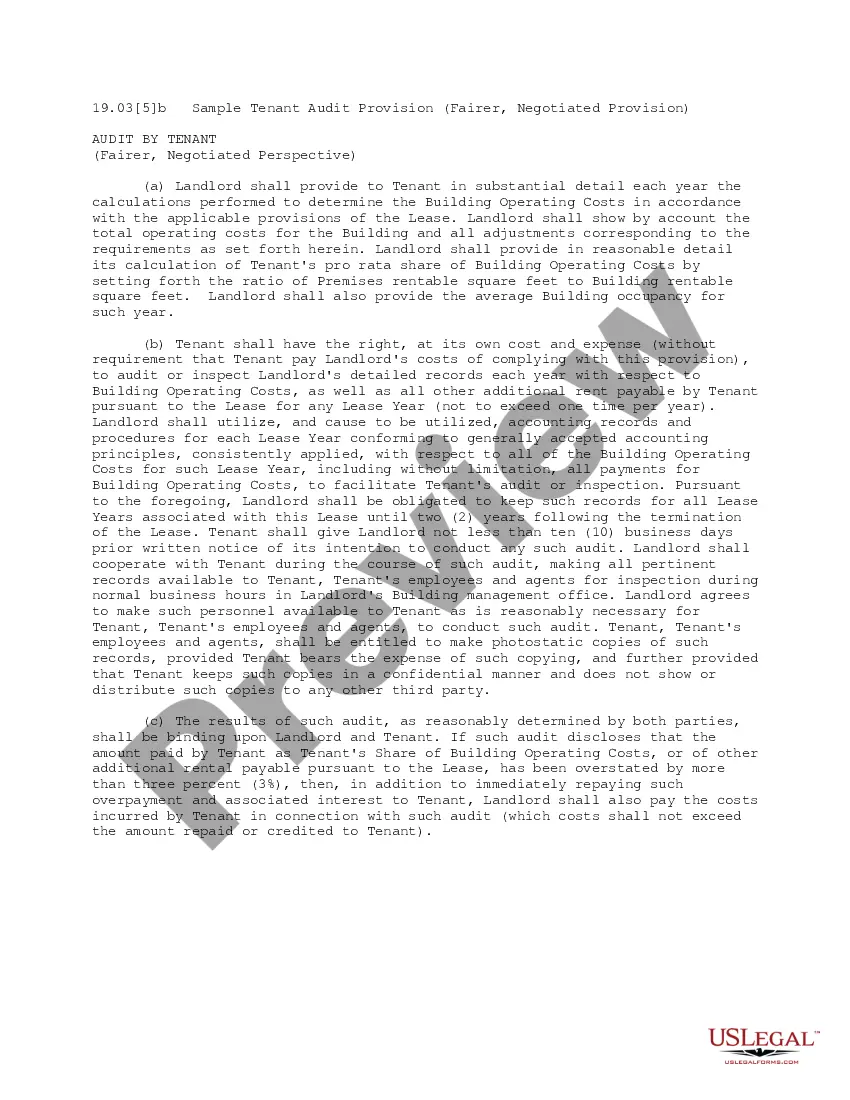
The Fairer Force Majeure Clause is a legal form that outlines how obligations under an office lease are affected by unforeseen circumstances, known as force majeure events. This form clarifies that if a party is unable to fulfill its lease obligations due to natural disasters, government actions, or other significant events, those obligations may be suspended. This clause differs from standard lease agreements by explicitly addressing conditions that allow for the suspension of responsibilities without penalty, ensuring fairness for both landlords and tenants during emergencies.
Main sections of this form
- Definition of force majeure events, including natural calamities and government actions.
- Conditions under which lease obligations are suspended or excused.
- Requirements for landlords to make a good faith effort to provide services during such events.
- Provision for tenant rent abatement proportional to the inability to fulfill lease obligations.
- Clarification that tenants retain rights to cancel the lease under certain circumstances.
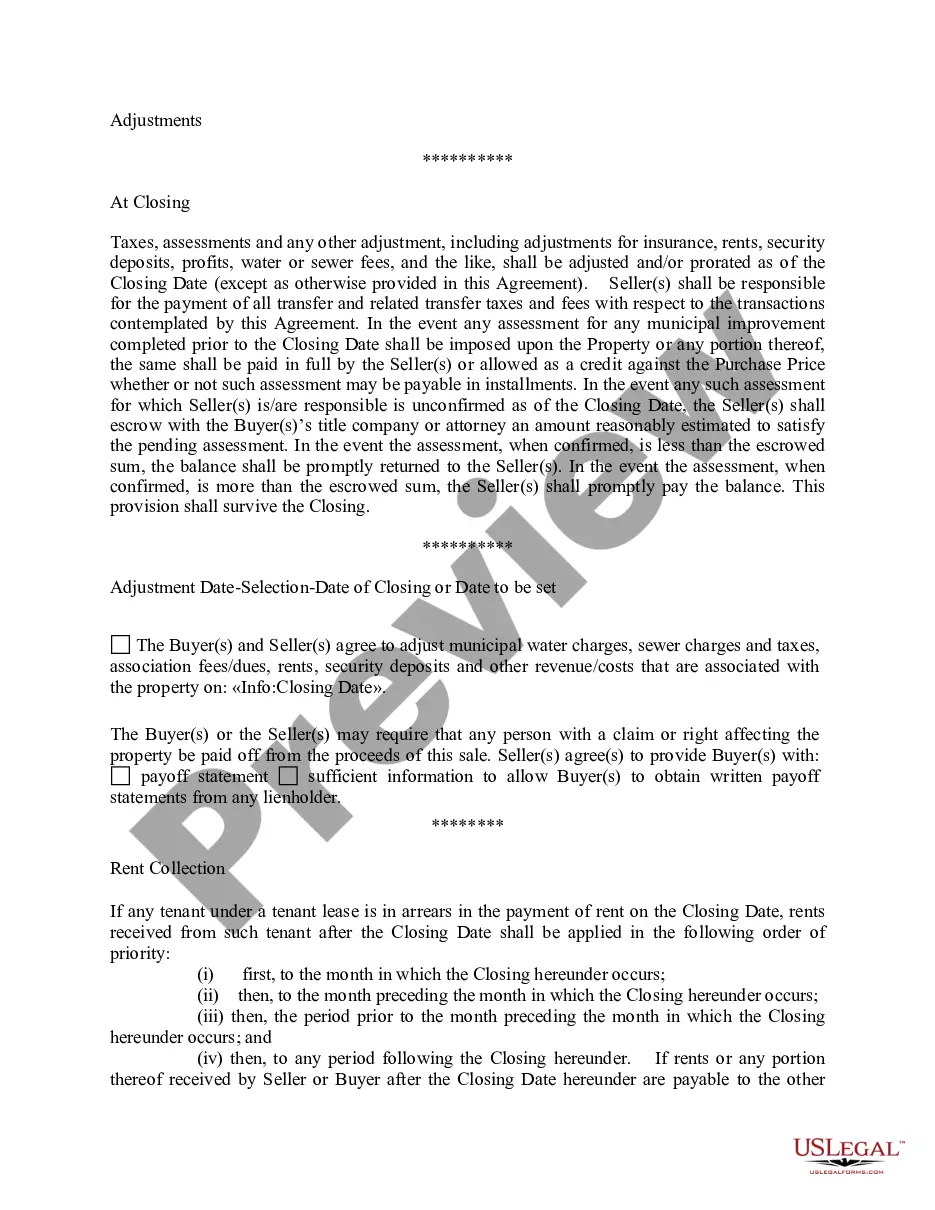
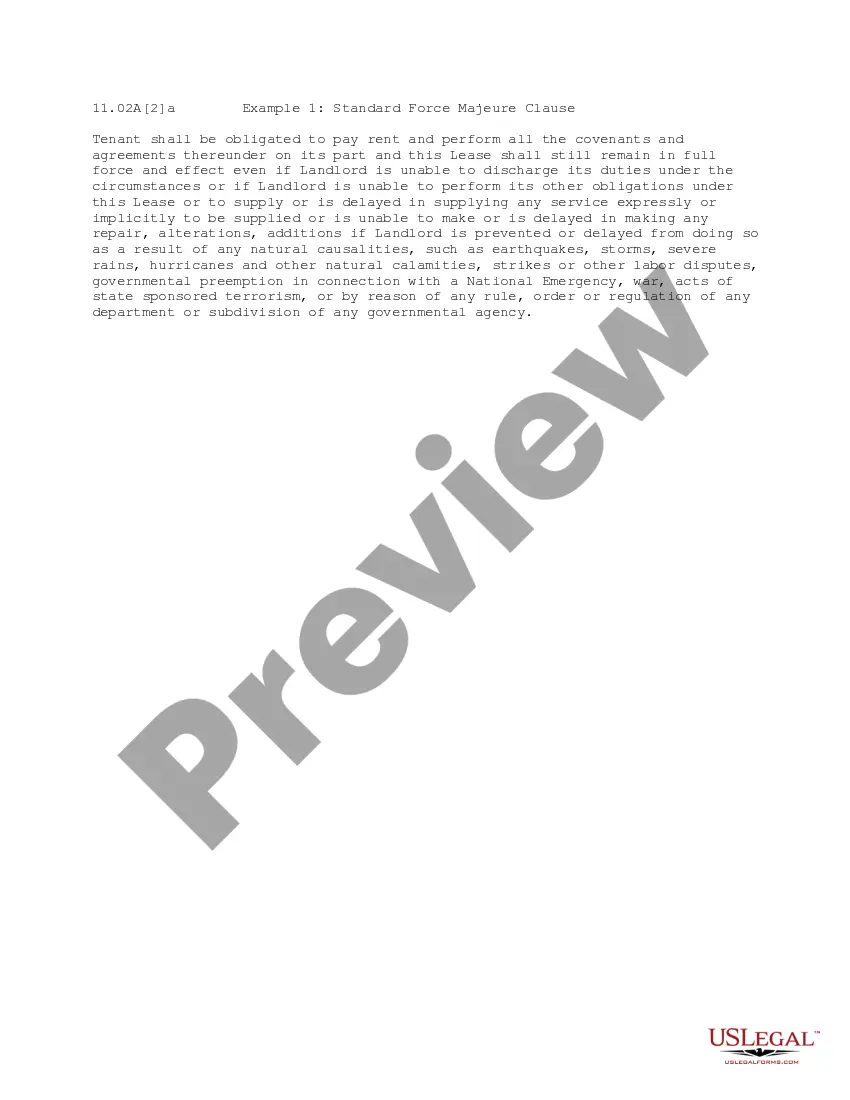
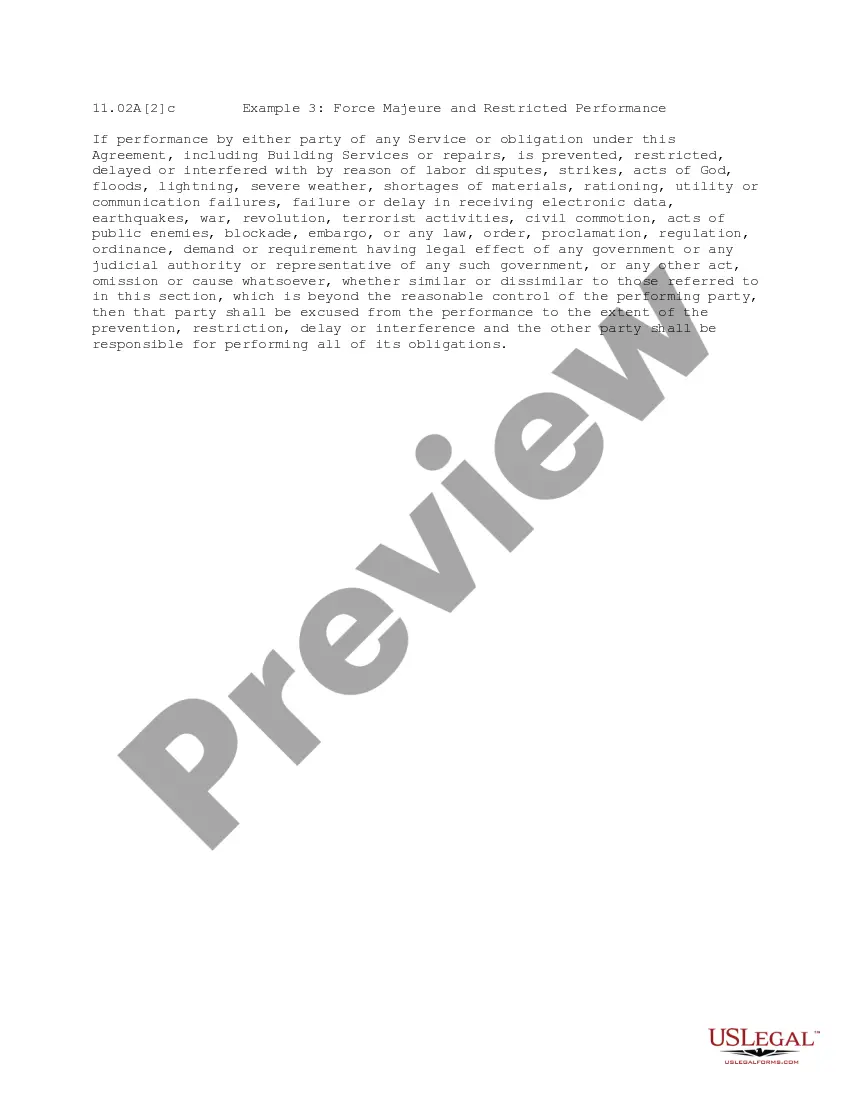
When to use this form
This form is essential when entering an office lease agreement where potential disruptions due to natural disasters, government interventions, or other extraordinary events may occur. It is particularly useful for tenants and landlords who wish to protect their interests and clarify the responsibilities of each party during unpredictable situations, ensuring that both parties understand their rights and obligations if a force majeure event arises.
Who needs this form
- Landlords who want to include protections against unforeseen events in their lease agreements.
- Tenants concerned about their obligations under a lease during natural disasters or emergencies.
- Legal professionals drafting lease agreements to ensure clarity and fairness regarding force majeure situations.
Completing this form step by step
- Identify the parties involved in the lease agreement.
- Clearly define the property subject to the lease.
- Specify examples of force majeure events that will be recognized under the lease.
- Include provisions outlining the process for requesting rent abatement during a force majeure event.
- Ensure both parties sign and date the agreement to confirm acceptance of the terms.
Does this document require notarization?
This form usually doesn’t need to be notarized. However, local laws or specific transactions may require it. Our online notarization service, powered by Notarize, lets you complete it remotely through a secure video session, available 24/7.
Get your form ready online
Our built-in tools help you complete, sign, share, and store your documents in one place.
Make edits, fill in missing information, and update formatting in US Legal Forms—just like you would in MS Word.
Download a copy, print it, send it by email, or mail it via USPS—whatever works best for your next step.
Sign and collect signatures with our SignNow integration. Send to multiple recipients, set reminders, and more. Go Premium to unlock E-Sign.
If this form requires notarization, complete it online through a secure video call—no need to meet a notary in person or wait for an appointment.
We protect your documents and personal data by following strict security and privacy standards.

Make edits, fill in missing information, and update formatting in US Legal Forms—just like you would in MS Word.

Download a copy, print it, send it by email, or mail it via USPS—whatever works best for your next step.

Sign and collect signatures with our SignNow integration. Send to multiple recipients, set reminders, and more. Go Premium to unlock E-Sign.

If this form requires notarization, complete it online through a secure video call—no need to meet a notary in person or wait for an appointment.

We protect your documents and personal data by following strict security and privacy standards.
Common mistakes
- Failing to clearly define what constitutes a force majeure event.
- Not outlining the process for rent abatement, leading to potential disputes.
- Overlooking the need for both parties to sign the agreement properly.
Why use this form online
- Convenience of accessing and downloading the form anytime.
- Ability to customize the form to meet specific legal requirements easily.
- Reliability of using templates drafted by licensed attorneys.
Legal use & context
- This clause aims to balance the rights and responsibilities of both landlords and tenants during unforeseen events.
- Incorporating this form into lease agreements can enhance enforceability by clearly stating each party's obligations.
- Limitations may exist based on jurisdiction, so refer to state-specific regulations for additional clarity.
What to keep in mind
- The Fairer Force Majeure Clause provides essential protections for both landlords and tenants.
- It is important to clearly define force majeure events in lease agreements.
- Using this form online offers convenience and reliability in legal documentation.
- Understanding local laws is crucial for proper implementation of the clause.
Looking for another form?
Form popularity
FAQ
For the purpose of this Agreement, an Event of Force Majeure means any circumstance not within the reasonable control of the Party affected, but only if and to the extent that (i) such circumstance, despite the exercise of reasonable diligence and the observance of Good Utility Practice, cannot be, or be caused to be
Under most national laws, force majeure events must meet four criteria: (1) the event must be external to the contract and the parties; (2) the event must render the party0393CAs performance radically different from what the parties originally contemplated; (3) the event must have been unforeseeable; and (4) the
What is Force Majeure?Examples of events that might trigger a force majeure clause into effect include a declaration of war, a disease epidemic, or a hurricane, earthquake, or other natural disaster events that fall under the legal term, act of God.
A force majeure clause (1) specifies the events which enable either party to declare a force majeure/act of God event, (2) how a party should notify its counterparty about the occurrence, and (3) the consequences after a force majeure event has occurred.
Generally, an Act of God includes only natural occurring events, whereas force majeure includes both naturally occurring events and events due to human intervention.For example, a shipping contract would have a force majeure clause that could cover natural disasters like a tsunami.
Force majeure examples There are dozens of circumstances or events that we class as examples of force majeure. War, riots, earthquakes, hurricanes, lightning, and explosions, for example, are force majeure events. The term also includes energy blackouts, unexpected legislation, lockouts, slowdowns, and strikes.
1, The company declared force majeure on its shipping commitments. 2, Damage is caused due to force majeure. 4, Any party to natural disasters and other force majeure causes of delay in performance of duty, incomplete or non-performance should not be treated as breach of contract.
An example of an operative clause is: " . 1 Neither party is responsible for any failure to perform its obligations under this contract, if it is prevented or delayed in performing those obligations by an event of force majeure. .