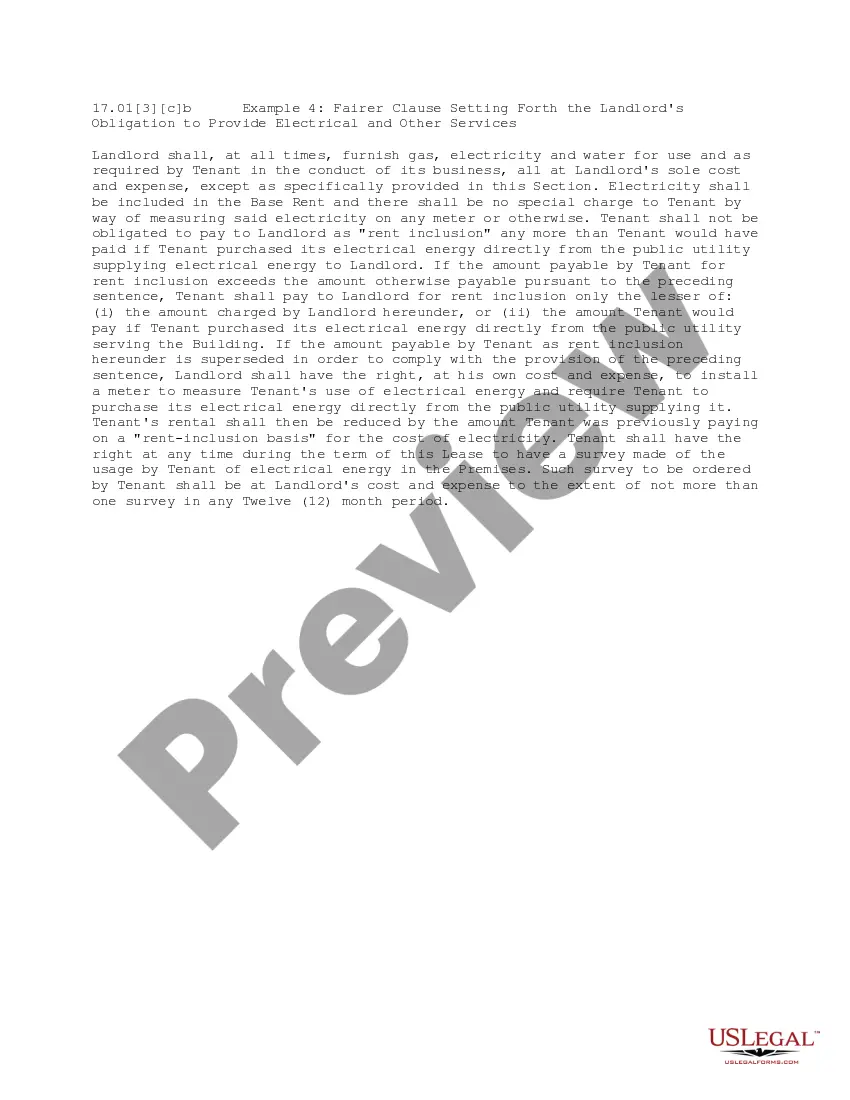
Fairer Clause Setting Forth the Landlord Obligation to Provide Electrical and Other Services
Understanding this form
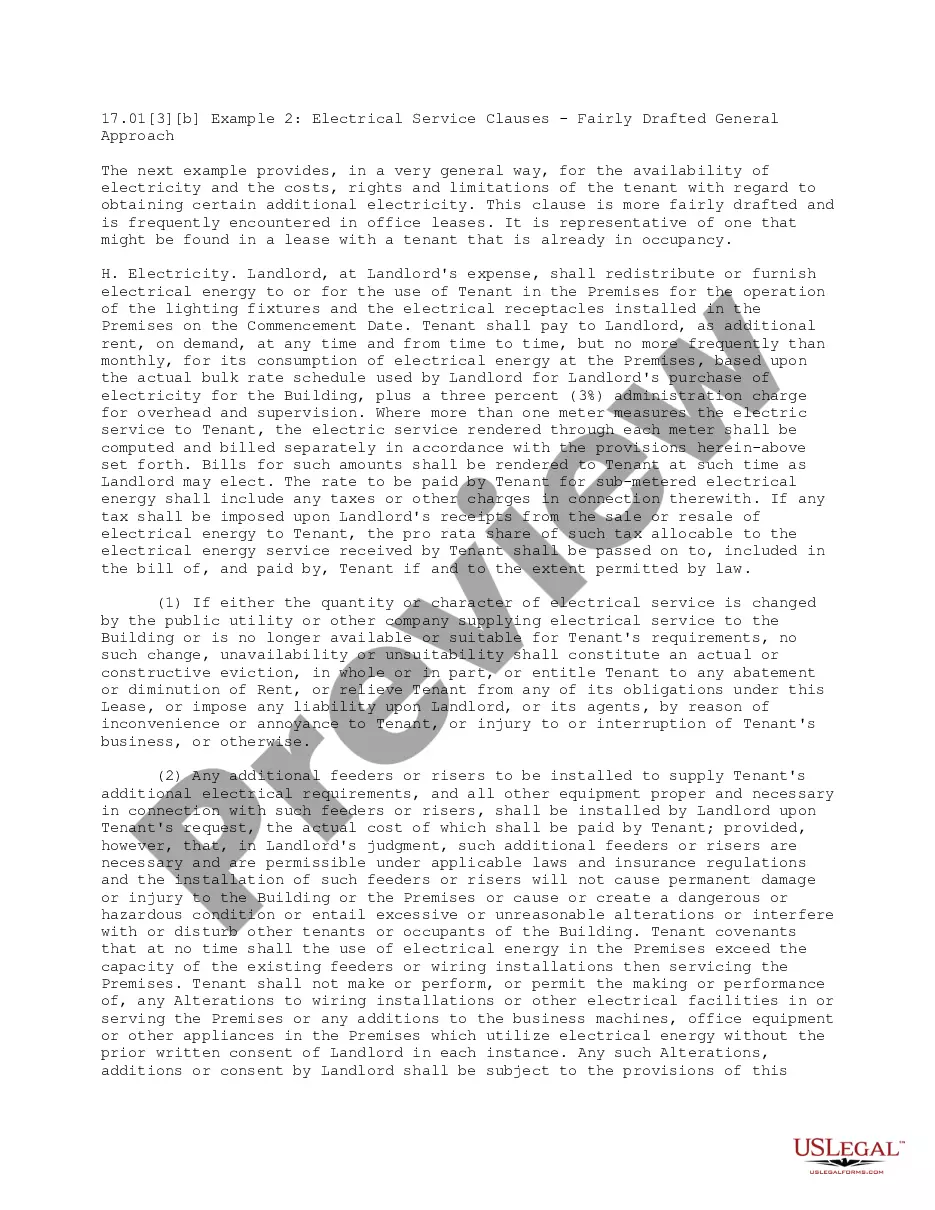
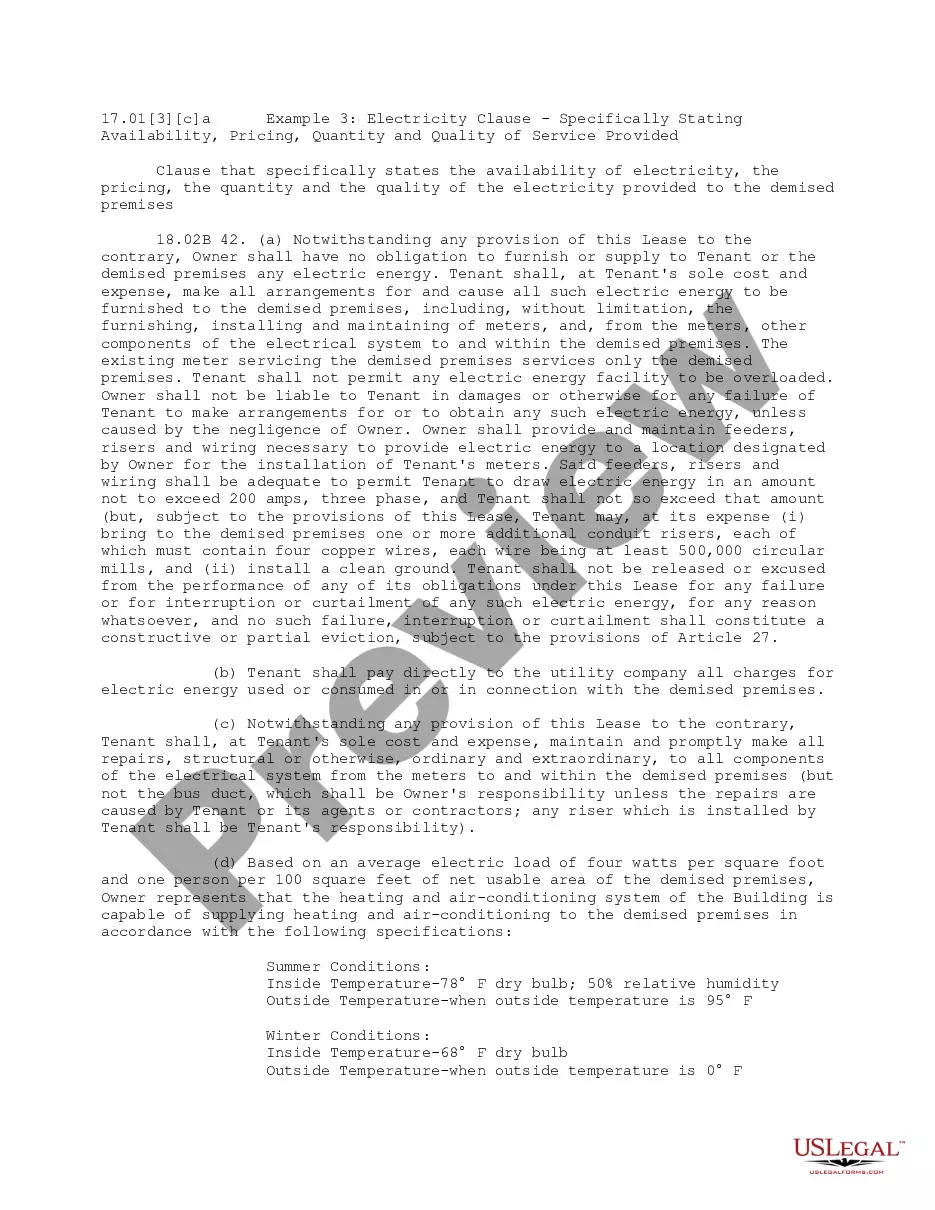
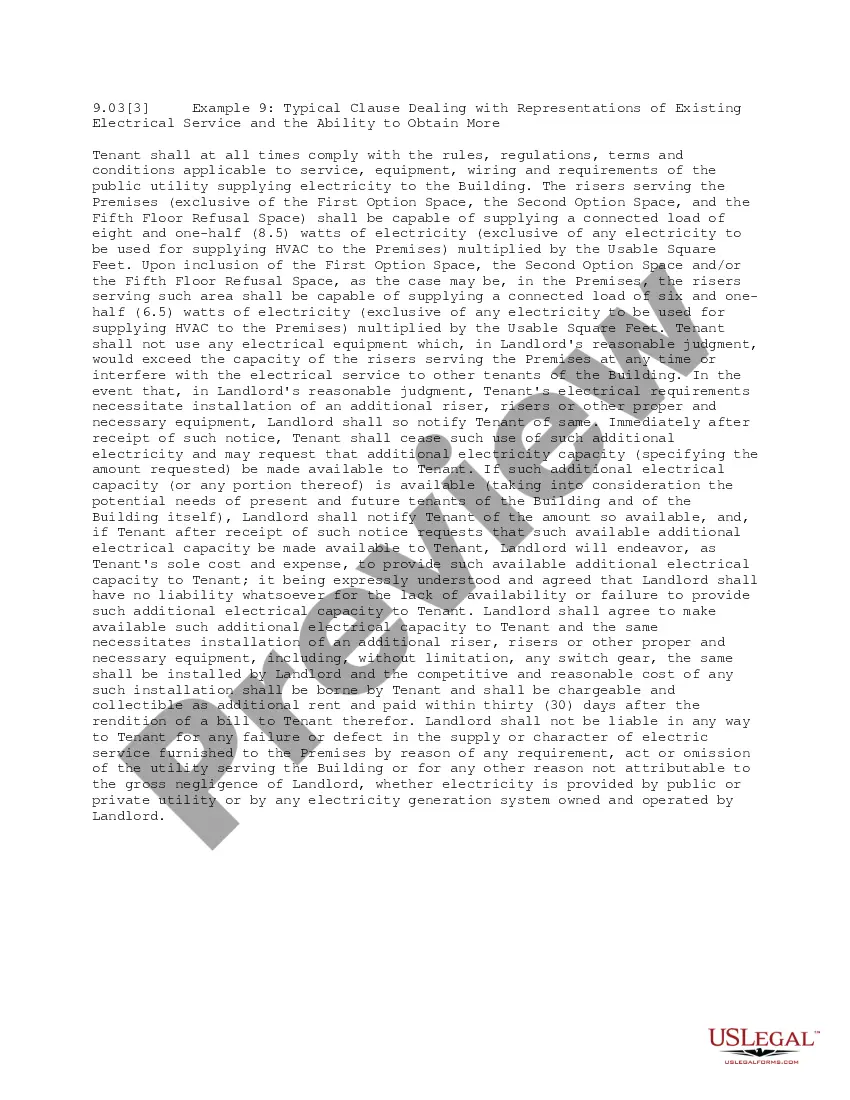
This form is a Fairer Clause Setting Forth the Landlord Obligation to Provide Electrical and Other Services. It outlines the utility services, specifically electricity, that the landlord must provide to tenants at no additional cost beyond their rent. This clause ensures that tenants are not charged extra for utilities they rely on for their business operations, differentiating it from standard rental agreements that might include hidden fees or additional charges for utilities.
Form components explained
- Landlord's obligation to provide essential utilities like gas, electricity, and water.
- Inclusion of electricity costs in the base rent with no separate charge.
- Limitations on charges for electrical energy based on direct public utility rates.
- Landlord's right to install a meter at their expense if necessary.
- Tenant's right to conduct an energy usage survey at the landlord's cost.
When to use this document
Use this form when drafting an office lease agreement to clearly define the landlord's responsibilities regarding utility services. It is particularly useful when negotiating terms with landlords, ensuring that tenants understand their rights to utilities without unexpected costs. This clause can help prevent disputes over utility charges during the lease term.
Who can use this document
- Commercial landlords who are leasing space to tenants.
- Business tenants looking for clarity in their lease agreements regarding utility obligations.
- Real estate attorneys involved in drafting or reviewing commercial lease agreements.
- Property managers handling lease negotiations and tenant communications.
How to prepare this document
- Identify and enter the names of the landlord and tenant.
- Specify the property address and description.
- Outline the utility services provided by the landlord in the designated section.
- Indicate any conditions or limitations concerning utility charges.
- Have both parties sign and date the form to make it legally binding.
Notarization guidance
This form does not typically require notarization to be legally valid. However, some jurisdictions or document types may still require it. US Legal Forms provides secure online notarization powered by Notarize, available 24/7 for added convenience.
Get your form ready online
Our built-in tools help you complete, sign, share, and store your documents in one place.
Make edits, fill in missing information, and update formatting in US Legal Forms—just like you would in MS Word.
Download a copy, print it, send it by email, or mail it via USPS—whatever works best for your next step.
Sign and collect signatures with our SignNow integration. Send to multiple recipients, set reminders, and more. Go Premium to unlock E-Sign.
If this form requires notarization, complete it online through a secure video call—no need to meet a notary in person or wait for an appointment.
We protect your documents and personal data by following strict security and privacy standards.

Make edits, fill in missing information, and update formatting in US Legal Forms—just like you would in MS Word.

Download a copy, print it, send it by email, or mail it via USPS—whatever works best for your next step.

Sign and collect signatures with our SignNow integration. Send to multiple recipients, set reminders, and more. Go Premium to unlock E-Sign.

If this form requires notarization, complete it online through a secure video call—no need to meet a notary in person or wait for an appointment.

We protect your documents and personal data by following strict security and privacy standards.
Common mistakes to avoid
- Failing to specify all utility services provided, leading to confusion or disputes.
- Not including the requirement that costs are to be borne solely by the landlord.
- Using vague language that can be misinterpreted by either party.
- Neglecting to have both parties sign the agreement, making it unenforceable.
Advantages of online completion
- Convenient access to a legally vetted form that saves time and effort.
- Editable templates that can be tailored to specific lease negotiations.
- Reliable content drafted by licensed attorneys, ensuring compliance with legal standards.
Legal use & context
- Establishes clear obligations of the landlord regarding utility provision to avoid future conflicts.
- Helps ensure tenants have necessary services for their business operations without incurring additional costs.
What to keep in mind
- The form provides essential details on a landlord's obligation to furnish utilities.
- It protects tenants from additional utility costs beyond their rent.
- Clear communication of utility obligations can mitigate leasing disputes.
Looking for another form?



Form popularity
FAQ
As a landlord you must: keep your rented properties safe and free from health hazards. make sure all gas and electrical equipment is safely installed and maintained. provide an Energy Performance Certificate for the property.
Most rental agreements are short-term agreements, such as month-to-month tenancies, while lease agreements are usually for longer rental periods, such as six months, a year, or more.
The typical day of a landlord involves more than collecting rent and doing the odd repair job. One day, a landlord could be dealing with tenants who are disrupting neighbors. Then, they may get a call in the middle of the night to fix a burst pipe. The next day, they could be closing the deal on buying a new property.
Overview. Alberta has 2 types of rental agreements: Fixed term agreement. A fixed term tenancy begins and ends on specific dates. Periodic agreement. A periodic tenancy has a start date but no end date. Boarding and employer accommodations. Application of the legislation.
Fundamental responsibilities of landlords include: providing and maintaining the property in a clean and reasonable standard; giving proper receipts and maintaining records of all transactions pertaining to the tenancy; paying council rates and taxes; maintaining locks to ensure the property's security; and lodging the
Answer. No state law requires landlords to repaint a rental unit in between tenants.Your landlord will have to repaint or take other steps to remedy any unsanitary or unsafe conditionfor example, if a window is painted shut or there's mold on the walls. Also, your landlord must comply with all lead-based paint laws.
Complying with all state and local health and building codes. Maintaining structural components and a reasonably weather-protected unit. Providing the necessary heat, electric, and hot and cold water facilities. Making any requested repairs promptly.
Landlord responsibilities include an obligation to their tenant's to keep a warranty of habitability. This is accomplished by making sure the rental is livable, safe and clean for your tenant. A landlord is also responsible for financials, taxes, utilities and property maintenance.
A. Landlords are responsible for most repairs in a rental property, including any appliances provided by the landlord for making use of the supply of water, gas, and electricity. Landlords are not responsible for repairs to appliances owned by their tenants.