Procedure for Conducting an I 9 Audit
Overview of this form
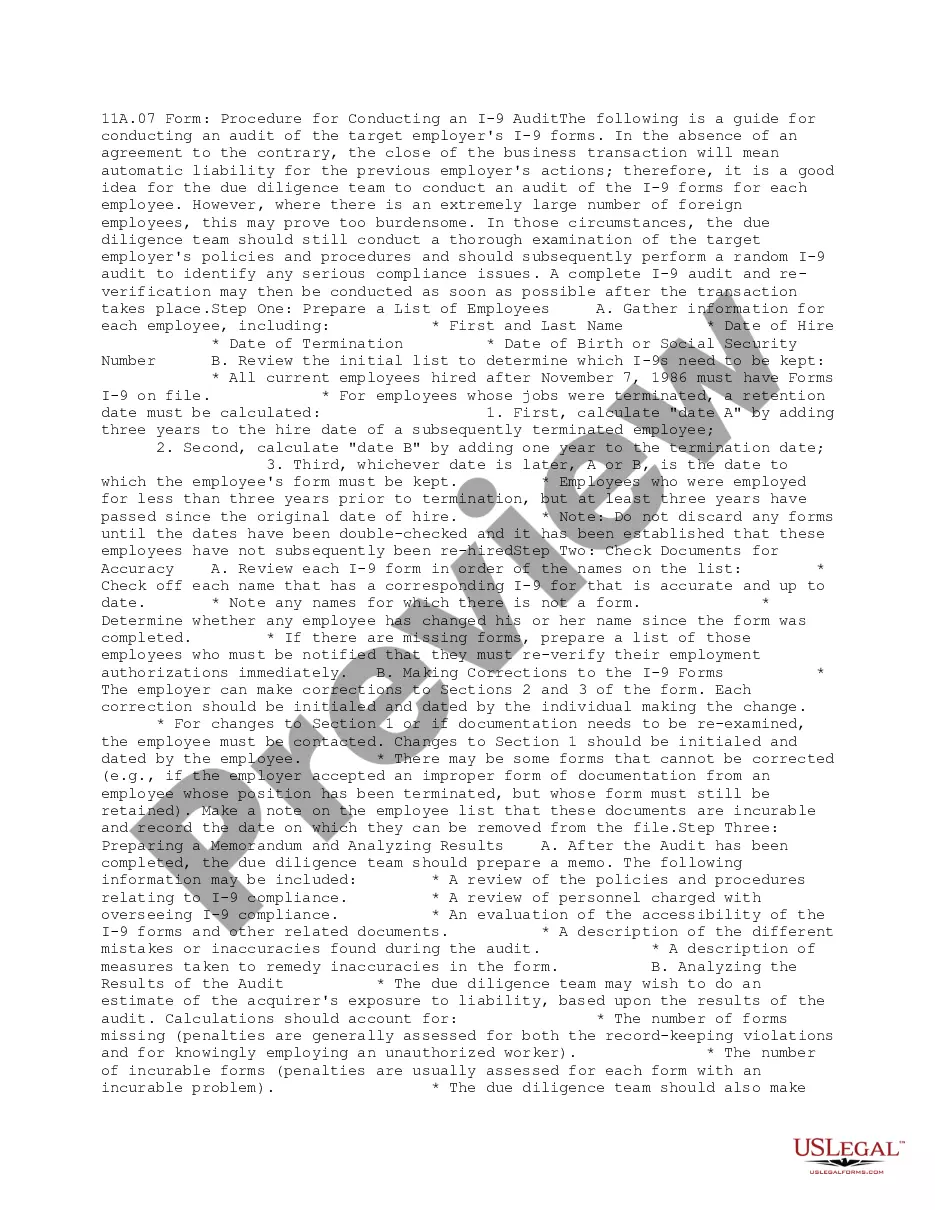
The Procedure for Conducting an I-9 Audit is a critical document that guides employers through the process of auditing their I-9 forms, which verify the identity and eligibility of employees to work in the United States. This form helps ensure compliance with federal regulations and identify potential issues, setting it apart from other employment-related forms by focusing specifically on documentation and record-keeping related to work authorization status.
What’s included in this form
- Employee List: A comprehensive list of all employees, including essential details such as names, hire dates, and termination dates.
- Document Verification: Guidelines for checking the accuracy and completeness of each I-9 form.
- Correction Procedures: Instructions for making corrections to inaccurate I-9 forms, including when to contact employees.
- Audit Memorandum: A summary report detailing findings, including compliance review and identified inaccuracies.
- Liability Analysis: An assessment of the potential legal and financial liabilities based on audit outcomes.

Common use cases
This form is essential for employers who are preparing for an I-9 audit, particularly during due diligence processes such as mergers, acquisitions, or changes in ownership. It is also applicable when there is a need to resolve compliance issues or enhance the record-keeping practices for employment eligibility verification.
Who this form is for
- Human Resources professionals responsible for employee documentation.
- Business owners seeking to ensure compliance with employment laws.
- Due diligence teams conducting audits during business transactions.
- Employers with a diverse workforce requiring verification of work eligibility.
Completing this form step by step
- Prepare a list of all employees including their identification details.
- Review the I-9 forms for accuracy, noting which forms are missing or incorrect.
- Make necessary corrections to the I-9 forms, ensuring proper documentation for changes.
- Compile a memorandum outlining the audit findings and any recommended actions.
- Analyze the results to assess potential liabilities and areas for improvement.
Does this form need to be notarized?
In most cases, this form does not require notarization. However, some jurisdictions or signing circumstances might. US Legal Forms offers online notarization powered by Notarize, accessible 24/7 for a quick, remote process.
Get your form ready online
Our built-in tools help you complete, sign, share, and store your documents in one place.
Make edits, fill in missing information, and update formatting in US Legal Forms—just like you would in MS Word.
Download a copy, print it, send it by email, or mail it via USPS—whatever works best for your next step.
Sign and collect signatures with our SignNow integration. Send to multiple recipients, set reminders, and more. Go Premium to unlock E-Sign.
If this form requires notarization, complete it online through a secure video call—no need to meet a notary in person or wait for an appointment.
We protect your documents and personal data by following strict security and privacy standards.

Make edits, fill in missing information, and update formatting in US Legal Forms—just like you would in MS Word.

Download a copy, print it, send it by email, or mail it via USPS—whatever works best for your next step.

Sign and collect signatures with our SignNow integration. Send to multiple recipients, set reminders, and more. Go Premium to unlock E-Sign.

If this form requires notarization, complete it online through a secure video call—no need to meet a notary in person or wait for an appointment.

We protect your documents and personal data by following strict security and privacy standards.
Typical mistakes to avoid
- Neglecting to keep I-9 forms for former employees past the required retention period.
- Failing to update I-9 forms for employees who have legally changed their names.
- Overlooking the need for timely re-verification of expired work authorizations.
- Assuming all employees' forms are complete without conducting a thorough review.
Why use this form online
- Accessible anywhere, allowing for more flexibility in auditing processes.
- Editable templates that streamline the process of updating employee information.
- Reliable access to professionally drafted forms that comply with current legal standards.
Legal use & context
- This form is legally required for employers to validate employees' eligibility to work in the U.S.
- Completing an I-9 audit helps mitigate the risks associated with non-compliance and potential penalties.
Quick recap
- The Procedure for Conducting an I-9 Audit is essential for verifying employee eligibility and compliance with employment laws.
- Employers should conduct audits periodically to avoid penalties associated with non-compliance.
- Detailed documentation and correction procedures are vital for maintaining accurate employee records.
Looking for another form?

Form popularity
FAQ
What is an I-9 Audit? To put it simply, an I-9 audit is designed to verify employment eligibility and ensure employers are following legal hiring practices. Because of this, it is good practice to undergo regular I-9 compliance audits.
An I-9 audit can be triggered for a number of reasons, including random samples and reporting by disgruntled employees (or ex-employees). Certain business sectors, for example food production, are especially susceptible to I-9 audits, and "silent raids" by ICE.
During the audits, Immigration and Customs Enforcement (ICE) inspectors review businesses' documentation regarding work authorization for their foreign employees.If you're not sure you're prepared for a Form I-9 audit, you'll want to play it safe and review your current employees' documentation.
The I-9 verifies the identity and the employment authorization of each employee and is part of the federal immigration regulatory process.An I-9 audit takes place when Immigration and Customs Enforcement (ICE) serves a Notice of Inspection on an employer, compelling them to surrender their I-9 forms to the government.
Audits of I-9 records quadrupled in 2018 over the prior year (the federal fiscal year). That means nearly 6,000 employers were audited, which led to several dozen civil and criminal convictions.With a quick review of basic I-9 employment eligibility verification requirements and common errors.
The prime purpose of the audit is to form an opinion on the information in the financial report taken as a whole, and not to identify all possible irregularities. This means that although auditors are on the look-out for signs of potential material fraud, it is not possible to be certain that frauds will be identified.
For example, an auditor looks for inconsistencies in financial records.An audit might include collecting a sample from a pool of data using a specific protocol and analyzing the findings to generalize about the data pool's characteristics.
Definition: Audit is the examination or inspection of various books of accounts by an auditor followed by physical checking of inventory to make sure that all departments are following documented system of recording transactions. It is done to ascertain the accuracy of financial statements provided by the organisation.
There are three main types of audits: external audits, internal audits, and Internal Revenue Service (IRS) audits. External audits are commonly performed by Certified Public Accounting (CPA) firms and result in an auditor's opinion which is included in the audit report.