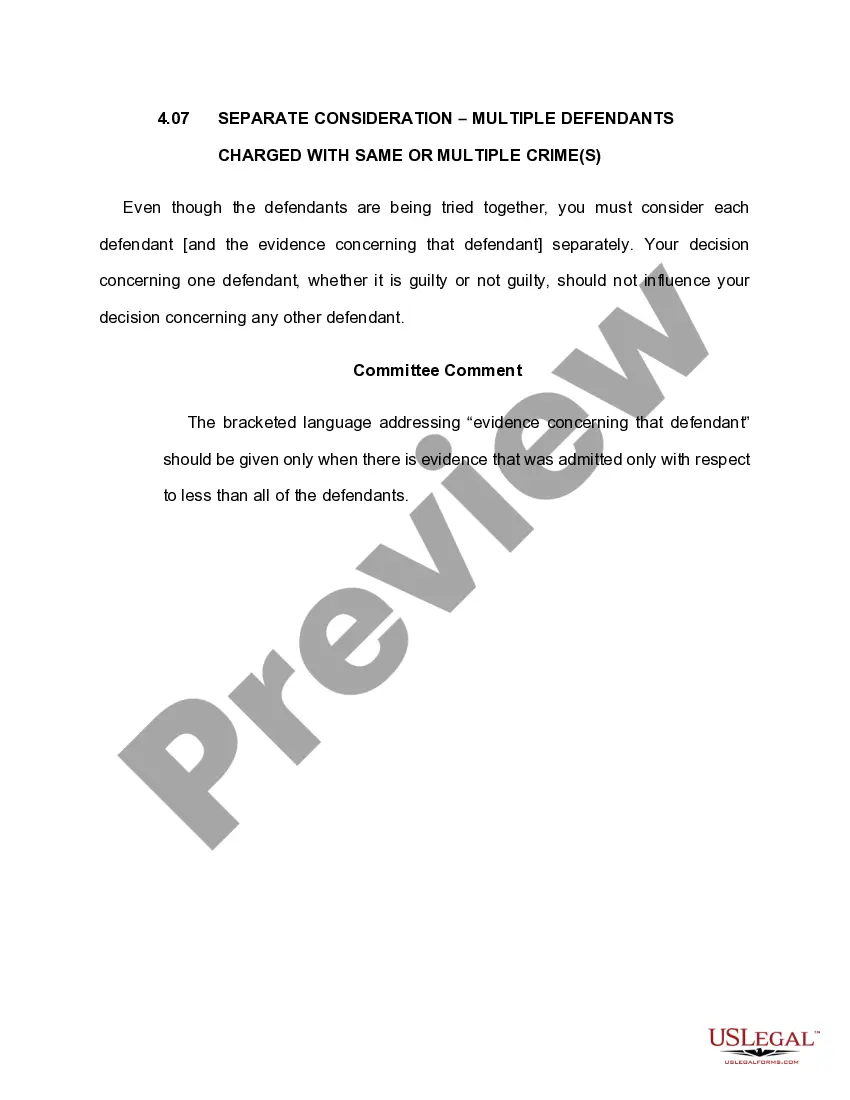
4.07 SEPARATE CONSIDERATION - MULTIPLE DEFENDANTS CHARGED WITH SAME OR MULTIPLE CRIME(S
About this form
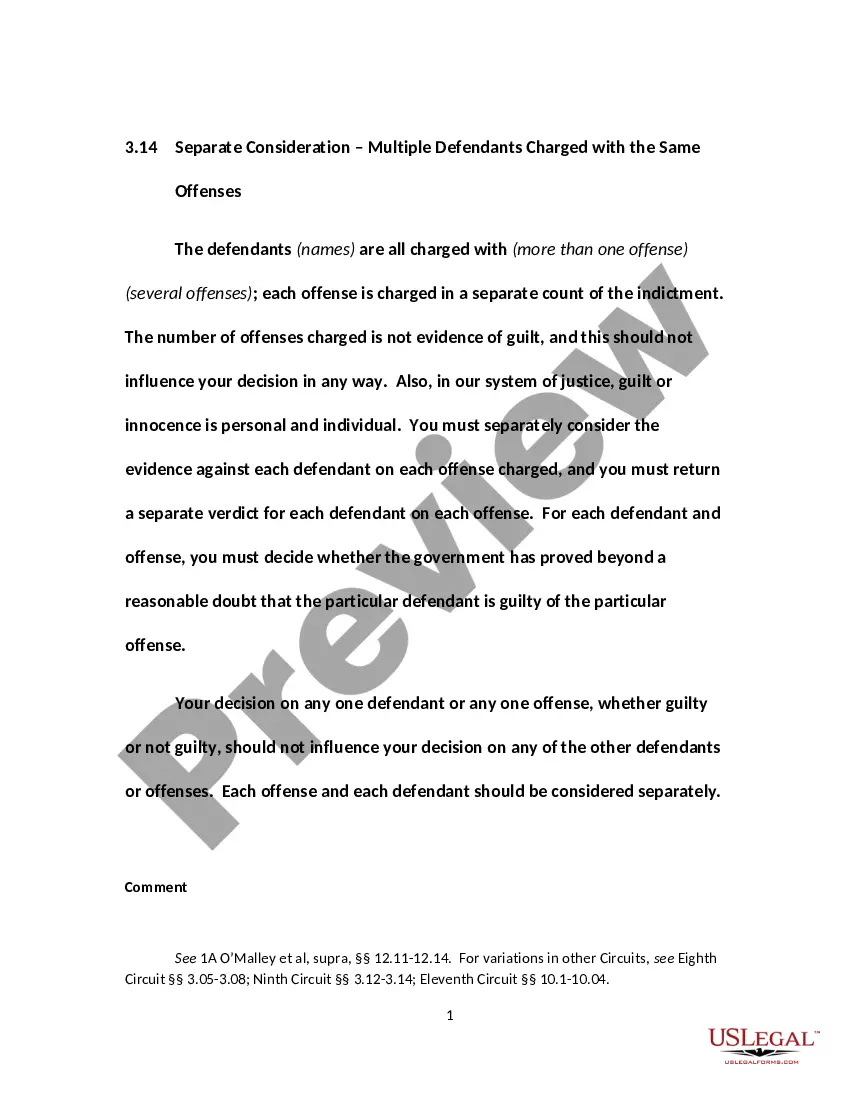
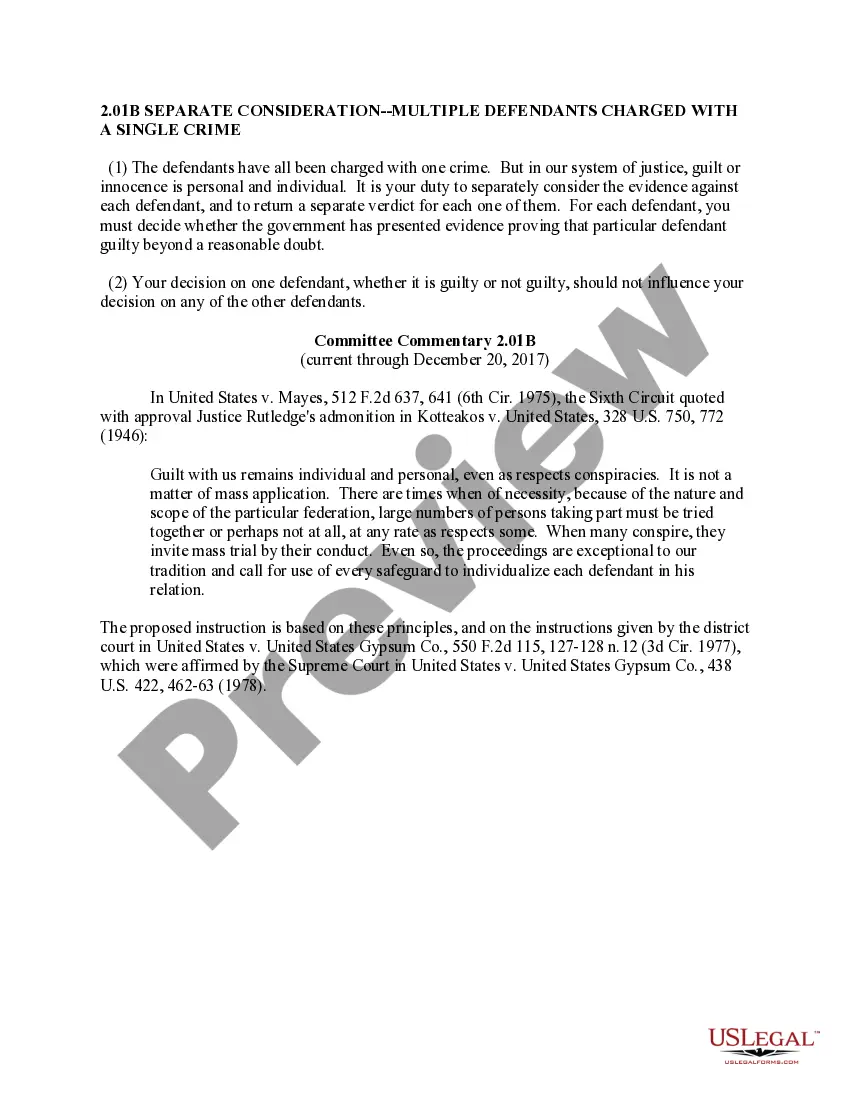
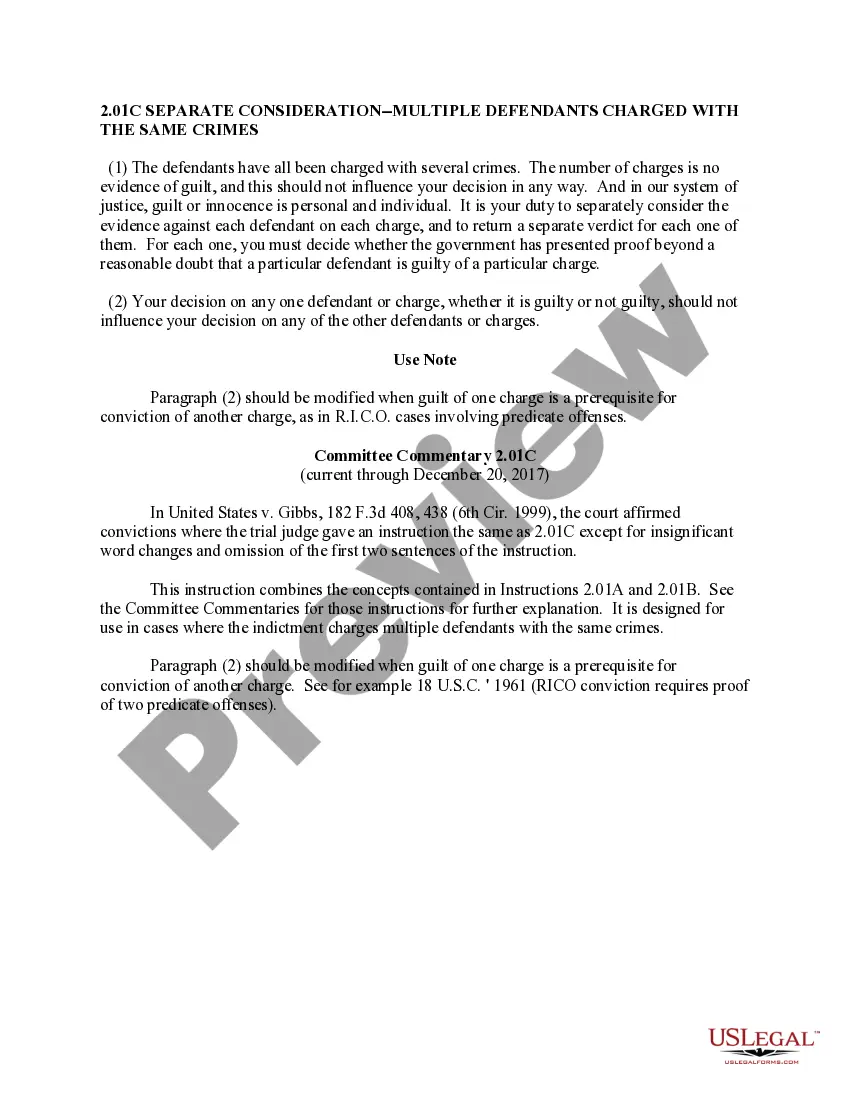
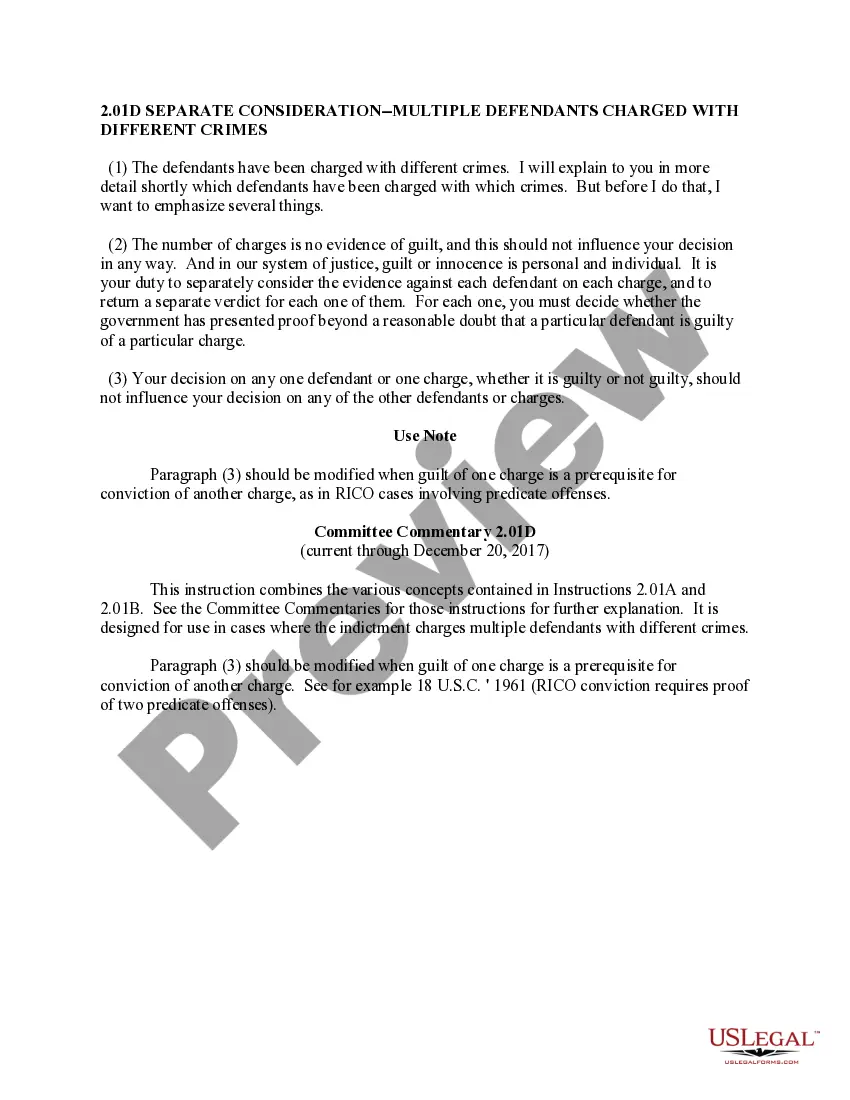
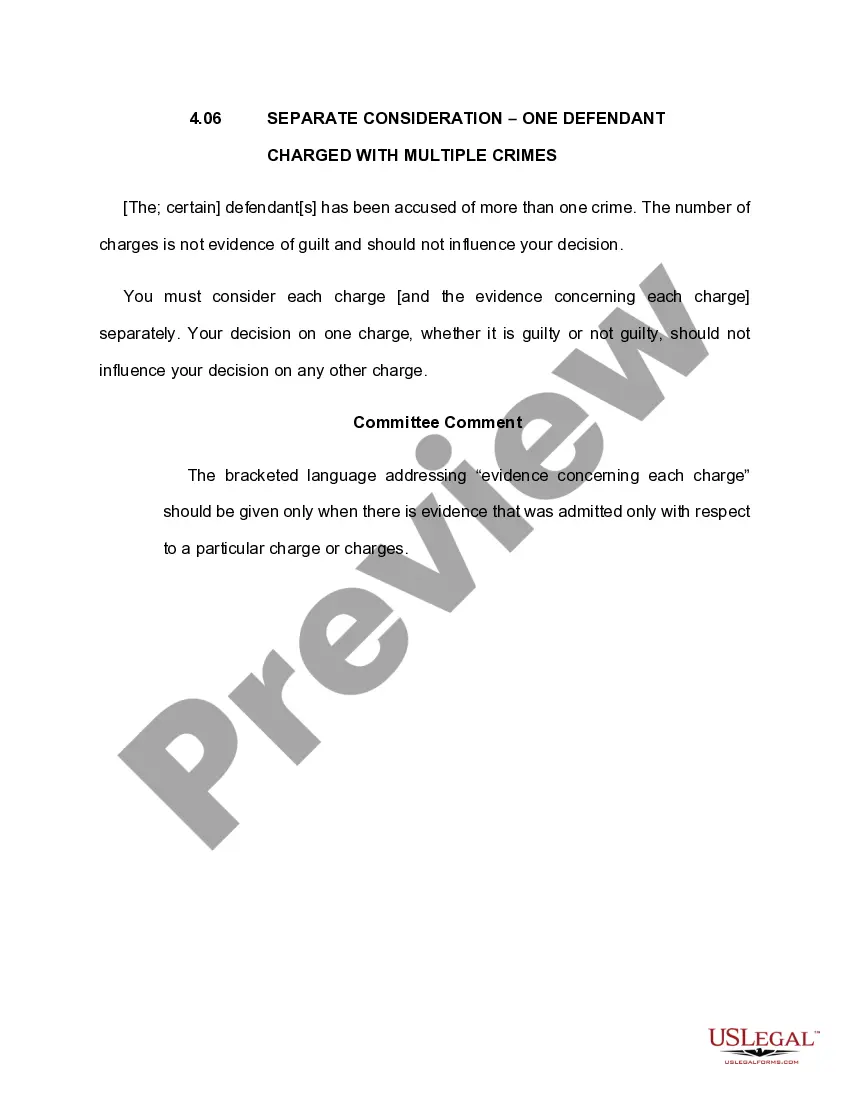
The 4.07 Separate Consideration form is an official jury instruction utilized in cases involving multiple defendants charged with the same or different crimes. This instruction guides jurors to evaluate each defendant separately, ensuring that their decisions are based solely on the evidence presented for each individual, without influence from the others. This form is critical for maintaining fairness in multi-defendant trials and differs from other jury instructions by emphasizing individual consideration.
Form components explained
- Instruction for jurors to consider each defendant independently.
- Guidance on handling evidence specific to particular defendants.
- Clarifications to avoid cross-influence between defendants during deliberations.
When to use this document
This form is essential in jury trials where multiple defendants are being tried at the same time. It should be used when the defendants face the same or different charges, ensuring jurors apply the appropriate standard of justice for each individual in the deliberation process. For example, in cases involving a group accused of a crime, this instruction helps to uphold the principle that each defendant's guilt or innocence must be determined separately based on the evidence relevant to them alone.
Who this form is for
- Jurors involved in trial proceedings with multiple defendants.
- Court officials responsible for jury instructions during deliberations.
- Attorneys who wish to understand jury considerations and frame their arguments accordingly.
Completing this form step by step
- Read the instruction carefully to understand its implications for the trial.
- Ensure that the names of all defendants are correctly listed.
- Consider the evidence related to each defendant independently as directed.
- Discuss with fellow jurors how the instructions apply to the case at hand.
- Reach a verdict for each defendant based solely on individual consideration.
Is notarization required?
Notarization is not commonly needed for this form. However, certain documents or local rules may make it necessary. Our notarization service, powered by Notarize, allows you to finalize it securely online anytime, day or night.
Get your form ready online
Our built-in tools help you complete, sign, share, and store your documents in one place.
Make edits, fill in missing information, and update formatting in US Legal Forms—just like you would in MS Word.
Download a copy, print it, send it by email, or mail it via USPS—whatever works best for your next step.
Sign and collect signatures with our SignNow integration. Send to multiple recipients, set reminders, and more. Go Premium to unlock E-Sign.
If this form requires notarization, complete it online through a secure video call—no need to meet a notary in person or wait for an appointment.
We protect your documents and personal data by following strict security and privacy standards.

Make edits, fill in missing information, and update formatting in US Legal Forms—just like you would in MS Word.

Download a copy, print it, send it by email, or mail it via USPS—whatever works best for your next step.

Sign and collect signatures with our SignNow integration. Send to multiple recipients, set reminders, and more. Go Premium to unlock E-Sign.

If this form requires notarization, complete it online through a secure video call—no need to meet a notary in person or wait for an appointment.

We protect your documents and personal data by following strict security and privacy standards.
Common mistakes
- Failing to acknowledge the requirement to consider each defendant separately.
- Allowing discussions or decisions about one defendant to affect opinions on another.
- Misinterpreting evidence that pertains only to a specific defendant as applicable to all defendants.
Benefits of using this form online
- Immediate access to the document allows for quicker preparation for trial.
- The form is easily modifiable to fit the needs of specific cases.
- Electronic formats ensure that users can store and retrieve the document conveniently.
Legal use & context
- This form is derived from official jury instructions recognized by the Federal 7th Circuit Court.
- Using this form helps to maintain legal standards in jury deliberations.
- It is crucial for ensuring that the right to fair trial and justice is upheld for each defendant.
What to keep in mind
- Each defendant in a trial must be considered independently based on the evidence available.
- This form is essential for preventing bias in jury decisions involving multiple defendants.
- Jurors must be guided to avoid allowing one defendant's situation to influence the others.
Looking for another form?
Form popularity
FAQ
Criminal stacking refers to the practice of charging a defendant with as many relevant charges at once as possible. Sometimes, more charges than are really fair are placed against the defendant.
Paxton, 64 M.J. 484 (multiplicity, a constitutional violation under the Double Jeopardy Clause, occurs if a court, contrary to the intent of Congress, imposes multiple convictions and punishments under different statutes for the same act or course of conduct).
The Fifth Amendment to the Constitution provides in part that ?nor shall any person be subject for the same offense to be twice put in jeopardy of life and limb.? This is referred to as the double jeopardy clause, and it protects an individual from being charged with, tried for, or convicted of the same crime twice.
Duplicity occurs when more than one offense is alleged in the same charge. See this Manual at 919 for a general discussion of duplicity. Conversely, multiplicity occurs when two charges allege the same offense. Charges are not multiplicious if each offense requires proof of an additional fact that the other does not.
A judge in a criminal case may feel that it is appropriate to combine the cases of multiple defendants when their charges involve the same set of circumstances. This can help a judge streamline their calendar and resolve a case more efficiently.
Duplicity is the joining in a single count of two or more distinct and separate offenses; multiplicity is the charging of a single offense in several counts.