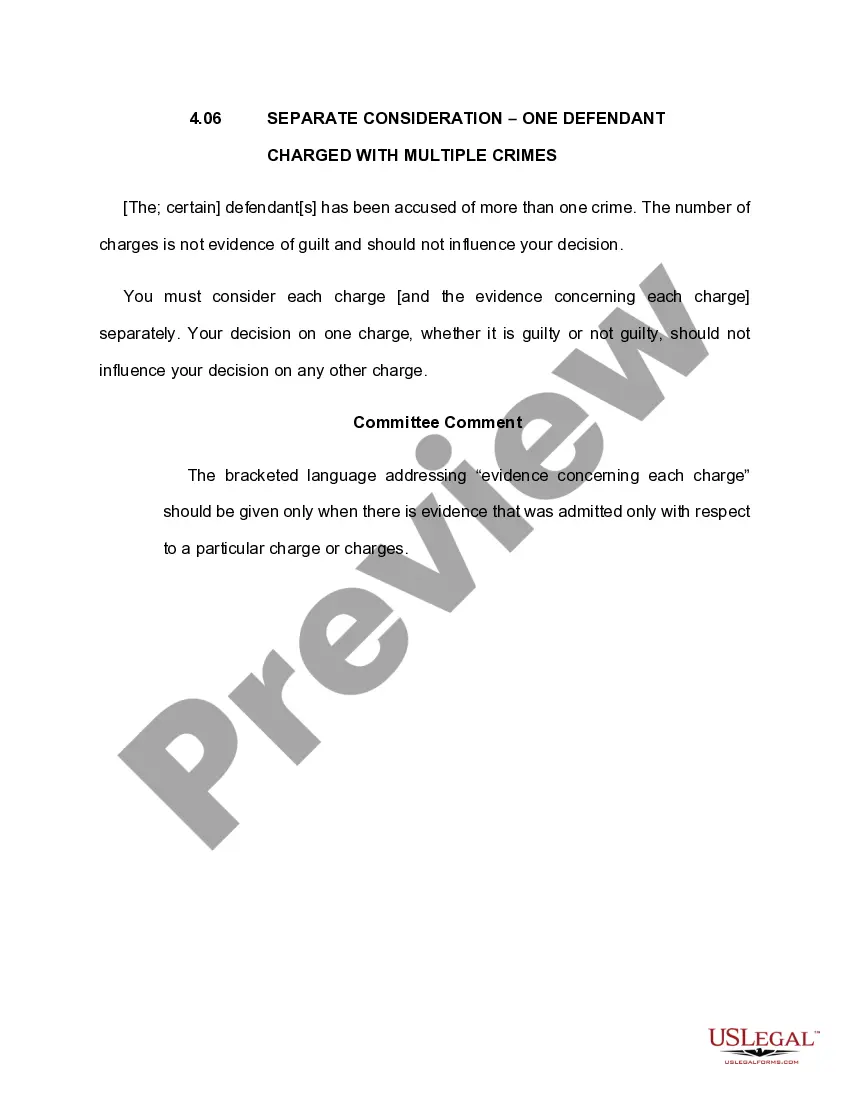
4.06 SEPARATE CONSIDERATION - ONE DEFENDANT CHARGED WITH MULTIPLE CRIMES
What this document covers
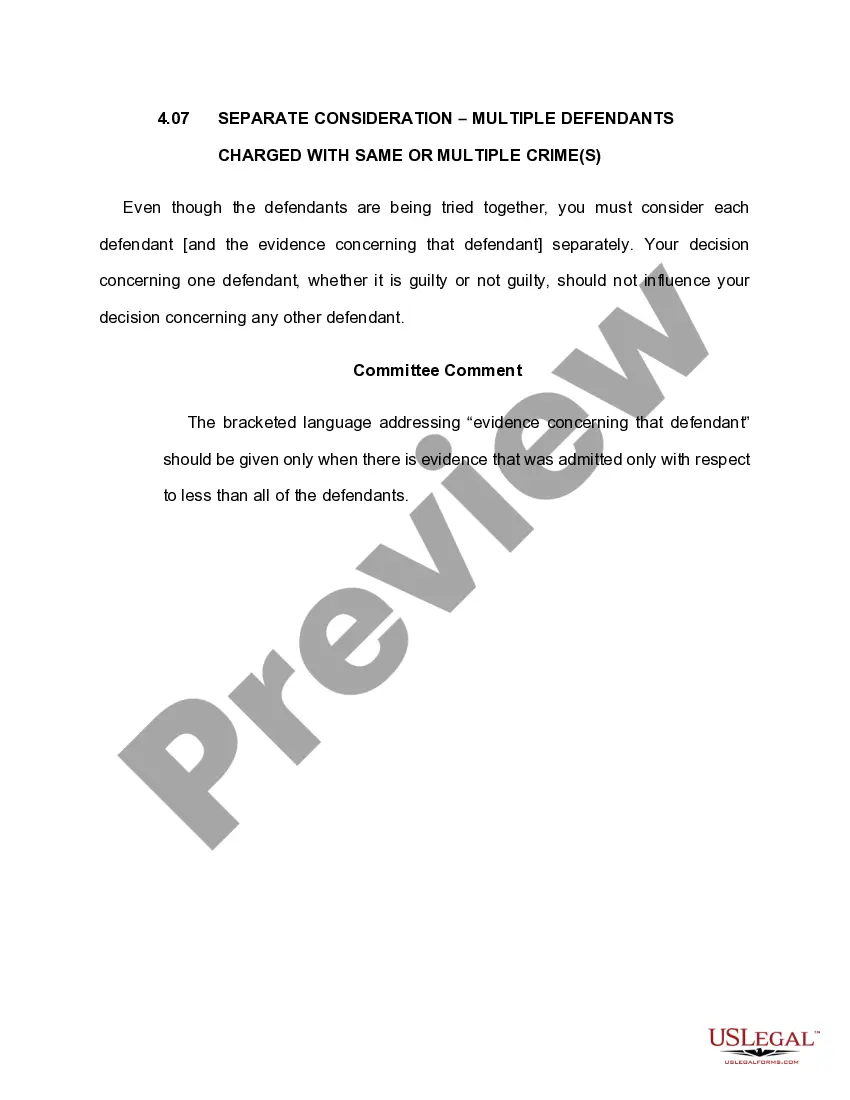
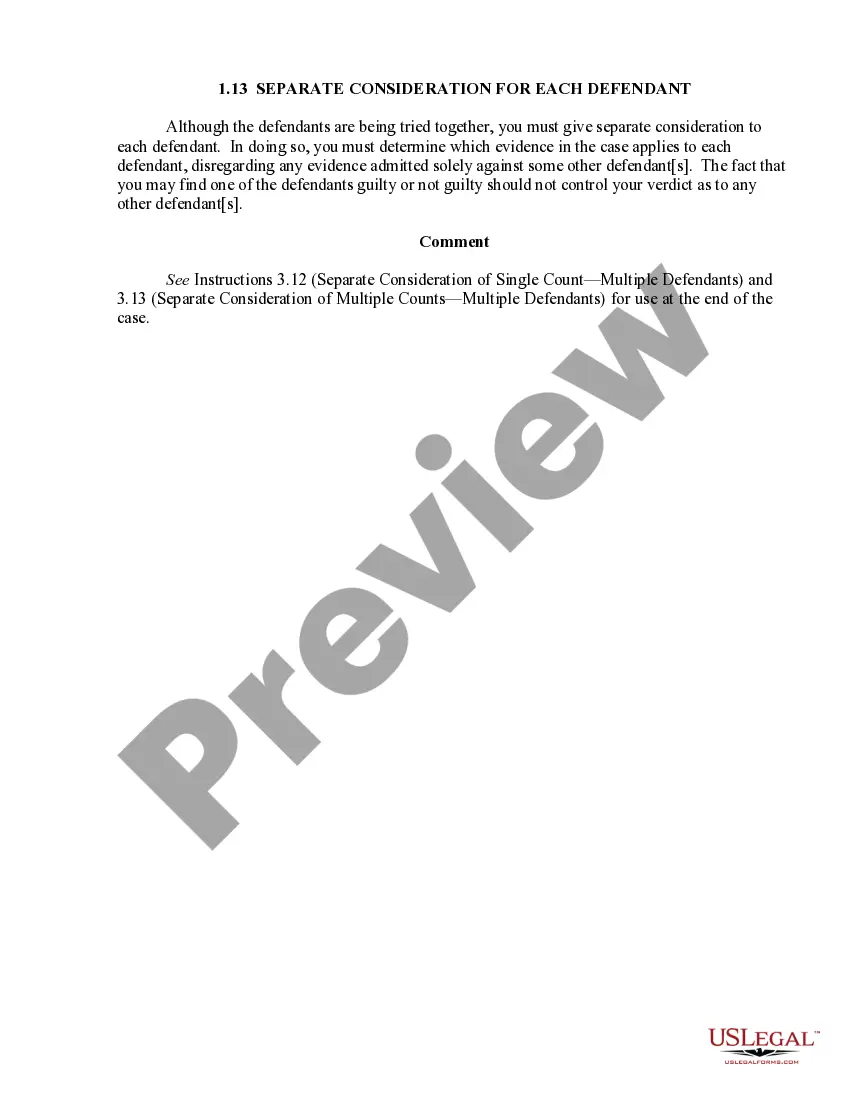
The 4.06 Separate Consideration form is an official pattern jury instruction used in federal courts. Its primary purpose is to guide jurors when a single defendant is charged with multiple crimes. This form emphasizes that jurors must evaluate each charge independently, ensuring that decisions on one charge do not influence decisions on another. This distinguishes it from instructions that may not separately address multiple charges against a defendant.
What’s included in this form
- Statement that a defendant has been accused of multiple crimes.
- Clarification that the number of charges is not indicative of guilt.
- Instruction to consider each charge and related evidence separately.
- Guidance for jurors on how decisions on one charge affect others.
- Comments addressing conditions for specific evidence admission.
When to use this form
This form is utilized during jury instructions in criminal trials where a defendant faces multiple charges. It is critical when the jury must deliberate on each charge distinctly to arrive at a fair verdict, thereby avoiding bias from one charge to another. This ensures that the jurors understand the importance of considering each crime based solely on the evidence presented for that specific charge.
Who can use this document
This form is intended for:
- Judges presiding over criminal trials involving a defendant charged with multiple offenses.
- Legal professionals involved in instructing jurors about the requirements during deliberation.
- Jurors needing clear guidance on how to approach their decision-making in a trial.
Steps to complete this form
- Identify the defendant and the specific charges they face.
- Clearly state that the number of charges does not indicate guilt.
- Provide instructions for the jury to consider each charge separately.
- Include comments on any evidence relevant to particular charges, as needed.
- Ensure the form aligns with federal guidelines and local court rules if applicable.
Does this document require notarization?
This form does not typically require notarization to be legally valid. However, some jurisdictions or document types may still require it. US Legal Forms provides secure online notarization powered by Notarize, available 24/7 for added convenience.
Get your form ready online
Our built-in tools help you complete, sign, share, and store your documents in one place.
Make edits, fill in missing information, and update formatting in US Legal Forms—just like you would in MS Word.
Download a copy, print it, send it by email, or mail it via USPS—whatever works best for your next step.
Sign and collect signatures with our SignNow integration. Send to multiple recipients, set reminders, and more. Go Premium to unlock E-Sign.
If this form requires notarization, complete it online through a secure video call—no need to meet a notary in person or wait for an appointment.
We protect your documents and personal data by following strict security and privacy standards.

Make edits, fill in missing information, and update formatting in US Legal Forms—just like you would in MS Word.

Download a copy, print it, send it by email, or mail it via USPS—whatever works best for your next step.

Sign and collect signatures with our SignNow integration. Send to multiple recipients, set reminders, and more. Go Premium to unlock E-Sign.

If this form requires notarization, complete it online through a secure video call—no need to meet a notary in person or wait for an appointment.

We protect your documents and personal data by following strict security and privacy standards.
Common mistakes
- Instructing jurors to consider the number of charges when deciding guilt.
- Failing to clarify the importance of separate consideration for each charge.
- Overlooking specific evidence that pertains only to certain charges.
Benefits of completing this form online
- Convenient access to a legally vetted jury instruction form.
- Easy customization for specific cases or jurisdictions.
- Immediate downloads for quick use in court proceedings.
Looking for another form?

Form popularity
FAQ
A judge in a criminal case may feel that it is appropriate to combine the cases of multiple defendants when their charges involve the same set of circumstances. This can help a judge streamline their calendar and resolve a case more efficiently.
No person shall be held to answer for a capital, or otherwise infamous crime, unless on a presentment or indictment of a Grand Jury, except in cases arising in the land or naval forces, or in the Militia, when in actual service in time of War or public danger; nor shall any person be subject for the same offence to be
Duplicity is the joining in a single count of two or more distinct and separate offenses; multiplicity is the charging of a single offense in several counts.
Double Jeopardy does not apply when the different actions are both in criminal and civil court. Civil actions address different areas of the law than criminal actions and require a lower standard of proof called preponderance of the evidence campared to the criminal standard of beyond a reasonable doubt.
Criminal charge stacking is when a police officer or prosecutor charges as many crimes against a defendant at once as they can. Law enforcement officers have full discretion over what crimes to submit against a suspect.
Again, double jeopardy applies only to criminal cases. This means that when an alleged offender is tried for a criminal case, double jeopardy will not protect them from also being tried for a related offense in civil court.
U.S. , the U.S. Supreme Court rules that the double jeopardy clause is not violated when a defendant is convicted of two different crimes arising from a single act.