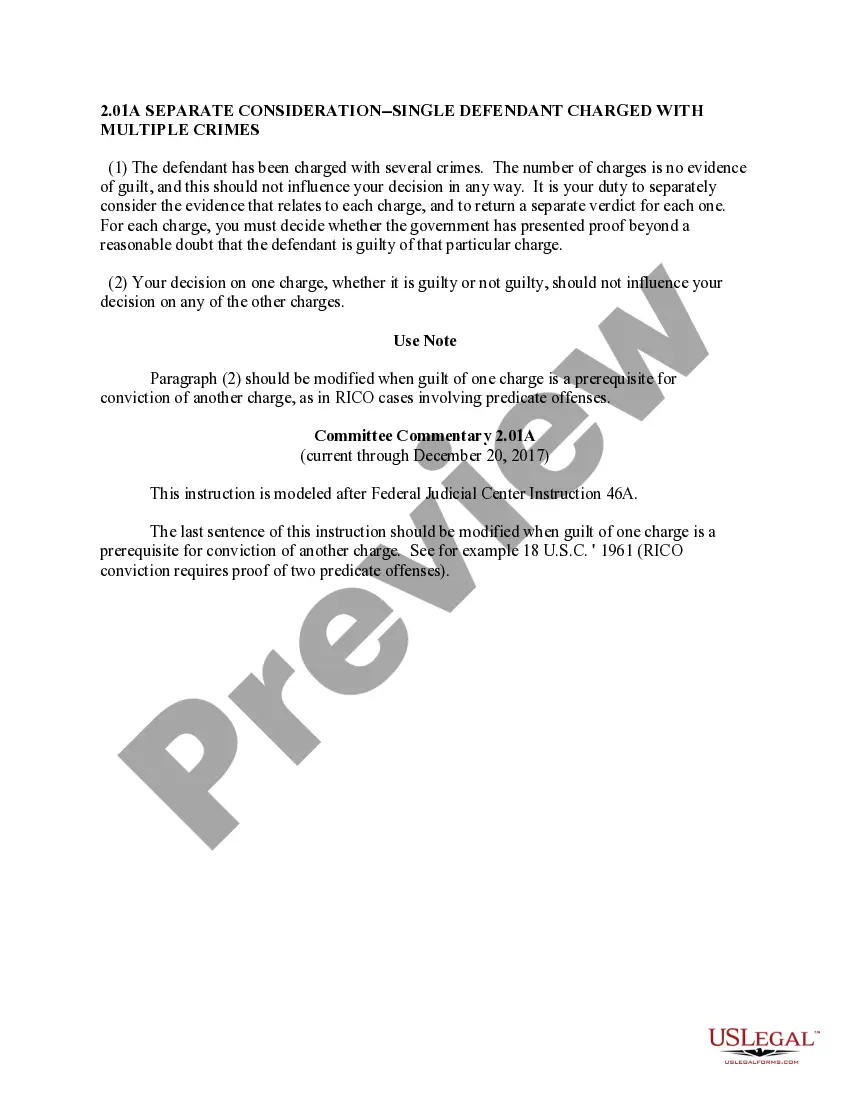
SEPARATE CONSIDERATION--SINGLE DEFENDANT CHARGED WITH MULTIPLE CRIMES
What this document covers
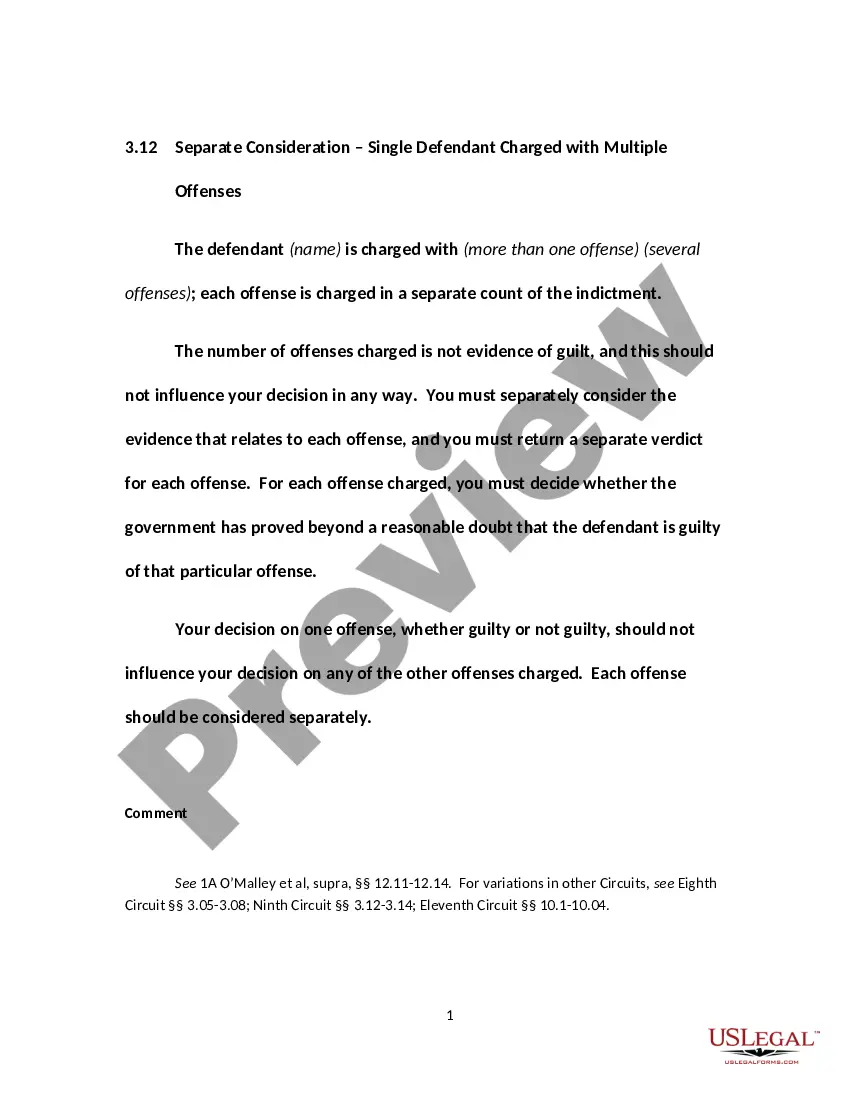
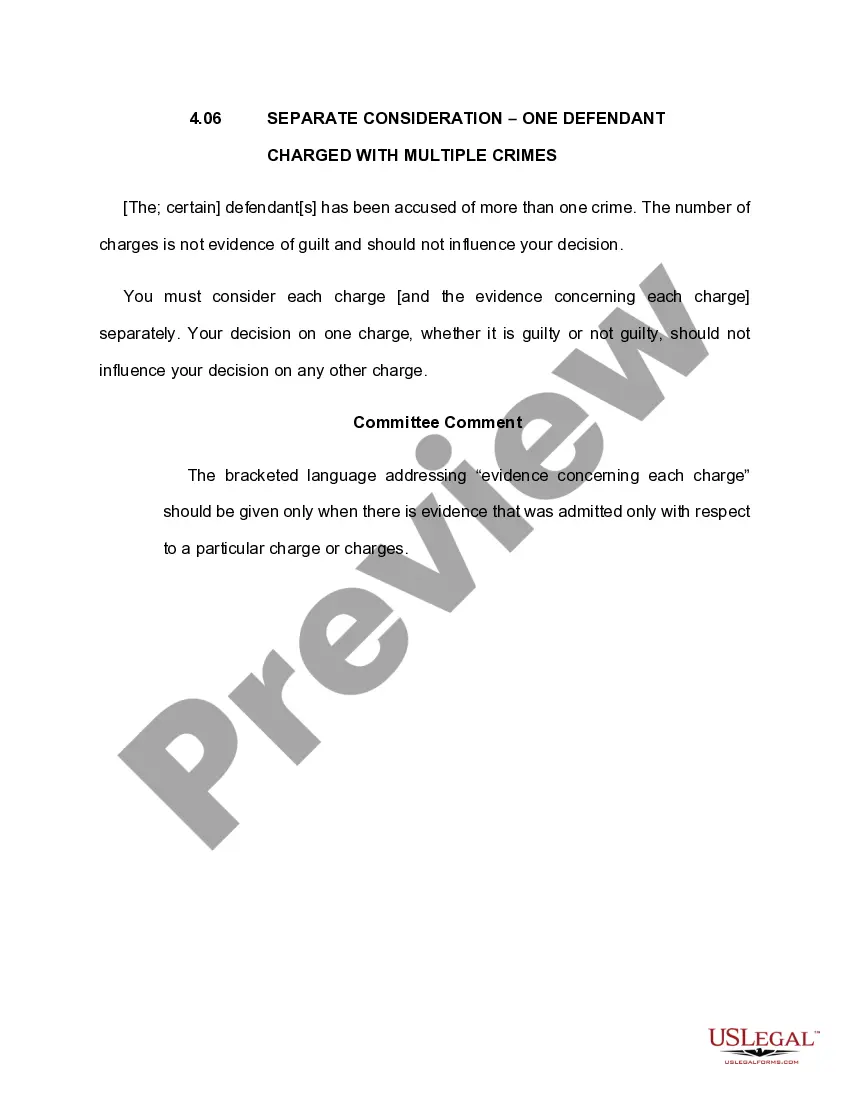
The Separate Consideration form is a legal directive used in criminal trials where a single defendant is charged with multiple crimes. This form instructs jurors to consider each charge independently and to deliver separate verdicts for each one. The purpose is to ensure that the jury evaluates evidence for each crime without bias from the existence of other charges, which sets it apart from other jury instruction forms that may not specifically address multiple charges.
What’s included in this form
- Instructions for jurors to consider each charge individually.
- Emphasis that the number of charges does not imply guilt.
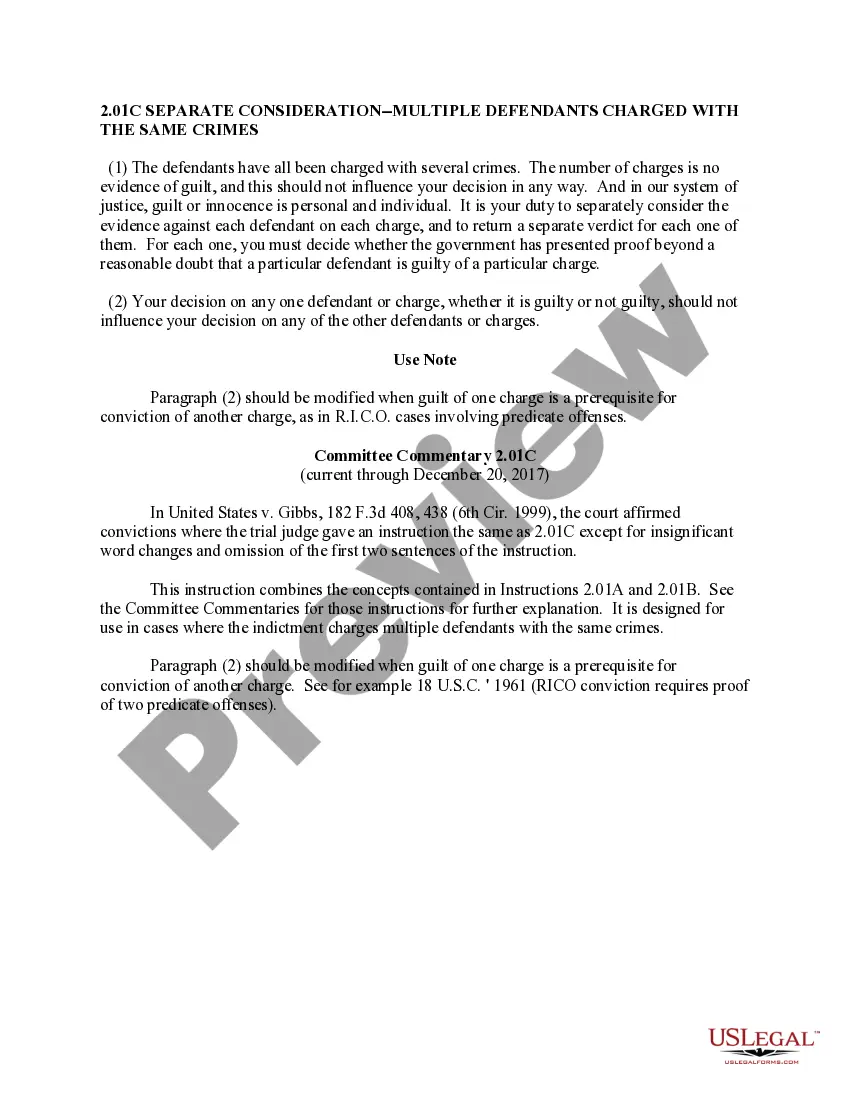
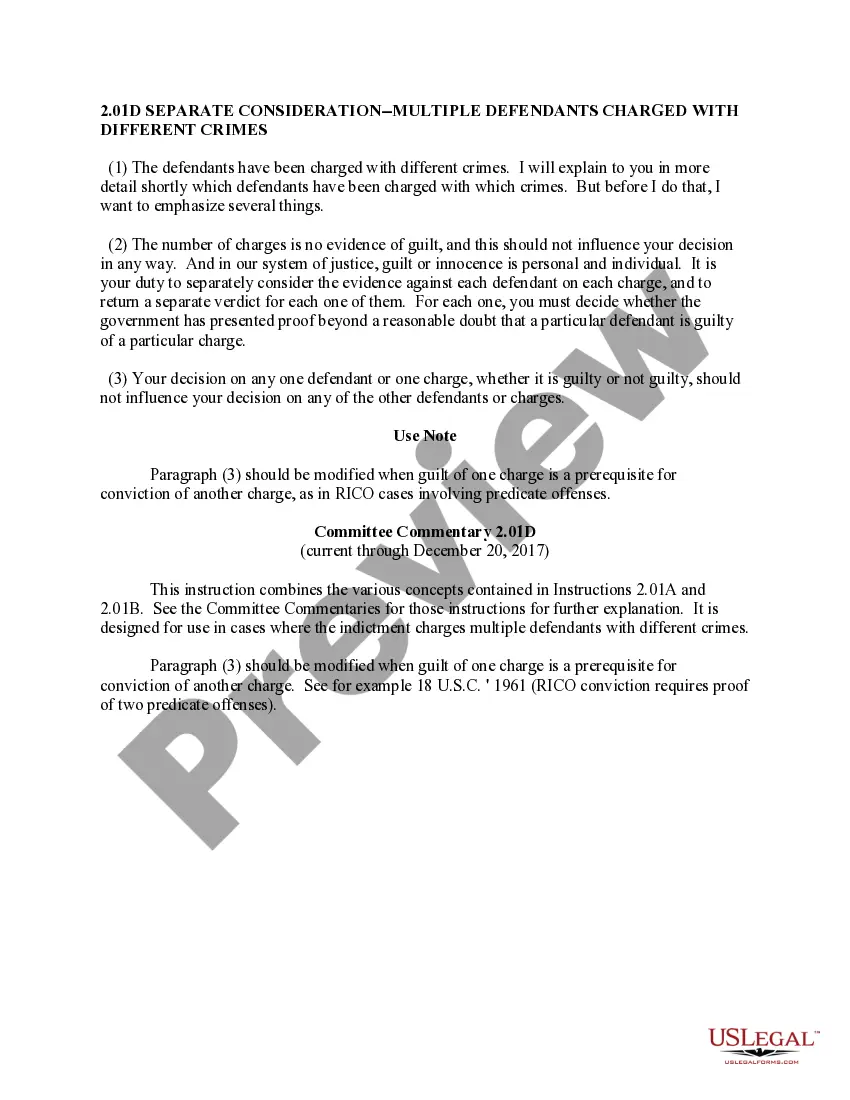
- Guidance on how to handle verdicts relating to interconnected charges, such as in RICO cases.
- Clarification on the standard of proof required for each charge.
Common use cases
This form should be used in cases where a single defendant faces multiple criminal charges. It is essential when the prosecution alleges different offenses, allowing jurors to assess each charge based solely on the respective evidence without influence from other accusations. For instance, it would be appropriate in a case involving a robbery and assault where the jurors must evaluate the evidence for each charge separately.
Who can use this document
This form is intended for:
- Judges overseeing criminal trials with a single defendant and multiple charges.
- Legal practitioners advising juries on how to approach a case with multiple allegations.
- Jury members tasked with determining verdicts in such cases.
How to prepare this document
- Review all charges presented against the defendant.
- Consider evidence for each specific charge independently.
- Determine if the evidence meets the standard of proof beyond a reasonable doubt.
- Return separate verdicts for each charge based on your findings.
- Modify the approach if one charge is a prerequisite for another, as in certain RICO cases.
Notarization guidance
Notarization is generally not required for this form. However, certain states or situations might demand it. You can complete notarization online through US Legal Forms, powered by Notarize, using a verified video call available anytime.
Get your form ready online
Our built-in tools help you complete, sign, share, and store your documents in one place.
Make edits, fill in missing information, and update formatting in US Legal Forms—just like you would in MS Word.
Download a copy, print it, send it by email, or mail it via USPS—whatever works best for your next step.
Sign and collect signatures with our SignNow integration. Send to multiple recipients, set reminders, and more. Go Premium to unlock E-Sign.
If this form requires notarization, complete it online through a secure video call—no need to meet a notary in person or wait for an appointment.
We protect your documents and personal data by following strict security and privacy standards.

Make edits, fill in missing information, and update formatting in US Legal Forms—just like you would in MS Word.

Download a copy, print it, send it by email, or mail it via USPS—whatever works best for your next step.

Sign and collect signatures with our SignNow integration. Send to multiple recipients, set reminders, and more. Go Premium to unlock E-Sign.

If this form requires notarization, complete it online through a secure video call—no need to meet a notary in person or wait for an appointment.

We protect your documents and personal data by following strict security and privacy standards.
Common mistakes
- Failing to consider each charge separately, leading to biased verdicts.
- Confusing the relationship between charges, particularly in cases involving predicate offenses.
- Relying on the number of charges as an indication of guilt.
Benefits of completing this form online
- Convenient access to comprehensive legal guidance instantly.
- Edit and customize the form as needed for specific cases.
- Reliability of professionally drafted legal content created by licensed attorneys.
Looking for another form?


Form popularity
FAQ
Duplicity is the joining in a single count of two or more distinct and separate offenses; multiplicity is the charging of a single offense in several counts.
Stacking refers to the process of recovering benefits from a second policy on a same claim when recovery from the first policy is inadequate. It is a method to increase coverage for insured. Generally, stacking issues arise in the context of automobile insurance cases.
Prosecutors often use charge stacking as a way to convince defendants to accept plea offers that might otherwise be unfavorable. For example, a prosecutor might tell a defendant that he or she will ask for an enhanced sentence if the defendant takes the case against him or her to trial.
Double Jeopardy does not apply when the different actions are both in criminal and civil court. Civil actions address different areas of the law than criminal actions and require a lower standard of proof called preponderance of the evidence campared to the criminal standard of beyond a reasonable doubt.
The only law that works against criminal charge stacking is double jeopardy. Double jeopardy states that no person can be tried twice for the same criminal offense. However, a defendant can be tried and punished for two crimes if each contains an element that the other does not.
In jurisprudence, double jeopardy is a procedural defence (primarily in common law jurisdictions) that prevents an accused person from being tried again on the same (or similar) charges following an acquittal or conviction and in rare cases prosecutorial and/or judge misconduct in the same jurisdiction.
A common practice among prosecutors is to charge defendants with as many crimes, for a single incident or transaction, as they can. This practice is commonly known as ?charge-stacking.? Police officers and district attorneys have substantial discretion over what crimes to charge a suspect.
A common practice among prosecutors is to charge defendants with as many crimes, for a single incident or transaction, as they can. This practice is commonly known as ?charge-stacking.? Police officers and district attorneys have substantial discretion over what crimes to charge a suspect.