Separate Consideration - Single Defendant Charged With Multiple Offenses
What this document covers
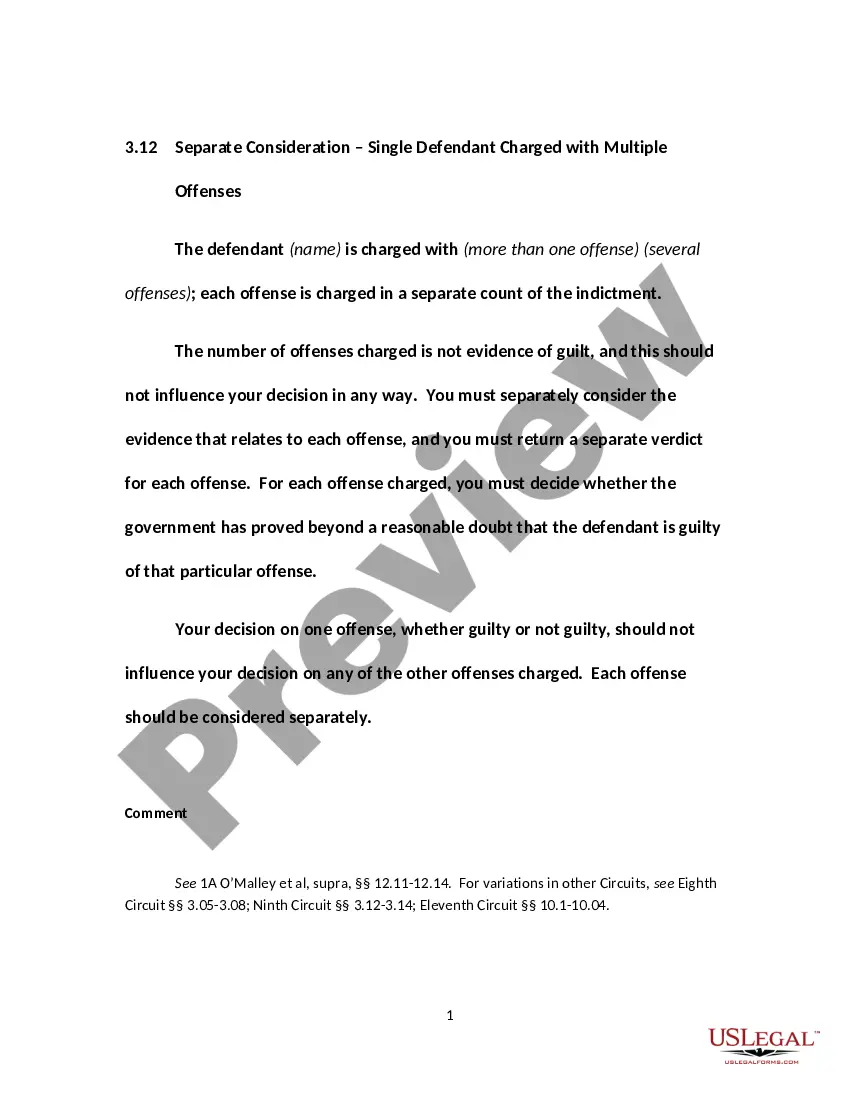
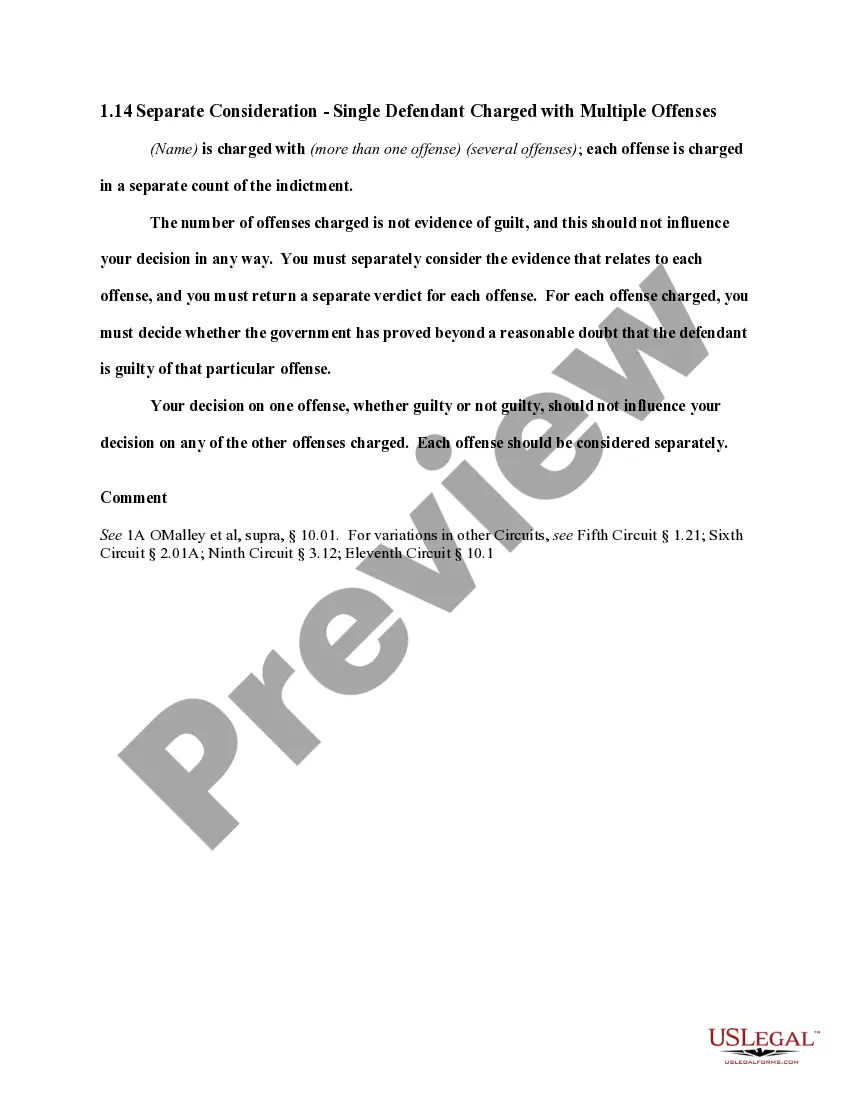
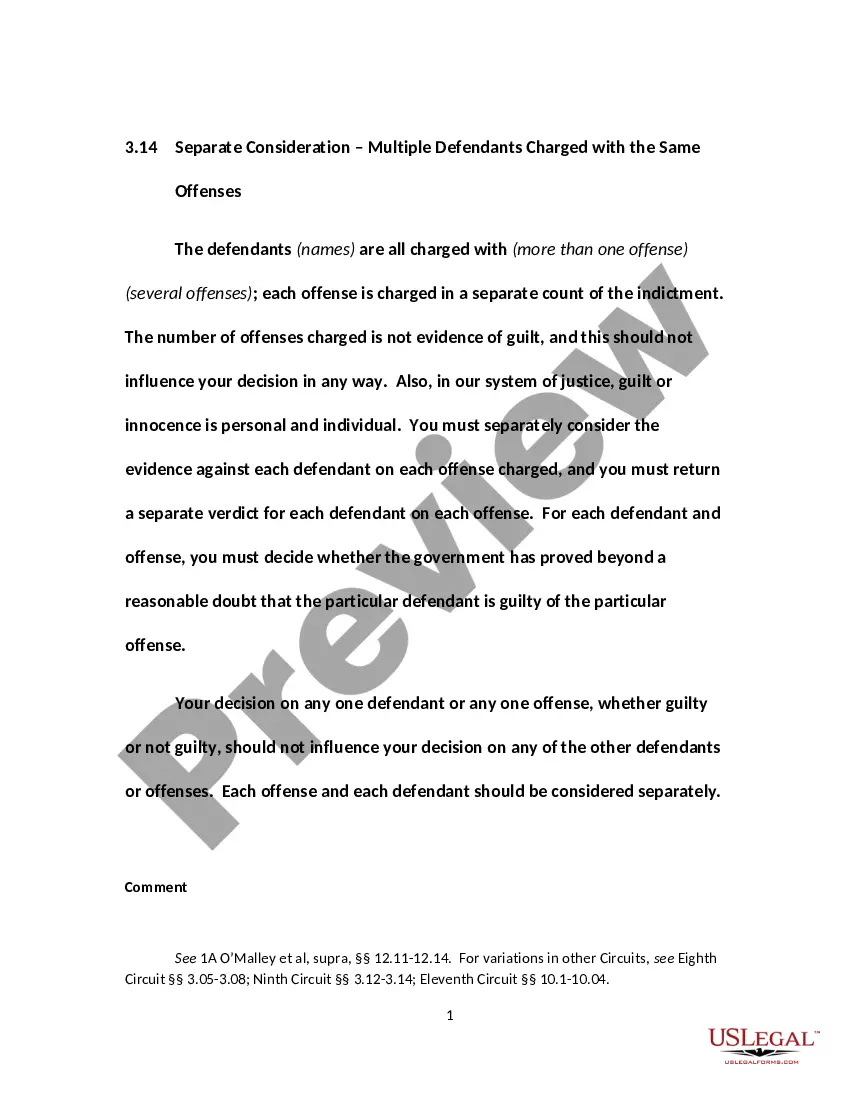
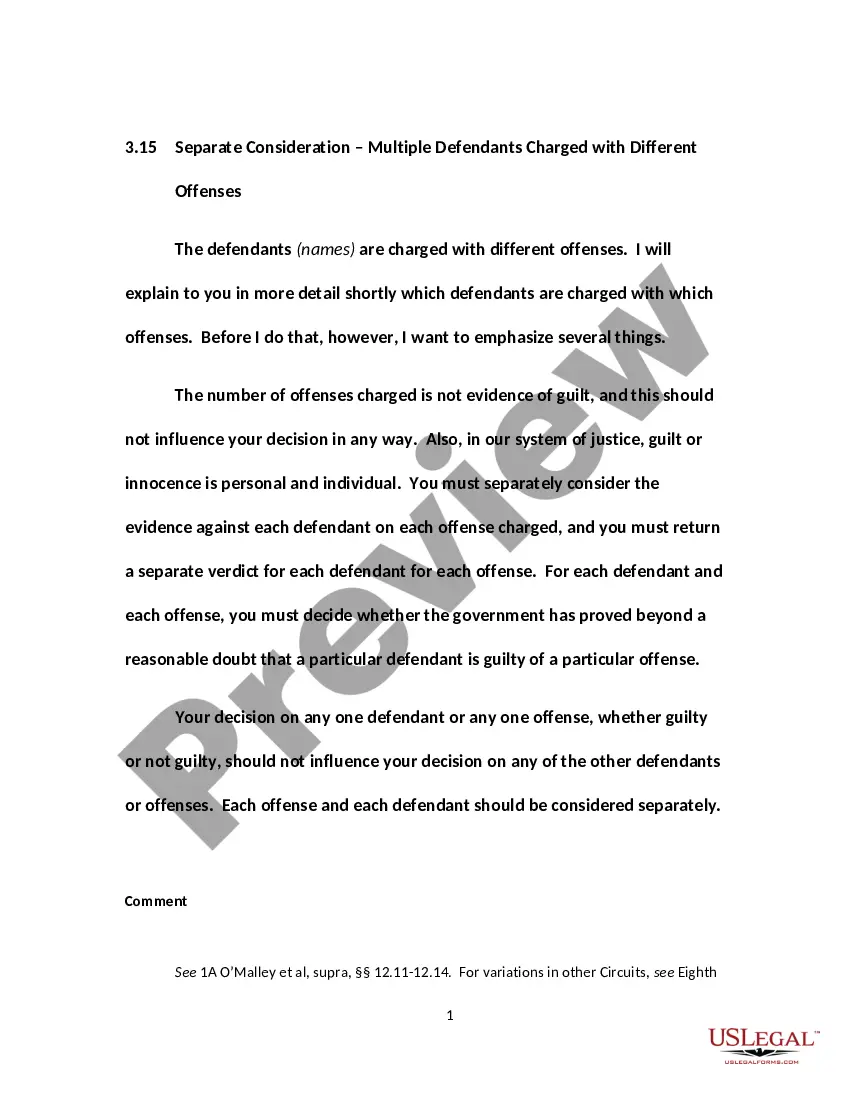
The Separate Consideration - Single Defendant Charged With Multiple Offenses form is a legal document used in criminal trials. Its primary purpose is to instruct jurors on how to approach a case where a defendant is accused of multiple offenses. This form emphasizes that each charge must be evaluated independently, ensuring that jurors do not let the number of offenses influence their verdict on any single charge.
What’s included in this form
- Introduction of the defendant and the specific offenses charged.
- Clarification that the number of charges does not imply guilt.
- Instructions for jurors to consider each offense separately.
- Requirement for a separate verdict for each charge.
- Commentary on variations in legal instructions across different circuits.


Situations where this form applies
This form is applicable in situations where a defendant faces multiple criminal charges in a single case. It is particularly relevant during jury instructions in a trial, where jurors need guidance on how to deliberate on each charge without bias from the overall number of offenses.
Who this form is for
- Legal professionals involved in criminal defense or prosecution.
- Judges presiding over cases with multiple offenses.
- Jury members needing clarification on their deliberation duties.
Instructions for completing this form
- Identify the name of the defendant and the offenses he or she is charged with.
- Clearly state that each offense is charged in a separate count.
- Instruct jurors to consider the evidence for each offense independently.
- Ensure that jurors understand the requirement for separate verdicts.
- Provide commentary on any variations in local judicial instructions.
Is notarization required?
Notarization is not commonly needed for this form. However, certain documents or local rules may make it necessary. Our notarization service, powered by Notarize, allows you to finalize it securely online anytime, day or night.
Get your form ready online
Our built-in tools help you complete, sign, share, and store your documents in one place.
Make edits, fill in missing information, and update formatting in US Legal Forms—just like you would in MS Word.
Download a copy, print it, send it by email, or mail it via USPS—whatever works best for your next step.
Sign and collect signatures with our SignNow integration. Send to multiple recipients, set reminders, and more. Go Premium to unlock E-Sign.
If this form requires notarization, complete it online through a secure video call—no need to meet a notary in person or wait for an appointment.
We protect your documents and personal data by following strict security and privacy standards.

Make edits, fill in missing information, and update formatting in US Legal Forms—just like you would in MS Word.

Download a copy, print it, send it by email, or mail it via USPS—whatever works best for your next step.

Sign and collect signatures with our SignNow integration. Send to multiple recipients, set reminders, and more. Go Premium to unlock E-Sign.

If this form requires notarization, complete it online through a secure video call—no need to meet a notary in person or wait for an appointment.

We protect your documents and personal data by following strict security and privacy standards.
Common mistakes
- Assuming all charges are connected when they should be evaluated separately.
- Confusing jurors by not clearly stating the separate counts of offenses.
- Neglecting to emphasize that a guilty verdict on one count does not influence others.
Benefits of completing this form online
- Convenient access to accurate legal language created by licensed attorneys.
- Ability to download and fill out the form quickly from any device.
- Ensures that you are using up-to-date legal templates that comply with current laws.
What to keep in mind
- The form instructs jurors to evaluate each offense independently.
- It is crucial to inform jurors that multiple charges do not imply guilt.
- The separate consideration of charges is essential for fair verdicts.
Looking for another form?
Form popularity
FAQ
In cases where someone is charged with multiple counts of the same crime, the judge often has to decide if the convicted defendant will serve the sentence concurrently or consecutively. A concurrent sentence means that time for two or more of the convictions will all be served at once.
A judge in a criminal case may feel that it is appropriate to combine the cases of multiple defendants when their charges involve the same set of circumstances. This can help a judge streamline their calendar and resolve a case more efficiently.
The "separate offense" rule states that where the same acts or transaction constitutes a violation of two distinct statutory provisions, the test can be applied to determine whether there are two offenses or only one, is whether each provision. requires proof of an additional fact which the other does not.
Criminal charge stacking is when a police officer or prosecutor charges as many crimes against a defendant at once as they can. Law enforcement officers have full discretion over what crimes to submit against a suspect.
Recidivism is one of the most fundamental concepts in criminal justice.
Duplicity is the joining in a single count of two or more distinct and separate offenses; multiplicity is the charging of a single offense in several counts.
Law enforcement officers have full discretion over what crimes to submit against a suspect. In some cases, they put forth more charges than is fair for the situation, often in an attempt to strengthen the main case that the prosecutor wishes to pursue.
A common practice among prosecutors is to charge defendants with as many crimes, for a single incident or transaction, as they can. This practice is commonly known as ?charge-stacking.? Police officers and district attorneys have substantial discretion over what crimes to charge a suspect.