Separate Consideration - Multiple Defendants Charged With Different Offenses
About this form
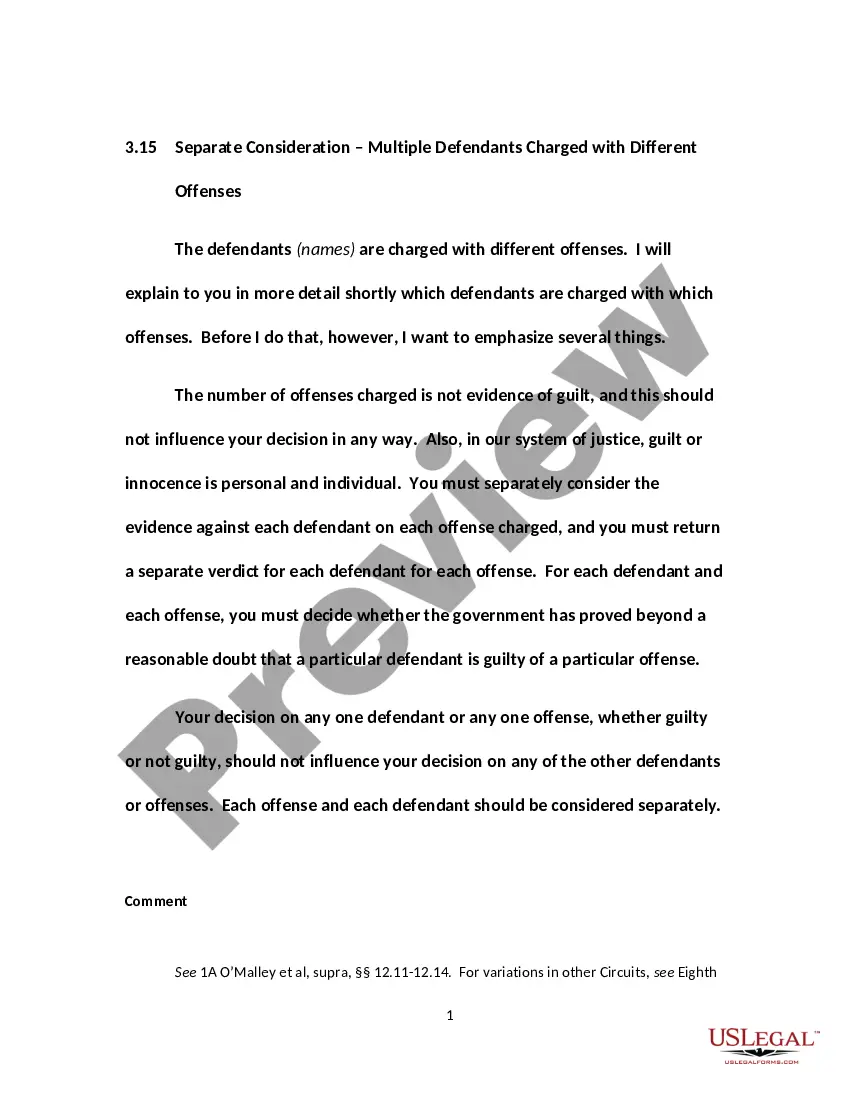
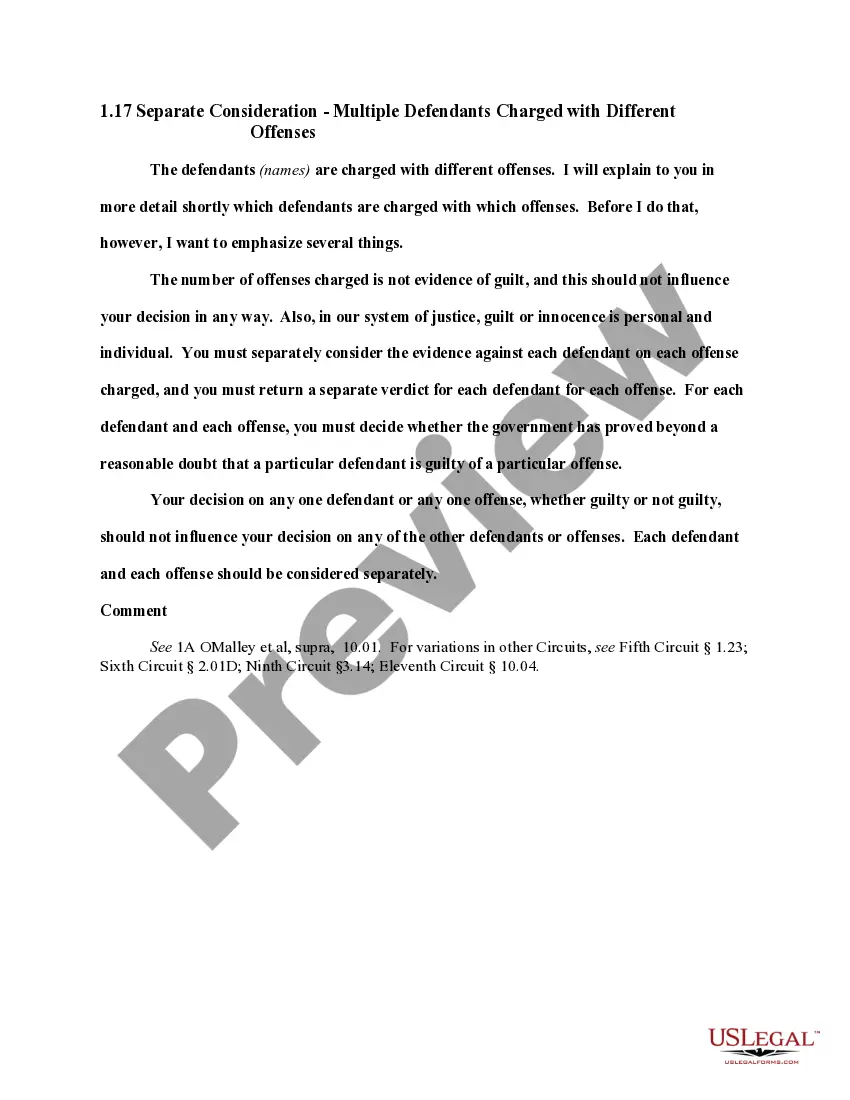
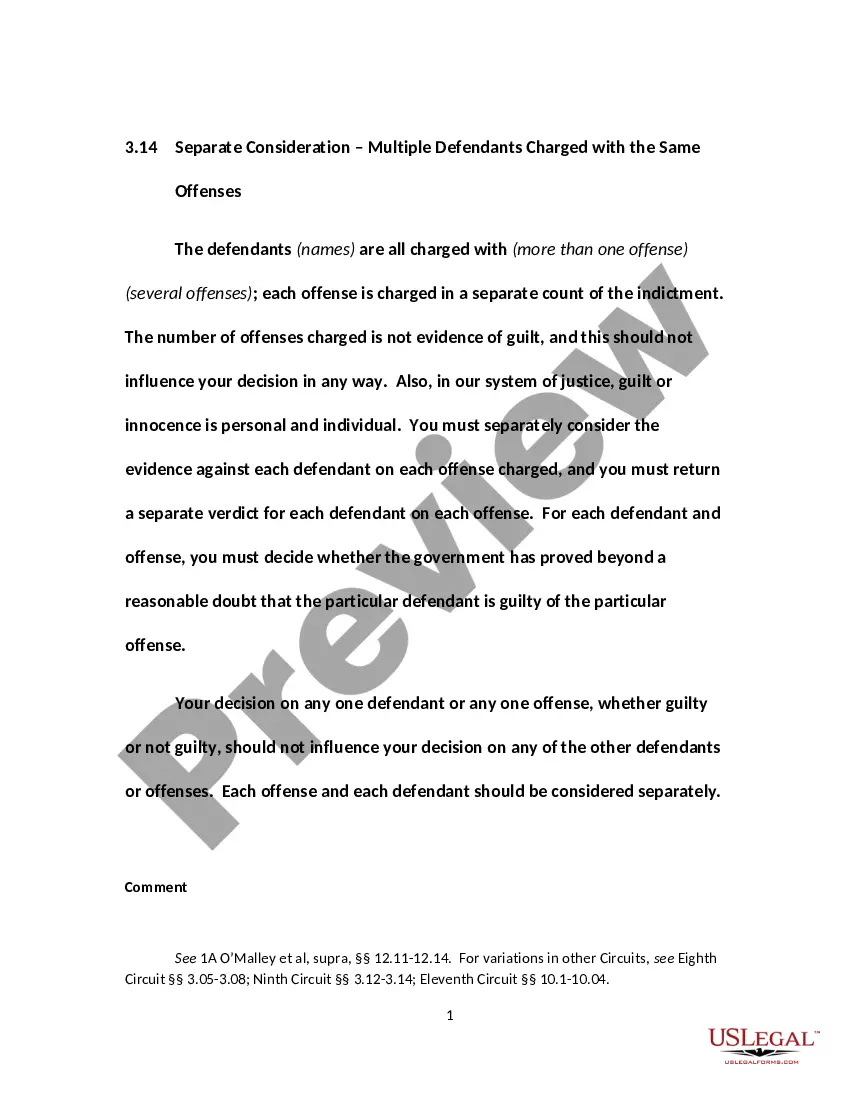
The Separate Consideration - Multiple Defendants Charged With Different Offenses form is used in legal proceedings where several defendants are charged with different crimes. This form is crucial because it emphasizes that jurors must evaluate the evidence against each defendant separately. Unlike other forms that may group defendants or offenses, this form ensures that each case is considered on its own merits, highlighting the individuality of each charge and defendant.
Form components explained
- Identification of defendants: Lists the names of all defendants charged.
- Clarification of charges: Explains which defendant is charged with which specific offense.
- Emphasis on separate consideration: Stresses the importance of treating each defendant and charge independently.
- Instruction on burden of proof: Indicates that the government must prove guilt beyond a reasonable doubt for each offense charged.
- Provision for separate verdicts: Requires jurors to return individual verdicts for each defendant and offense.



Common use cases
This form should be used in criminal trials where multiple defendants are involved, and each defendant faces different allegations. It is particularly important in ensuring fair trials and preventing jury confusion regarding the individual responsibilities of each defendant. Scenarios may include cases involving conspiracies, joint enterprises, or simultaneous but separate offenses committed by different individuals.
Intended users of this form
- Defendants facing criminal charges alongside other individuals.
- Defense attorneys representing clients charged with separate offenses.
- Prosecutors managing cases involving multiple defendants.
Completing this form step by step
- Identify all defendants involved in the case and list their names accurately.
- Clearly specify the offenses charged against each defendant.
- Ensure that jurors understand the importance of considering each charge independently.
- Reiterate the requirement for delivering separate verdicts for each defendant and offense.
- Review legal standards for burden of proof applicable to the case.
Notarization guidance
Notarization is not commonly needed for this form. However, certain documents or local rules may make it necessary. Our notarization service, powered by Notarize, allows you to finalize it securely online anytime, day or night.
Get your form ready online
Our built-in tools help you complete, sign, share, and store your documents in one place.
Make edits, fill in missing information, and update formatting in US Legal Forms—just like you would in MS Word.
Download a copy, print it, send it by email, or mail it via USPS—whatever works best for your next step.
Sign and collect signatures with our SignNow integration. Send to multiple recipients, set reminders, and more. Go Premium to unlock E-Sign.
If this form requires notarization, complete it online through a secure video call—no need to meet a notary in person or wait for an appointment.
We protect your documents and personal data by following strict security and privacy standards.

Make edits, fill in missing information, and update formatting in US Legal Forms—just like you would in MS Word.

Download a copy, print it, send it by email, or mail it via USPS—whatever works best for your next step.

Sign and collect signatures with our SignNow integration. Send to multiple recipients, set reminders, and more. Go Premium to unlock E-Sign.

If this form requires notarization, complete it online through a secure video call—no need to meet a notary in person or wait for an appointment.

We protect your documents and personal data by following strict security and privacy standards.
Typical mistakes to avoid
- Failing to clearly identify the offenses associated with each defendant.
- Forgetting to emphasize the separate consideration required for each charge.
- Allowing jurors to confuse the charges between defendants.
Advantages of online completion
- Convenience of instant access and ability to download from anywhere.
- Editability allows for tailoring the form to specific cases or jurisdictions.
- Reliability as the forms are drafted by licensed attorneys and adhere to legal standards.
Looking for another form?


Form popularity
FAQ
Yes, co-defendants in drug cases may receive different sentences. When two people are charged and convicted of the same crime, the maximum penalty they are facing may be the same, but the actual sentence each receives can vary greatly.
When to Sever Trials. A defendant generally does not have a right to a separate trial upon request, except in some narrow situations such as death penalty cases. However, a defendant can ask a judge to sever a joint trial if proceeding jointly would jeopardize their right to a fair trial.
A joint trial of codefendants (also known as "joinder") occurs when a judge merges the cases of two or more defendants. Joint trials happen when the issues in the defendants' cases overlap enough to make a single trial both fair and more efficient.
Co-defendants often have conflicting interest in a criminal case. A prosecutor may offer a co-defendant a plea agreement to testify against or "flip" against the other co-defendants in a case. If the case proceeds to trial, lawyers for a co-defendant may have different strategies for defending the case.
It can be difficult for an attorney to represent both codefendants competently and diligently as required. The American Bar Association advises against representing co-defendants, but there is no general law forbidding it.
A judge in a criminal case may feel that it is appropriate to combine the cases of multiple defendants when their charges involve the same set of circumstances. This can help a judge streamline their calendar and resolve a case more efficiently.
Simply put, a ?co-defendant? is simply someone who is also charged in your case. He or she may have the same charges you have, have slightly different charges, or have completely different charges. It all depends on the facts of your case.