Sample Letter regarding Memorandum Opinion on Summary Judgment Motion
What is this form?
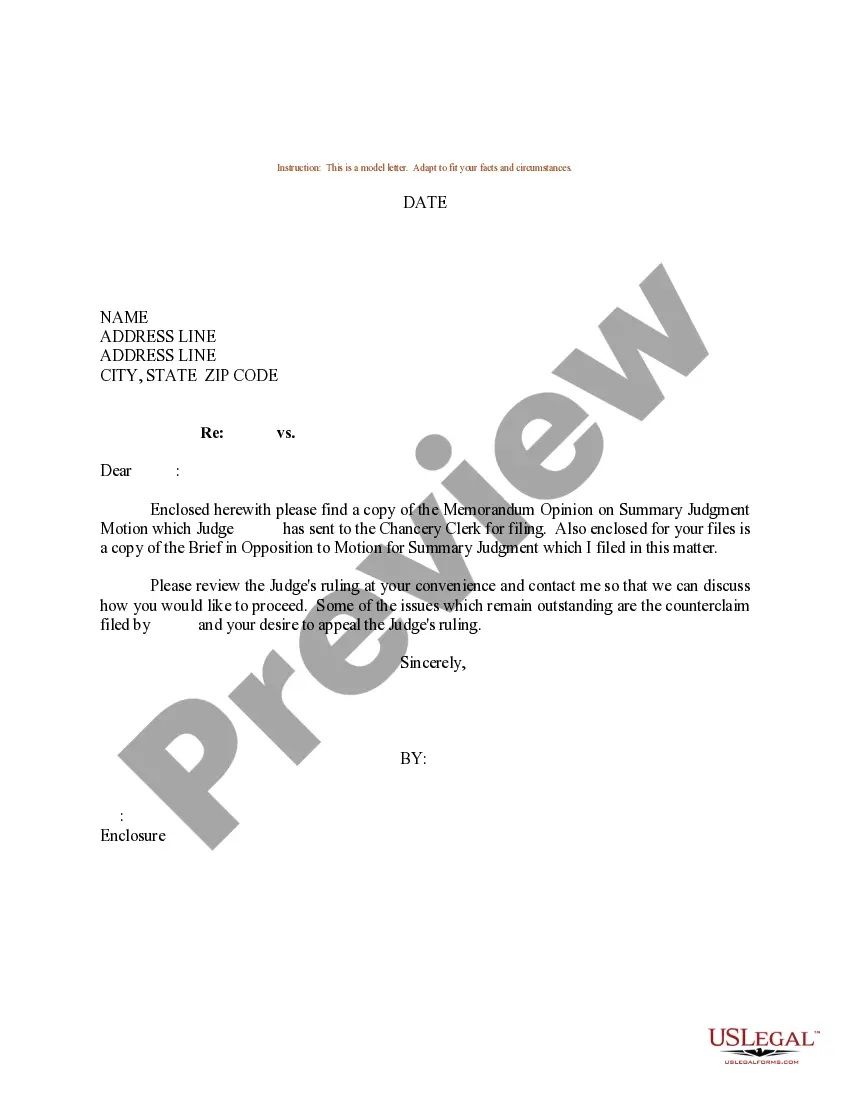
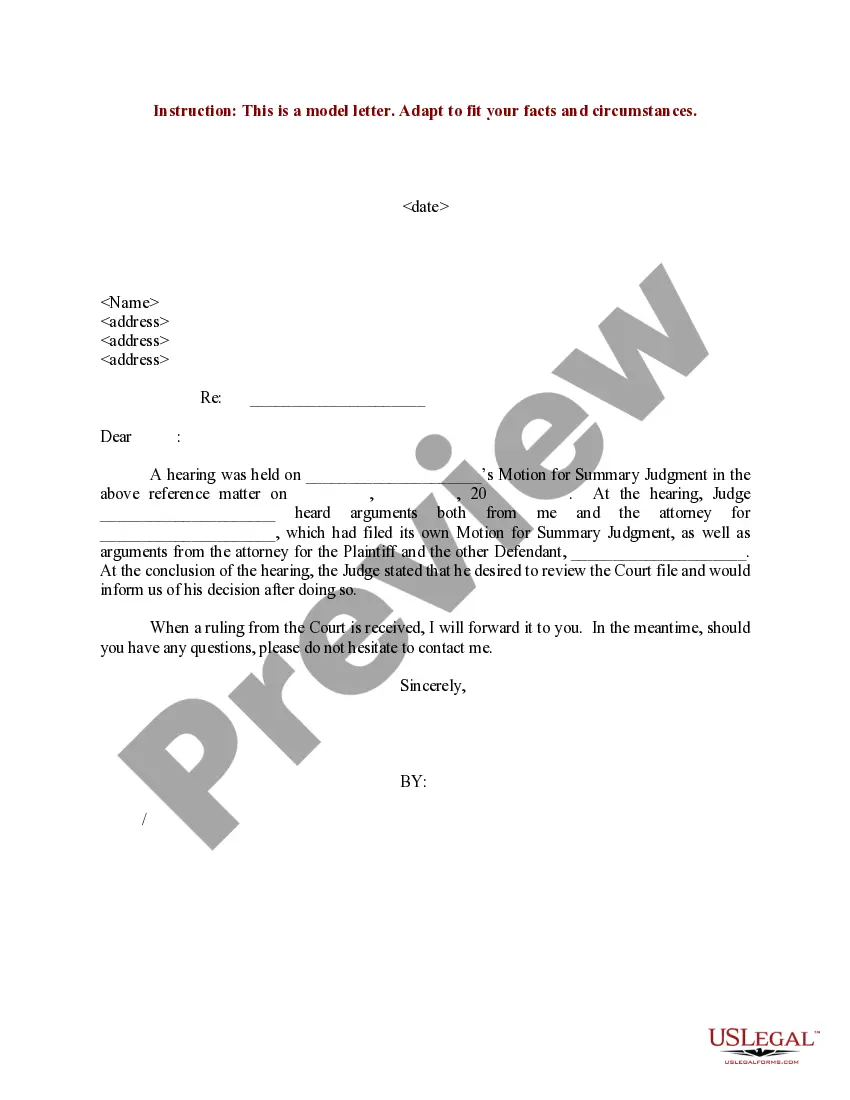
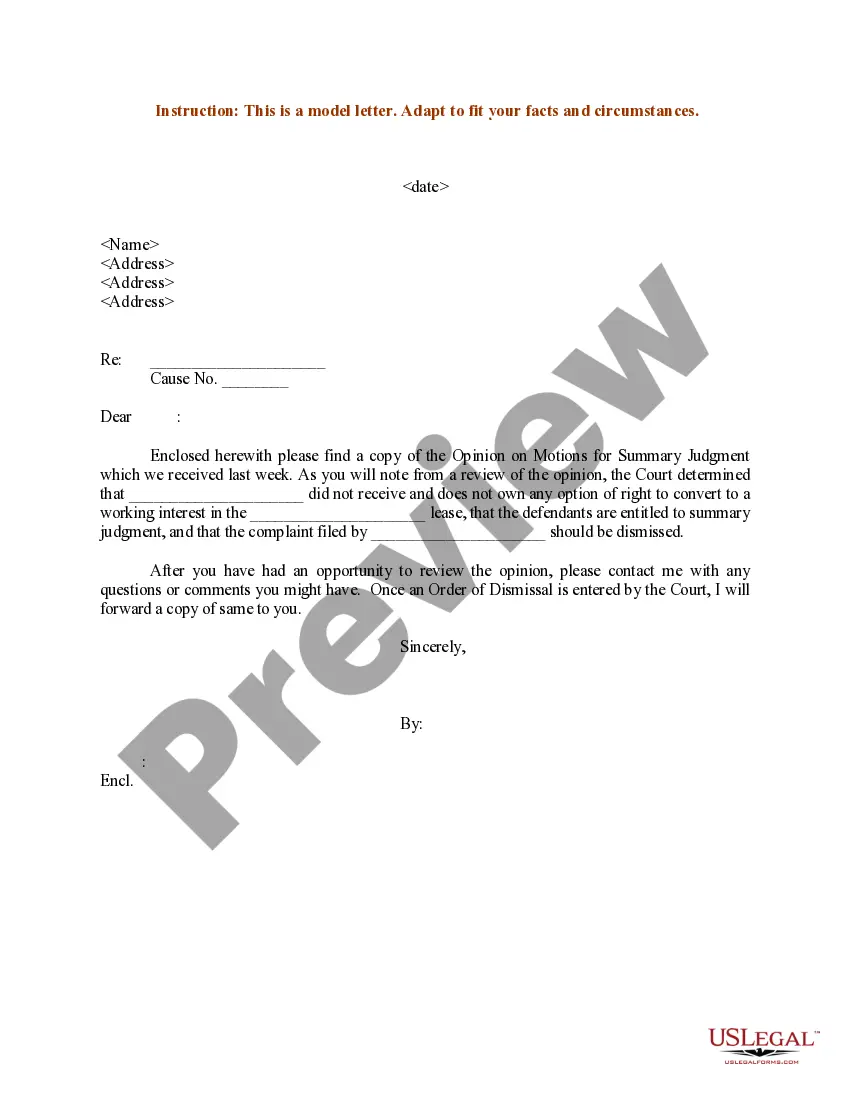
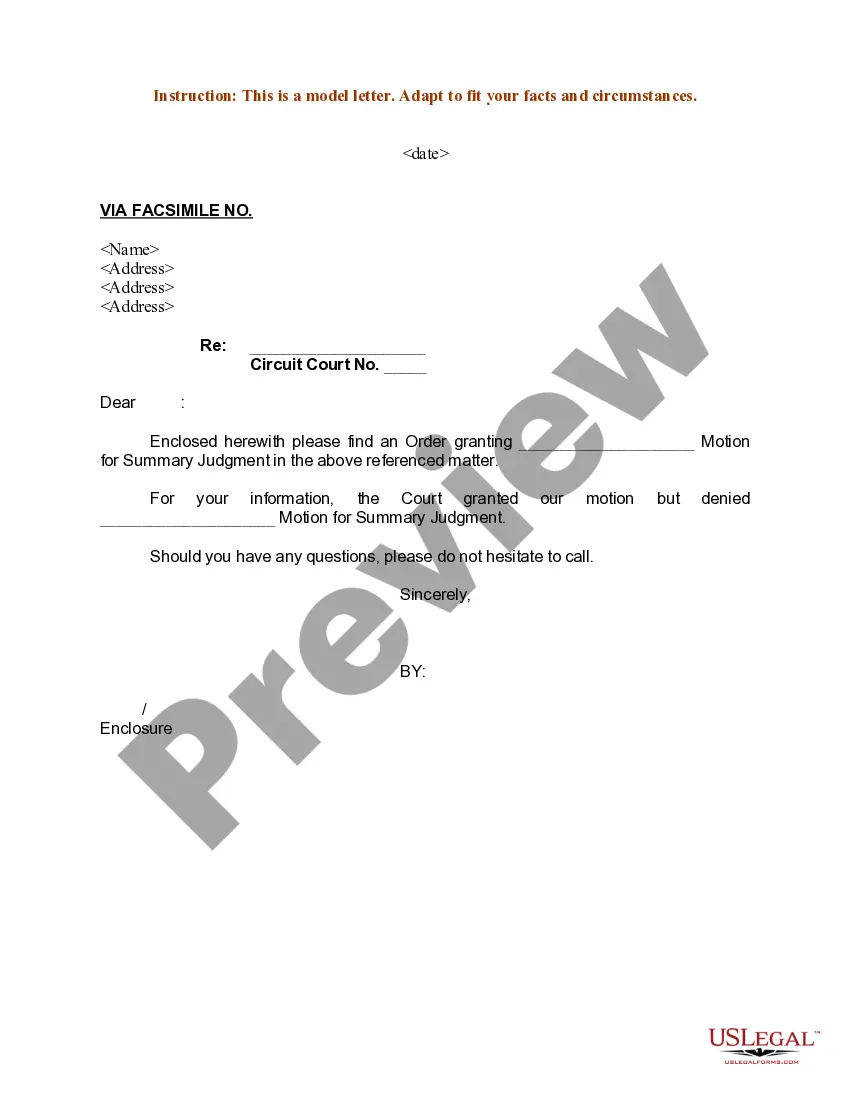
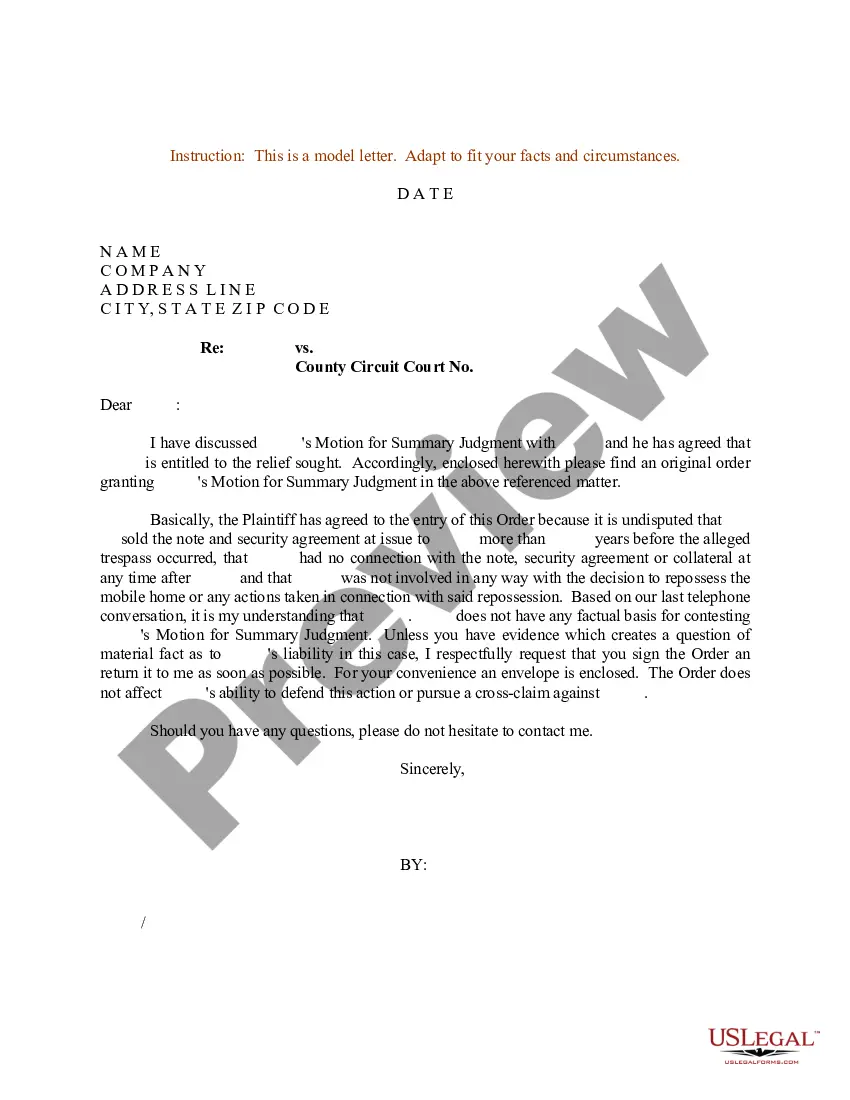
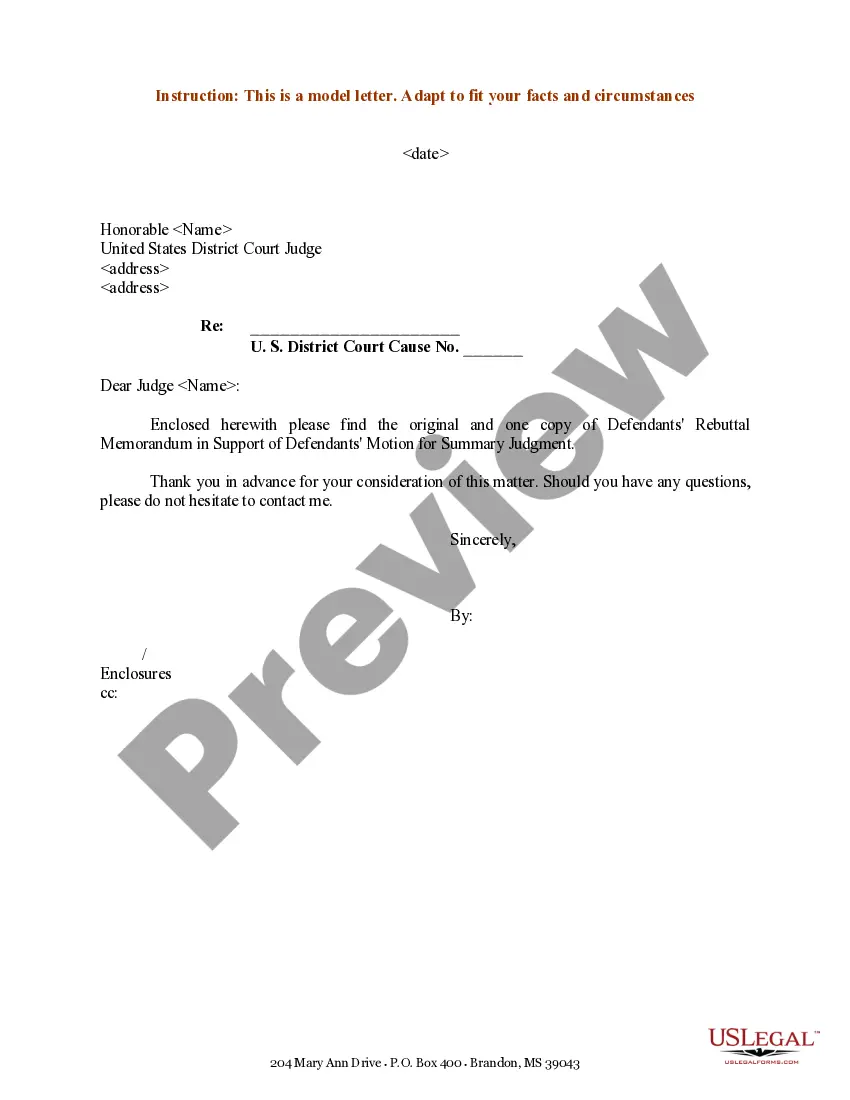
The Sample Letter regarding Memorandum Opinion on Summary Judgment Motion is a template designed for individuals or legal professionals to outline their responses or communications related to a memorandum opinion concerning a summary judgment motion. This form serves as an effective tool to clearly express the party's stance and highlight important legal points, distinguishing it from other general correspondence letters by focusing specifically on legal judgments.
Key components of this form
- Date field to specify when the letter is written.
- Recipient's name and address to ensure proper delivery.
- Clear subject line to indicate the purpose of the letter.
- Body of the letter to present arguments and opinions regarding the judgment motion.
- Signature line for the sender to authenticate the document.
Common use cases
This form is useful when a party needs to communicate formally about a memorandum opinion rendered in response to a summary judgment motion. It may be used in situations where a party wishes to file their insights, express concerns, or communicate further legal strategies related to the decision made by the court. Use this letter to present your arguments in a structured manner, ensuring clarity and legal compliance.
Who can use this document
- Individuals involved in legal proceedings as parties to the case.
- Attorneys representing clients in litigation matters.
- Legal assistants or paralegals drafting legal correspondence.
- Any party seeking to respond to court findings on judgment motions.
How to prepare this document
- Enter the date at the top of the letter.
- Provide the recipient's full name and address.
- Add a subject line that clearly states the letter's focus.
- Write the body of the letter, articulating your responses to the memorandum opinion.
- Sign the letter to confirm authenticity and acknowledgement of content.
Does this document require notarization?
Notarization is generally not required for this form. However, certain states or situations might demand it. You can complete notarization online through US Legal Forms, powered by Notarize, using a verified video call available anytime.
Get your form ready online
Our built-in tools help you complete, sign, share, and store your documents in one place.
Make edits, fill in missing information, and update formatting in US Legal Forms—just like you would in MS Word.
Download a copy, print it, send it by email, or mail it via USPS—whatever works best for your next step.
Sign and collect signatures with our SignNow integration. Send to multiple recipients, set reminders, and more. Go Premium to unlock E-Sign.
If this form requires notarization, complete it online through a secure video call—no need to meet a notary in person or wait for an appointment.
We protect your documents and personal data by following strict security and privacy standards.

Make edits, fill in missing information, and update formatting in US Legal Forms—just like you would in MS Word.

Download a copy, print it, send it by email, or mail it via USPS—whatever works best for your next step.

Sign and collect signatures with our SignNow integration. Send to multiple recipients, set reminders, and more. Go Premium to unlock E-Sign.

If this form requires notarization, complete it online through a secure video call—no need to meet a notary in person or wait for an appointment.

We protect your documents and personal data by following strict security and privacy standards.
Mistakes to watch out for
- Failing to include the recipient's correct address.
- Using overly complex legal jargon instead of plain language.
- Not clearly stating the purpose of the letter in the subject line.
- Omitting a signature or date on the letter.
Why complete this form online
- Convenience of accessing a professionally drafted template at any time.
- Editability of the form to suit specific needs or circumstances.
- Reliability of using a legal form reviewed by licensed attorneys.
Quick recap
- This form is essential for formal communication regarding a memorandum opinion on a summary judgment motion.
- It is tailored for use by legal professionals and individuals involved in litigation.
- Ensure to follow state-specific rules when using this template to enhance its effectiveness.
Looking for another form?



Form popularity
FAQ
Completely resolve a case (e.g., entry of judgment for plaintiff or defendants) Completely resolve a claim. Completely determine the status of a particular party. Resolve a particular claim's application to a particular party. Establish a fact or ruling applicable to the case as it is further adjudicated.
Ordinarily, a party cannot appeal a denial of summary judgment after trial has taken place, unless the arguments were renewed in a motion for judgment as a matter of law under Federal Rule of Civil Procedure 50.Denials of summary judgment generally cannot be appealed after a full trial on the merits.
Stated different, to successfully defend against summary judgment the non-moving party (you) should seek to demonstrate that indeed there are material facts in dispute. Alternatively, the non-moving party (you) can argue that the undisputed facts support a judgment as a matter of law in your favor.
Rule 56 of the Federal Rules of Civil Procedure governs summary judgment for federal courts. Under Rule 56, in order to succeed in a motion for summary judgment, a movant must show 1) that there is no genuine dispute as to any material fact, and 2) that the movant is entitled to judgment as a matter of law.
When a motion for summary judgement is granted, it indicates there is sufficient evidence to declare one party the clear winner.The judge will then rule on the case based on the facts and evidence. A summary judgement can often be beneficial as it potentially skips a lengthy (and costly) court trial.
If a defendant refuses to produce documents or witnesses for depositions, you can oppose the summary-judgment motion by submitting your declaration and showing that facts essential to justify your opposition may exist but cannot for reasons stated be presented to the court.
A response must be in writing and include the same supporting documents as a motion for summary judgment. The opposition to the motion for summary judgment should also include a statement of facts showing the dispute and supporting documents.
Your three options following the court's grant of summary judgment or summary adjudication to the defense. This article explores the benefits and best practices of three options following the grant of summary judgment or summary adjudication: (1) a new-trial motion, (2) a writ, and (3) an appeal.
The moving party has the initial burden to show that summary judgment is proper even if the moving party would not have the BURDEN OF PROOF at trial. The court generally examines the evidence presented with the motion in the light most favorable to the opposing party.