Sample Letter for Motion for Summary Judgment
About this form
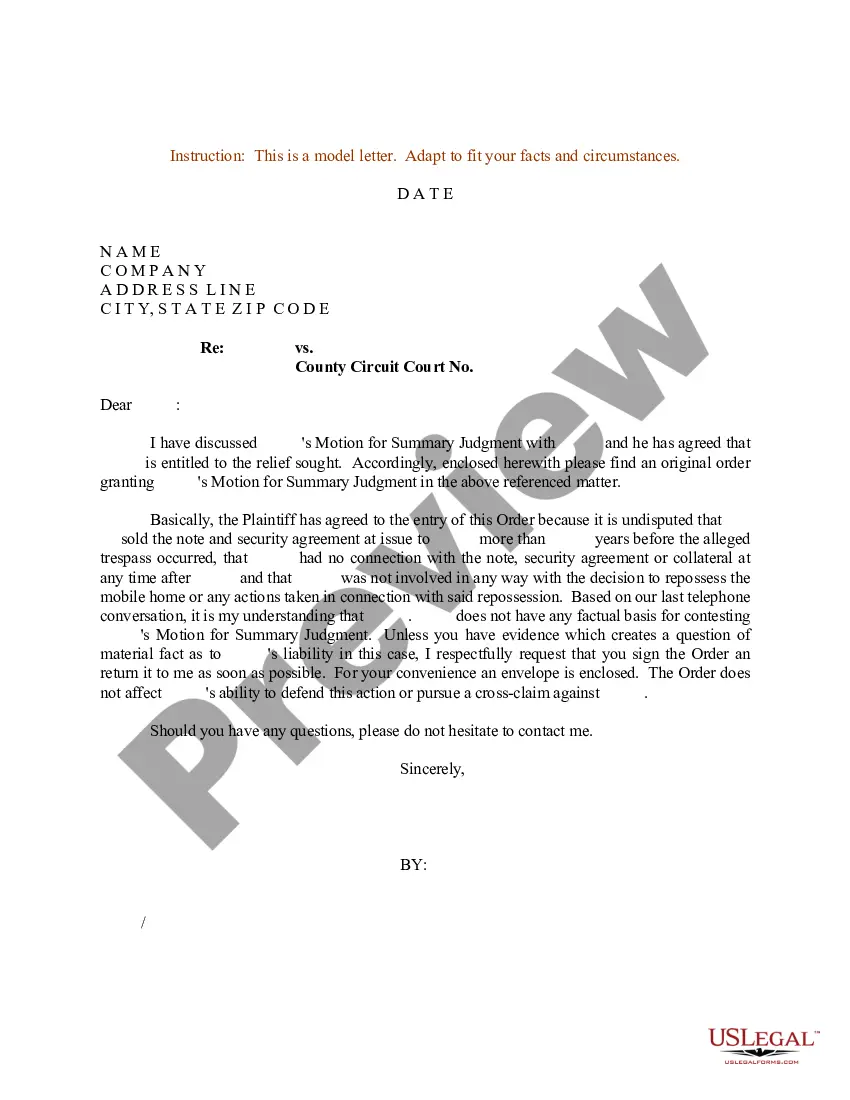
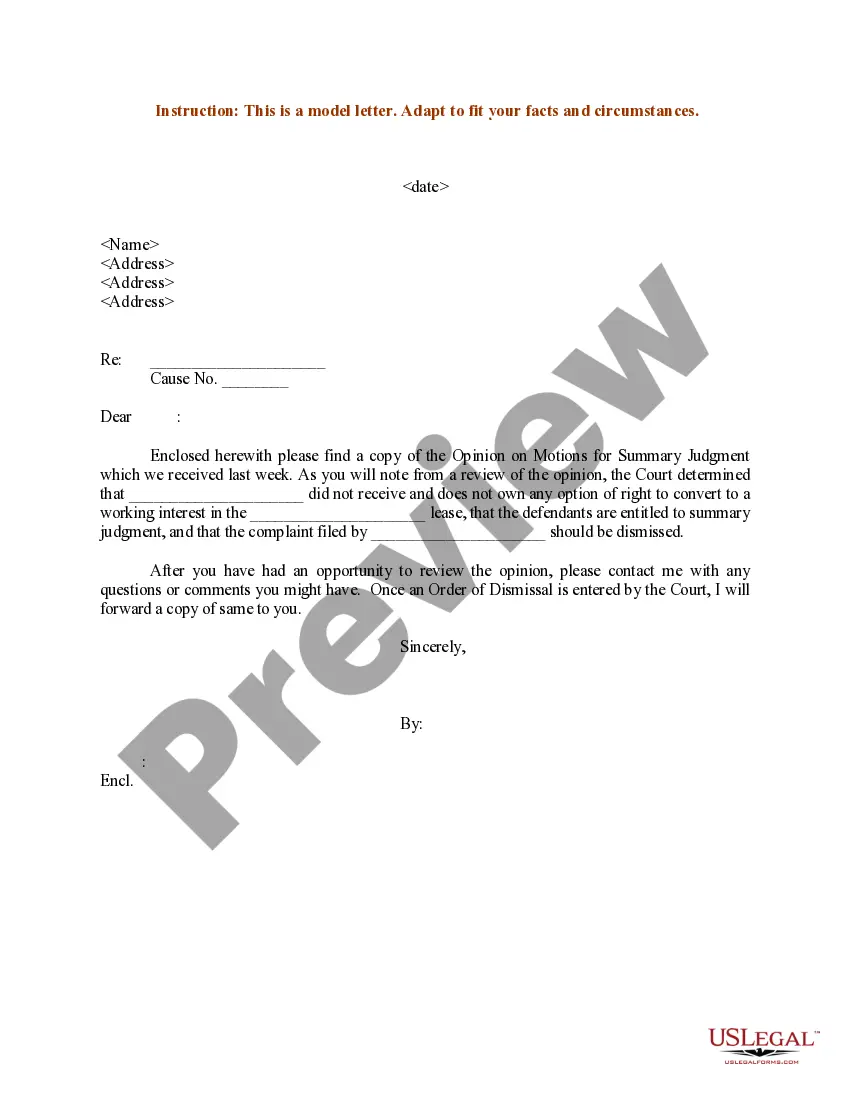
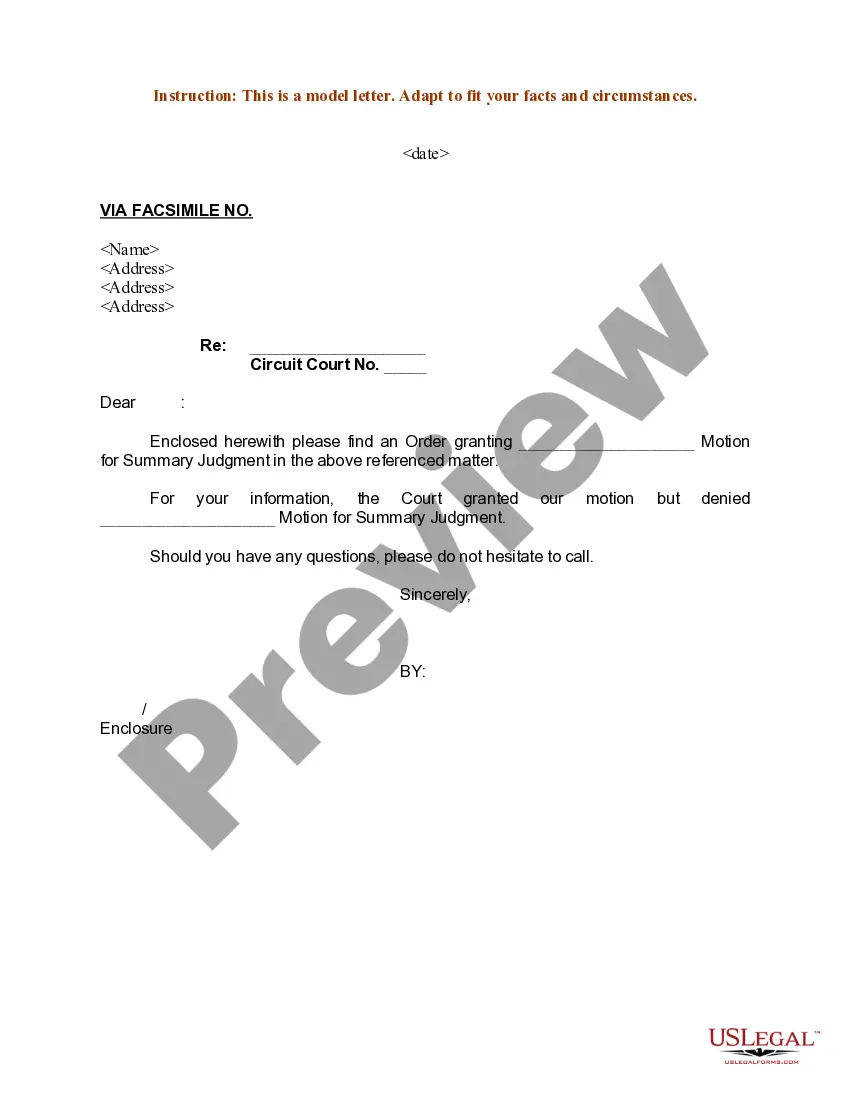
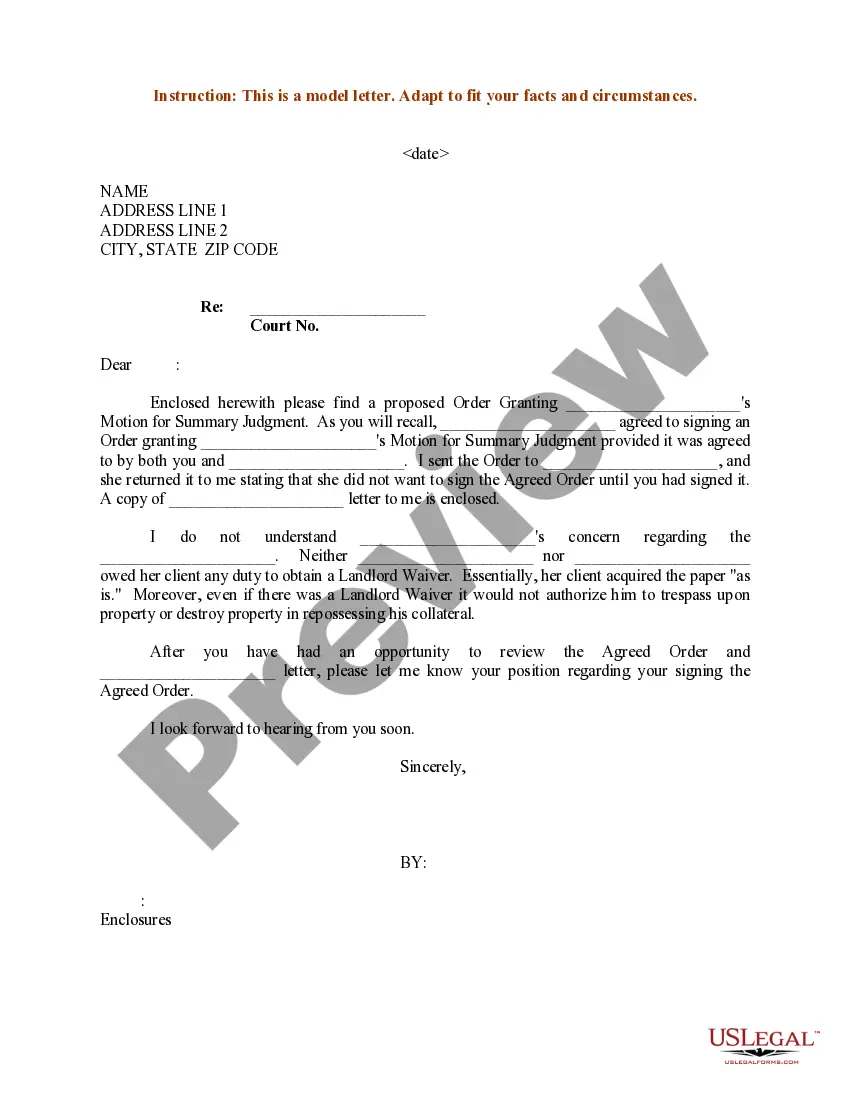
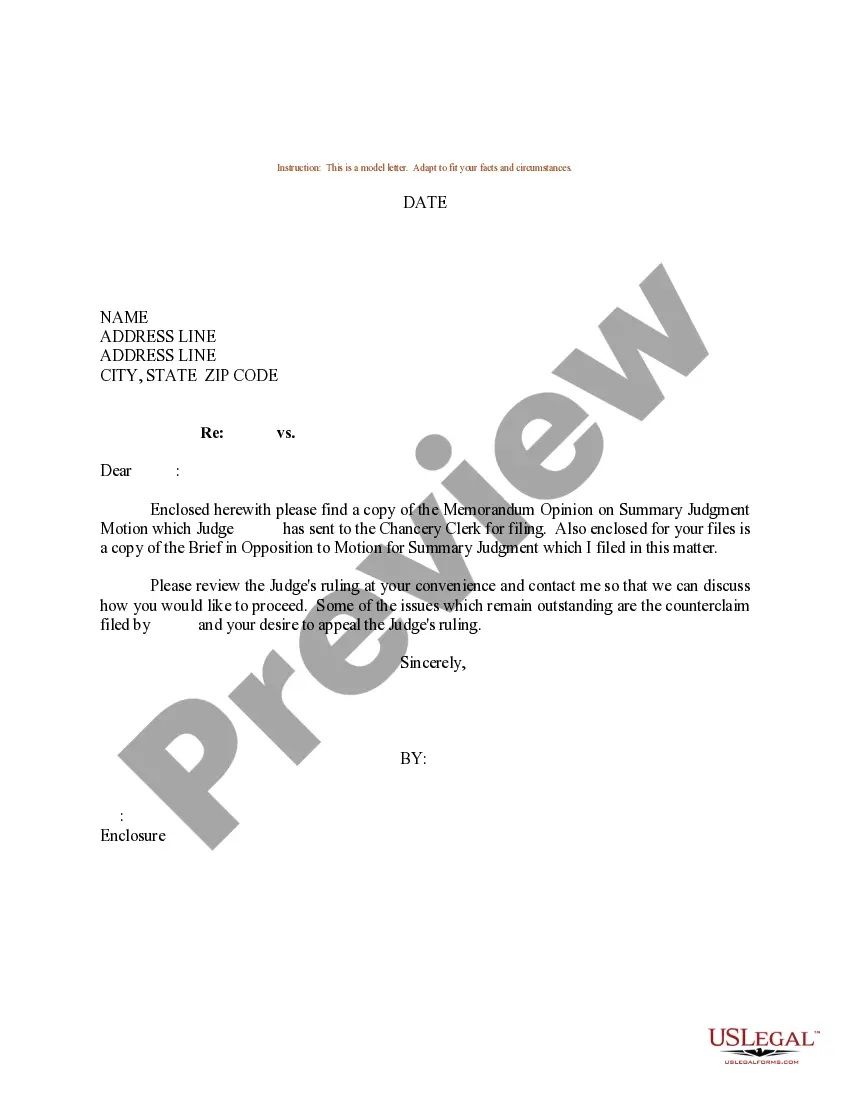
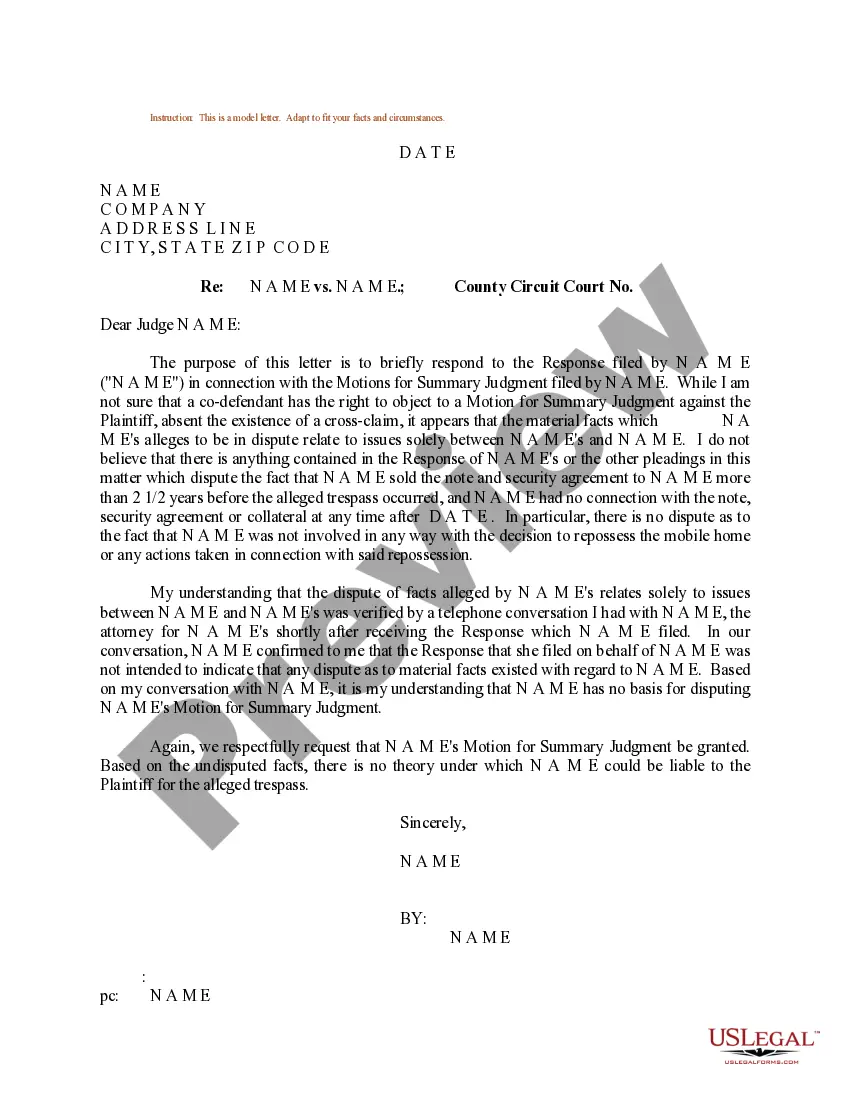
The Sample Letter for Motion for Summary Judgment is a template that facilitates the process of requesting a summary judgment in a court case. This form provides a structured way to present your motion, outlining the legal grounds and rationale behind your request. Unlike other legal forms, this sample letter is specifically designed for the introduction of a motion for summary judgment, making it distinct in its purpose and format.
What’s included in this form
- Date: Indicate the date the letter is being sent.
- Recipientâs information: Include the name, company, address, city, state, and zip code of the recipient.
- Subject line: Clearly state the purpose of the letter as a motion for summary judgment.
- Statement of facts: Briefly outline the relevant facts of the case.
- Legal argument: Present supporting legal principles and citations that justify the motion.
When this form is needed
This form is needed when you want to formally request a court to grant a summary judgment. You may find it applicable in situations where there are no genuine issues of material fact and you believe you are entitled to judgment as a matter of law. It is commonly used in civil litigation when one party seeks to expedite the resolution of a case without a full trial.
Who needs this form
- Individuals or entities involved in a civil lawsuit seeking to expedite their case.
- Attorneys representing clients in summary judgment motions.
- Self-represented litigants who understand the legal basis for a summary judgment.
How to complete this form
- Identify and enter the date at the top of the letter.
- Fill in the recipient's name, company, and complete address details.
- Craft a subject line indicating the letter's purpose clearly.
- Summarize the key facts related to the case in the statement of facts section.
- Articulate your legal arguments, citing relevant laws and precedents in the motion.
Is notarization required?
This form does not typically require notarization unless specified by local law. Always check your jurisdiction's requirements to ensure compliance with relevant legal standards.
Get your form ready online
Our built-in tools help you complete, sign, share, and store your documents in one place.
Make edits, fill in missing information, and update formatting in US Legal Forms—just like you would in MS Word.
Download a copy, print it, send it by email, or mail it via USPS—whatever works best for your next step.
Sign and collect signatures with our SignNow integration. Send to multiple recipients, set reminders, and more. Go Premium to unlock E-Sign.
If this form requires notarization, complete it online through a secure video call—no need to meet a notary in person or wait for an appointment.
We protect your documents and personal data by following strict security and privacy standards.

Make edits, fill in missing information, and update formatting in US Legal Forms—just like you would in MS Word.

Download a copy, print it, send it by email, or mail it via USPS—whatever works best for your next step.

Sign and collect signatures with our SignNow integration. Send to multiple recipients, set reminders, and more. Go Premium to unlock E-Sign.

If this form requires notarization, complete it online through a secure video call—no need to meet a notary in person or wait for an appointment.

We protect your documents and personal data by following strict security and privacy standards.
Mistakes to watch out for
- Failing to include the recipient's complete information, which can lead to delivery issues.
- Omitting essential facts that support the motion for summary judgment.
- Using complex legal jargon that may confuse the reader instead of simplified language.
- Not proofreading the letter for typos or grammatical errors before submission.
Benefits of completing this form online
- Convenient: Download and fill in the customizable template at your own pace.
- Time-saving: Quickly access a professionally drafted form without needing to create one from scratch.
- Reliable: Use a template prepared by licensed attorneys, ensuring legal compliance.
Legal use & context
- The letter serves as a formal communication to the court regarding a significant legal request.
- Filing a motion for summary judgment can significantly affect the trajectory of a case.
- Understanding proper legal procedures is crucial for the letter's acceptance by the court.
Looking for another form?




Form popularity
FAQ
If the motion is granted, the judgment on the issue or case is deemed to be a final judgment from which a party may seek an appeal. The court of appeal can reverse the grant of summary judgment and reinstate the claim in the lower court. However, this is rarely done and most summary judgments are upheld on appeal.
Stated different, to successfully defend against summary judgment the non-moving party (you) should seek to demonstrate that indeed there are material facts in dispute. Alternatively, the non-moving party (you) can argue that the undisputed facts support a judgment as a matter of law in your favor.
When a motion for summary judgement is granted, it indicates there is sufficient evidence to declare one party the clear winner.The judge will then rule on the case based on the facts and evidence. A summary judgement can often be beneficial as it potentially skips a lengthy (and costly) court trial.
When filing a motion for summary judgment, the motion must be filed with supporting evidence. Thus, the party bringing the motion must have conducted discovery and/or submitted evidence to the court following the applicable rules of evidence.
Completely resolve a case (e.g., entry of judgment for plaintiff or defendants) Completely resolve a claim. Completely determine the status of a particular party. Resolve a particular claim's application to a particular party. Establish a fact or ruling applicable to the case as it is further adjudicated.
Attack the Legal Argument. The first place to look for a weakness in your opponent's motion is at their legal argument. Attack the Evidence. Attack the Separate Statement. Consider Whether Your Opponent's Motion Meets its Burden. Consider Seeking a Continuance to Conduct More Discovery. Conclusion.
When a motion for summary judgement is granted, it indicates there is sufficient evidence to declare one party the clear winner.The judge will then rule on the case based on the facts and evidence. A summary judgement can often be beneficial as it potentially skips a lengthy (and costly) court trial.
Rule 56 of the Federal Rules of Civil Procedure governs summary judgment for federal courts. Under Rule 56, in order to succeed in a motion for summary judgment, a movant must show 1) that there is no genuine dispute as to any material fact, and 2) that the movant is entitled to judgment as a matter of law.