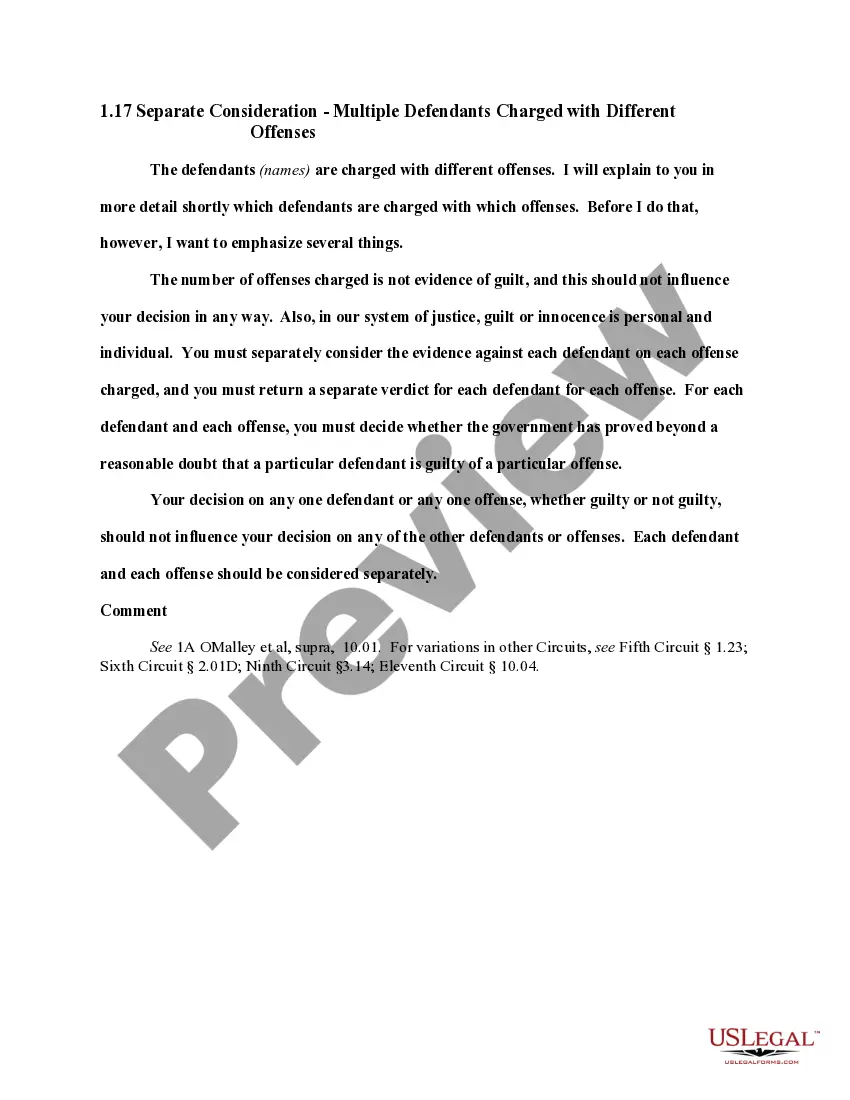
Separate Consideration Multiple Defendants Charged with Different Offenses
About this form
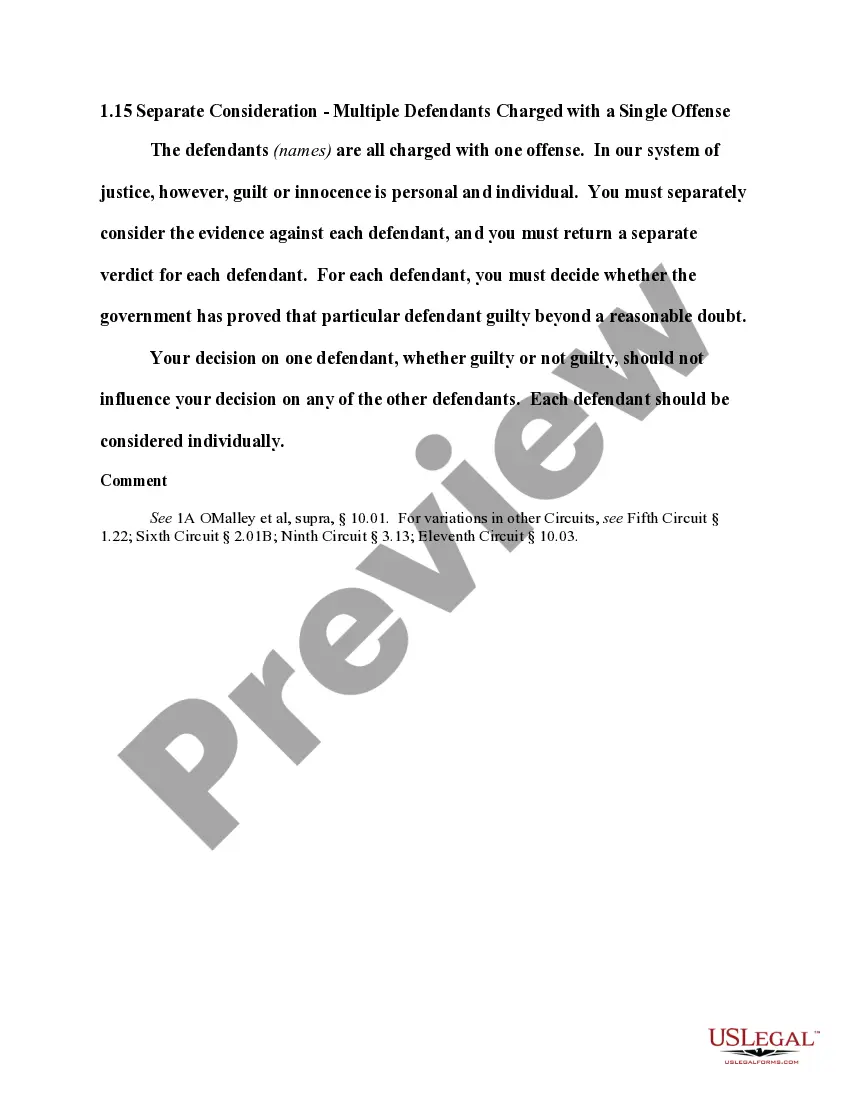
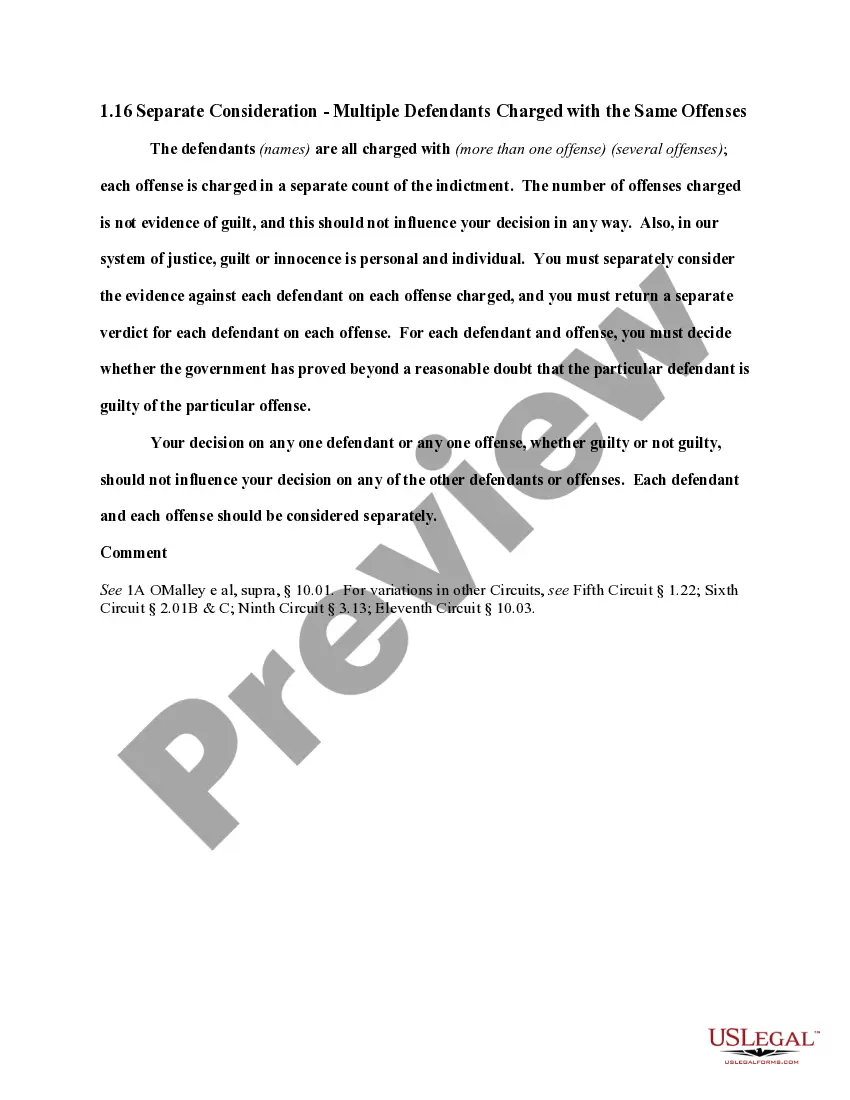
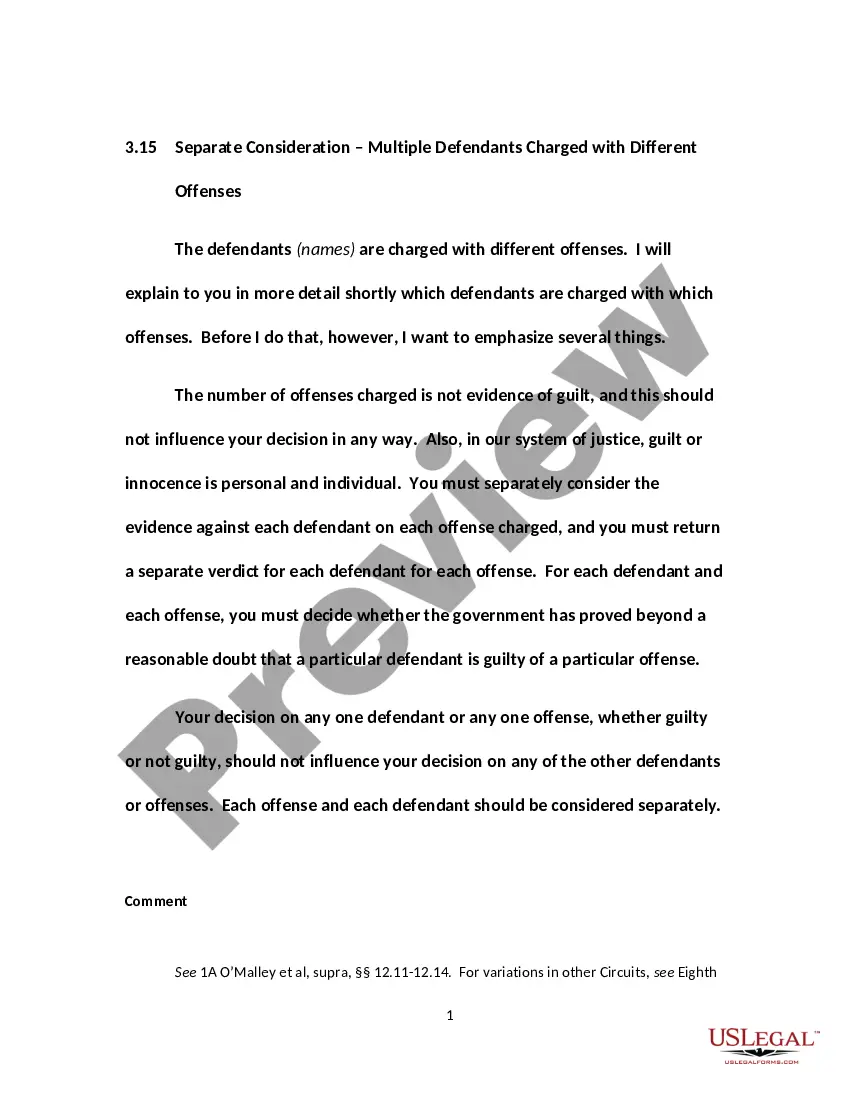
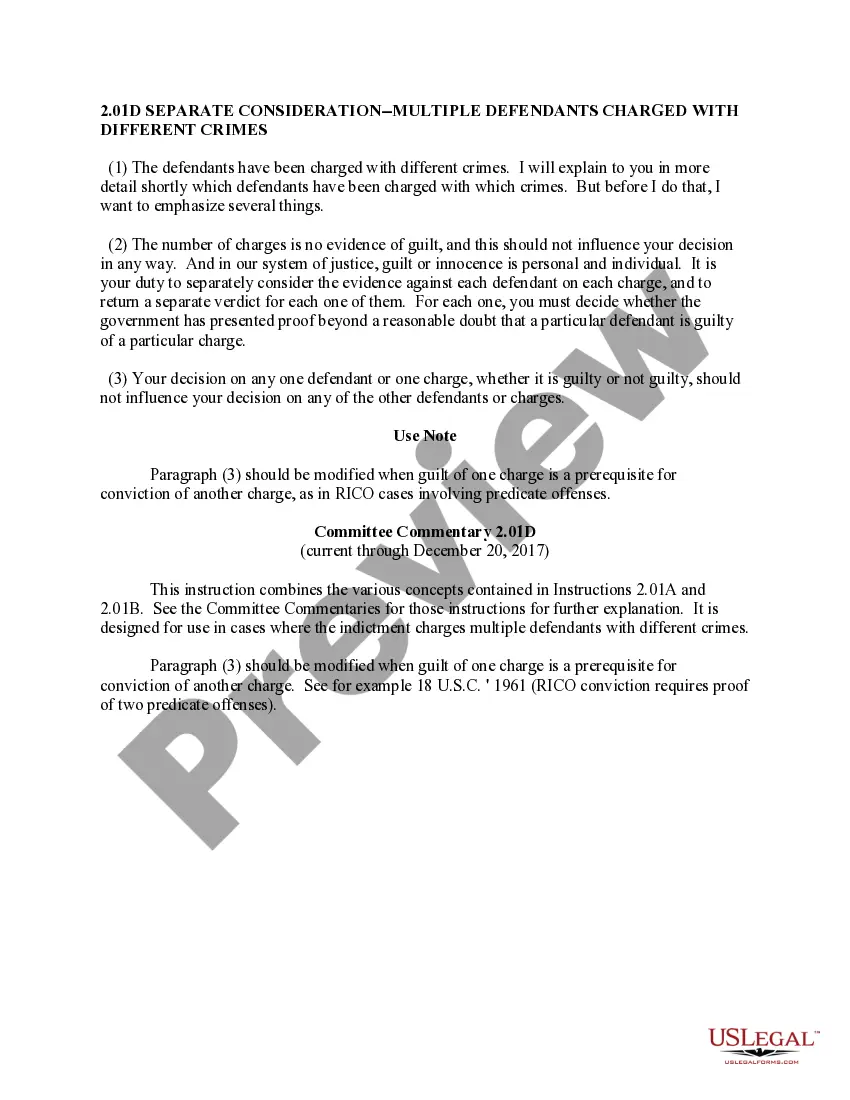
The Separate Consideration Multiple Defendants Charged with Different Offenses form is used in legal proceedings involving multiple defendants accused of different crimes. This form provides clear instructions for jurors to evaluate each defendant's guilt or innocence independently, ensuring that the decisions made for one defendant do not influence the verdict for another. This is crucial in maintaining a fair trial and respecting the principle of individual accountability in criminal justice.
Main sections of this form
- Instructions for jurors to treat each defendant's case as separate.
- Clarification that the number of charges does not imply guilt.
- Emphasis on making decisions based solely on evidence presented for each defendant.
- Guidance for returning separate verdicts for each defendant and offense.

When to use this document
This form is necessary in criminal cases where multiple defendants are charged with distinct offenses. It is pertinent when there is a risk that jurors may unintentionally connect the accusations or outcomes of one defendant with another, which could lead to biased verdicts. This ensures all defendants receive fair consideration based on their respective charges.
Who this form is for
- Judges presiding over cases involving multiple defendants.
- Jurors who must understand their responsibilities in rendering separate verdicts.
- Attorneys defending or prosecuting cases with more than one defendant.
- Legal professionals involved in jury instructions during criminal trials.
Instructions for completing this form
- Identify the names of each defendant involved in the case.
- Clearly state the specific offenses charged against each defendant.
- Review the instructions carefully to ensure they outline the separation of considerations for jurors.
- Provide any relevant background information needed for jurors to understand their duties.
- Gather all evidence related to each defendant and prepare to present it individually during the trial.
Does this form need to be notarized?
In most cases, this form does not require notarization. However, some jurisdictions or signing circumstances might. US Legal Forms offers online notarization powered by Notarize, accessible 24/7 for a quick, remote process.
Get your form ready online
Our built-in tools help you complete, sign, share, and store your documents in one place.
Make edits, fill in missing information, and update formatting in US Legal Forms—just like you would in MS Word.
Download a copy, print it, send it by email, or mail it via USPS—whatever works best for your next step.
Sign and collect signatures with our SignNow integration. Send to multiple recipients, set reminders, and more. Go Premium to unlock E-Sign.
If this form requires notarization, complete it online through a secure video call—no need to meet a notary in person or wait for an appointment.
We protect your documents and personal data by following strict security and privacy standards.

Make edits, fill in missing information, and update formatting in US Legal Forms—just like you would in MS Word.

Download a copy, print it, send it by email, or mail it via USPS—whatever works best for your next step.

Sign and collect signatures with our SignNow integration. Send to multiple recipients, set reminders, and more. Go Premium to unlock E-Sign.

If this form requires notarization, complete it online through a secure video call—no need to meet a notary in person or wait for an appointment.

We protect your documents and personal data by following strict security and privacy standards.
Avoid these common issues
- Failing to clarify the individual charges against each defendant.
- Allowing jurors to discuss or compare the cases before reaching their verdict.
- Not emphasizing the need for separate consideration of each defendant's guilt or innocence.
Benefits of using this form online
- Convenience of accessing and downloading the form from any location.
- Editable format allows for quick customization to fit specific cases.
- Reliable legal templates drafted by licensed attorneys ensure compliance with legal standards.
Looking for another form?





Form popularity
FAQ
The Federal Rules of Criminal Procedure 19 and all their state counterparts 20 permit prosecutors to charge multiple offenses ? officially known as ?charge joinder? ? by joining multiple counts of a crime upon a single defendant.
A judge in a criminal case may feel that it is appropriate to combine the cases of multiple defendants when their charges involve the same set of circumstances. This can help a judge streamline their calendar and resolve a case more efficiently.
In criminal law, if a defendant commits a single act that simultaneously fulfills the definition of two separate offenses, merger will occur. This means that the lesser of the two offenses will drop out, and the defendant will only be charged with the greater offense.
Criminal Cases with Co-Defendants When going through the legal process, they can either have separate trials or have them together, depending on the case.
(a) A prosecutor should seek or file criminal charges only if the prosecutor reasonably believes that the charges are supported by probable cause, that admissible evidence will be sufficient to support conviction beyond a reasonable doubt, and that the decision to charge is in the interests of justice.
A joint trial of codefendants (also known as "joinder") occurs when a judge merges the cases of two or more defendants. Joint trials happen when the issues in the defendants' cases overlap enough to make a single trial both fair and more efficient.