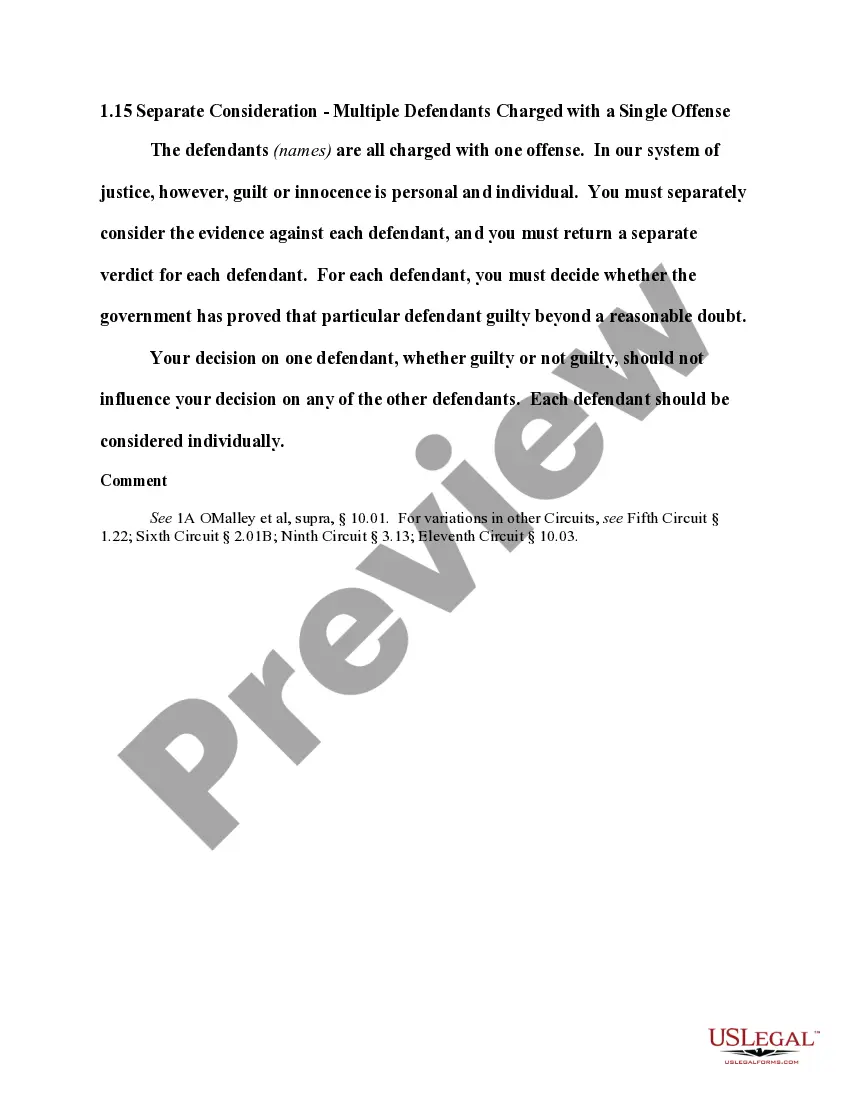
Separate Consideration Multiple Defendants Charged with Single Offense
About this form
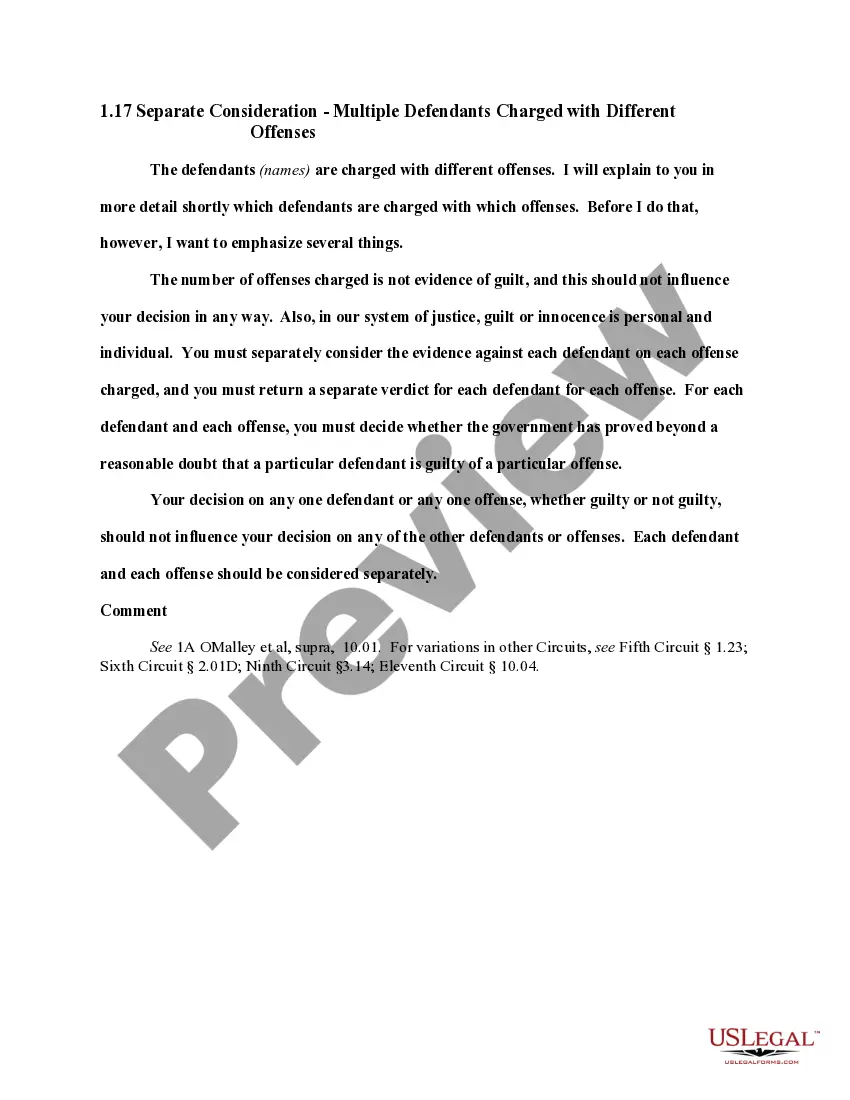
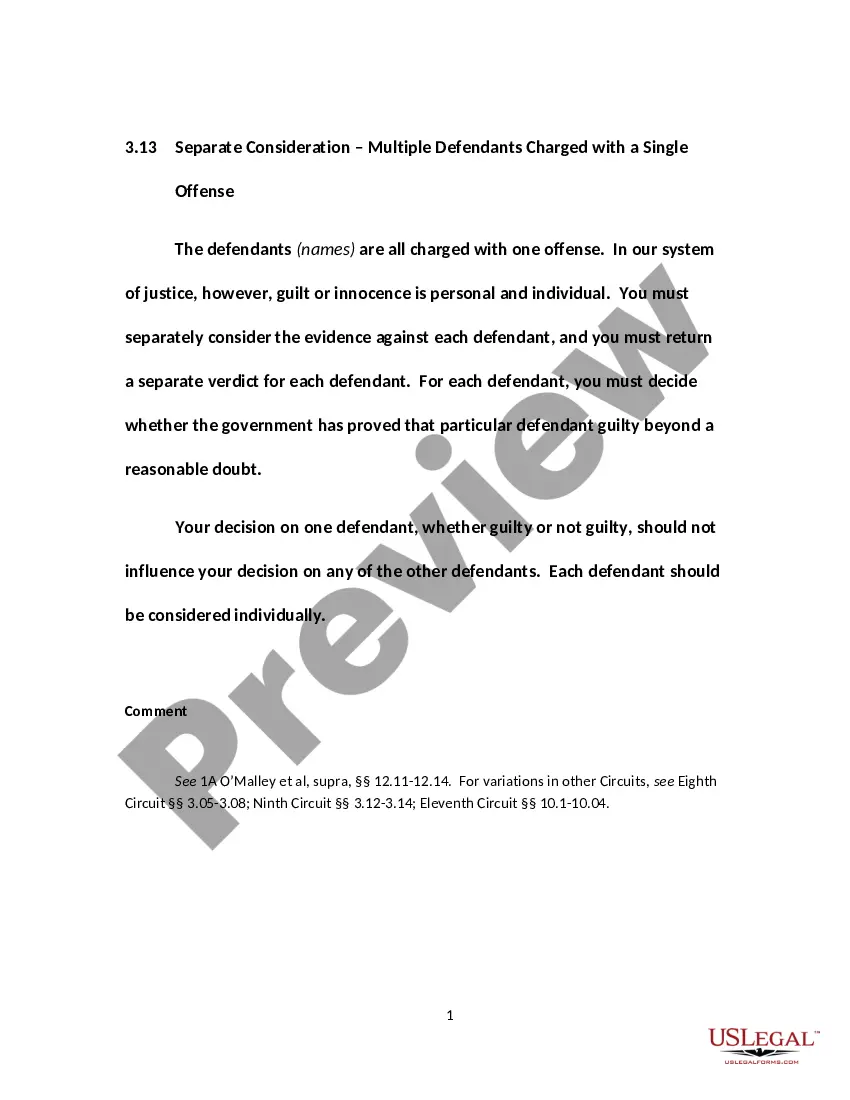
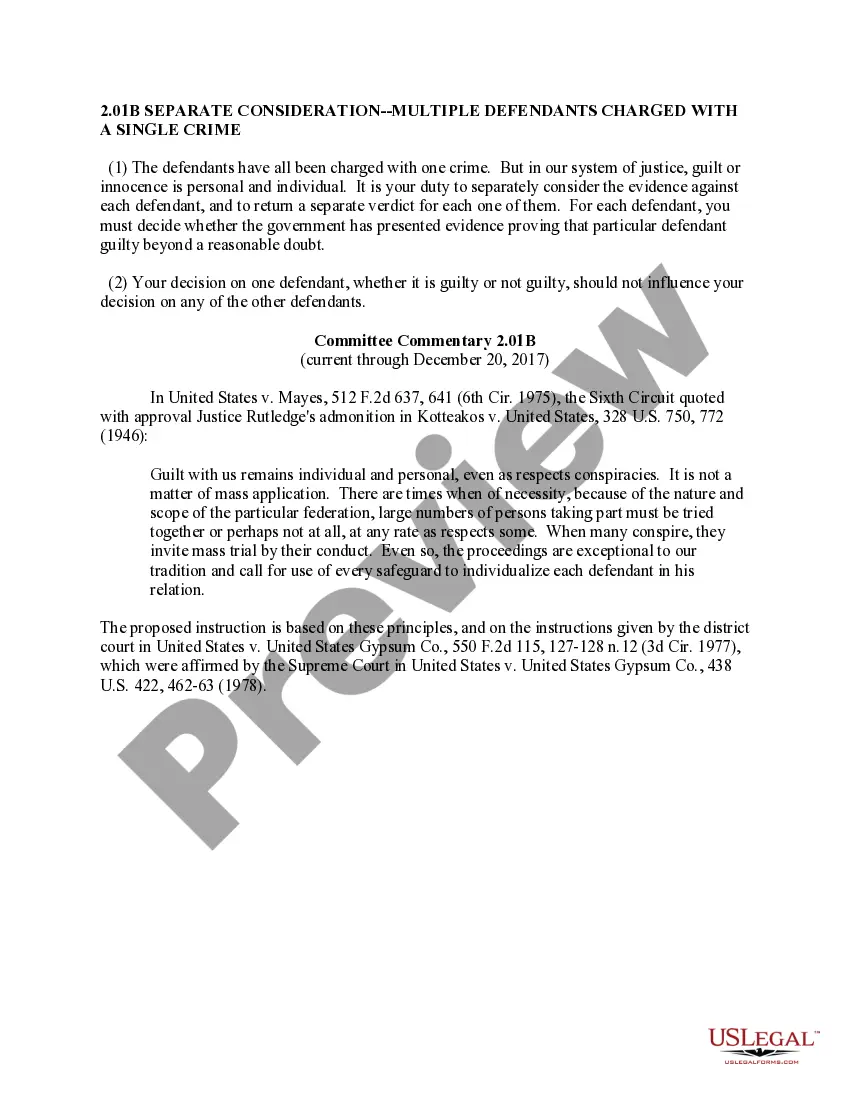
The Separate Consideration Multiple Defendants Charged with a Single Offense form is a legal document used in criminal cases where two or more defendants face the same charge. This form ensures that each defendant is assessed individually, emphasizing that guilt or innocence is a personal matter. Unlike other forms that may consider all defendants collectively, this form mandates separate verdicts based on distinct evidence for each party involved.
Key parts of this document
- Statement of charges against each defendant.
- Instructions for jurors regarding separate consideration.
- Emphasis on individual guilt or innocence.
- Directive to base verdicts solely on presented evidence.
- Guidance on the independence of verdicts among defendants.

When to use this document
This form is necessary when a case involves multiple defendants being charged with the same offense. It should be utilized in settings such as jury instructions where jurors need clear guidance on how to fairly deliberate, ensuring each defendant is judged solely on their specific circumstances and evidence presented during the trial.
Intended users of this form
- Jurors in cases with multiple defendants.
- Judges providing instructions to jurors.
- Legal practitioners seeking to clarify roles in multi-defendant cases.
- Court clerks preparing jury instructions for specific trials.
How to complete this form
- Identify each defendant by name and ensure clarity on charges.
- Outline the need for separate consideration of each defendant.
- Provide jurors with instructions that they must deliberate individually.
- Emphasize the necessity of basing verdicts on individual evidence only.
- Conclude with clear directives on returning separate verdicts.
Does this form need to be notarized?
This form usually doesn’t need to be notarized. However, local laws or specific transactions may require it. Our online notarization service, powered by Notarize, lets you complete it remotely through a secure video session, available 24/7.
Get your form ready online
Our built-in tools help you complete, sign, share, and store your documents in one place.
Make edits, fill in missing information, and update formatting in US Legal Forms—just like you would in MS Word.
Download a copy, print it, send it by email, or mail it via USPS—whatever works best for your next step.
Sign and collect signatures with our SignNow integration. Send to multiple recipients, set reminders, and more. Go Premium to unlock E-Sign.
If this form requires notarization, complete it online through a secure video call—no need to meet a notary in person or wait for an appointment.
We protect your documents and personal data by following strict security and privacy standards.

Make edits, fill in missing information, and update formatting in US Legal Forms—just like you would in MS Word.

Download a copy, print it, send it by email, or mail it via USPS—whatever works best for your next step.

Sign and collect signatures with our SignNow integration. Send to multiple recipients, set reminders, and more. Go Premium to unlock E-Sign.

If this form requires notarization, complete it online through a secure video call—no need to meet a notary in person or wait for an appointment.

We protect your documents and personal data by following strict security and privacy standards.
Typical mistakes to avoid
- Failing to instruct jurors on the importance of separate consideration.
- Using ambiguous language that could confuse jurors regarding individual assessments.
- Neglecting to clarify the independence of verdicts among defendants.
Benefits of completing this form online
- Easy access to downloadable legal forms drafted by licensed attorneys.
- Convenient for ensuring accurate and up-to-date jury instruction templates.
- Time-saving as the form can be filled out and customized to meet specific case requirements.
Legal use & context
- This form is designed to uphold the principles of individual justice in criminal proceedings.
- It ensures that the rights of each defendant are preserved throughout the trial process.
- Using this form helps avoid potential legal challenges related to jury decisions influenced by collective considerations.
Quick recap
- Each defendant must be considered separately for their charges and verdicts.
- The form emphasizes the importance of individual assessments based on the evidence presented.
- Court officials and jurors benefit from clear guidance on handling multi-defendant cases appropriately.
Looking for another form?








Form popularity
FAQ
In cases where someone is charged with multiple counts of the same crime, the judge often has to decide if the convicted defendant will serve the sentence concurrently or consecutively. A concurrent sentence means that time for two or more of the convictions will all be served at once.
: in all/several ways.
It means the number of crimes or the number of a certain crime. For example, a mass shooters kills 5 people and wounds another 7. They get charged with 5 counts of murder (one murder charge for each victim killed) and 7 counts of attempted murder (one for each victim wounded).
It means you committed the same crime more than once. An example is if someone shoots 10 people and they all survive, that person would have 10 counts of attempted murder. He committed the same crime against all of these people. So he has to answer for each person that was wronged by his action.
A joint trial of codefendants (also known as "joinder") occurs when a judge merges the cases of two or more defendants. Joint trials happen when the issues in the defendants' cases overlap enough to make a single trial both fair and more efficient.
Counts refer to the basis for bringing a case, including each cause of action in civil cases or charge in criminal cases. Lawsuits can involve multiple counts in which someone can be held liable. For example, assault and battery are separate causes of action that often are both present in a lawsuit.