Impeachment by Prior Conviction (Defendant's Testimony)
What is this form?
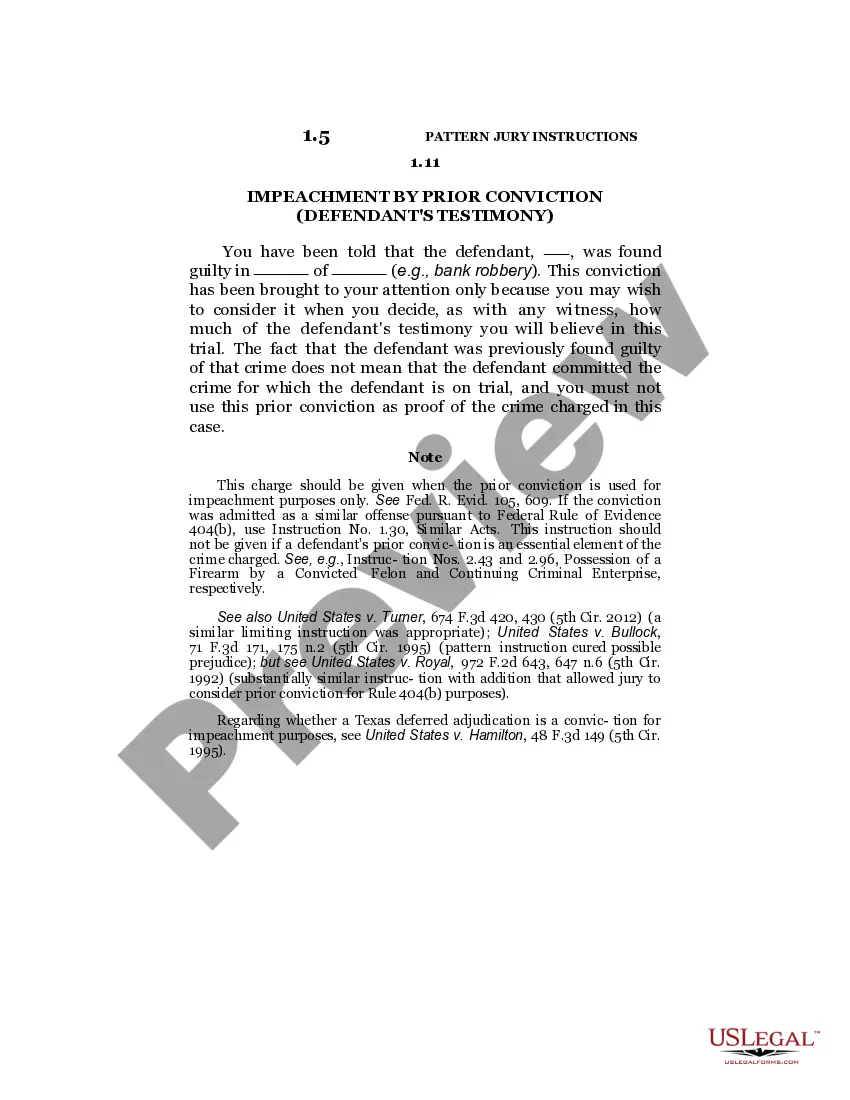
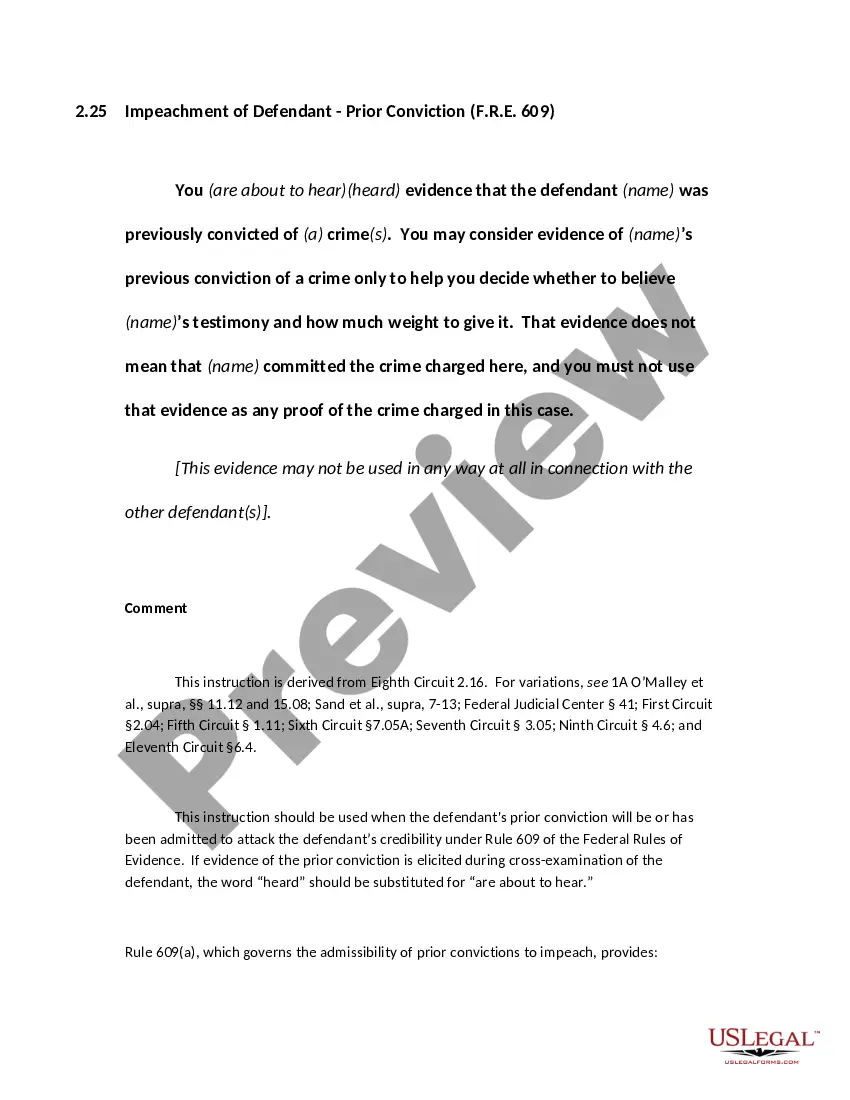
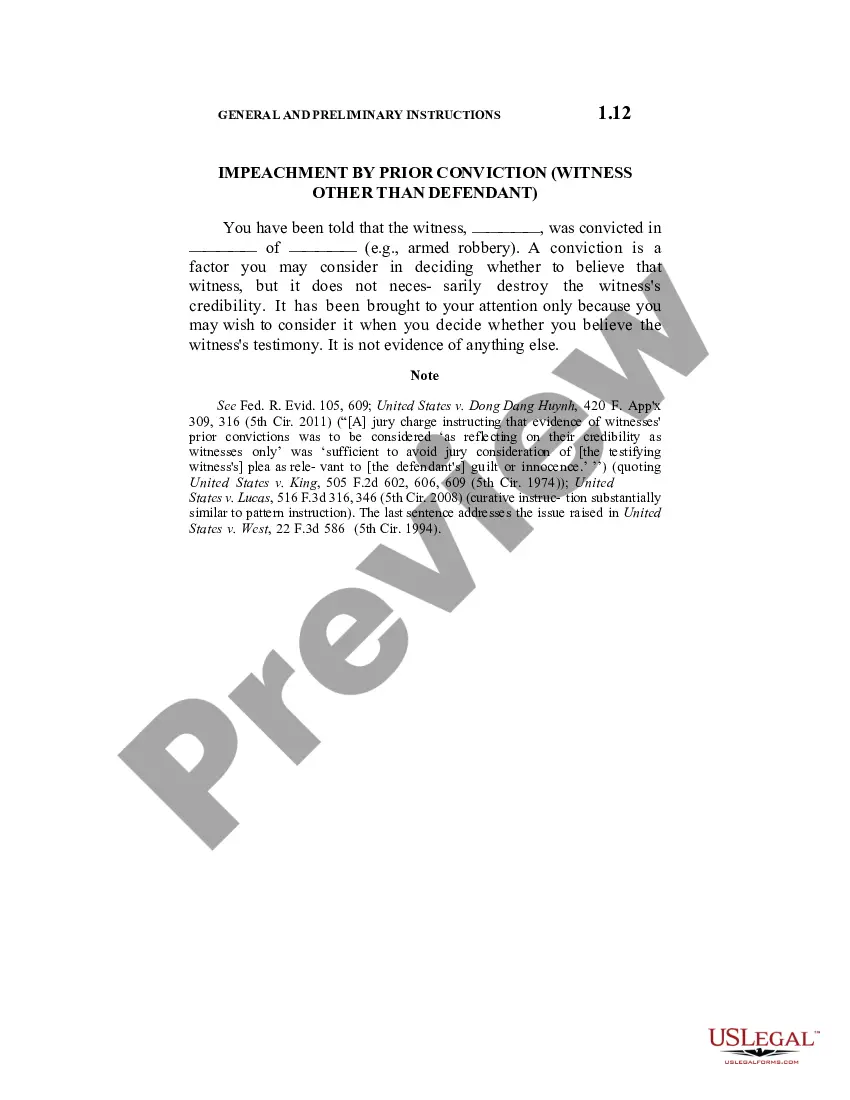
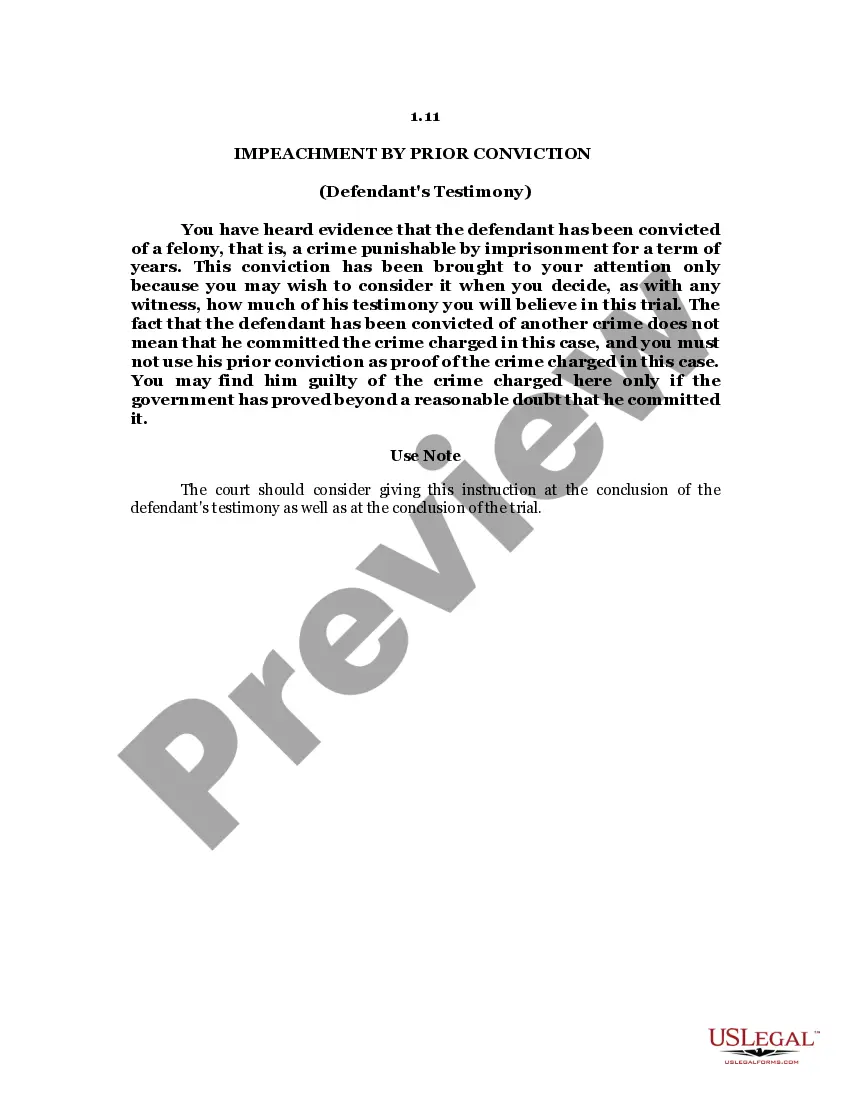
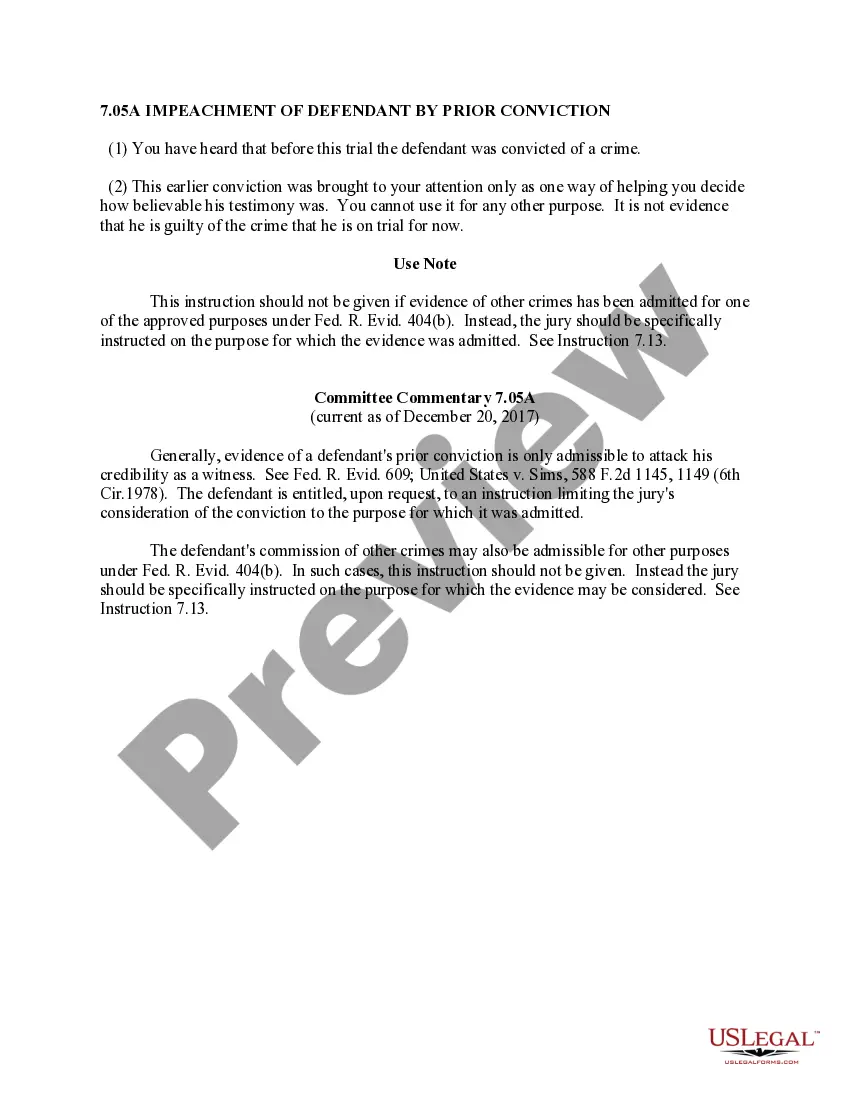
The Impeachment by Prior Conviction (Defendant's Testimony) form is used in legal proceedings to challenge the credibility of a defendant based on their previous convictions. This form allows jurors to evaluate the defendant's testimony while clarifying that past convictions do not necessarily prove guilt in the current case. It serves as an important tool to ensure a fair trial by providing the jury with guidance on how to consider prior convictions appropriately during their deliberations.
Main sections of this form
- Identification of the defendant and the specific prior conviction.
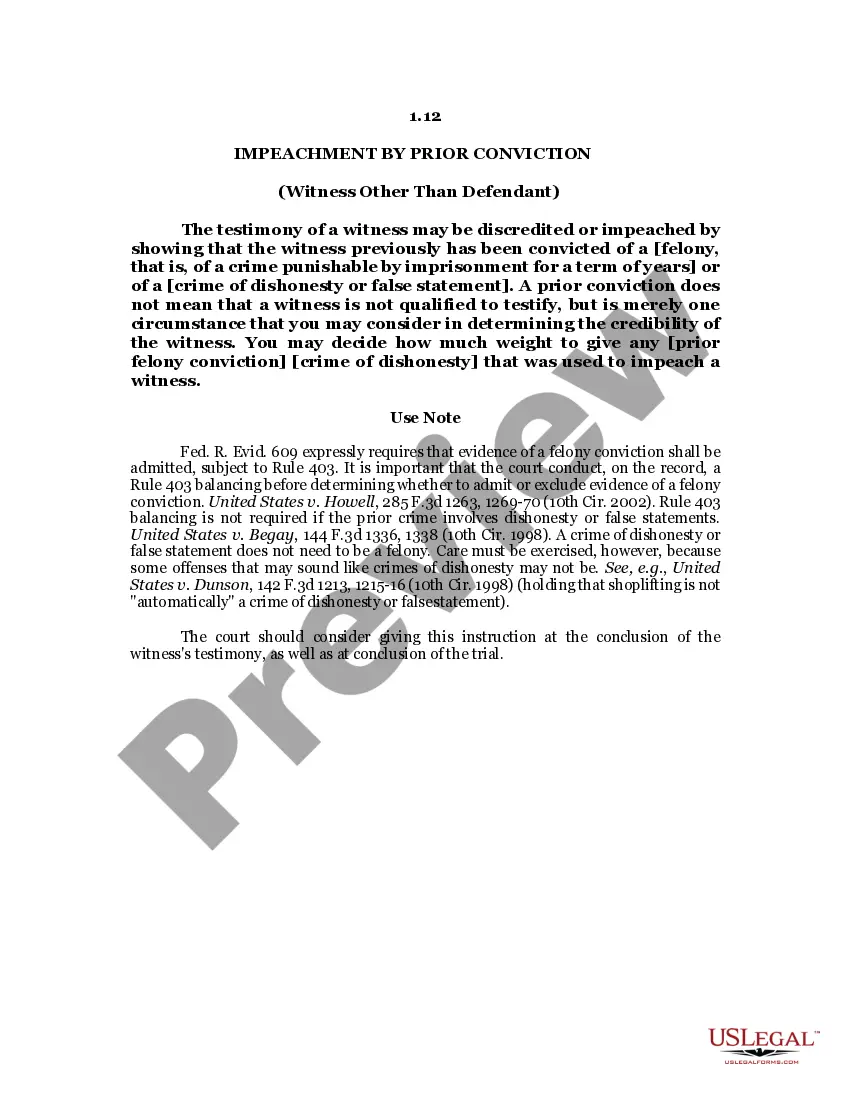
- Instructions for jurors regarding the limitations on using prior convictions for assessing credibility.
- Clarifications on what constitutes a valid prior conviction for impeachment purposes.
- Guidance on the difference between using prior convictions for impeachment vs. as evidence of the current charge.
Common use cases
This form should be used during criminal trials when the defendant's prior convictions are introduced for the purpose of impeachment. It is crucial in situations where the defense wishes to ensure that jurors understand the limitations of relying on a defendant's past offenses while making their decisions in the current case.
Who should use this form
- Defense attorneys representing a defendant in a criminal trial.
- Prosecutors who anticipate that a defendant's prior convictions may be raised.
- Judges presiding over cases where the admissibility of a defendant's prior convictions may be questioned.
How to prepare this document
- Identify the defendant's name and the specific prior conviction, including the crime and jurisdiction.
- State the context in which the prior conviction is being presented to the jury.
- Include any necessary instructions regarding how the jury should interpret the prior conviction in relation to the current case.
- Ensure all relevant legal citations are included to support the admissibility of the prior conviction.
Is notarization required?
This form does not typically require notarization unless specified by local law. Always check relevant state requirements to ensure compliance.
Get your form ready online
Our built-in tools help you complete, sign, share, and store your documents in one place.
Make edits, fill in missing information, and update formatting in US Legal Forms—just like you would in MS Word.
Download a copy, print it, send it by email, or mail it via USPS—whatever works best for your next step.
Sign and collect signatures with our SignNow integration. Send to multiple recipients, set reminders, and more. Go Premium to unlock E-Sign.
If this form requires notarization, complete it online through a secure video call—no need to meet a notary in person or wait for an appointment.
We protect your documents and personal data by following strict security and privacy standards.

Make edits, fill in missing information, and update formatting in US Legal Forms—just like you would in MS Word.

Download a copy, print it, send it by email, or mail it via USPS—whatever works best for your next step.

Sign and collect signatures with our SignNow integration. Send to multiple recipients, set reminders, and more. Go Premium to unlock E-Sign.

If this form requires notarization, complete it online through a secure video call—no need to meet a notary in person or wait for an appointment.

We protect your documents and personal data by following strict security and privacy standards.
Typical mistakes to avoid
- Failing to properly identify the prior conviction or its jurisdiction.
- Using prior convictions as evidence of the current charge rather than for impeachment purposes.
- Neglecting to provide appropriate juror instructions on how to consider the prior conviction.
Why complete this form online
- Convenience of accessing and downloading the form anytime.
- Editability allows users to customize the form to fit specific legal needs.
- Reliability of professionally drafted templates by licensed attorneys.
Legal use & context
- This form is designed to assist in the lawful process of jury instruction regarding prior convictions.
- Usage of this form must adhere to Federal Rules of Evidence, particularly Rule 105 and Rule 609.
- Improper use of prior convictions can lead to prejudicial outcomes; accurate compliance with applicable laws is essential.
Summary of main points
- The form allows for the impeachment of a defendant's testimony based on prior convictions.
- It emphasizes that previous convictions do not imply guilt regarding the current trial.
- Jurors must be provided with clear instructions on how to interpret prior convictions for credibility assessments.
Looking for another form?
Form popularity
FAQ
Any party may impeach the credibility of any witness with evidence suggesting that the witness's direct testimony is unworthy of belief.
Repeat. First, the most basic step, is to have the witness repeat the testimony from today's hearing that you want to impeach. You cannot effectively impeach unless the witness repeats a fact they said during the current hearing that clearly contradicts a prior statement.
Impeachment of a witness refers to the process of discrediting or undermining the credibility of a witness during a trial, by presenting evidence or asking questions that contradict their testimony or reveal a bias, inconsistency, or falsehood in their statements.
Under this provision, evidence of a general felony crime can be used for impeachment purposes only if the court determines that the probative value of admitting this evidence outweighs its prejudicial effect to the defendant.
Evidence of the conviction is admissible only if: (1) its probative value, supported by specific facts and circumstances, substantially outweighs its prejudicial effect; and (2) the proponent gives an adverse party reasonable written notice of the intent to use it so that the party has a fair opportunity to contest its
Although the rule does not forbid all use of convictions to impeach a defendant, it requires that the government show that the probative value of convictions as impeachment evidence outweighs their prejudicial effect.
Evidence has been presented that the defendant has heretofore been convicted of (another offense)/(other offenses) distinct from that charged in the information. This evidence is called impeachment evidence, and it is offered to show that the defendant's testimony is not believable or truthful.