IMPEACHMENT BY PRIOR CONVICTION
About this form
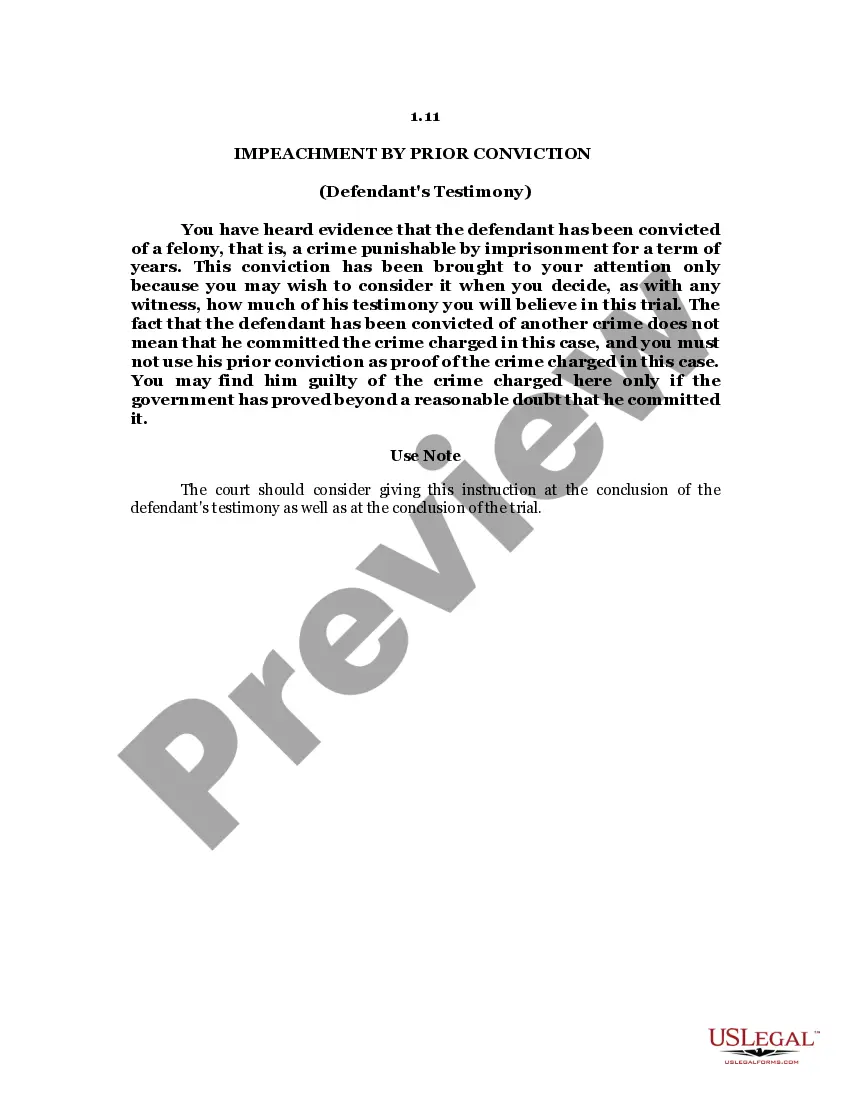
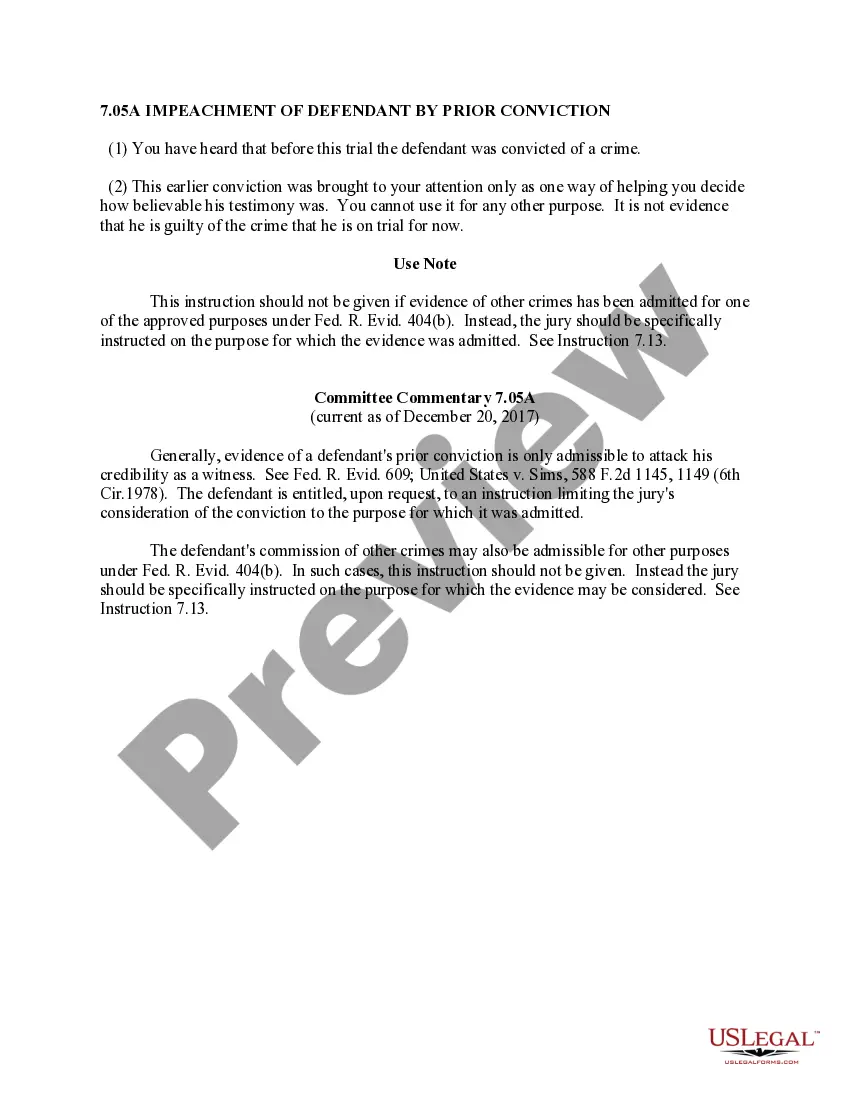
The Impeachment by Prior Conviction form is designed to address the consideration of a defendant's previous felony conviction during a trial. This form is crucial for instructing jurors on how to evaluate the credibility of the defendantâs testimony without using the past conviction as direct evidence of guilt in the current case. Unlike other forms that may simply document criminal history, this instruction aims to clarify legal standards for jurors, ensuring they understand the distinction between prior convictions and the charges presently being assessed.
Key parts of this document
- Details the nature of evidence regarding prior felony convictions.
- Explains the role of the previous conviction in evaluating witness credibility.
- Clarifies that prior convictions should not be taken as proof of the crime charged.
- Provides guidance on when to present this instruction to the jury.

When to use this document
This form is applicable in criminal trials where the defendant has a prior felony conviction. It should be utilized during jury instructions when the defendant testifies, ensuring jurors are properly informed on how to treat the prior conviction in relation to the current charges. This is particularly important in cases where the prosecution may mention the defendant's past to suggest character flaws, requiring appropriate judicial guidance to prevent undue prejudice.
Who needs this form
- Judges presiding over criminal trials.
- Legal practitioners representing defendants.
- Jurors needing clarification on their responsibilities regarding prior convictions.
Instructions for completing this form
- Identify the relevant felony conviction that is to be questioned.
- Prepare the jury instruction language to clarify the limits of using prior convictions.
- Present the instruction at the conclusion of the defendant's testimony.
- Reiterate this instruction at the end of the trial to reinforce its significance.
- Ensure jurors understand that the previous conviction does not imply guilt in the current trial.
Is notarization required?
This form does not typically require notarization to be legally valid. However, some jurisdictions or document types may still require it. US Legal Forms provides secure online notarization powered by Notarize, available 24/7 for added convenience.
Get your form ready online
Our built-in tools help you complete, sign, share, and store your documents in one place.
Make edits, fill in missing information, and update formatting in US Legal Forms—just like you would in MS Word.
Download a copy, print it, send it by email, or mail it via USPS—whatever works best for your next step.
Sign and collect signatures with our SignNow integration. Send to multiple recipients, set reminders, and more. Go Premium to unlock E-Sign.
If this form requires notarization, complete it online through a secure video call—no need to meet a notary in person or wait for an appointment.
We protect your documents and personal data by following strict security and privacy standards.

Make edits, fill in missing information, and update formatting in US Legal Forms—just like you would in MS Word.

Download a copy, print it, send it by email, or mail it via USPS—whatever works best for your next step.

Sign and collect signatures with our SignNow integration. Send to multiple recipients, set reminders, and more. Go Premium to unlock E-Sign.

If this form requires notarization, complete it online through a secure video call—no need to meet a notary in person or wait for an appointment.

We protect your documents and personal data by following strict security and privacy standards.
Avoid these common issues
- Failing to provide the instruction at both relevant times during the trial.
- Not clarifying the distinction between the prior conviction and the current charges.
- Assuming jurors will automatically disregard prior convictions without explicit instruction.
Benefits of completing this form online
- Convenient access to up-to-date legal language and standards.
- Editability allows for tailor-made instructions based on specific cases.
- Reliability from templates that reflect legal provisions written by licensed attorneys.
Looking for another form?
Form popularity
FAQ
Impeachment by Evidence of A Criminal Conviction. (2) for any crime regardless of the punishment, the evidence must be admitted if the court can readily determine that establishing the elements of the crime required proving - or the witness's admitting - a dishonest act or false statement.
Rule 607 allows the credibility of any witness to be attacked by the state or the defense, even if the witness was called to testify by that party.
Rule 609 provides that, with certain restrictions, a witness may be impeached witrh evidence of two kids of criminal convictions: (1) felonies, regardless of their nature; and (2) misdemeanors involving crimes of dishonesty and false statement, such as check deception and perjury.
Under this provision, evidence of a general felony crime can be used for impeachment purposes only if the court determines that the probative value of admitting this evidence outweighs its prejudicial effect to the defendant.
Evidence has been presented that the defendant has heretofore been convicted of (another offense)/(other offenses) distinct from that charged in the information. This evidence is called impeachment evidence, and it is offered to show that the defendant's testimony is not believable or truthful.
With respect to other witnesses, in addition to any prior conviction involving false statement or dishonesty, any other felony may be used to impeach if, and only if, the court finds that the probative value of such evidence outweighs its prejudicial effect against the party offering that witness.
By Rule 609(a) to impeach in civil cases, because Rule 609(a)(1) balancing process applies only to criminal defendants).
With regard to the discretionary standard established by paragraph (1) of rule 609(a), the Conference determined that the prejudicial effect to be weighed against the probative value of the conviction is specifically the prejudicial effect to the defendant.