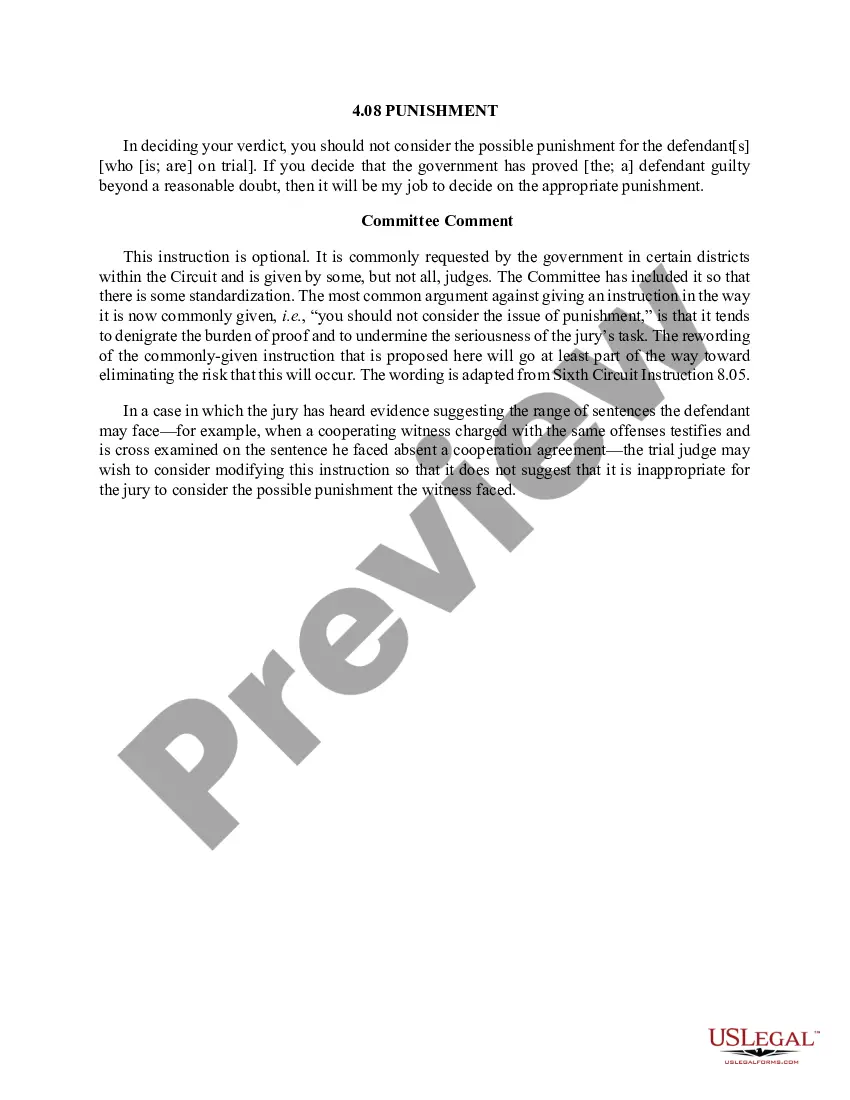
4.08 PUNISHMENT
What is this form?
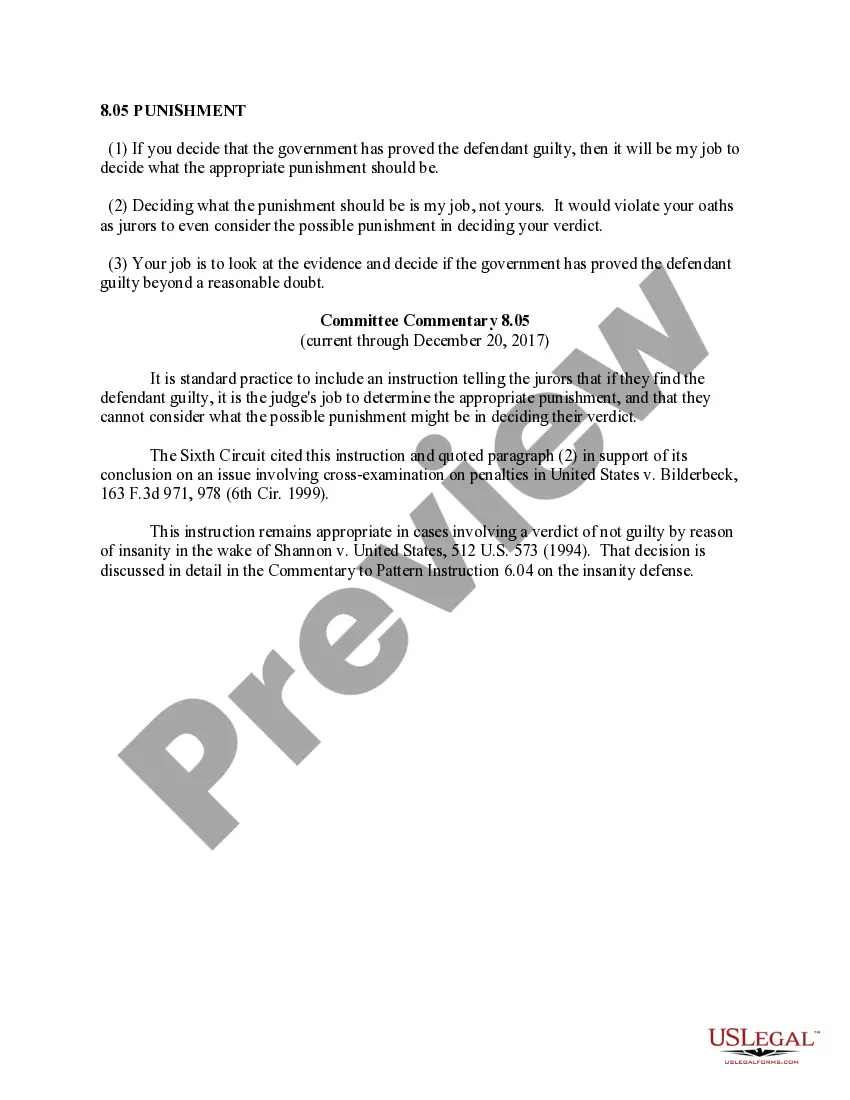
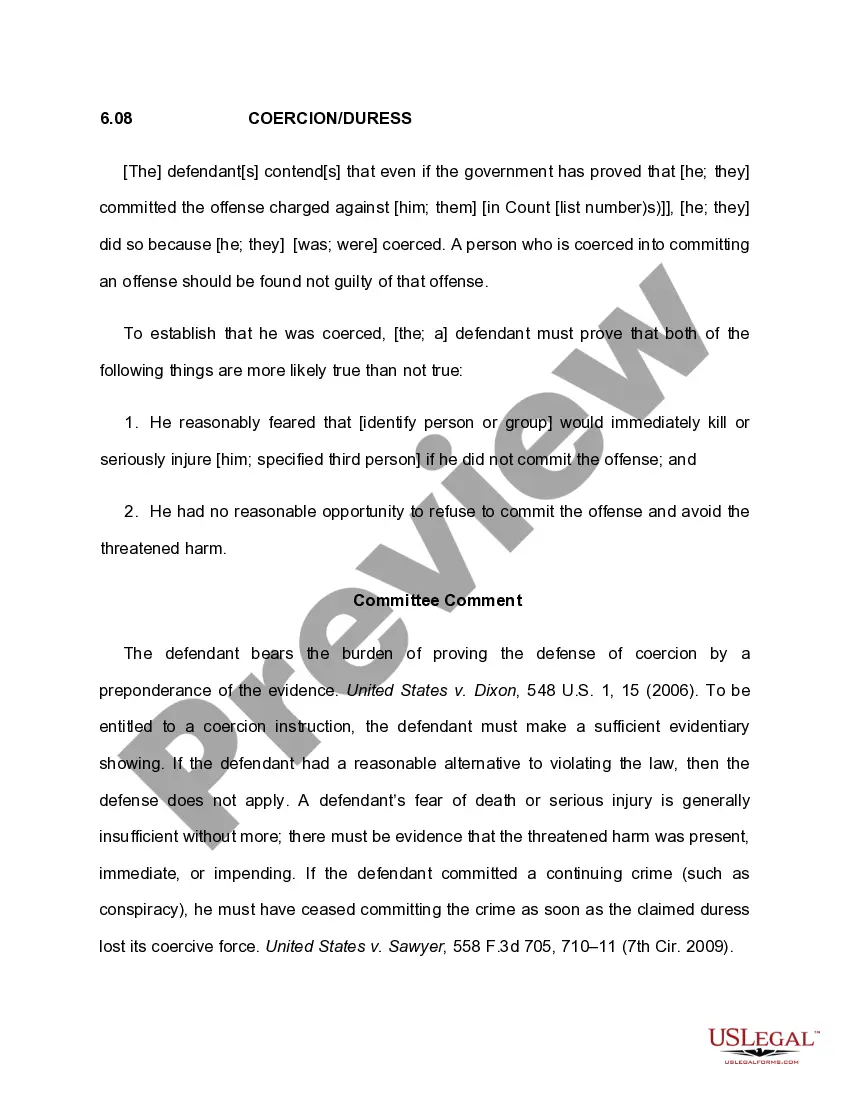
The 4.08 Punishment form provides jury instructions regarding the consideration of punishment in a trial. It emphasizes that jurors should not factor in the potential penalties when deciding on a verdict. This instruction is distinct from other jury instructions as it aims to maintain the focus on the evidence and the burden of proof without introducing the idea of sentencing. By clarifying this aspect, it helps jurors concentrate on their critical role in determining guilt based solely on the evidence presented.
What’s included in this form
- Instruction to jurors to disregard potential punishment when deliberating.
- Clarification on the role of the judge in determining the appropriate punishment, if applicable.
- Optional nature of the instruction, which may be requested by the government.
- Guidance on modifying the instruction in cases with evidence of other sentences faced by witnesses.

When to use this form
This form should be used in federal trials where jurors require guidance on their responsibilities related to punishment. It's particularly relevant in cases where the jury is deliberating on the guilt of a defendant and needs to focus solely on the evidence, avoiding any emotional biases that may arise from knowledge about potential penalties.
Who can use this document
- Judges presiding over federal criminal trials.
- Legal practitioners involved in the trial process, including prosecutors and defense attorneys.
- Juries in federal cases where punishment considerations may influence decision-making.
How to complete this form
- Review the entire jury instruction to understand its context and relevance.
- Ensure that jurors clearly understand they must disregard any potential punishments.
- Present this instruction during jury instructions before deliberation.
- Discuss any modifications needed based on the specific evidence in the case.
Does this document require notarization?
This form does not typically require notarization to be legally valid. However, some jurisdictions or document types may still require it. US Legal Forms provides secure online notarization powered by Notarize, available 24/7 for added convenience.
Get your form ready online
Our built-in tools help you complete, sign, share, and store your documents in one place.
Make edits, fill in missing information, and update formatting in US Legal Forms—just like you would in MS Word.
Download a copy, print it, send it by email, or mail it via USPS—whatever works best for your next step.
Sign and collect signatures with our SignNow integration. Send to multiple recipients, set reminders, and more. Go Premium to unlock E-Sign.
If this form requires notarization, complete it online through a secure video call—no need to meet a notary in person or wait for an appointment.
We protect your documents and personal data by following strict security and privacy standards.

Make edits, fill in missing information, and update formatting in US Legal Forms—just like you would in MS Word.

Download a copy, print it, send it by email, or mail it via USPS—whatever works best for your next step.

Sign and collect signatures with our SignNow integration. Send to multiple recipients, set reminders, and more. Go Premium to unlock E-Sign.

If this form requires notarization, complete it online through a secure video call—no need to meet a notary in person or wait for an appointment.

We protect your documents and personal data by following strict security and privacy standards.
Typical mistakes to avoid
- Allowing jurors to consider potential sentencing outcomes when making their decision.
- Failing to clearly communicate the instruction during jury charges.
- Not adapting the instruction when there is relevant evidence of punishments faced by witnesses.
Benefits of completing this form online
- Easy access to standardized jury instructions created by licensed attorneys.
- Ability to download and customize the form for specific cases.
- Convenient for legal professionals to use in trial preparations.
Legal use & context
- This instruction is commonly used in federal trials to uphold the integrity of the jury's deliberation process.
- Its enforceability relies on proper implementation by the presiding judge during jury instructions.
- Adhering to this instruction helps avoid juror biases that may arise from knowledge of sentencing laws.
Looking for another form?
Form popularity
FAQ
Fines, incarceration and, in some cases, certain acts of restitution are the most common forms of punishment meted out to criminal offenders by society through the criminal law system in this country. Punishment: Criminal Law Basics - UpCounsel upcounsel.com ? lectl-punishment-criminal-l... upcounsel.com ? lectl-punishment-criminal-l...
The four core principles are that behavior analysts should: benefit others; treat others with compassion, dignity, and respect; behave with integrity; and ensure their own competence.
The 3 most common violation categories were professionalism and integrity, improper or inadequate supervision or delegation, and failure to report or respond to the BACB as required. The standards in this column are ordered from most to least frequent.
Retribution is about punishment for punishment's sake; it's not about changing future behavior. Rehabilitation assumes that people who commit crimes do so because of personal shortcomings that can be "fixed" while in prison. Deterrence and Incapacitation: A Quick Review of the Research justjournalism.org ? page ? deterrence-and-incapa... justjournalism.org ? page ? deterrence-and-incapa...
There are majorly four theories of punishment. These theories are the deterrent theory, retributive theory, preventive theory, and reformative theory. Theories and Kinds of Punishment - Toppr toppr.com ? guides ? indian-penal-code ? th... toppr.com ? guides ? indian-penal-code ? th...
A multiple relationship exists when a behavior analyst is simultaneously in two relationships, for example serving a child client while also friends with the family; the concern is that when it comes time to make professional decisions about the child the behavior analyst may take into account that they are friends
5.06 Providing Feedback to Supervisees. a) Behavior analysts design feedback and reinforcement systems in a way that improves supervisee performance. 5.07 Evaluating the Effects of Supervision. Behavior analysts design systems for obtaining ongoing evaluation of their own supervision activities.
The Types of Criminal Punishment Retribution.Deterrence.Rehabilitation.Incapacitation.Restoration. Types of Criminal Punishment Crimes and Their Punishments pointpark.edu ? criminal-justice ? types-of-... pointpark.edu ? criminal-justice ? types-of-...