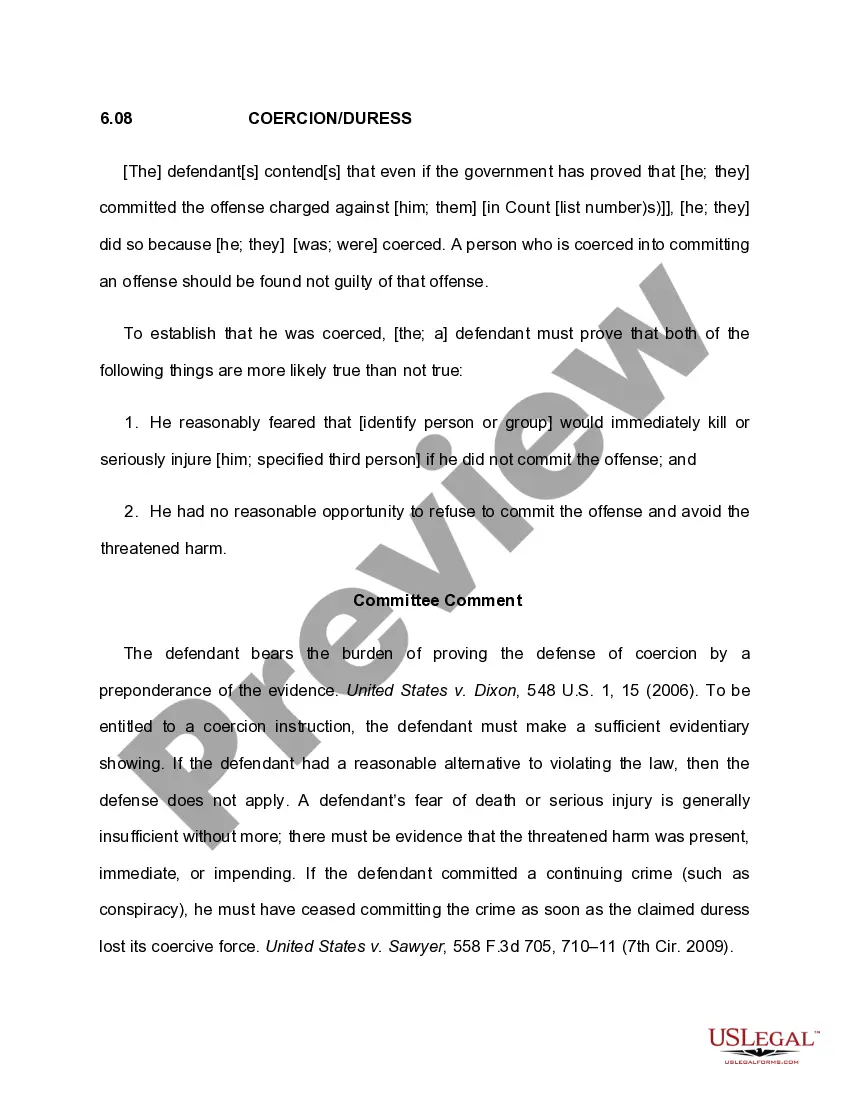
6.08 COERCION/DURESS
Overview of this form
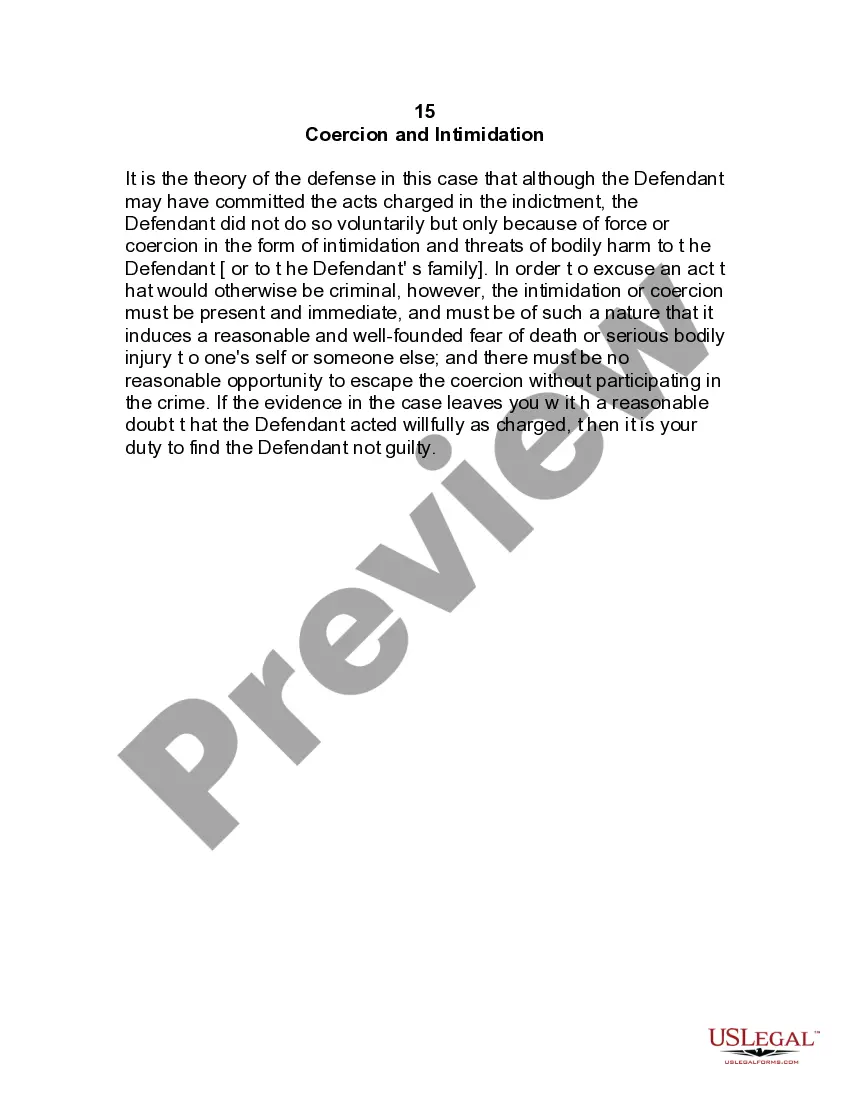
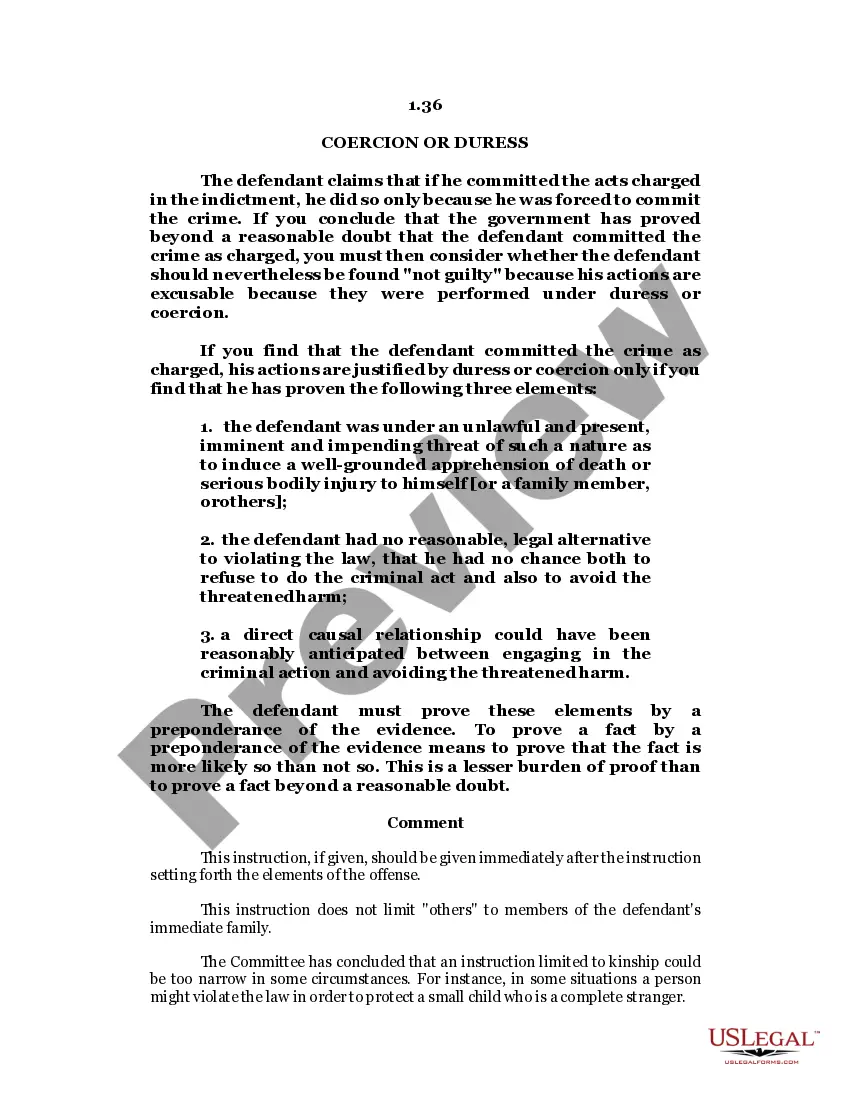
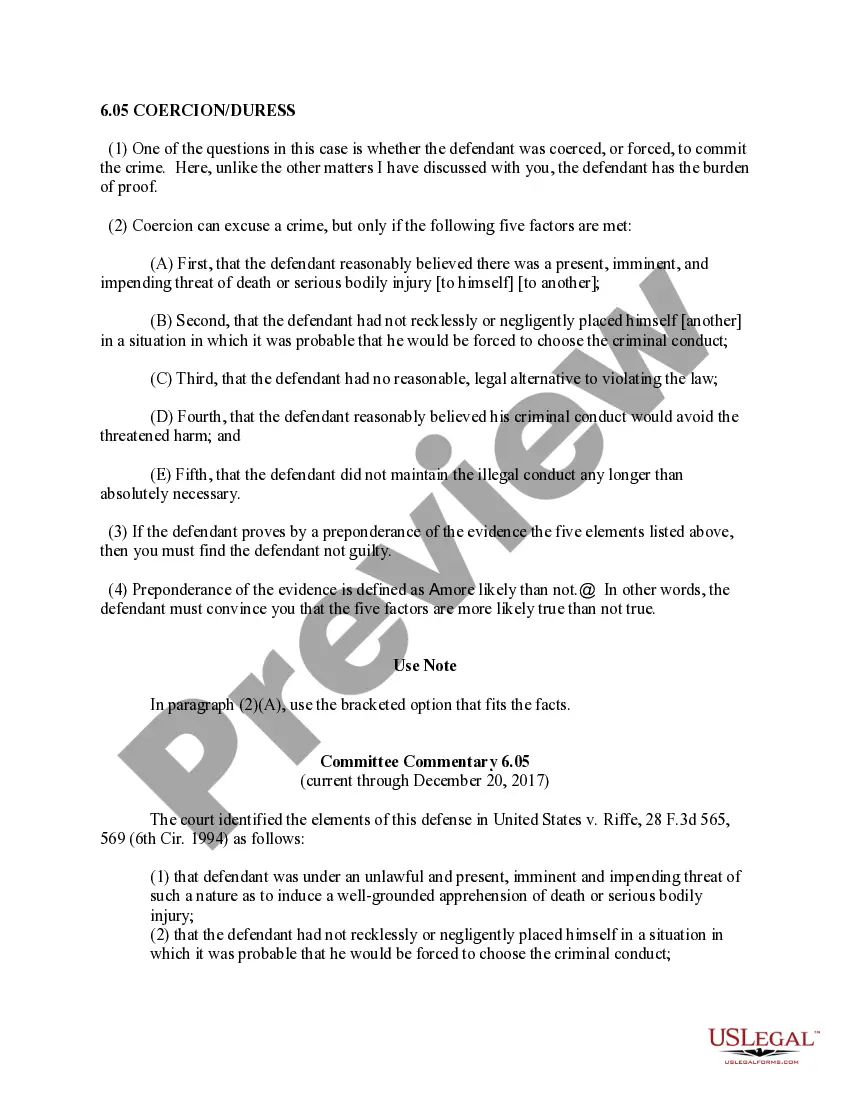
The 6.08 Coercion/Duress form is an official pattern jury instruction adopted by the Federal 7th Circuit Court. This legal document provides guidance on the defense of coercion, stating that a defendant may be found not guilty if they committed an offense under coercive threats. The form helps clarify the burden of proof on the defendant and the necessary elements to establish a coercion defense, differentiating it from other defenses in criminal law.
Main sections of this form
- Definition of coercion and its legal implications in criminal cases.
- Requirements for a defendant to prove coercion was present.
- Clarification of the burden of proof the defendant must meet.
- Details on the immediacy of threats and available alternatives.
- Commentary on case law that provides context.
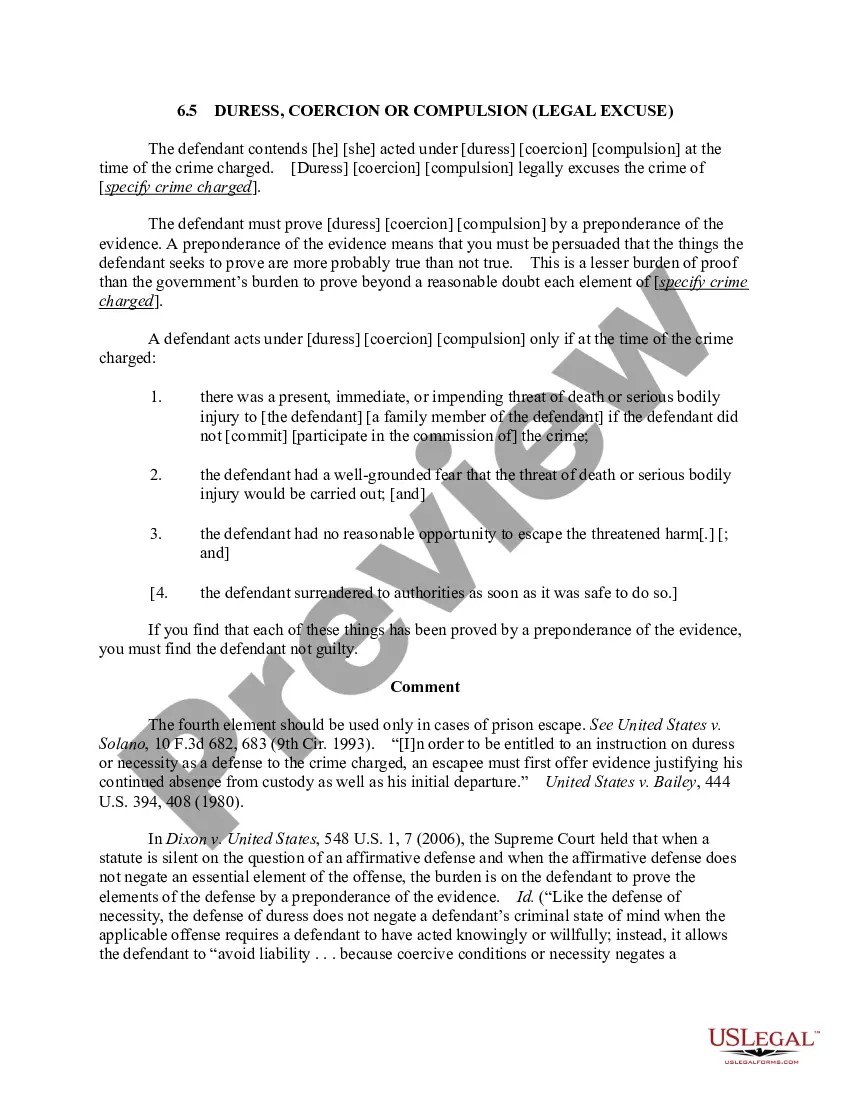
When to use this document
This form is used when a defendant in a criminal case claims they were coerced into committing a crime. It is applicable in situations where the defendant asserts they had a reasonable fear of death or serious harm as the basis for their actions. Use this document to mount a coercion defense in court when key elements can be demonstrated.
Who should use this form
- Defendants in criminal cases who argue coercion as a defense.
- Legal practitioners preparing jury instructions for cases involving duress.
- Individuals seeking to understand the legal framework surrounding coercion in offenses.
Completing this form step by step
- Identify the parties involved in the case, including the defendant.
- Specify the offense with applicable case numbers.
- Detail the nature of the coercion claim, including the specifics of the threat.
- Outline the defendant's opportunities to refuse the offense.
- Provide evidence or reference case law to support the coercion claim.
Notarization requirements for this form
Notarization is generally not required for this form. However, certain states or situations might demand it. You can complete notarization online through US Legal Forms, powered by Notarize, using a verified video call available anytime.
Get your form ready online
Our built-in tools help you complete, sign, share, and store your documents in one place.
Make edits, fill in missing information, and update formatting in US Legal Forms—just like you would in MS Word.
Download a copy, print it, send it by email, or mail it via USPS—whatever works best for your next step.
Sign and collect signatures with our SignNow integration. Send to multiple recipients, set reminders, and more. Go Premium to unlock E-Sign.
If this form requires notarization, complete it online through a secure video call—no need to meet a notary in person or wait for an appointment.
We protect your documents and personal data by following strict security and privacy standards.

Make edits, fill in missing information, and update formatting in US Legal Forms—just like you would in MS Word.

Download a copy, print it, send it by email, or mail it via USPS—whatever works best for your next step.

Sign and collect signatures with our SignNow integration. Send to multiple recipients, set reminders, and more. Go Premium to unlock E-Sign.

If this form requires notarization, complete it online through a secure video call—no need to meet a notary in person or wait for an appointment.

We protect your documents and personal data by following strict security and privacy standards.
Avoid these common issues
- Failing to provide sufficient evidence to support the coercion claim.
- Not clearly identifying the coercive threats made against the defendant.
- Assuming that fear alone qualifies for a coercion defense without additional context.
- Overlooking the requirement to show no reasonable alternatives were available.
Why use this form online
- Convenience of accessing templates anytime, without the need for physical travel.
- Editability provides flexibility to tailor the form to specific case details.
- Reliability of legally-assured content created and reviewed by licensed attorneys.
Looking for another form?
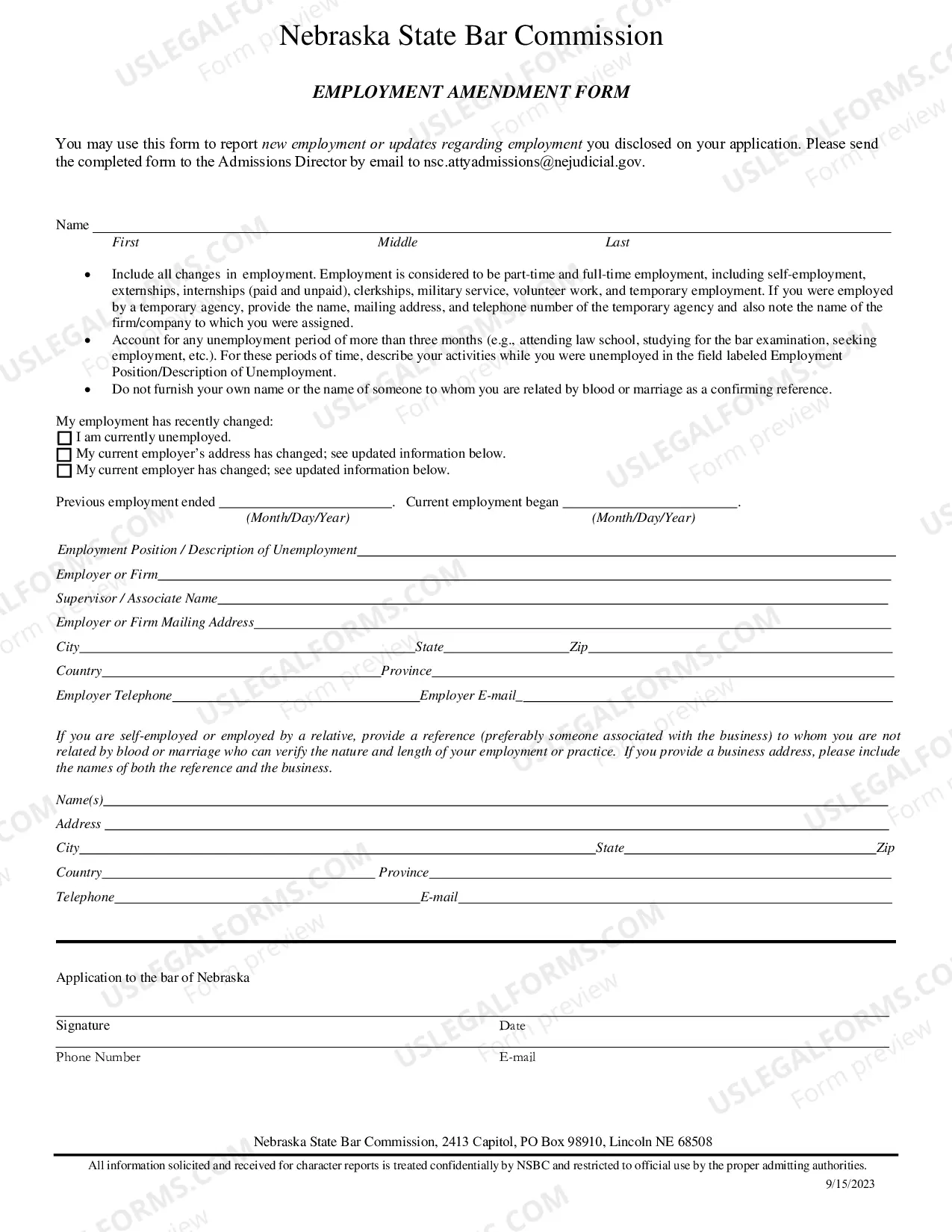
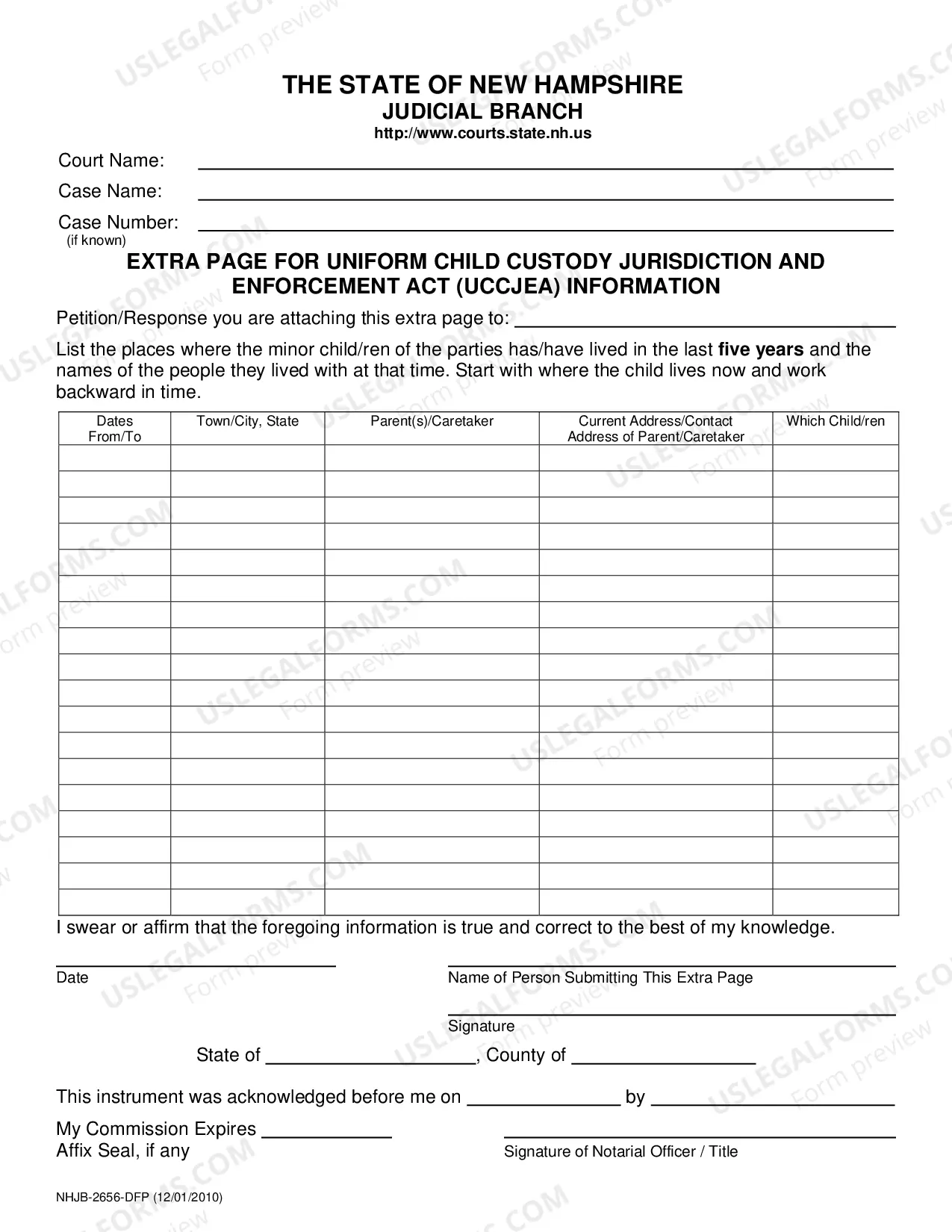
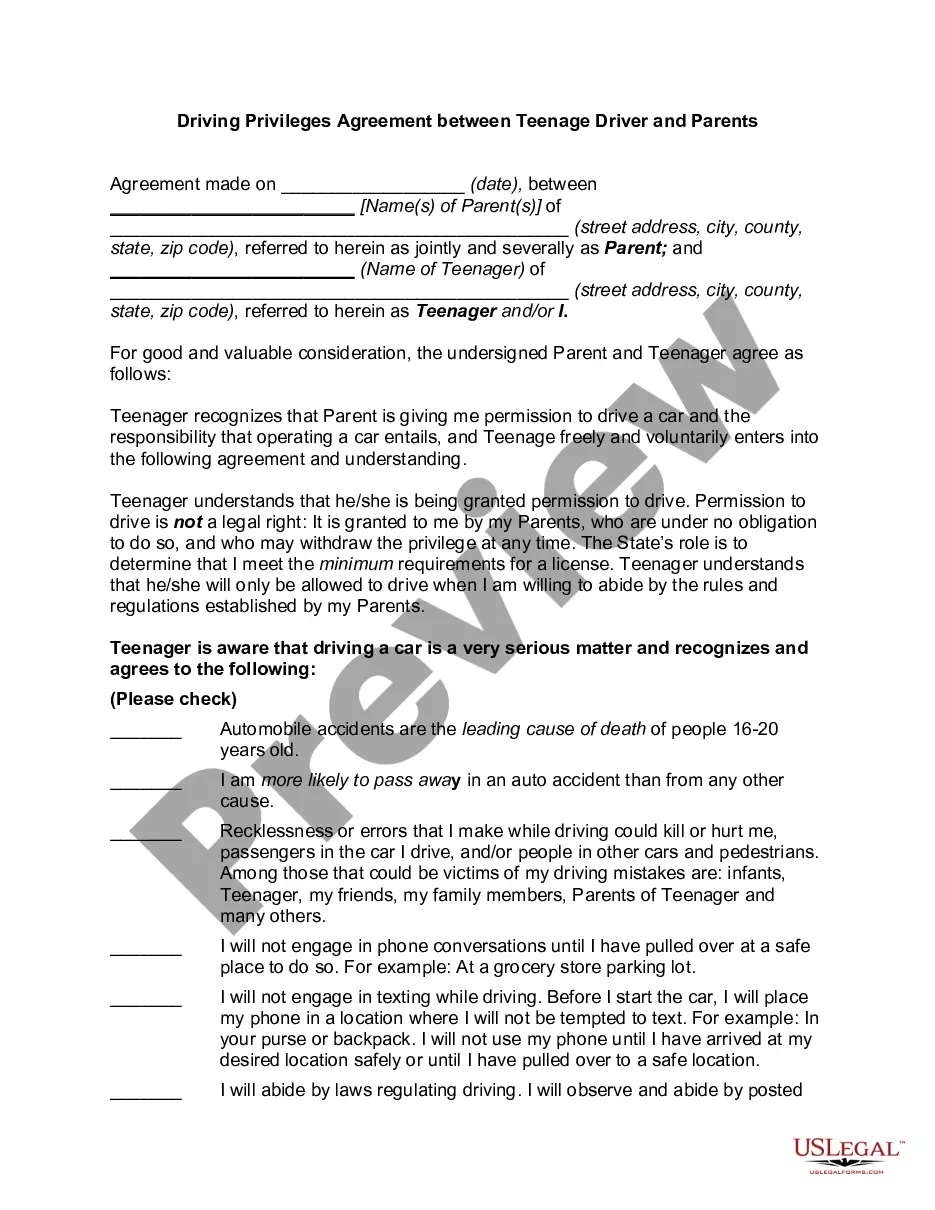
Form popularity
FAQ
Proving duress in a contract requires two things be proven: The contract was signed by a serious threat of unlawful or wrongful action. Blackmail or physical violence are examples of signing a contract under duress. He or she must also show that they had no reasonable alternative but to agree to the contract.
Duress refers to a situation where one person makes unlawful threats or otherwise engages in coercive behavior that causes another person to commit acts that they would otherwise not commit. In McCord v. Goode, 308 S.W.
Duress refers to coercion that causes a person to perform an act against his or her will. Duress is an important concept in both civil and criminal law that recognizes that a person who is acting without free will should not be held responsible for the conduct.
Requirements of Duress The party is in immediate threat of serious bodily harm or death. The threat made to the victim must be constant.The party believes that the perpetrator of the act will carry out the threat.There is no opportunity to escape safely, except by committing the unlawful act.
Physical coercion and threats of harm are common examples of conduct that constitute duress. Another form of conduct that might constitute legal duress includes wrongfully withholding a party's property, or threatening to wrongfully withhold the property until a contract is signed.
Contracts Entered Under Duress Duress to an Individual. When an individual enters into a contract because of threats to that person physically, then the contract may be set aside as long as the threat of physical violence was the reason the person entered into the contract.Duress to Goods.Economic Duress.
They are different. Undue Influence results from improper use of influence while Duress results from a threat or the actual performance of violence that coerces the testator to change the Will.