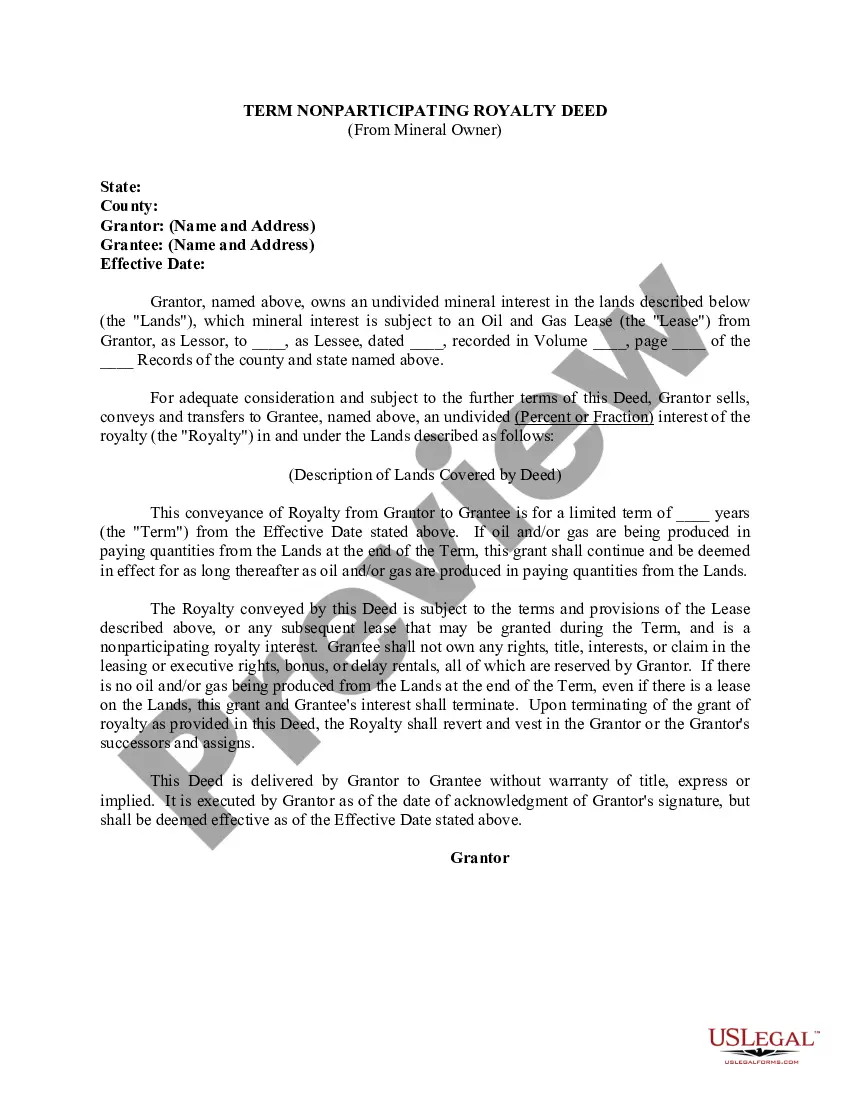
Term Nonparticipating Royalty Deed from Mineral Owner
Understanding this form
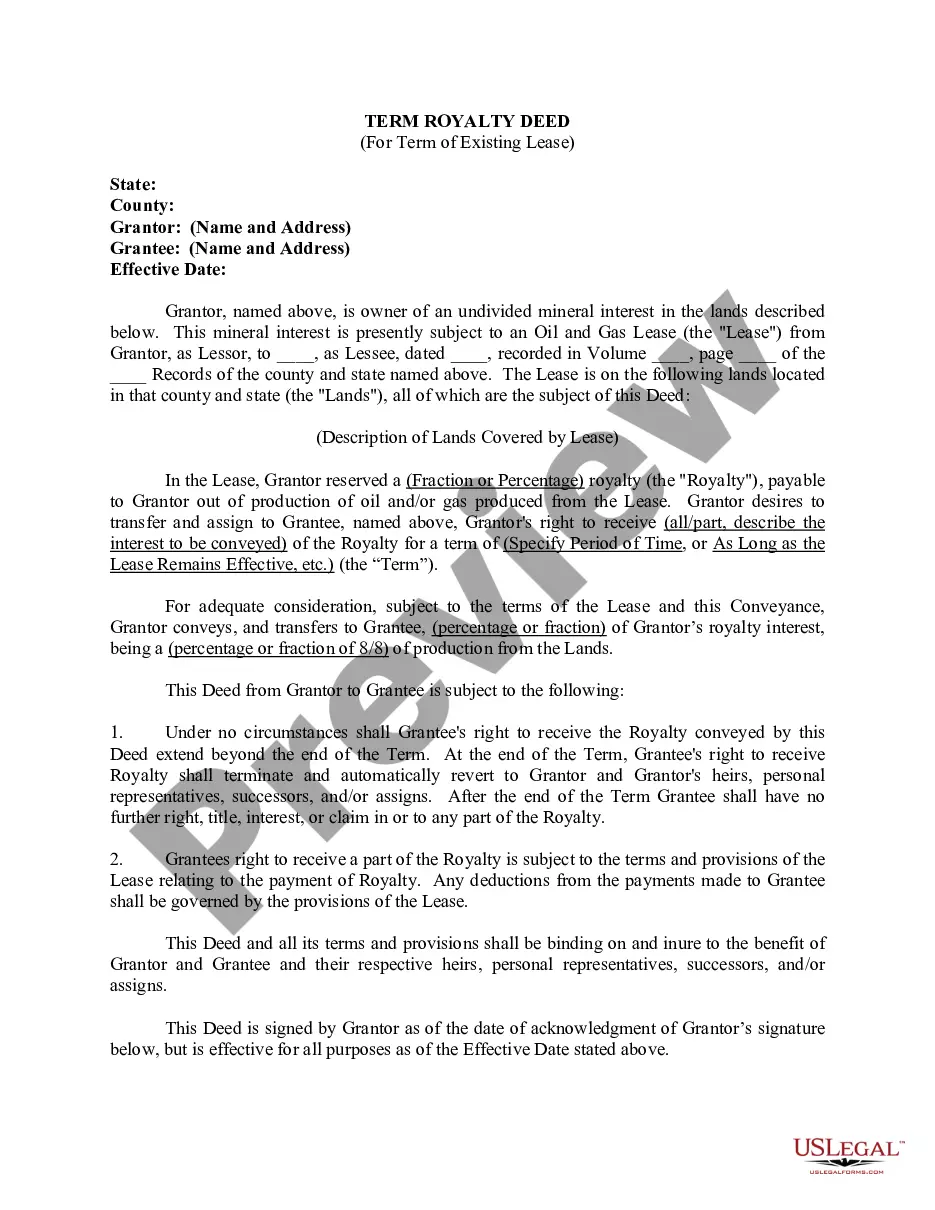
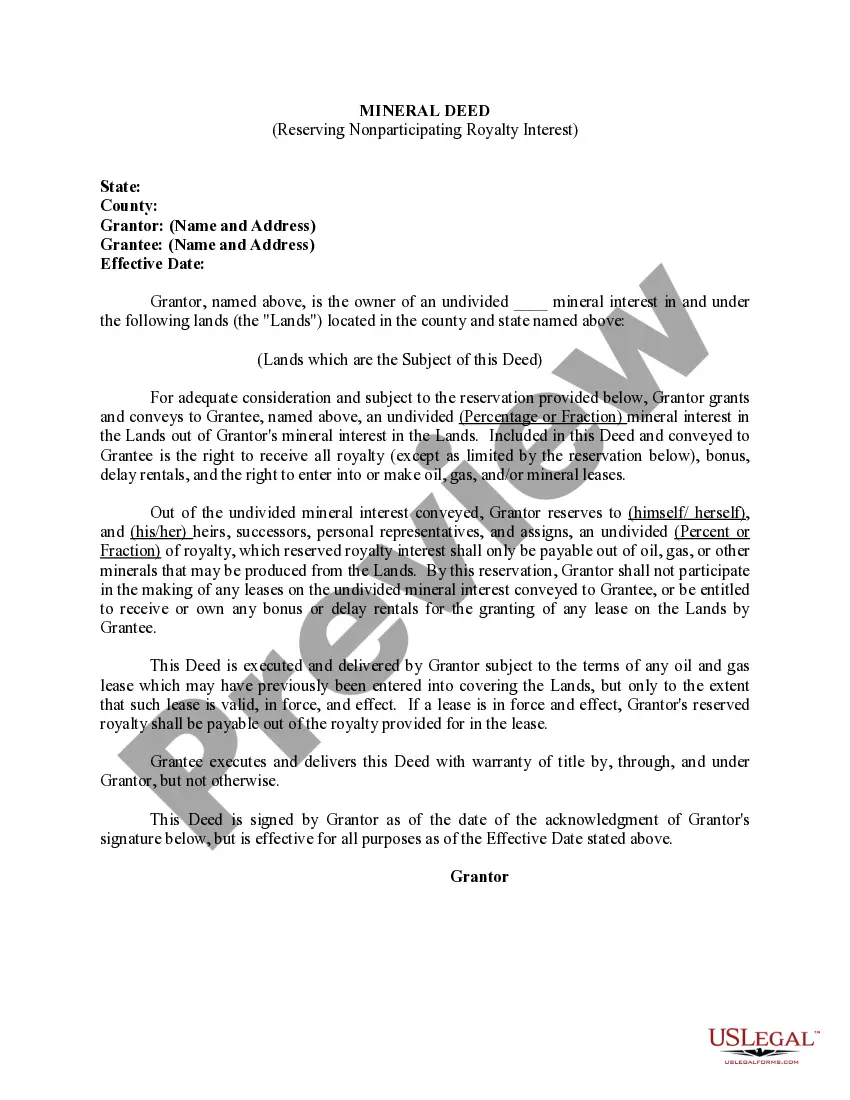
The Term Nonparticipating Royalty Deed from Mineral Owner is a legal document that facilitates the transfer of a specified royalty interest in mineral rights. This deed allows a mineral owner, known as the grantor, to convey a defined percentage of the royalty to another party, referred to as the grantee, for a specific term. Unlike other deeds, this document stipulates that the grantee will not have rights to other interests, such as leasing or executive rights, making it a nonparticipating royalty interest.
What’s included in this form
- Grantor and grantee details, including names and addresses.
- Effective date of the conveyance.
- Description of the land and mineral interests involved.
- Percentage or fraction of the royalty interest being conveyed.
- Term of years for which the royalty interest is granted.
- Conditions under which the royalty interest continues or terminates.

When to use this document
This form is typically used when a mineral owner wants to transfer a portion of their royalty interest in a mineral lease for a specified duration. Common scenarios include estate planning, financial transactions where immediate cash flow is needed, or when a mineral owner wishes to retain some rights while monetizing others. It is ideal when oil or gas is being produced and the owner wants to allow another party to receive royalties without transferring full ownership rights.
Intended users of this form
- Mineral owners who wish to convey a portion of their royalty interests.
- Individuals or entities interested in acquiring nonparticipating royalty interests for investment purposes.
- Heirs or successors needing to manage inherited mineral rights effectively.
Steps to complete this form
- Identify the parties by entering the names and addresses of the grantor and grantee.
- Specify the effective date of the conveyance.
- Provide a complete description of the lands and mineral interests involved.
- Enter the percentage or fraction of the royalty interest being conveyed.
- Indicate the term of the conveyance in years.
- Sign and date the deed as required, ensuring any necessary acknowledgments are completed.
Does this form need to be notarized?
To make this form legally binding, it must be notarized. Our online notarization service, powered by Notarize, lets you verify and sign documents remotely through an encrypted video session.
Get your form ready online
Our built-in tools help you complete, sign, share, and store your documents in one place.
Make edits, fill in missing information, and update formatting in US Legal Forms—just like you would in MS Word.
Download a copy, print it, send it by email, or mail it via USPS—whatever works best for your next step.
Sign and collect signatures with our SignNow integration. Send to multiple recipients, set reminders, and more. Go Premium to unlock E-Sign.
If this form requires notarization, complete it online through a secure video call—no need to meet a notary in person or wait for an appointment.
We protect your documents and personal data by following strict security and privacy standards.

Make edits, fill in missing information, and update formatting in US Legal Forms—just like you would in MS Word.

Download a copy, print it, send it by email, or mail it via USPS—whatever works best for your next step.

Sign and collect signatures with our SignNow integration. Send to multiple recipients, set reminders, and more. Go Premium to unlock E-Sign.

If this form requires notarization, complete it online through a secure video call—no need to meet a notary in person or wait for an appointment.

We protect your documents and personal data by following strict security and privacy standards.
Common mistakes
- Not specifying the land description accurately.
- Failing to clearly state the percentage of the royalty interest being conveyed.
- Omitting to record the deed as required by local laws.
- Not including an effective date, which can lead to confusion about when the rights transfer occurs.
Benefits of completing this form online
- Convenience of downloading and completing the form at your own pace.
- Editability ensures you can customize the document to fit your specific transaction.
- Access to forms drafted by licensed attorneys for reliability and legal accuracy.
- Instant availability without the need for in-person appointments.
Looking for another form?
Form popularity
FAQ
After a divorce, mineral rights can be transferred by submitting the divorce decree and conveyances to the county (where the minerals are located) for recording. They usually go to the same agency that records titles and property deeds. The county will return the recorded original documents to the new owner.
Are inherited mineral rights taxable? The federal government does not consider inherited mineral rights taxable. Still, any income you accumulate from those rights does have to be reported on your tax return.
A mineral deed form is a legal document, regarding the ownership of the minerals below the surface of the earth.A royalty owner will only benefit economically if the mineral owner decides to produce and sell the minerals.
Call the county where the minerals are located and ask how to transfer mineral ownership after death. They will probably advise you to submit a copy of the death certificate, probate documents (if any), and a copy of the will (or affidavit of heirship if there is no will).
Mineral interests and royalty interests both involve ownership of the minerals under the ground. The main difference between the two is that the owner of a mineral interest has the right to execute leases and collect bonus payments and the owner of royalty interests does not execute leases or collect bonus payments.
Mineral rights are automatically included as a part of the land in a property conveyance, unless and until the ownership gets separated at some point by an owner/seller.Conveying (selling or otherwise transferring) the land but retaining the mineral rights.
Mineral rights must be transferred to heirs before any transactions related to them can take place. Unlike a home, which can be sold by an estate, mineral rights must be transferred before any sale. Mineral rights can be transferred to rightful heir(s) or to a trust through a mineral deed.
If you want to sell the mineral rights to another person, you can transfer them by deed. You will need to create a mineral deed and have it recorded. You should check with the county Recorder of Deeds in the county where the land is located and ask if a printed mineral deed form is available to use.