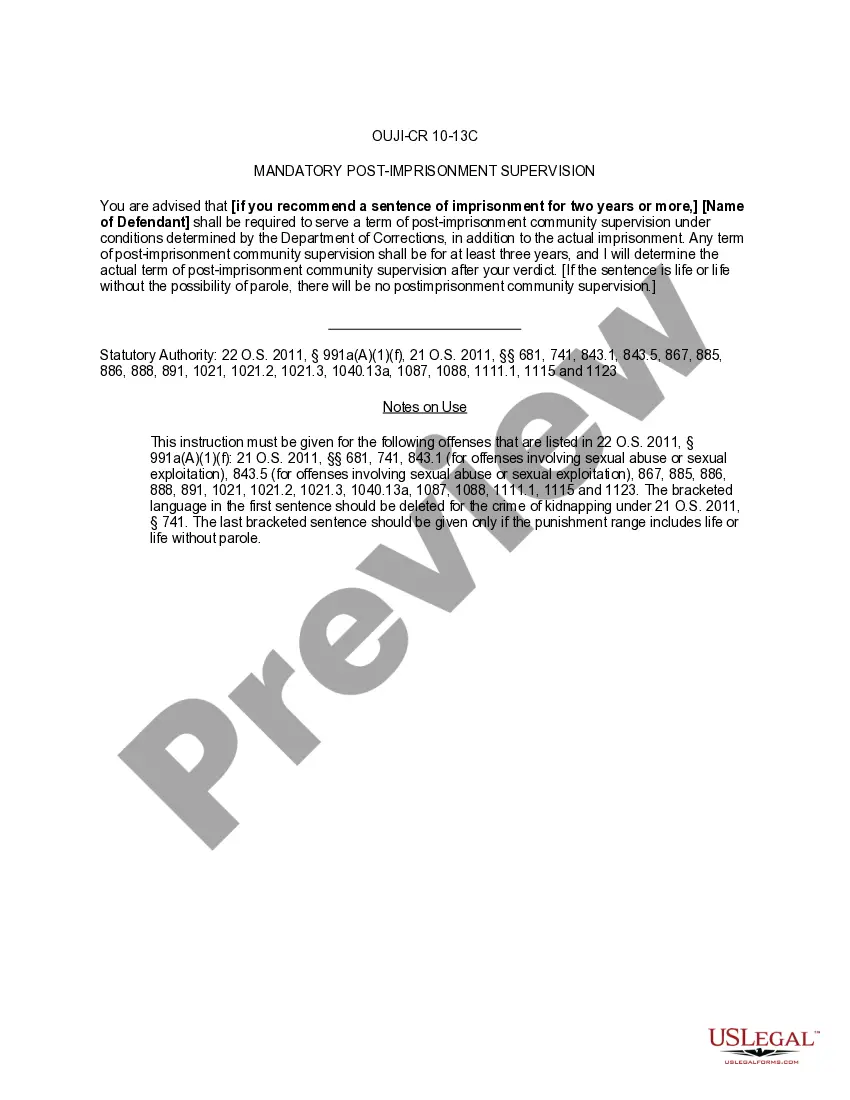
Term Royalty Deed for Term of Existing Lease
What is this form?
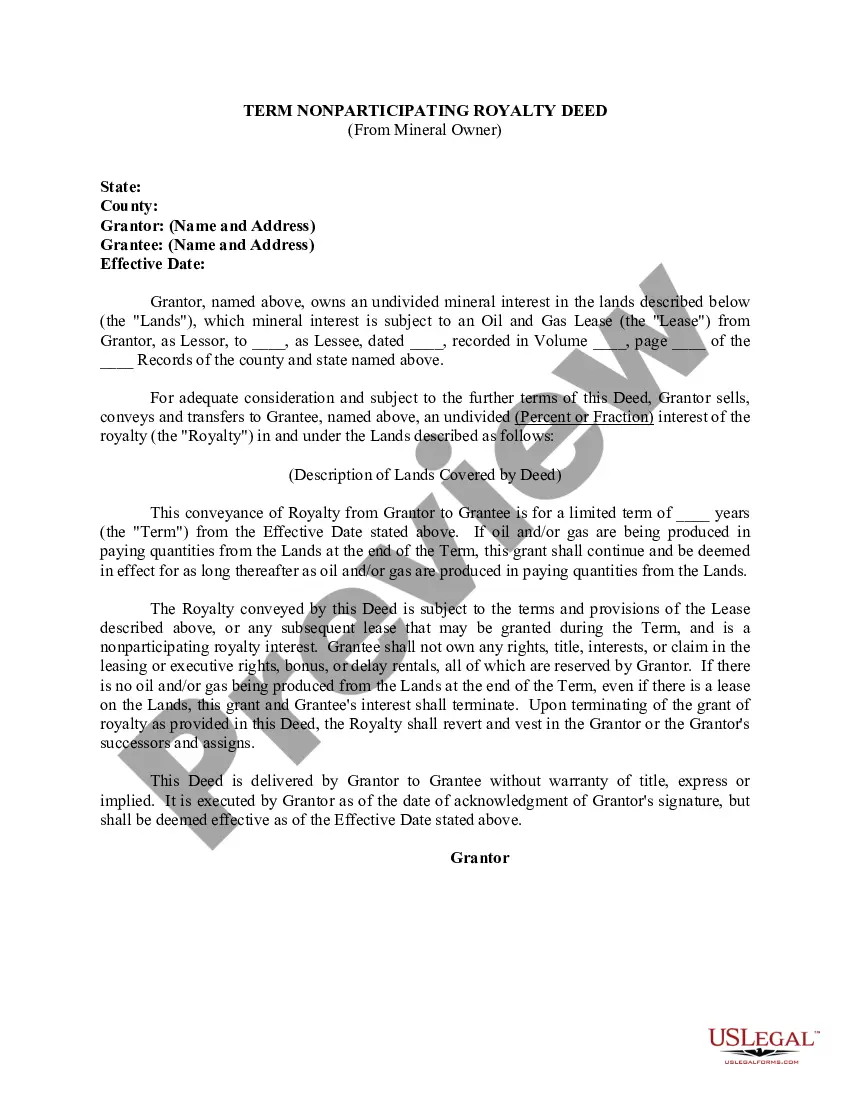
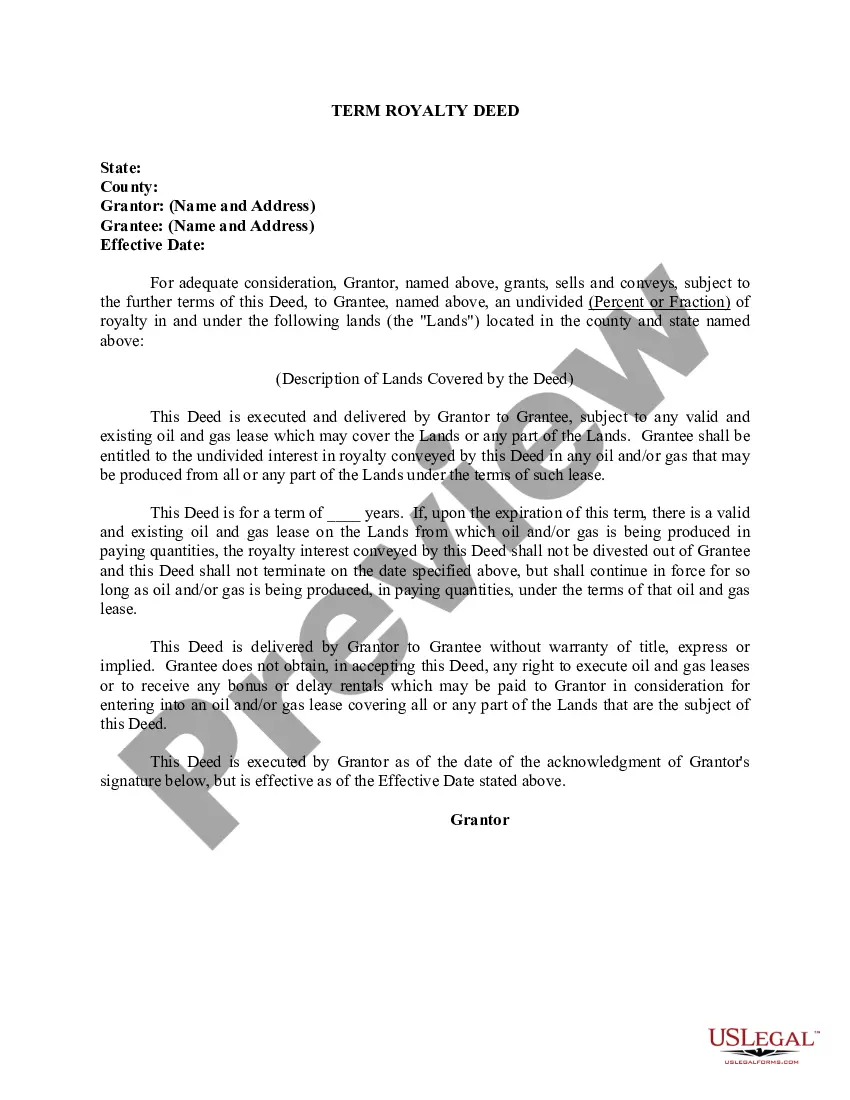
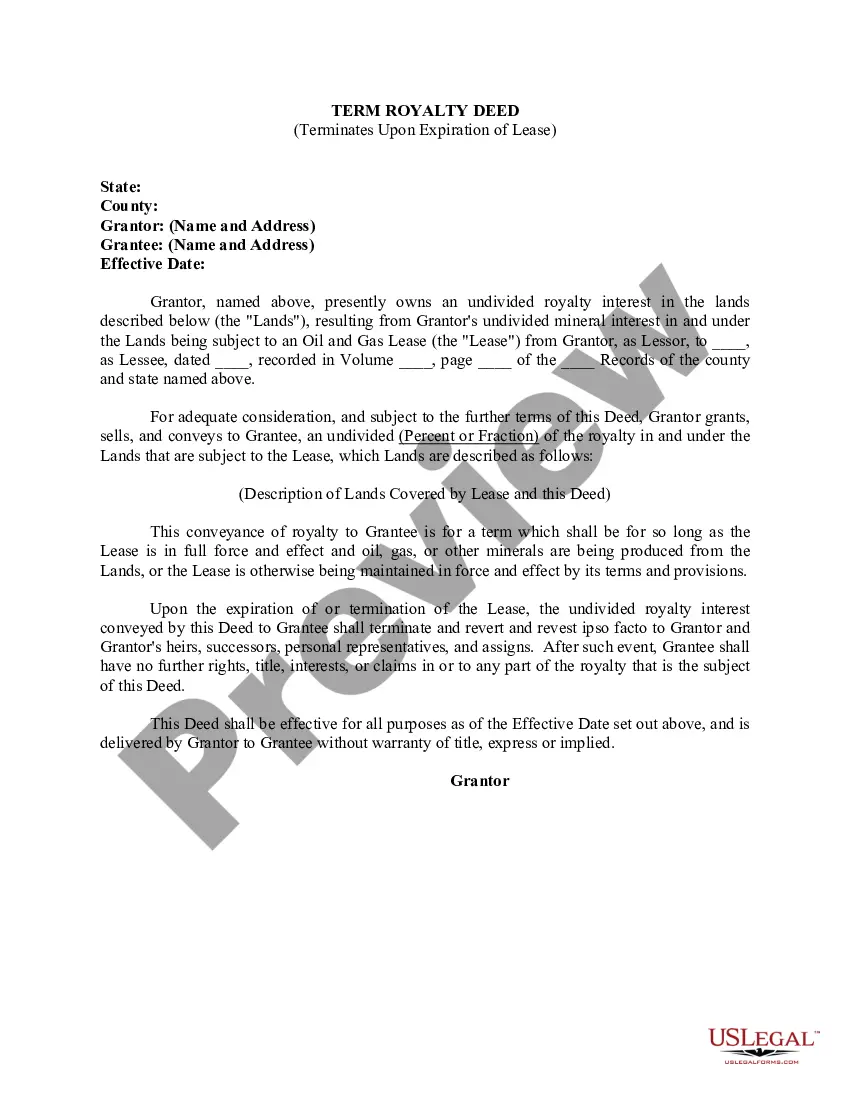
The Term Royalty Deed for Term of Existing Lease is a legal document used to convey a royalty interest for a specified duration, linked to an existing oil and gas lease. This form is essential for transferring the right to receive royalties from oil and gas production, distinguishing it from other deed types that may not be temporally bound or tied to active leases.
What’s included in this form
- Grantor and Grantee Information: Clearly identifies the parties involved, including names and addresses.
- Effective Date: Specifies when the transfer of royalty interest becomes effective.
- Description of Lands Covered: Details the property subject to the oil and gas lease.
- Royalty Transfer Terms: Outlines the fraction or percentage of the royalty being conveyed.
- Term Duration: Defines the time period or conditions under which the royalty interest remains effective.
- Conditions of Reversion: States that the rights will revert to the grantor and their heirs after the specified term.

When to use this document
This form should be used when the owner of mineral rights wants to temporarily transfer their right to receive royalties from an oil and gas lease to another party. It is useful in situations such as financial arrangements, investment opportunities, or when the mineral owner wishes to share profits for a limited time while retaining ownership of the property rights.
Who can use this document
- Mineral interest owners looking to transfer royalty rights for a limited time.
- Investors wanting to acquire a percentage of royalties from oil and gas production.
- Estate executors managing the distribution of mineral rights during asset division.
- Individuals seeking to formalize a financial contract related to oil and gas lease royalties.
Completing this form step by step
- Identify and enter the names and addresses of the Grantor (seller) and Grantee (buyer).
- Specify the effective date of the royalty transfer.
- Provide a detailed description of the lands covered by the existing oil and gas lease.
- Indicate the fraction or percentage of royalty interest being conveyed.
- Define the duration of the royalty rights, whether for a specified period or as long as the lease remains effective.
- Have the Grantor sign the deed and ensure proper acknowledgment is executed.
Notarization guidance
This document requires notarization to meet legal standards. US Legal Forms provides secure online notarization powered by Notarize, allowing you to complete the process through a verified video call, available 24/7.
Get your form ready online
Our built-in tools help you complete, sign, share, and store your documents in one place.
Make edits, fill in missing information, and update formatting in US Legal Forms—just like you would in MS Word.
Download a copy, print it, send it by email, or mail it via USPS—whatever works best for your next step.
Sign and collect signatures with our SignNow integration. Send to multiple recipients, set reminders, and more. Go Premium to unlock E-Sign.
If this form requires notarization, complete it online through a secure video call—no need to meet a notary in person or wait for an appointment.
We protect your documents and personal data by following strict security and privacy standards.

Make edits, fill in missing information, and update formatting in US Legal Forms—just like you would in MS Word.

Download a copy, print it, send it by email, or mail it via USPS—whatever works best for your next step.

Sign and collect signatures with our SignNow integration. Send to multiple recipients, set reminders, and more. Go Premium to unlock E-Sign.

If this form requires notarization, complete it online through a secure video call—no need to meet a notary in person or wait for an appointment.

We protect your documents and personal data by following strict security and privacy standards.
Common mistakes to avoid
- Failing to accurately describe the lands covered by the oil and gas lease.
- Neglecting to specify the exact duration for which the royalty interest is being conveyed.
- Leaving out essential details about the Grantor and Grantee, such as addresses.
- Not having the document signed and acknowledged appropriately.
Advantages of online completion
- Convenience of downloading and filling out the form at your own pace.
- Editable templates that allow for customization to fit your specific lease terms.
- Access to legal forms prepared by licensed attorneys, ensuring clarity and compliance.
Looking for another form?
Form popularity
FAQ
Oil & gas royalties are paid monthly, consistent with the normal accounting cycle of the producer, unless the obligation does not meet the minimum check requirement for that particular state. These laws are generally known as aggregate pay laws, usually set at either $25 or $100.
An owner can separate the mineral rights from his or her land by: Conveying (selling or otherwise transferring) the land but retaining the mineral rights. (This is accomplished by including a statement in the deed conveying the land that reserves all rights to the minerals to the seller.)
In the event oil and gas were found and the wells produce, then the royalties kick in. So if the oil well produce 100 barrels a day, and the price of oil is $80 per barrel that month, then the cash flow is 100x$80 = $8,000/day The royalty owner, who agreed to 15% royalty, would receive $8,000 x 0.15 = $1,200/day.
Whenever oil or gas production begins, the landowner is entitled to part of the total production. A royalty is agreed upon as a percentage of the lease, minus what was reasonably used in the Lessee's production costs. The royalty is paid by the Lessee to the owner of the mineral rights, the Lessor in the Lease.
In other words royalty is a fee or consideration paid to the property owner for the right to use the property or patentee for the use of a patent or property against money obtained on sold of each patent or value of extract resources during the licensed period.
A royalty is the portion of production the landowner receives. A royalty clause in the oil or gas title process will typically give a percentage of the lease that the company pays to the owner of the mineral rights, minus production costs. Royalties are free from costs and charges, other than taxes.
As a mineral rights value rule of thumb, the 3X cash flow method is often used. To calculate mineral rights value, multiply the 12-month trailing cash flow by 3. For a property with royalty rights, a 5X multiple provides a more accurate valuation (stout.com).
An overriding royalty interest is the right to receive revenue from the production of oil and gas from a well. The overriding royalty is carved out of the lessee's (operator's) working interest and entitles its owner to a fraction of production.
For many years, almost all oil and gas leases reserved a 1/8th royalty. Today, the royalty fraction is negotiable, and is usually between 1/8th and 1/4th. Bonus. The bonus is the amount paid to the Lessor as consideration for his/her execution of the lease.