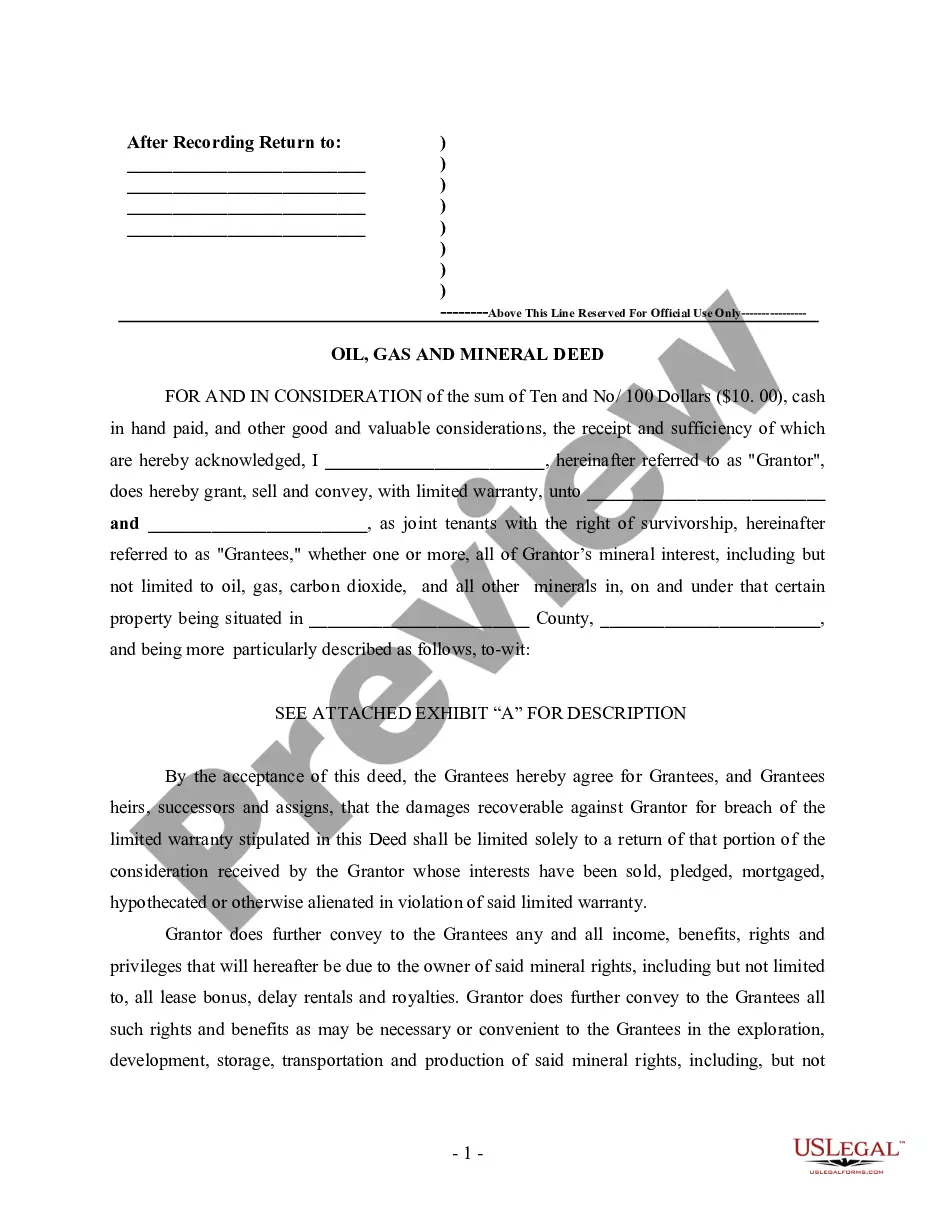
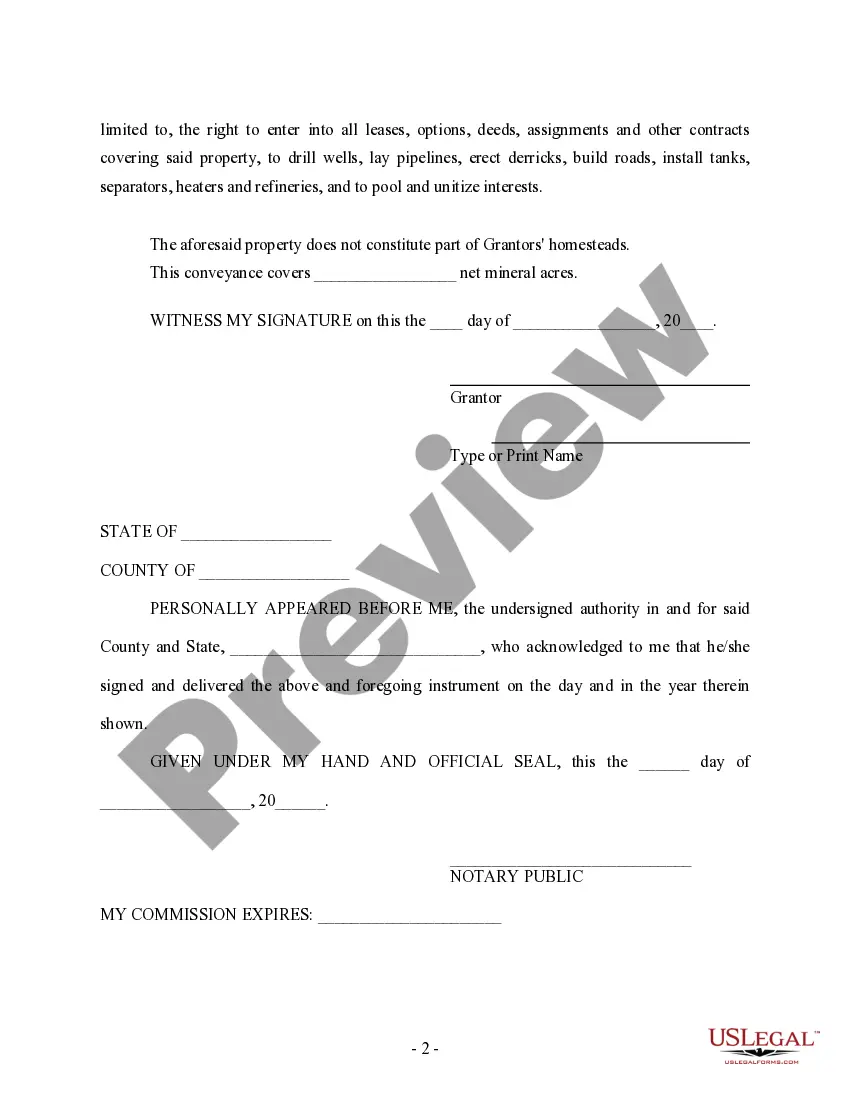
Grantor conveys, with limited warranty, unto the grantees all of grantor's mineral interest, including but not limited to oil, gas, carbon dioxide, and all other minerals in, on and under certain property described in the document.
Oil, Gas and Mineral Deed - Individual to Two Individuals
Category:
State:
Multi-State
Control #:
US-00576-A
Format:
Word;
Rich Text
Instant download
Description
Free preview


How to fill out Oil, Gas And Mineral Deed - Individual To Two Individuals?
Aren't you sick and tired of choosing from countless samples every time you want to create a Oil, Gas and Mineral Deed - Individual to Two Individuals? US Legal Forms eliminates the lost time millions of American people spend surfing around the internet for appropriate tax and legal forms. Our skilled group of attorneys is constantly upgrading the state-specific Forms catalogue, so that it always provides the proper files for your situation.
If you’re a US Legal Forms subscriber, just log in to your account and click on the Download button. After that, the form can be found in the My Forms tab.
Visitors who don't have an active subscription should complete easy actions before having the ability to get access to their Oil, Gas and Mineral Deed - Individual to Two Individuals:
- Use the Preview function and read the form description (if available) to make sure that it’s the proper document for what you are looking for.
- Pay attention to the applicability of the sample, meaning make sure it's the proper template for the state and situation.
- Make use of the Search field at the top of the site if you have to look for another file.
- Click Buy Now and choose a convenient pricing plan.
- Create an account and pay for the service using a credit card or a PayPal.
- Download your document in a needed format to finish, print, and sign the document.
Once you have followed the step-by-step instructions above, you'll always have the ability to log in and download whatever file you need for whatever state you need it in. With US Legal Forms, completing Oil, Gas and Mineral Deed - Individual to Two Individuals templates or other official files is not hard. Get going now, and don't forget to double-check your examples with certified attorneys!
Form popularity
FAQ
A: Mineral rights are the legal rights to the minerals in a property. Whoever owns a property's mineral rights has full legal rights to mine for and profit from those minerals.
An owner can separate the mineral rights from his or her land by: Conveying (selling or otherwise transferring) the land but retaining the mineral rights. (This is accomplished by including a statement in the deed conveying the land that reserves all rights to the minerals to the seller.)
As a mineral rights value rule of thumb, the 3X cash flow method is often used. To calculate mineral rights value, multiply the 12-month trailing cash flow by 3. For a property with royalty rights, a 5X multiple provides a more accurate valuation (stout.com).
After a divorce, mineral rights can be transferred by submitting the divorce decree and conveyances to the county (where the minerals are located) for recording. They usually go to the same agency that records titles and property deeds. The county will return the recorded original documents to the new owner.
A deed that names the seller/donor and the purchaser/donee. It states and describes the rights being sold or given. Filing of the notarized conveyance in the county government office which is generally the county clerk's office.
In Texas, and most other states, the ownership of the mineral estate can be separated (severed) from the surface estate. Put another way, one person may own the rights to use the surface of a piece of property while another person has the right to use the minerals underneath the property.
Call the county where the minerals are located and ask how to transfer mineral ownership after death. They will probably advise you to submit a copy of the death certificate, probate documents (if any), and a copy of the will (or affidavit of heirship if there is no will).
A mineral owner's rights typically include the right to use the surface of the land to access and mine the minerals owned. This might mean the mineral owner has the right to drill an oil or natural gas well, or excavate a mine on your property.
If you want to sell the mineral rights to another person, you can transfer them by deed. You will need to create a mineral deed and have it recorded. You should check with the county Recorder of Deeds in the county where the land is located and ask if a printed mineral deed form is available to use.