Impeachment of Defendant - Prior Conviction (F.R.E. 609) (revised 2014)
What this document covers
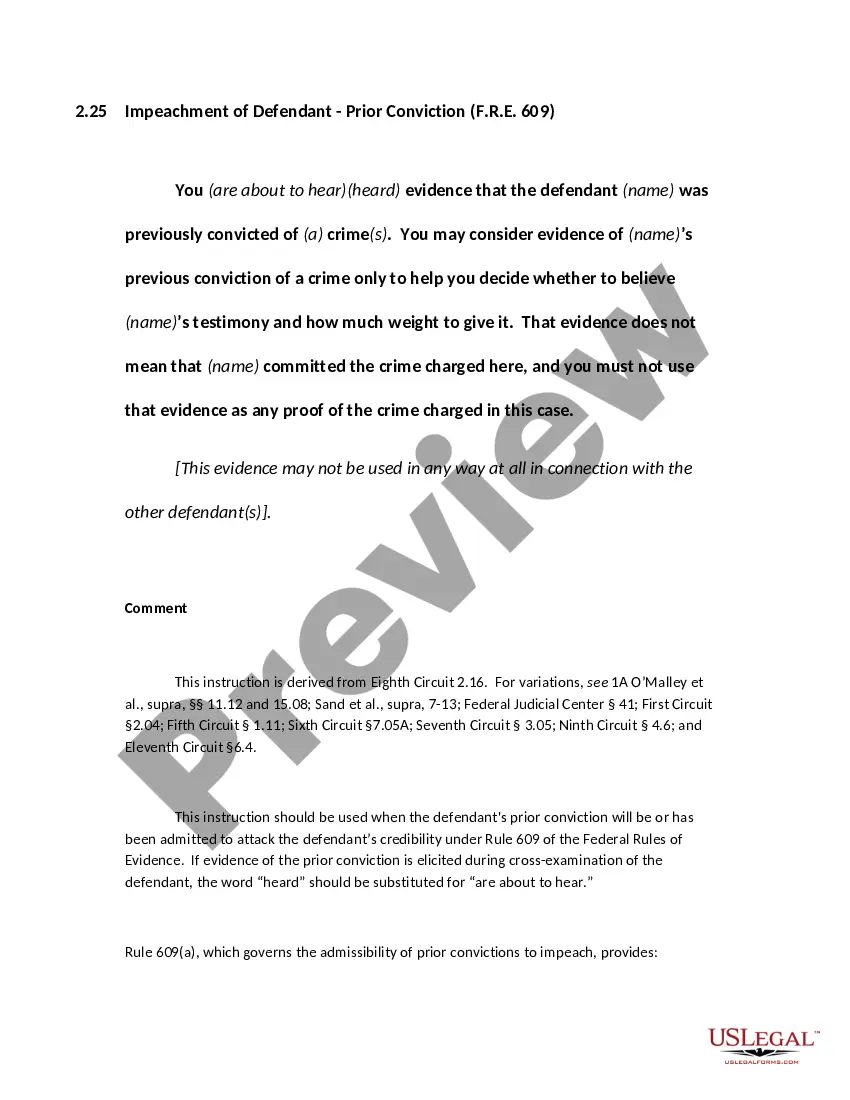
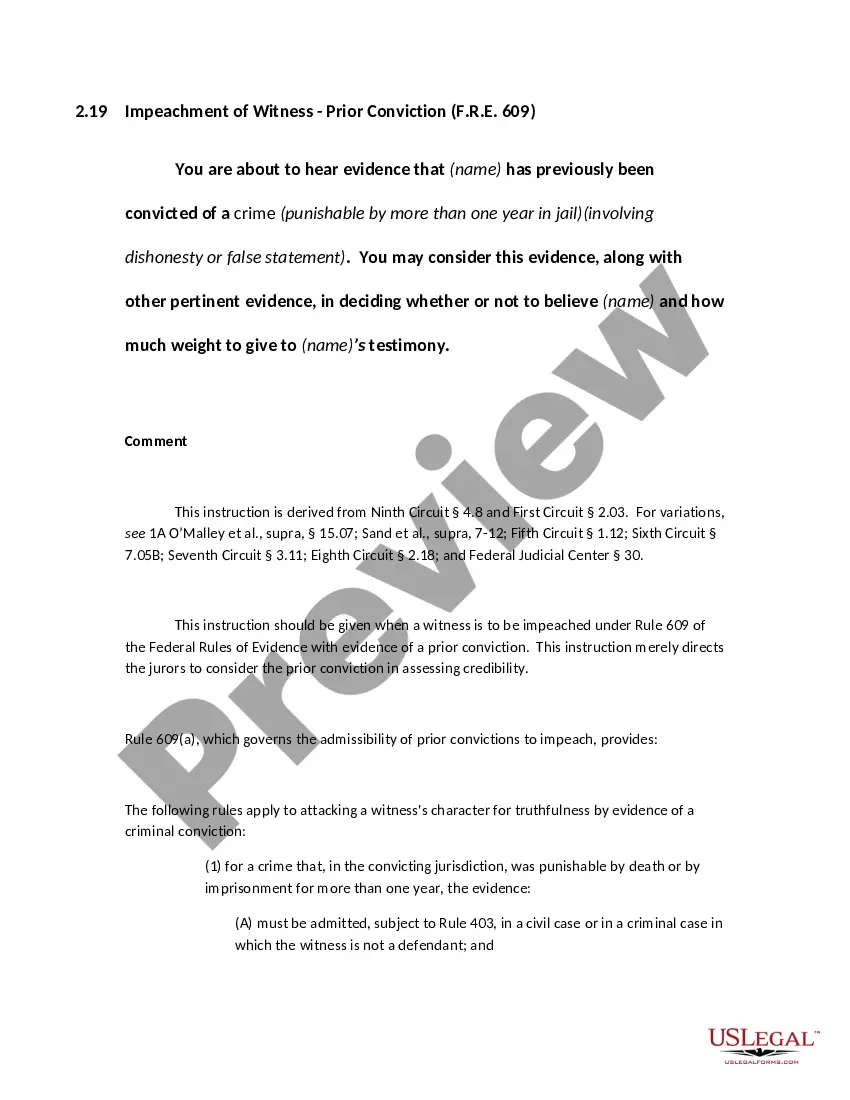
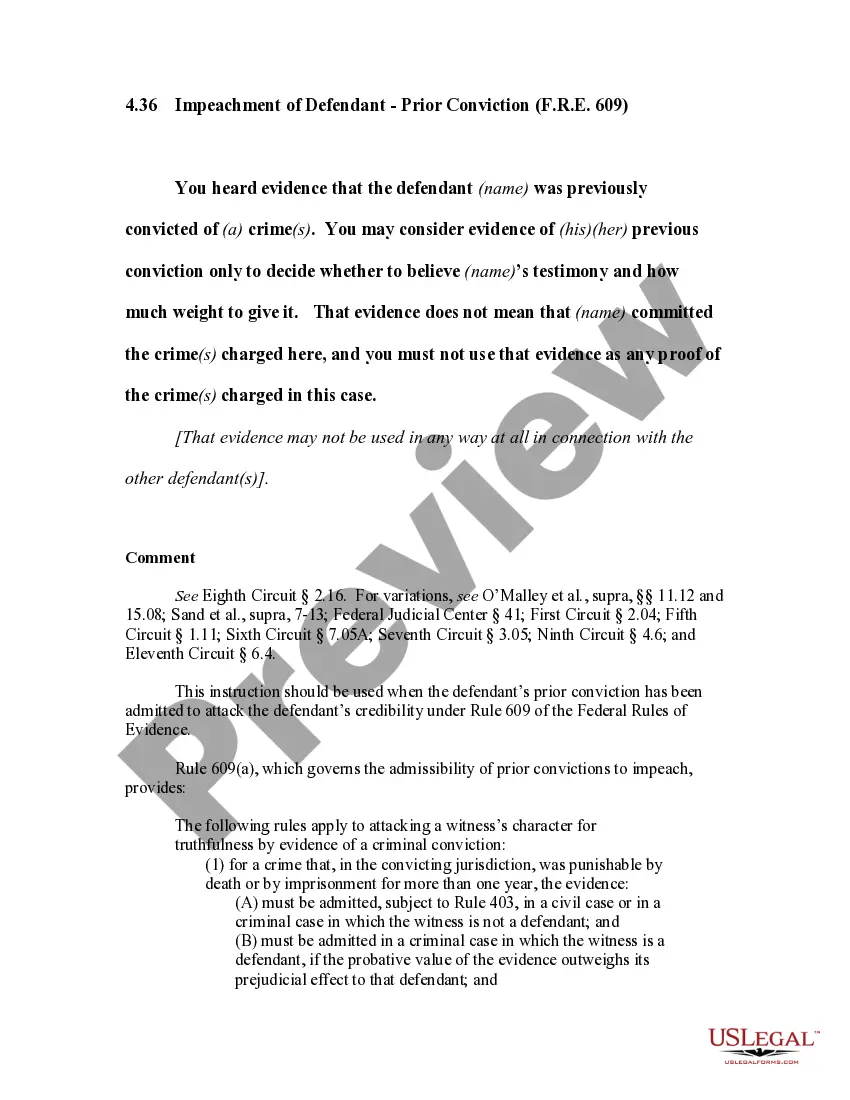
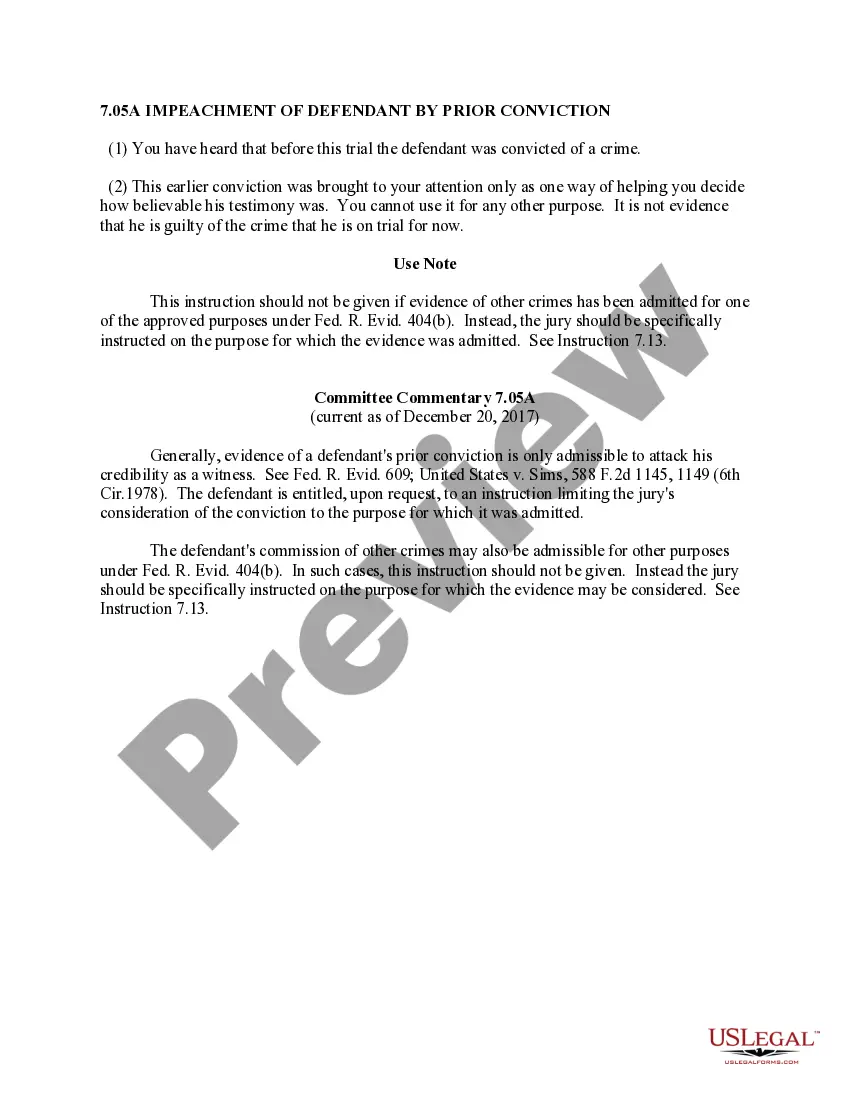
The Impeachment of Defendant - Prior Conviction (F.R.E. 609) is a legal form used to present evidence regarding a defendant's past criminal convictions in court. This form is specifically designed to allow juries to evaluate the credibility of a defendant's testimony without assuming guilt for the current charges based solely on their prior offenses. It serves a distinct purpose compared to other legal forms as it provides jurors with guidance on how to appropriately consider prior convictions.
Key parts of this document
- Defendant's name: Identify the person whose prior convictions are being referenced.
- Description of prior convictions: Specific details about the nature of the prior crimes committed.
- Consideration of evidence: Instructions to jurors on how to use the prior conviction evidence regarding the defendant's testimony.
- Limitations on use: Guidelines on restricting the use of this evidence solely for attacking credibility to avoid prejudicing the jury against the defendant.
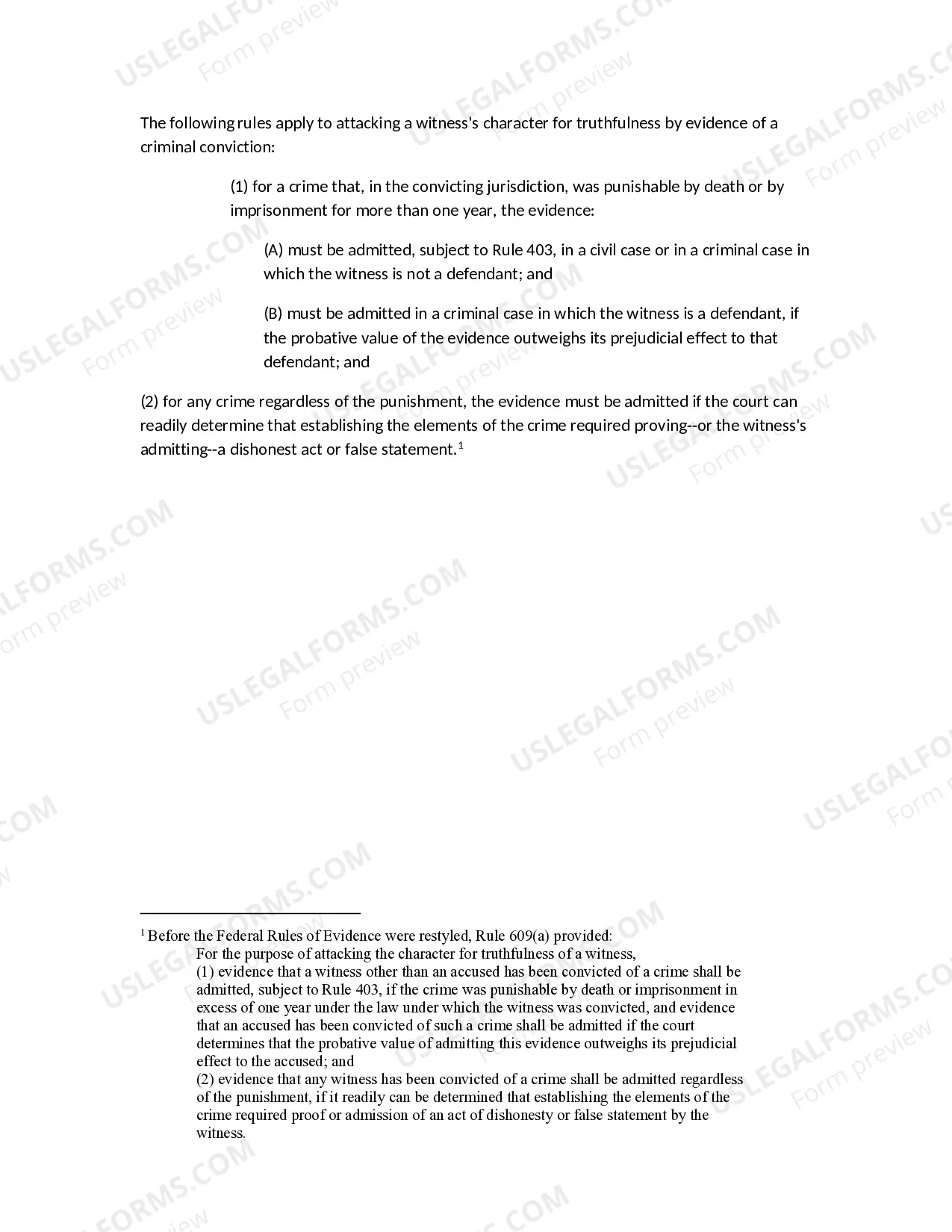
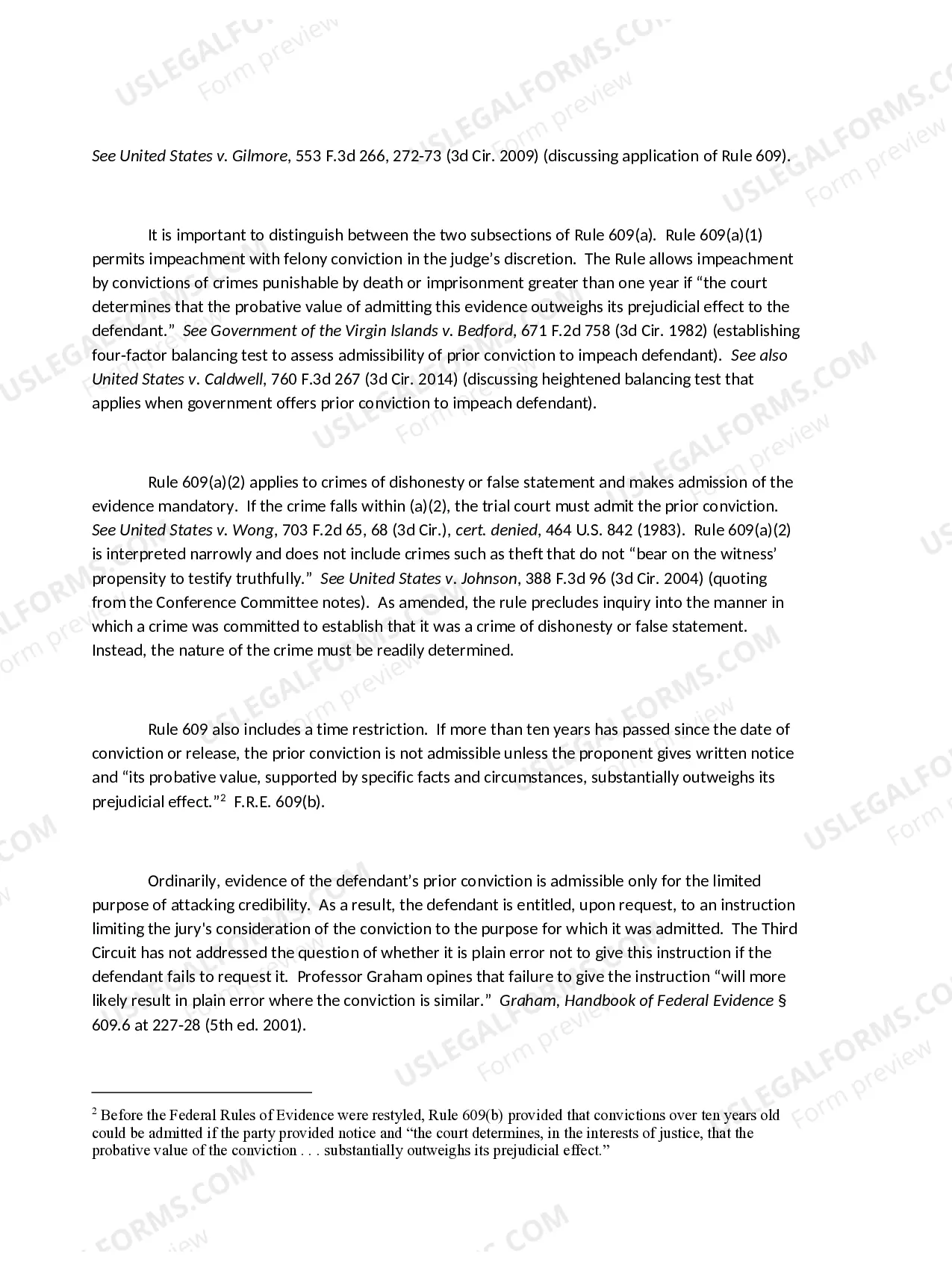
- Legal references: Cites relevant legal standards and case law to support the admissibility of prior convictions under Rule 609.
Situations where this form applies
This form is utilized during criminal trials when the defendant's past convictions are admitted as evidence to challenge their credibility. It ensures that jurors understand they can consider these past offenses only for determining how much weight to give the defendant's testimony, not as evidence of guilt for the current charges.
Who needs this form
- Trial judges seeking to instruct juries on the proper use of prior conviction evidence.
- Prosecutors planning to introduce a defendant's previous convictions during a trial.
- Defense attorneys who wish to understand the implications of such evidence and prepare appropriate jury instructions.
Instructions for completing this form
- Identify the defendant's full name to be included in the form.
- Specify the details of each prior conviction relevant to the case.
- Prepare the jury instructions by ensuring they clearly explain the limited purpose of considering the prior convictions.
- Cite applicable rules and legal precedents that support the admissibility and consideration of this evidence.
- Consult with legal counsel to ensure compliance with jurisdiction-specific laws and standards.
Is notarization required?
This form does not typically require notarization to be legally valid. However, some jurisdictions or document types may still require it. US Legal Forms provides secure online notarization powered by Notarize, available 24/7 for added convenience.
Get your form ready online
Our built-in tools help you complete, sign, share, and store your documents in one place.
Make edits, fill in missing information, and update formatting in US Legal Forms—just like you would in MS Word.
Download a copy, print it, send it by email, or mail it via USPS—whatever works best for your next step.
Sign and collect signatures with our SignNow integration. Send to multiple recipients, set reminders, and more. Go Premium to unlock E-Sign.
If this form requires notarization, complete it online through a secure video call—no need to meet a notary in person or wait for an appointment.
We protect your documents and personal data by following strict security and privacy standards.

Make edits, fill in missing information, and update formatting in US Legal Forms—just like you would in MS Word.

Download a copy, print it, send it by email, or mail it via USPS—whatever works best for your next step.

Sign and collect signatures with our SignNow integration. Send to multiple recipients, set reminders, and more. Go Premium to unlock E-Sign.

If this form requires notarization, complete it online through a secure video call—no need to meet a notary in person or wait for an appointment.

We protect your documents and personal data by following strict security and privacy standards.
Mistakes to watch out for
- Failing to properly limit the jury's consideration of prior convictions to attack credibility.
- Confusing the purpose of this form with other uses of prior convictions that may exist in different contexts.
- Not providing clear citations for legal precedents that support the use of prior conviction evidence.
Advantages of online completion
- Convenience of accessing and downloading the form quickly without visiting a physical location.
- Editability allows users to tailor the form to their specific circumstances easily.
- Reliable templates drafted by licensed attorneys ensure that the legal language is accurate and up to date.
Legal use & context
- This form is rooted in recognized federal legal standards concerning the impeachment of witnesses via prior convictions.
- Prior convictions can significantly impact the credibility of a defendant during trial, highlighting the importance of this form.
- Misuse of prior conviction evidence can lead to prejudicial outcomes, hence the need for clear instructions provided by this form.
Looking for another form?
Form popularity
FAQ
By Rule 609(a) to impeach in civil cases, because Rule 609(a)(1) balancing process applies only to criminal defendants).
The balancing test protects civil litigants, the government in criminal cases, and the defendant in a criminal case who calls other witnesses. The amendment addresses prior convictions offered under Rule 609, not for other purposes, and does not run afoul, therefore, of Davis v. Alaska, 415 U.S. 308 (1974).
Rule 609 of the Federal Rules of Evidence deals with the impeachment of a witness by evidence that the witness has been previously convicted of a crime.
Evidence has been presented that the defendant has heretofore been convicted of (another offense)/(other offenses) distinct from that charged in the information. This evidence is called impeachment evidence, and it is offered to show that the defendant's testimony is not believable or truthful.
A crime of moral turpitude is one that involves dishonesty, fraud, deceit, misrepresentation, or deliberate violence. Moral turpitude has been defined as: ? Anything done knowingly contrary to justice, honesty, principle, or good morals.
Article VI. Witnesses. (a) General Rule - For the purpose of attacking the credibility of a witness, evidence that the witness has been convicted of a crime may be admitted if the following procedures and conditions are satisfied: (1) The witness must be asked about the conviction on cross-examination.
(f) Notice. Evidence of a witness's conviction is not admissible under this rule if, after receiving from the adverse party a timely written request specifying the witness, the proponent of the conviction fails to provide sufficient written notice of intent to use the conviction.
With regard to the discretionary standard established by paragraph (1) of rule 609(a), the Conference determined that the prejudicial effect to be weighed against the probative value of the conviction is specifically the prejudicial effect to the defendant.