Montana Construction Lien Notice - Individual
Understanding this form
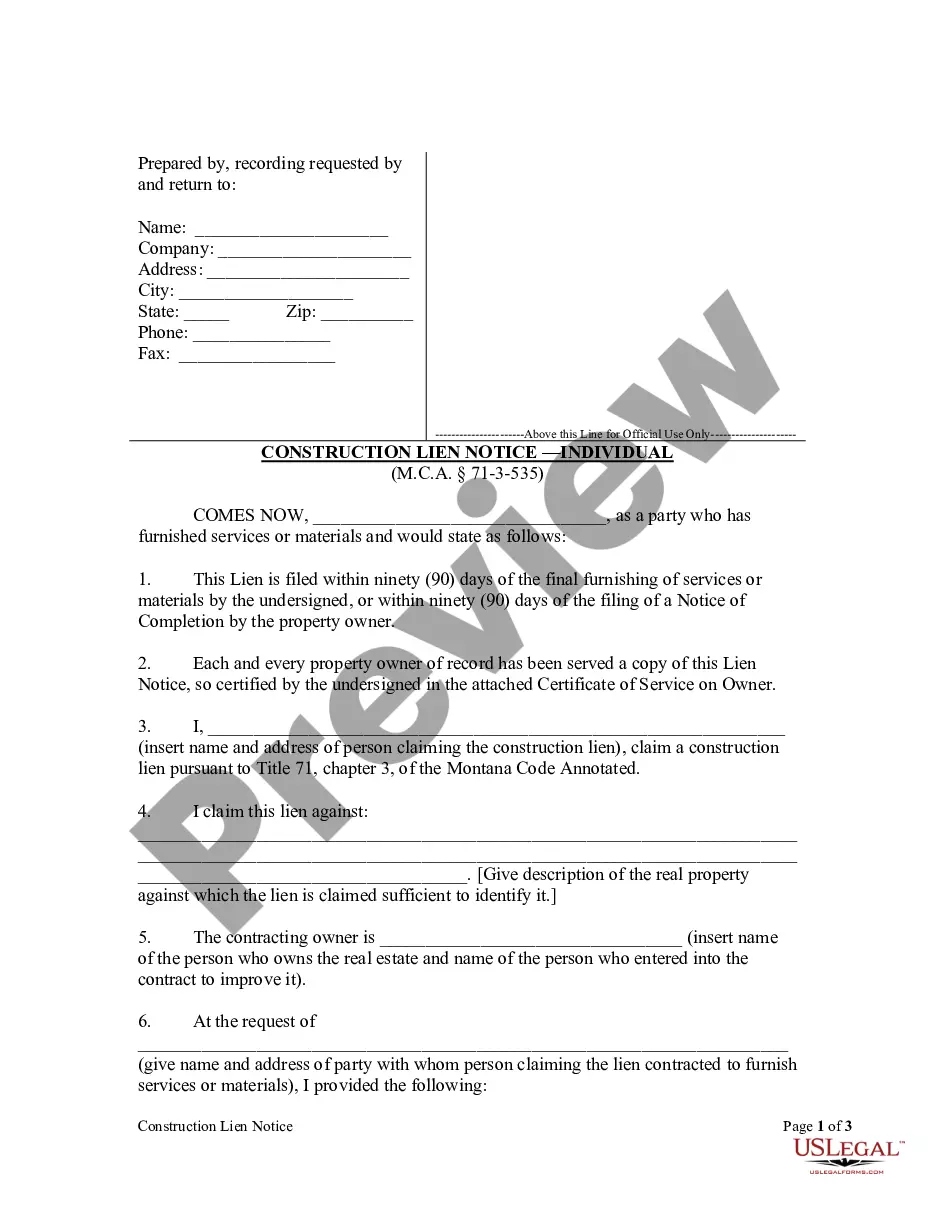
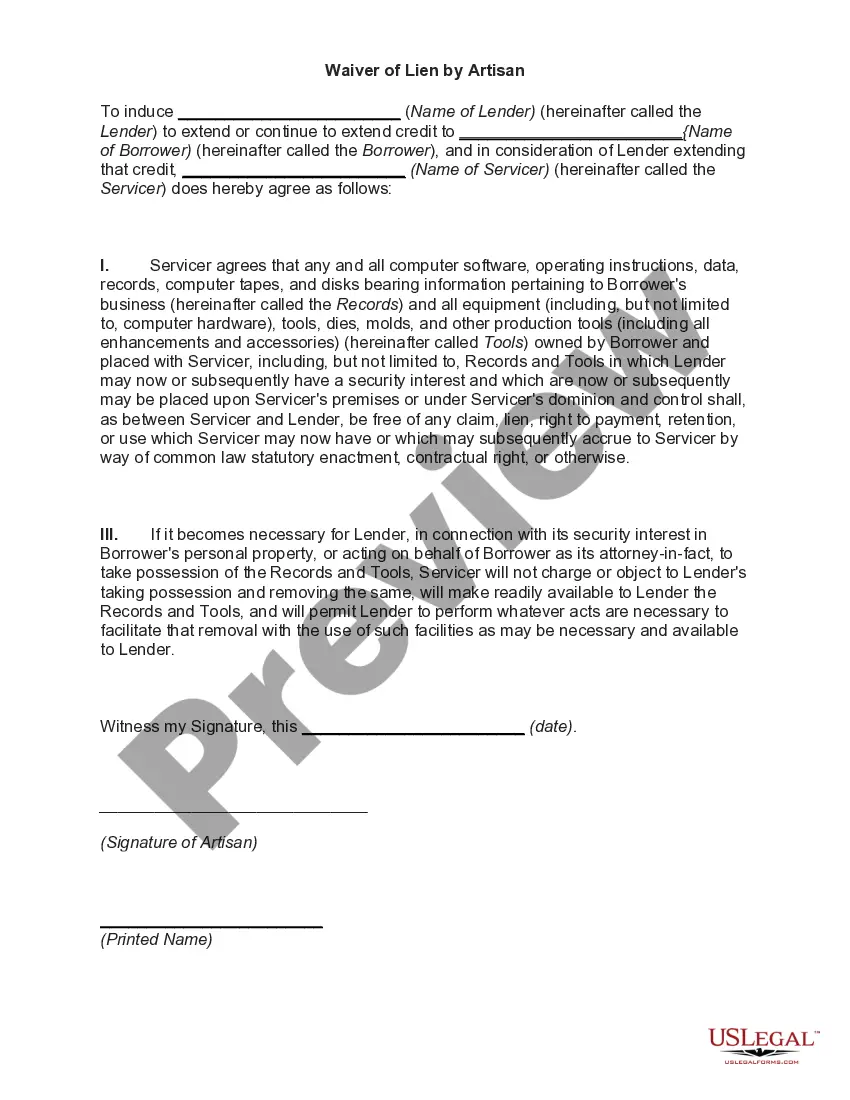
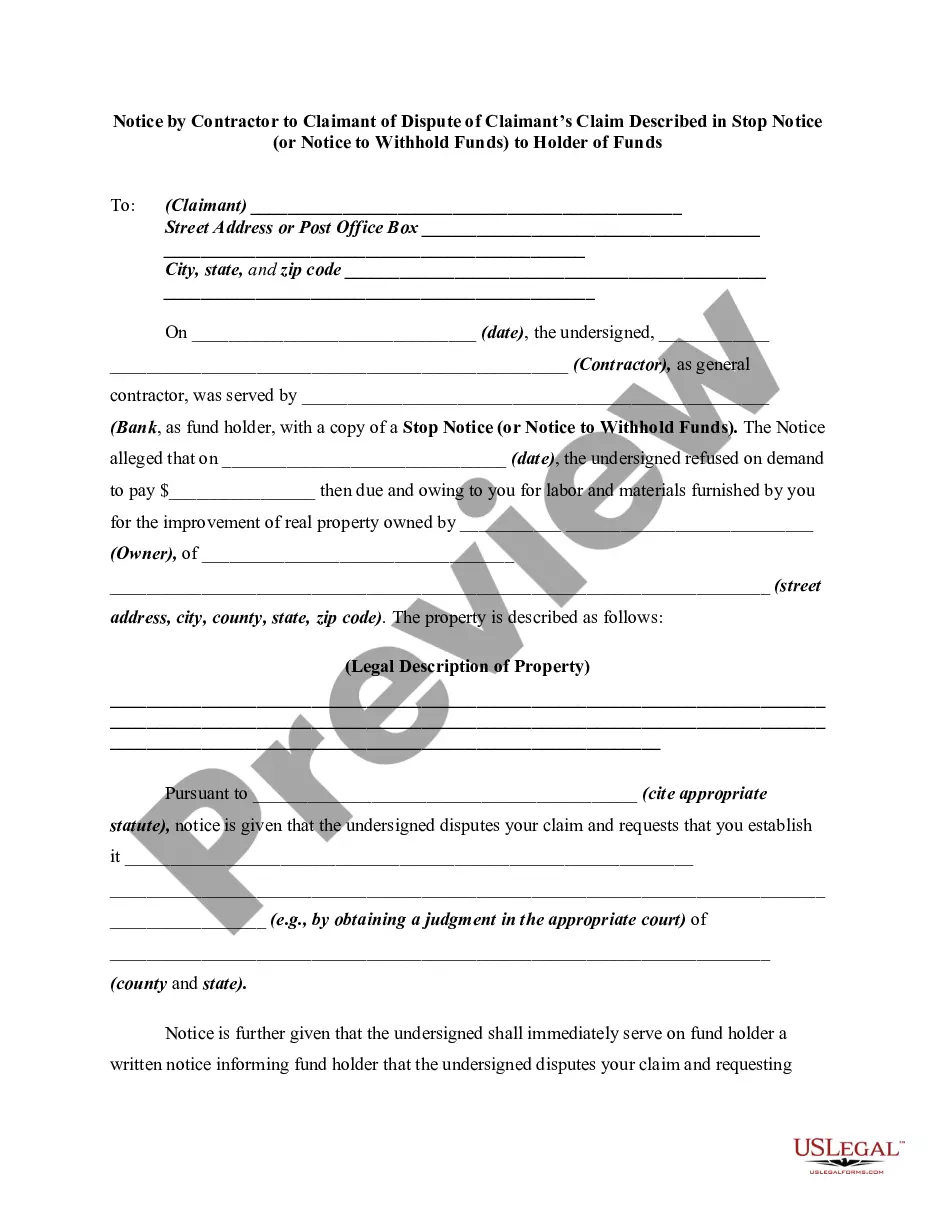
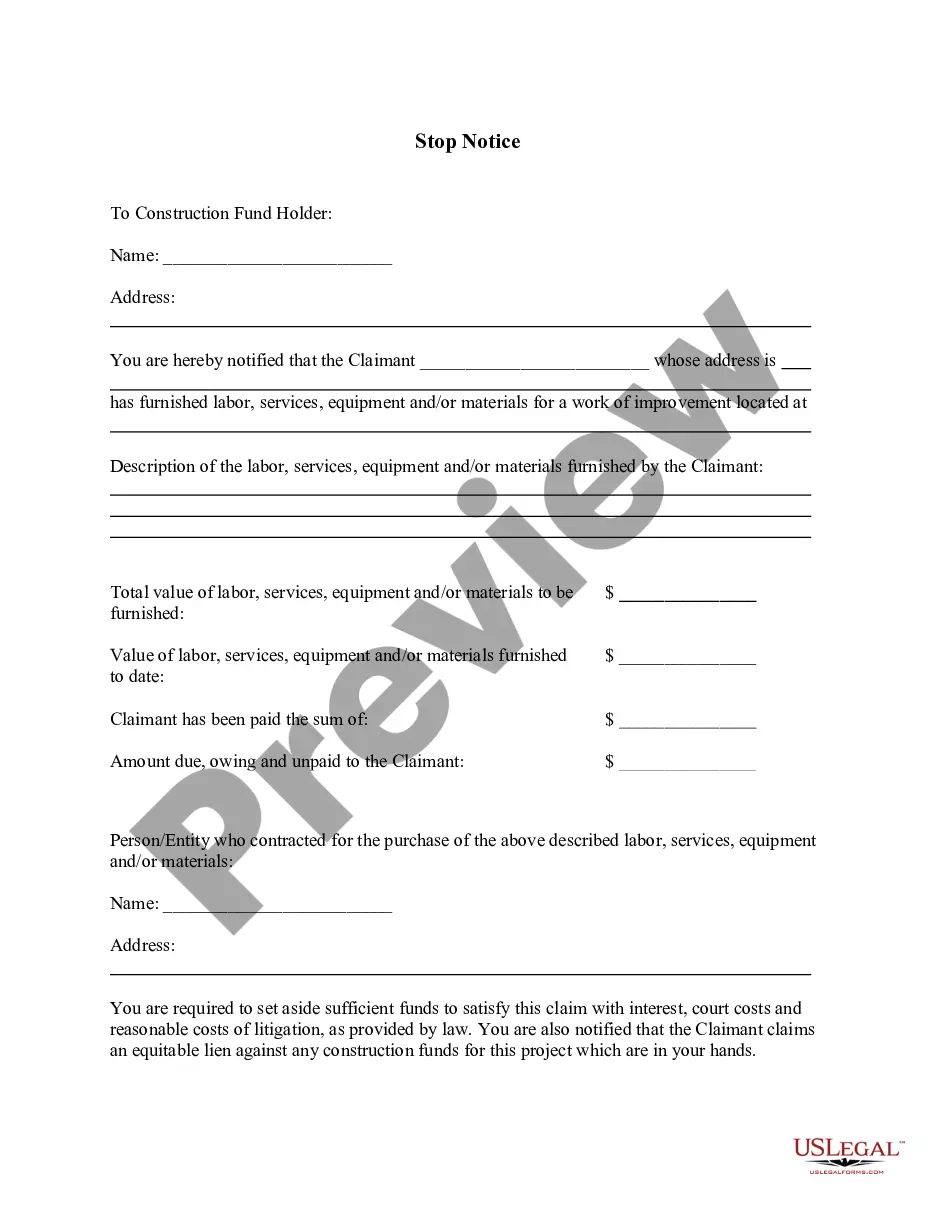
The Construction Lien Notice - Individual is a legal document used in Montana to officially notify all interested parties of a construction lien. This form ensures that the lien claimant's stake in a property is recognized and provides a structured way to communicate the details of service or materials provided. It differs from other forms by focusing specifically on individual lien claimants in construction scenarios.

Situations where this form applies
This form is used when a contractor, subcontractor, or material supplier has not been paid for services or materials provided for construction projects. It must be filed within ninety days of the last service or the filing of a Notice of Completion, making it essential for protecting your rights as a claimant in the construction process.
Who this form is for
- Contractors and subcontractors who have provided services or materials for a construction project.
- Individuals or companies with unpaid invoices related to construction work.
- Anyone acting on behalf of a lien claimant seeking to assert their rights in Montana.
How to complete this form
- Identify the parties involved: your name, address, and contact information.
- Provide a description of the property where services or materials were provided.
- Enter the contracting owner's name and details.
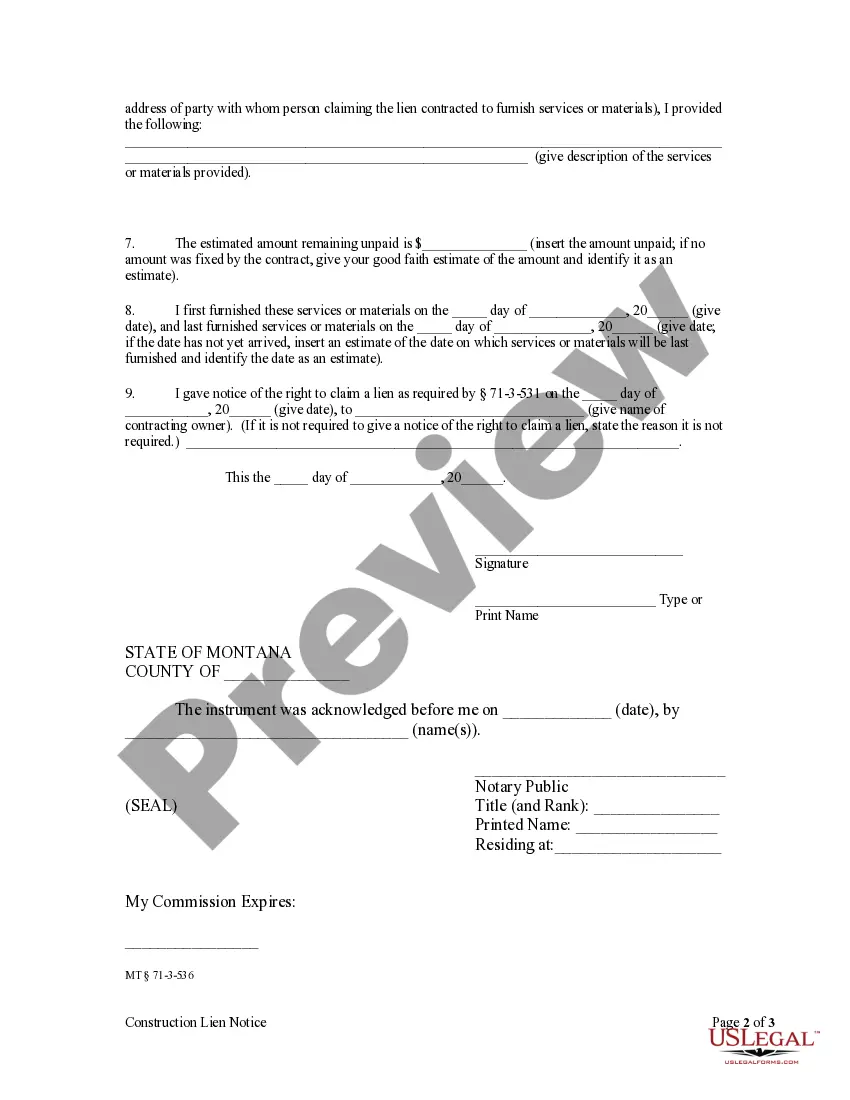
- Detail the nature of the services or materials provided and the unpaid amount.
- Include dates related to when services were first and last provided, along with notice dates.
- Sign and have the form notarized to validate the document.
Is notarization required?
This form must be notarized to be legally valid. US Legal Forms provides secure online notarization powered by Notarize, allowing you to complete the process through a verified video call.
Get your form ready online
Our built-in tools help you complete, sign, share, and store your documents in one place.
Make edits, fill in missing information, and update formatting in US Legal Forms—just like you would in MS Word.
Download a copy, print it, send it by email, or mail it via USPS—whatever works best for your next step.
Sign and collect signatures with our SignNow integration. Send to multiple recipients, set reminders, and more. Go Premium to unlock E-Sign.
If this form requires notarization, complete it online through a secure video call—no need to meet a notary in person or wait for an appointment.
We protect your documents and personal data by following strict security and privacy standards.

Make edits, fill in missing information, and update formatting in US Legal Forms—just like you would in MS Word.

Download a copy, print it, send it by email, or mail it via USPS—whatever works best for your next step.

Sign and collect signatures with our SignNow integration. Send to multiple recipients, set reminders, and more. Go Premium to unlock E-Sign.

If this form requires notarization, complete it online through a secure video call—no need to meet a notary in person or wait for an appointment.

We protect your documents and personal data by following strict security and privacy standards.
Common mistakes to avoid
- Failing to file the form within the ninety-day deadline.
- Not providing adequate property descriptions that are sufficient for identification.
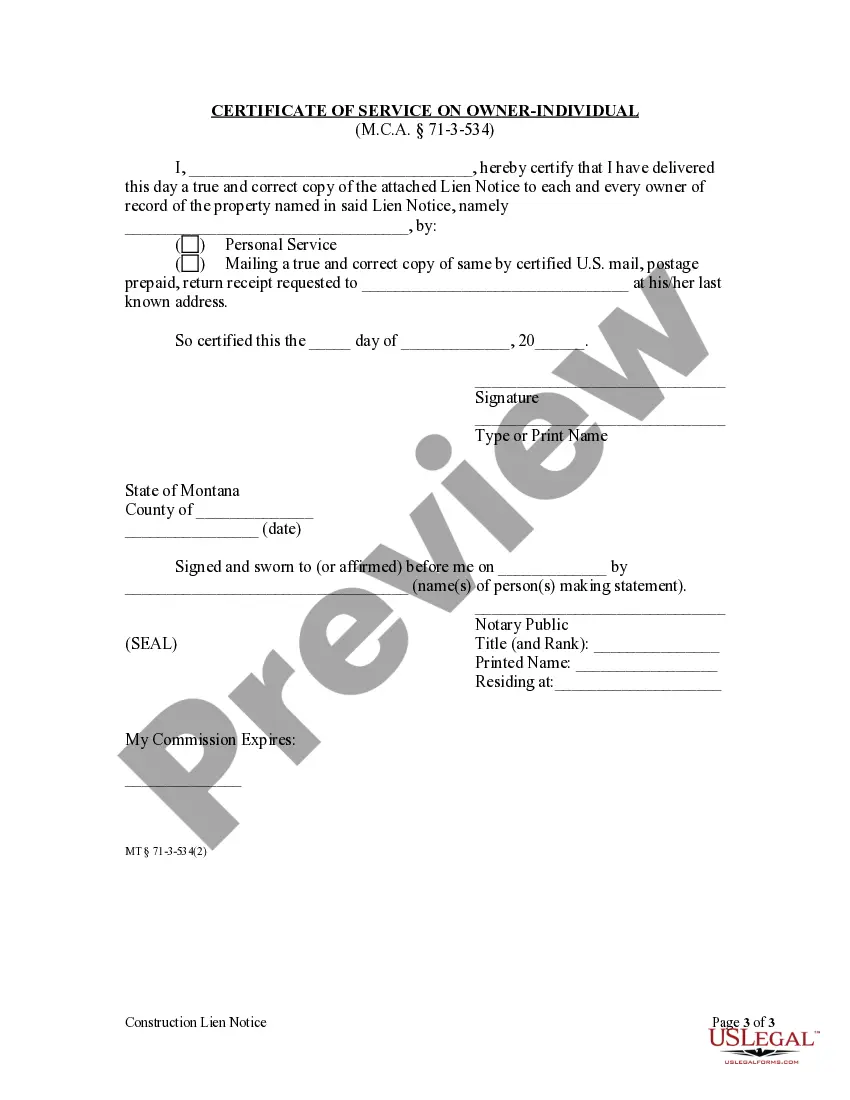
- Neglecting to notify all property owners of the lien, which may invalidate the claim.
- Not including the required notarized signature.
Looking for another form?

Form popularity
FAQ
What Is a Mechanics' (Construction) Lien? When a contractor files a mechanics' (construction) lien on your home, the lien makes your home into what's called security for an outstanding debt, which the contractor claims is due and unpaid for services or materials.
Fill out the correct mechanics lien form. Send a notice of lien claim. File your mechanics lien with the right county recorder. Release or enforce your mechanics lien.
Steps to avoid a lien Before making any partial or final payment to your contractor, ask for a Release of Lien and Affidavit (or Partial Release of Lien and Affidavit). These will either indicate that the contractor has paid all laborers or list out who is still owed money and how much.
Even though these states may permit project participants to secure lien rights and claim a mechanics lien even without a written contract, it is generally best practice to have a signed written contract for work provided.
To place a lien, you must first demonstrate that you have a valid debt that has not been paid by the property holder for example if you performed construction work as a contractor or subcontractor at company headquarters and the business did not pay your bill.
Therefore, liens are not officially recorded, and personal property could be sold off to a third party who is unaware of the lien's existence. In most states, judgment liens must be filed by the creditor through the county or state.
Filing a construction lien on residential projects requires filing a Notice of Unpaid Balance and Right to File Lien within 90 days of the last day of service. The homeowner must also get a copy of that notice within 10 days of its filing.
If you want to place a lien on a commercial rental property and you are not the landlord, you may need to put a lien on the property by filing with the court of record in the jurisdiction where the property is actually located.
Negotiate with the contractor who placed the lien (the "lienor" to remove it. Obtain a lien bond to discharge the lien, or. File a lawsuit to vacate the lien.