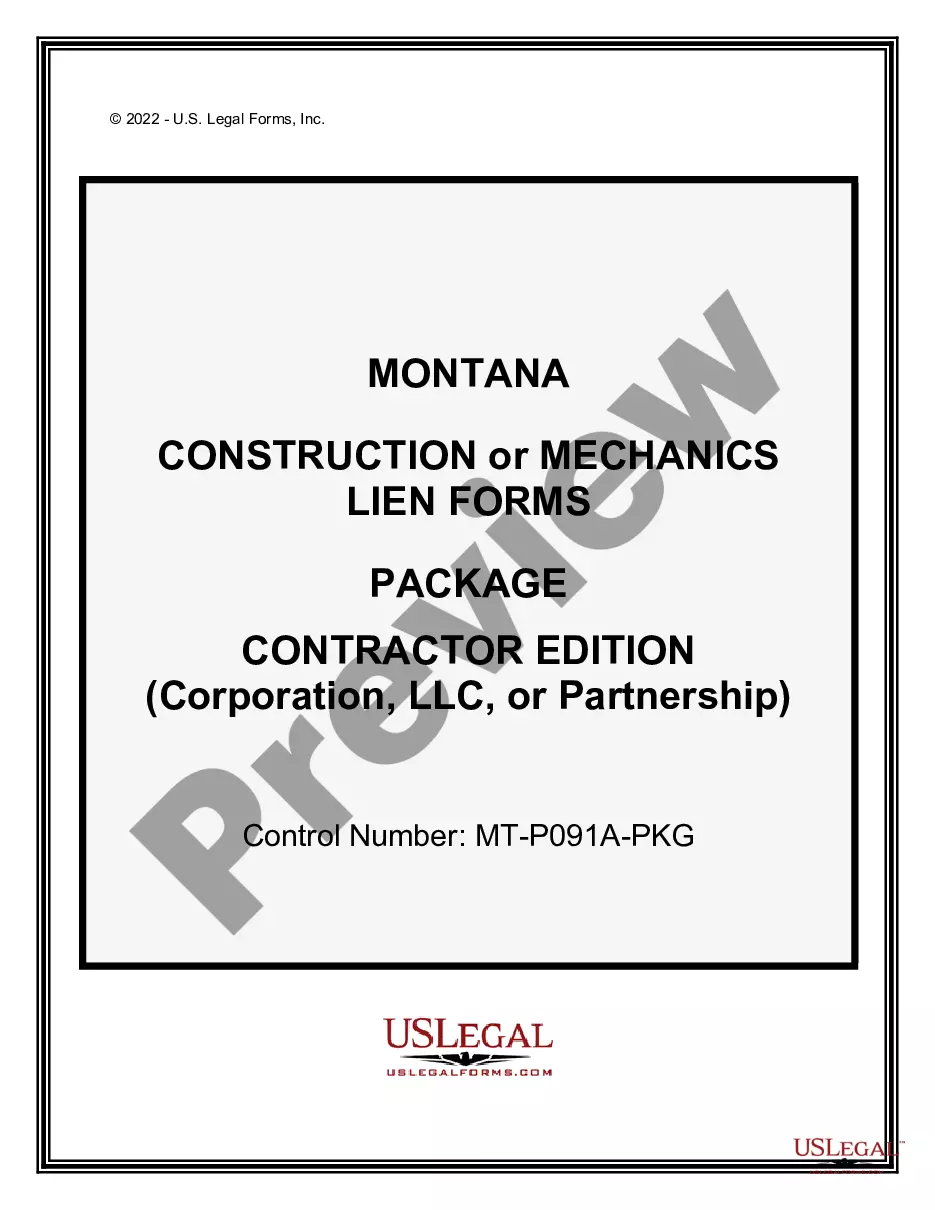
Montana Construction or Mechanics Lien Package - Individual

Understanding this form package
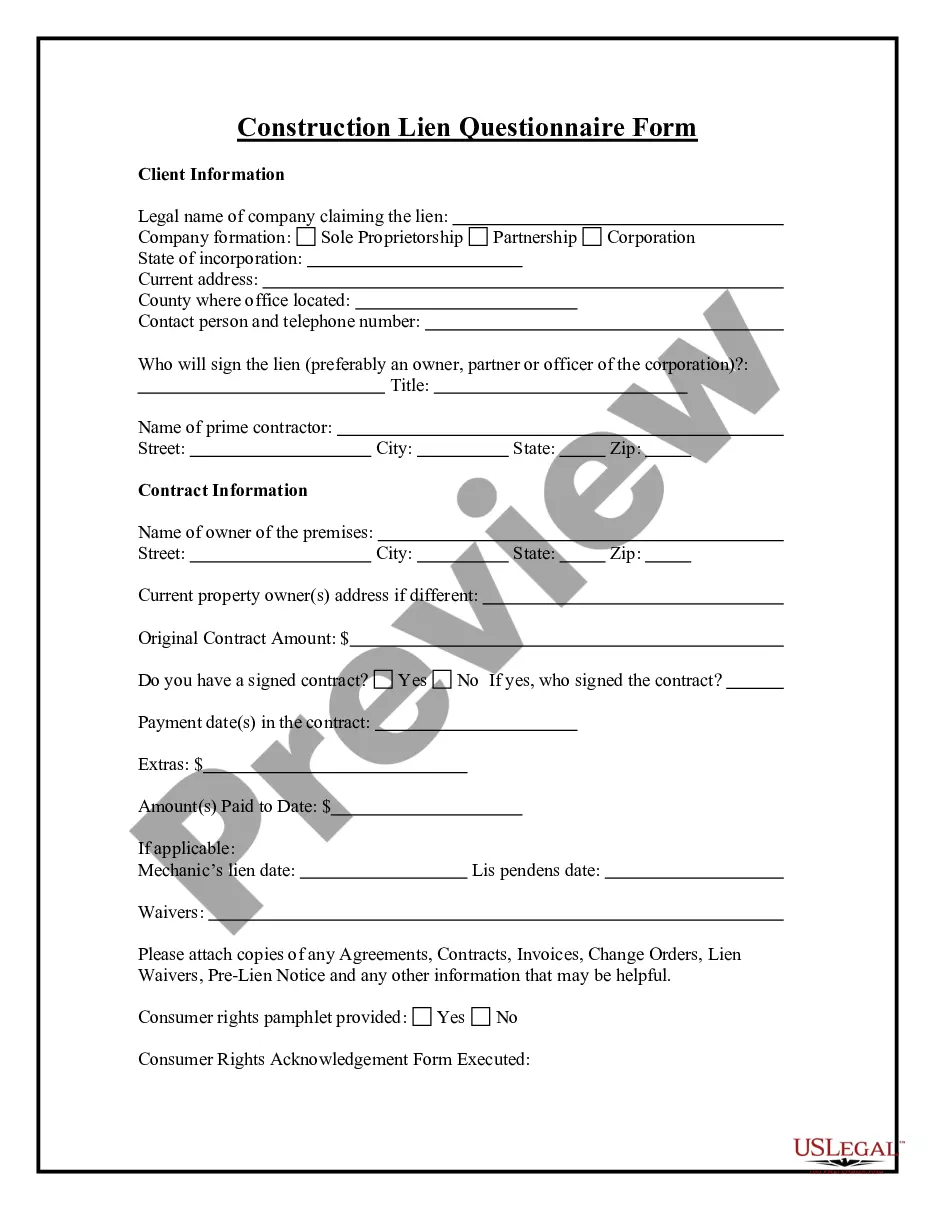
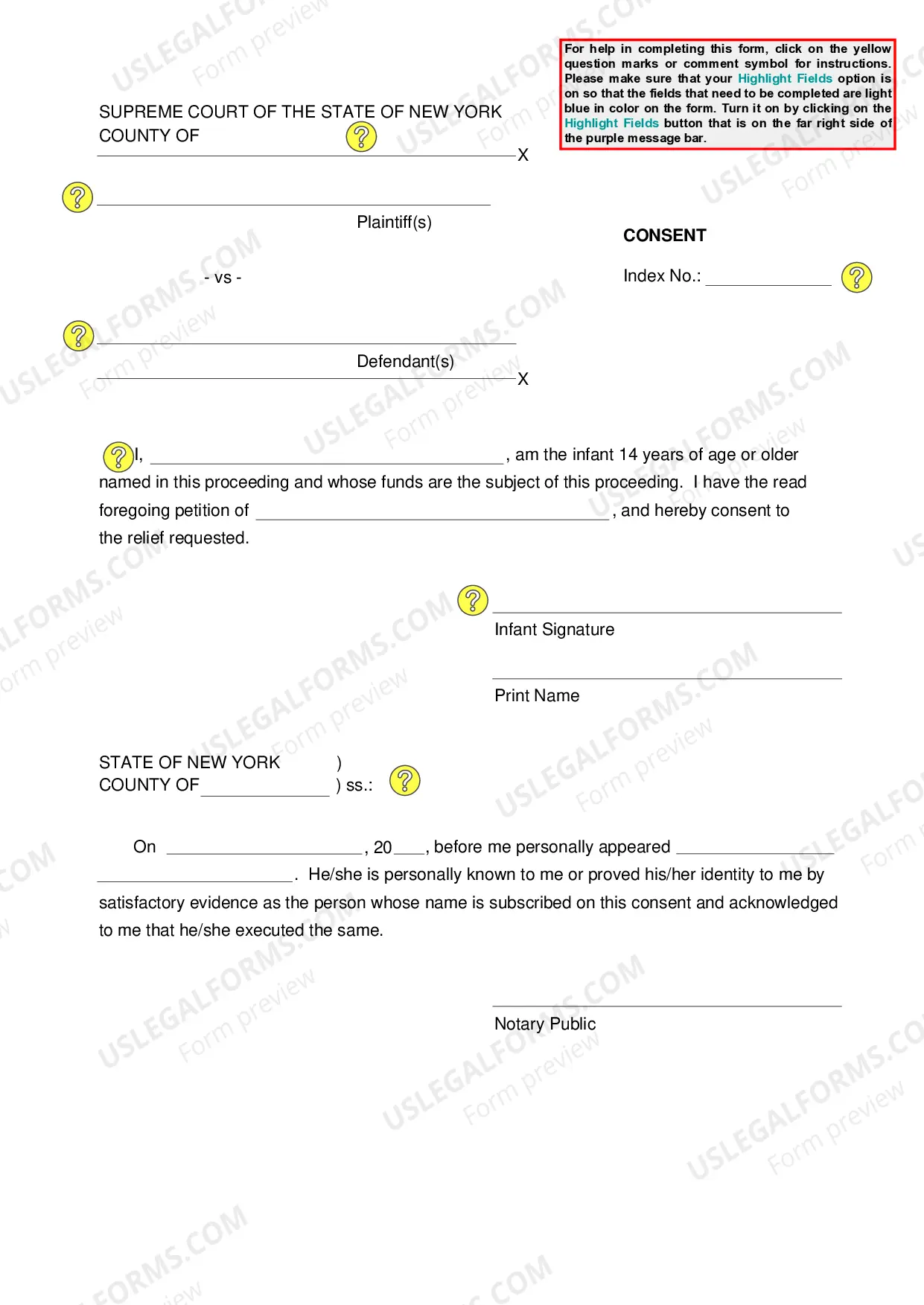
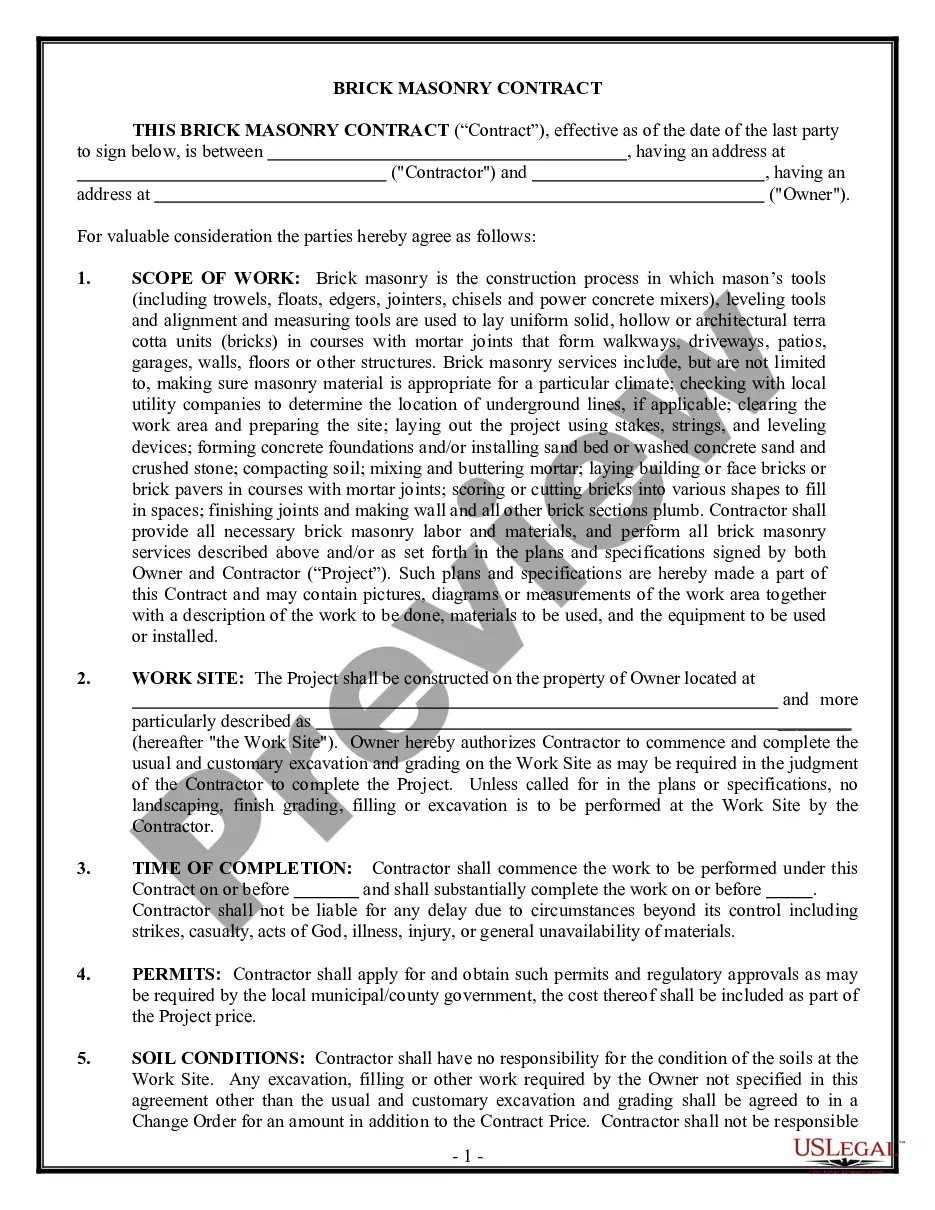
The Montana Construction or Mechanics Lien Package - Individual is designed to help sole proprietors who provide labor, materials, or services for improvements on real property in recovering payments owed to them through a lien. This package contains essential forms and guidance tailored to the unique needs of individual contractors or suppliers, differentiating it from other lien packages which may not focus specifically on sole proprietors.
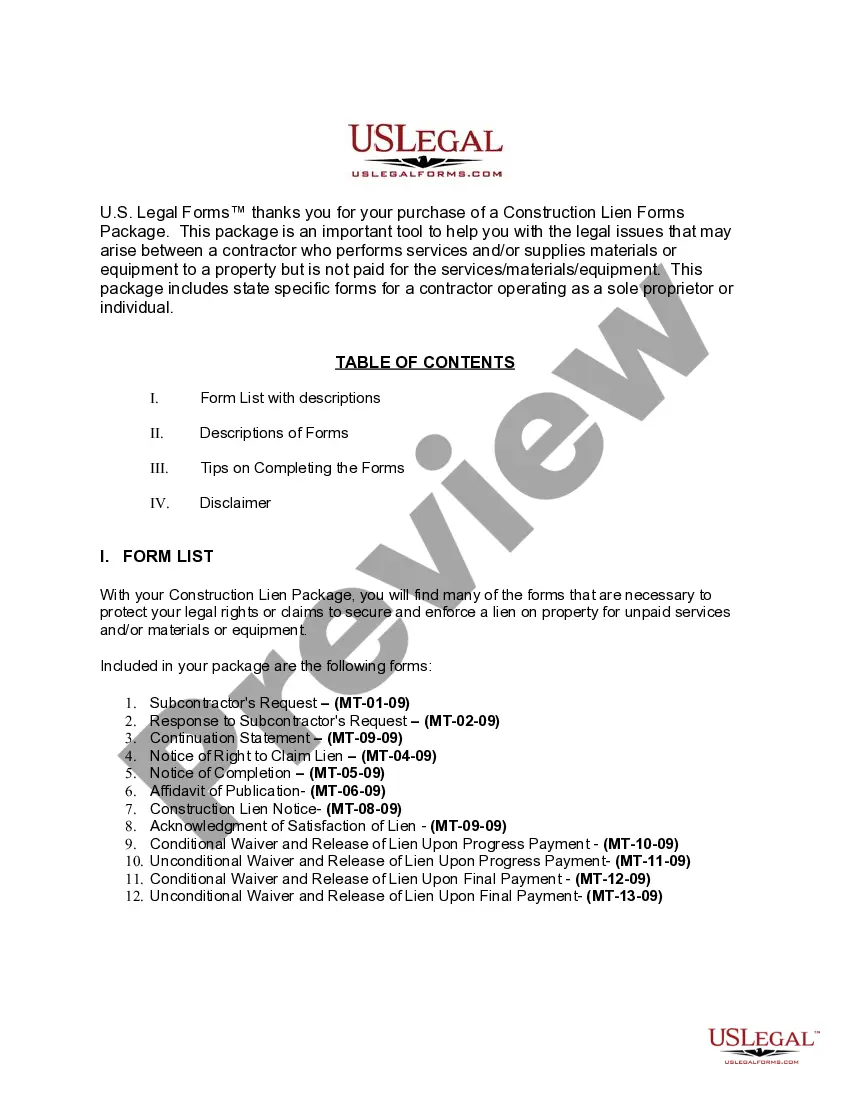
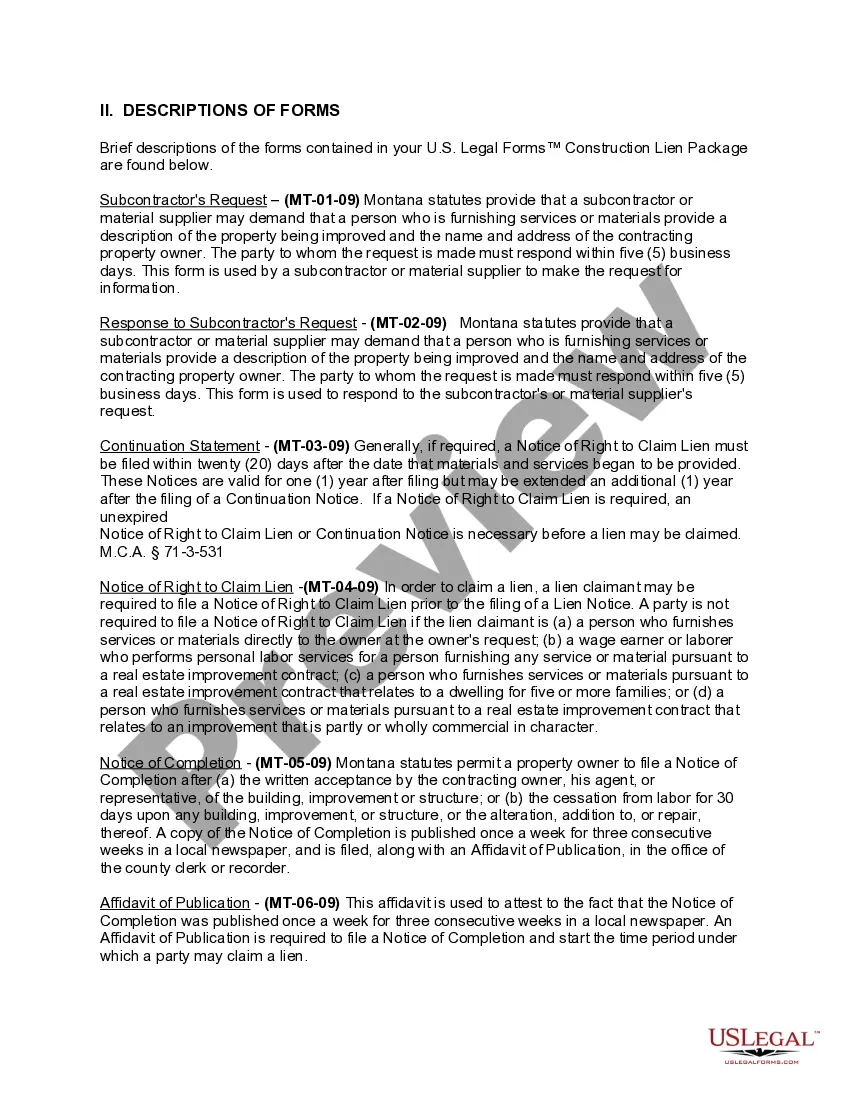
Forms included in this package
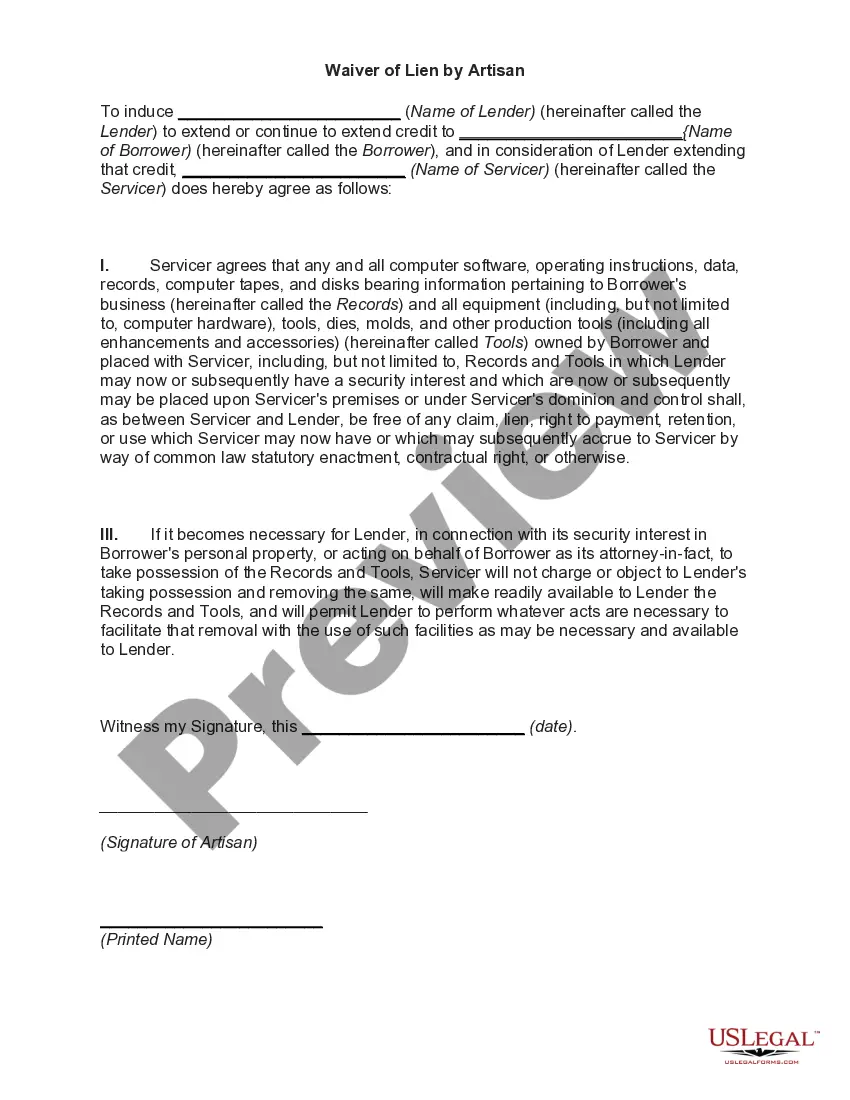
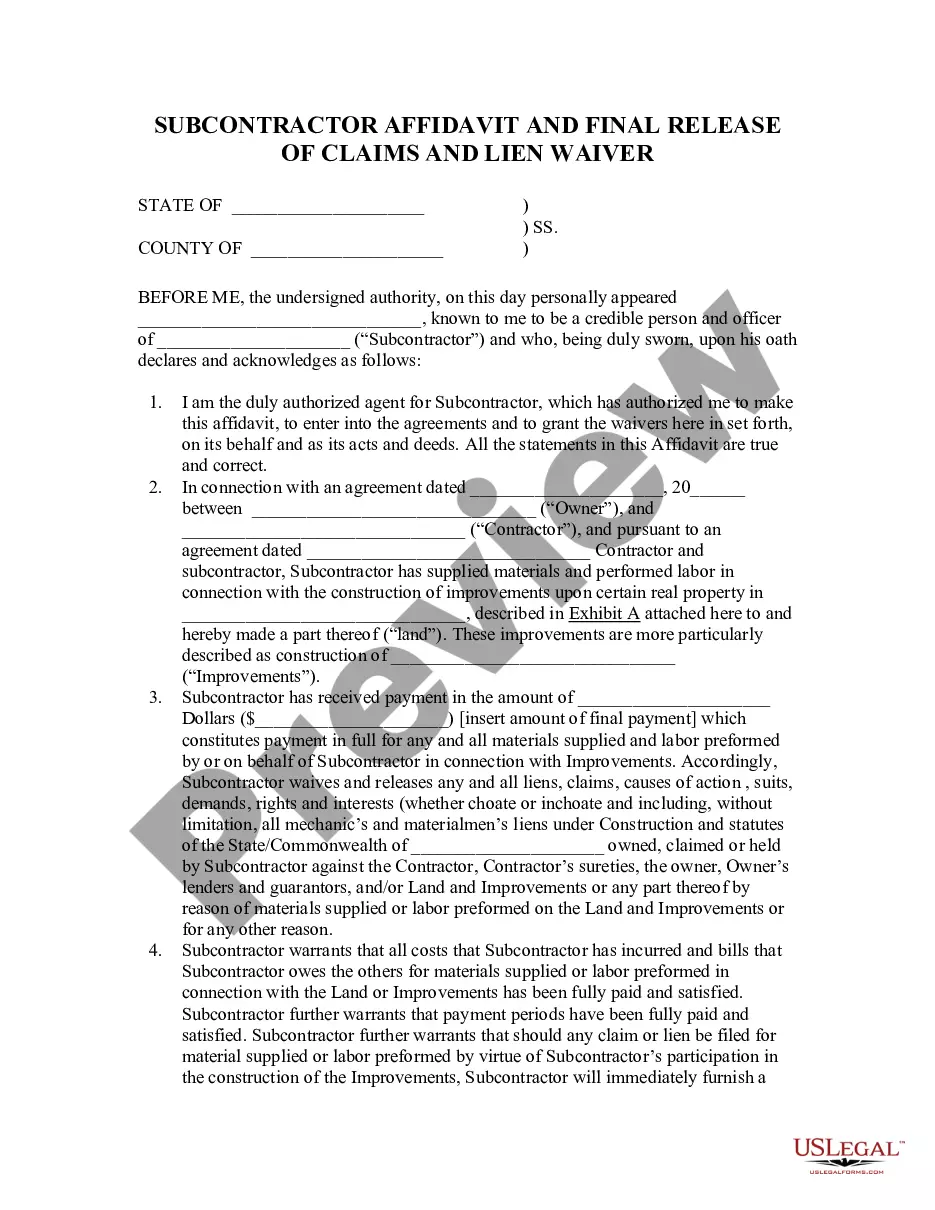
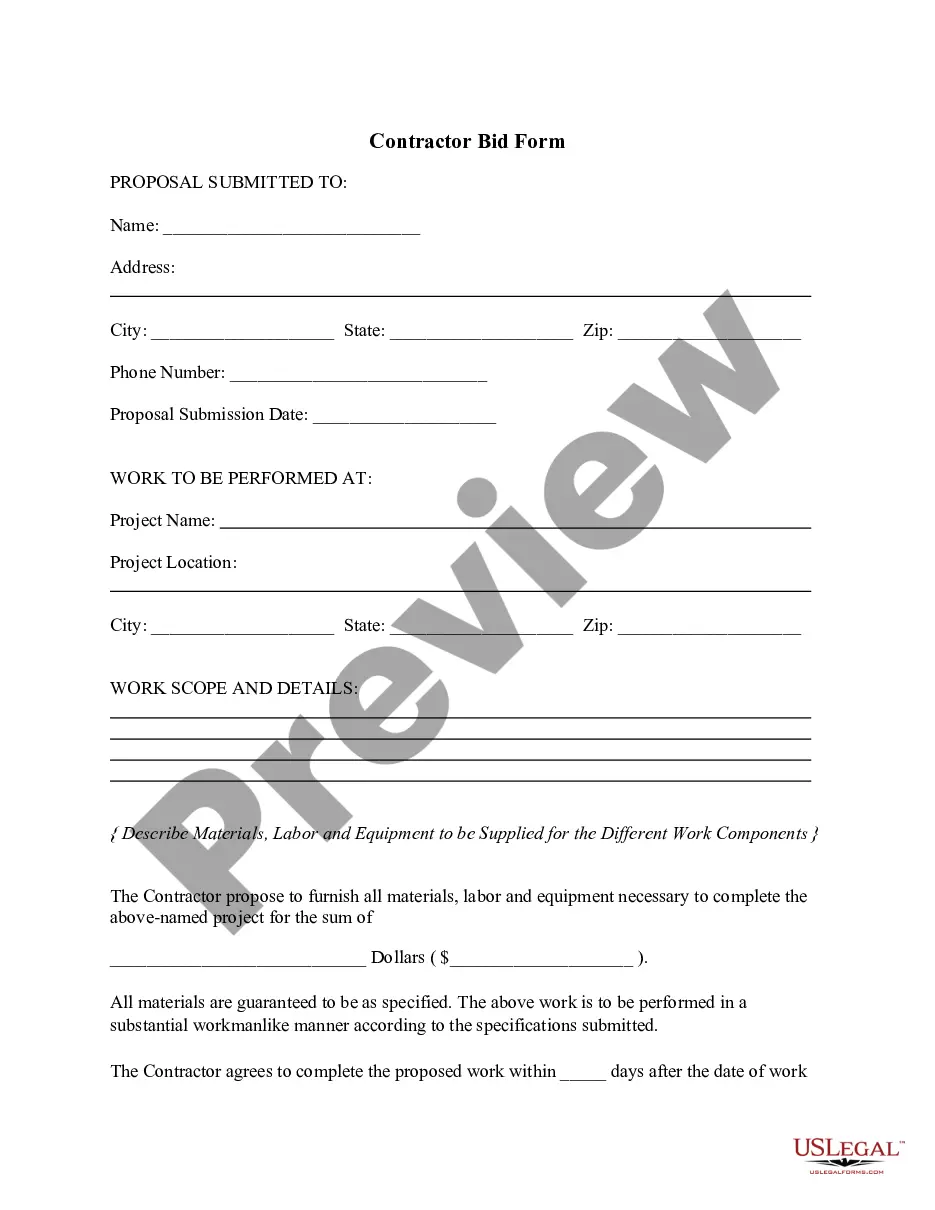
- Subcontractor's Request - Individual
- Response to Subcontractor's Request - Individual
- Continuation Statement - Individual
- Notice of Right to Claim Lien - Individual
- Notice of Completion - Individual
- Affidavit of Publication - Individual
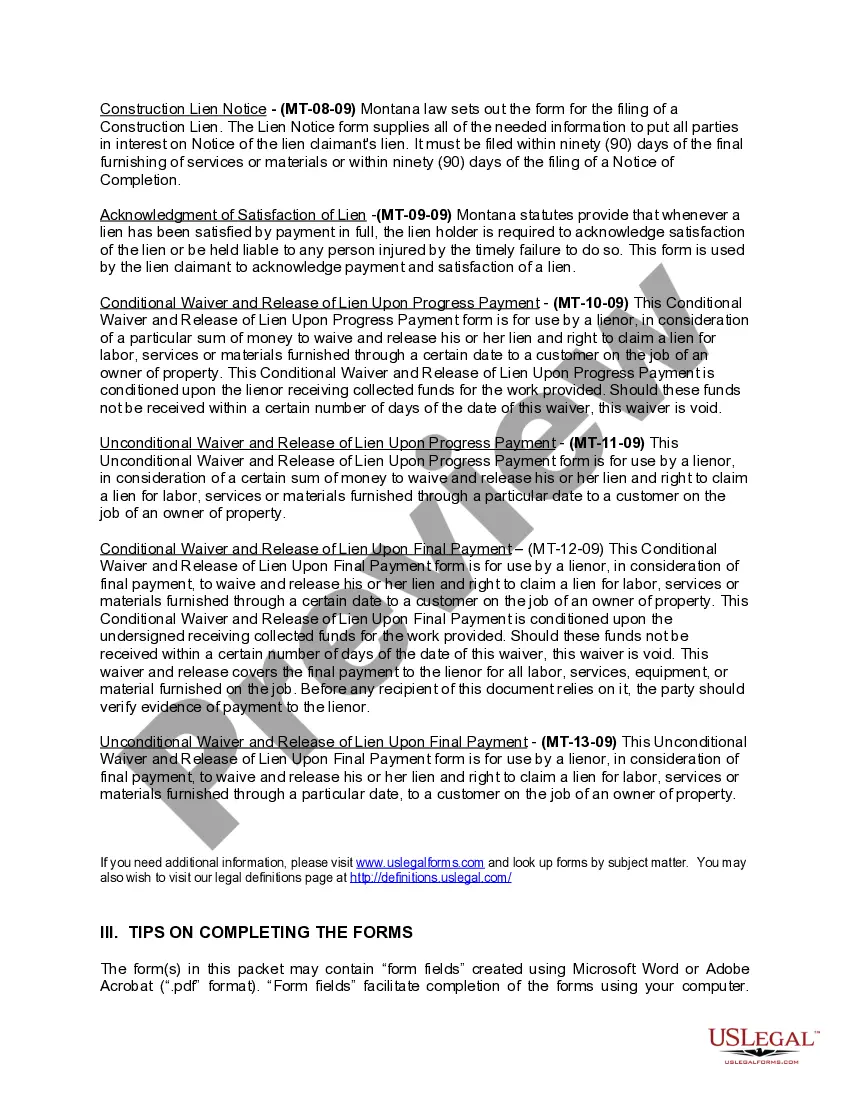
- Construction Lien Notice - Individual
- Acknowledgment of Satisfaction of Lien - Individual
- Unconditional Waiver and Release of Lien Upon Progress Payment
- Conditional Waiver and Release of Lien Upon Final Payment
- Unconditional Waiver and Release of Lien Upon Final Payment
When this form package is needed
This package may be needed in various situations, including:
- When a sole proprietor has not been paid for labor or materials provided for a construction or renovation project.
- When a contractor needs to secure their right to payment by placing a lien on the property improved by their work.
- When it's necessary to communicate intent to claim a lien in accordance with Montana state law.
Who needs this form package
- Sole proprietors providing construction services or materials in Montana.
- Independent contractors who have not received payment for their work on a property.
- Subcontractors or suppliers seeking to enforce their payment rights through lien procedures.
How to complete these forms
- Review the included forms carefully and identify the ones that apply to your situation.
- Fill out each form with the required information, ensuring accuracy and completeness.
- Attach any necessary documentation to support your lien claim.
- File the completed forms with the appropriate county office as instructed.
- Keep a copy of all documents for your records.
Do documents in this package require notarization?
Notarization is not commonly needed for forms in this package. However, if your state’s laws require it, our notarization service, powered by Notarize, allows you to finalize documents online 24/7 without in-person visits.
Get your form ready online
Our built-in tools help you complete, sign, share, and store your documents in one place.
Make edits, fill in missing information, and update formatting in US Legal Forms—just like you would in MS Word.
Download a copy, print it, send it by email, or mail it via USPS—whatever works best for your next step.
Sign and collect signatures with our SignNow integration. Send to multiple recipients, set reminders, and more. Go Premium to unlock E-Sign.
If this form requires notarization, complete it online through a secure video call—no need to meet a notary in person or wait for an appointment.
We protect your documents and personal data by following strict security and privacy standards.

Make edits, fill in missing information, and update formatting in US Legal Forms—just like you would in MS Word.

Download a copy, print it, send it by email, or mail it via USPS—whatever works best for your next step.

Sign and collect signatures with our SignNow integration. Send to multiple recipients, set reminders, and more. Go Premium to unlock E-Sign.

If this form requires notarization, complete it online through a secure video call—no need to meet a notary in person or wait for an appointment.

We protect your documents and personal data by following strict security and privacy standards.
Avoid these common issues
- Failing to file a Notice of Right to Claim Lien within the required time frame.
- Not including all necessary forms with the lien filing.
- Providing incorrect or incomplete information in the forms.
- Delaying the filing process, which could jeopardize your lien rights.
Advantages of online completion
- Convenience of downloading and printing forms at any time.
- Editable forms that can be filled out digitally or by hand.
- Access to comprehensive guidance and tips on completing the forms correctly.
- Reliability and accuracy in accordance with current Montana laws and regulations.
Looking for another form?
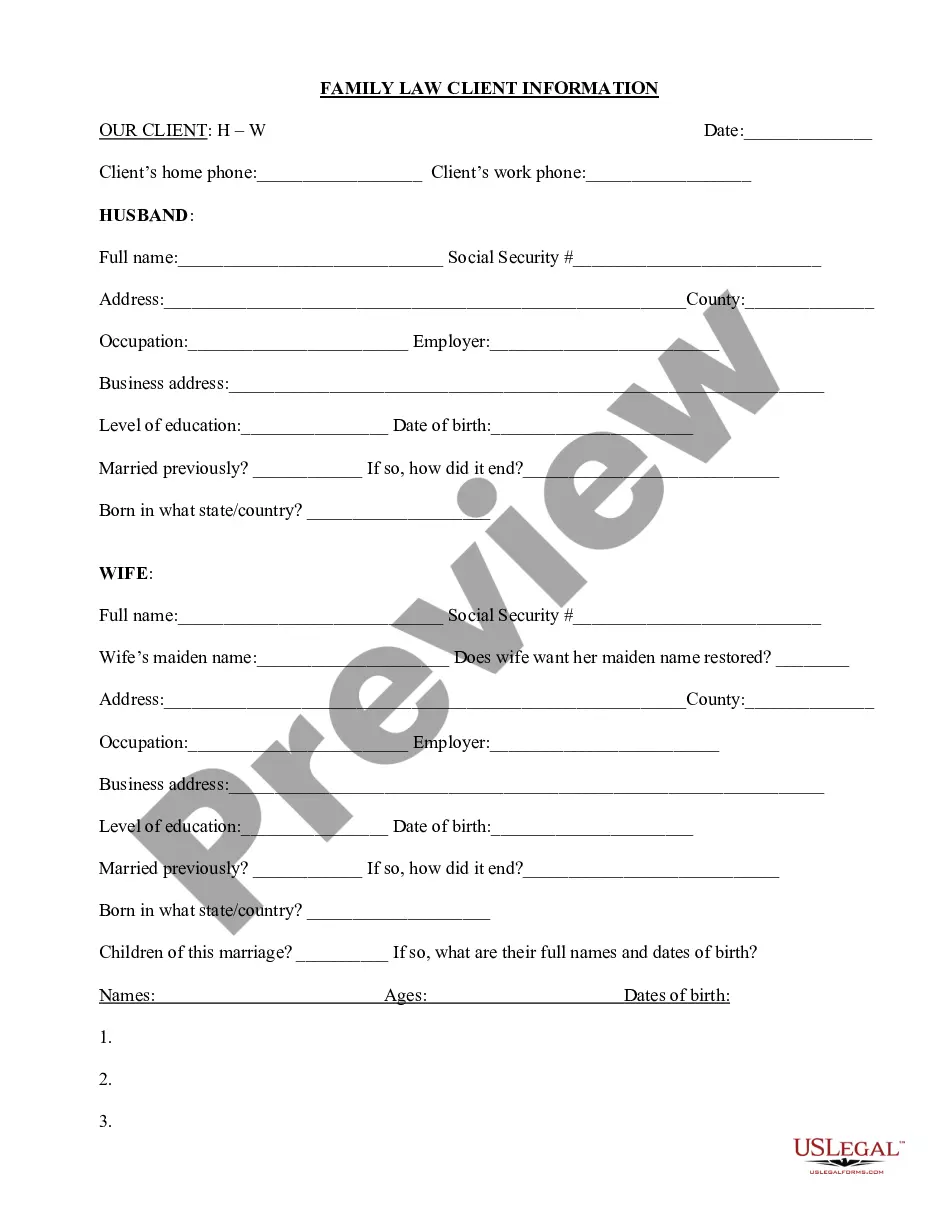

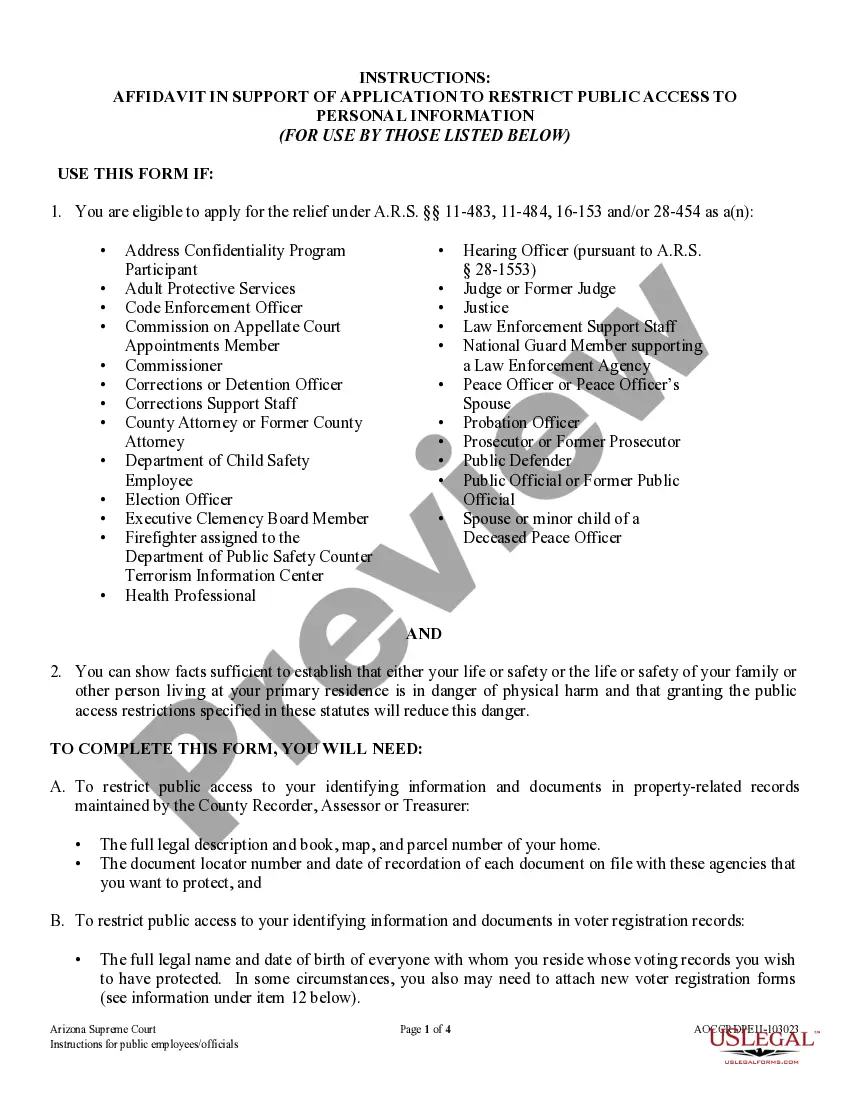
Form popularity
FAQ
With the judgment in hand, a judgment creditor can place a judgment lien on your real estate and occasionally on personal property depending on the state in which you live.
Get free mechanics lien form A construction mechanics lien is claimed against real estate property, and the lien must be filed in the appropriate office in order to be valid.Additionally, construction liens have strict timing and notice requirements. Machinery mechanics liens are possessory liens.
Placing the Lien With a direct contractor, the notice is part of her contract with you. If the bills go unpaid, the contractor or sub sends you a notice along with her claim of lien. She then files the lien with the county within 90 days of the project being finished or your acceptance of the work.
A mortgage creates a lien on your property that gives the lender the right to foreclose and sell the home to satisfy the debt. A deed of trust (sometimes called a trust deed) is also a document that gives the lender the right to sell the property to satisfy the debt should you fail to pay back the loan.
The simplest way to prevent liens and ensure that subcontractors and suppliers are paid is to pay with joint checks. This is when both parties endorse the check. Compare the contractor's materials or labor bill to the schedule of payments in your contract and the Preliminary Notices.
A construction lien is a claim made against a property by a contractor or subcontractor who has not been paid for work done on that property. Construction liens are designed to protect professionals from the risk of not being paid for services rendered.
Even though these states may permit project participants to secure lien rights and claim a mechanics lien even without a written contract, it is generally best practice to have a signed written contract for work provided.
A contractor's lien (often known as a mechanic's lien, or a construction lien) is a claim made by contractors or subcontractors who have performed work on a property, and have not yet been paid.After all, contractors would rather work out a deal than go through the hassle of filing a lien against your property.
Filing a construction lien on residential projects requires filing a Notice of Unpaid Balance and Right to File Lien within 90 days of the last day of service. The homeowner must also get a copy of that notice within 10 days of its filing.