Recruiting Activity Report - Month by Month Numbers
Overview of this form
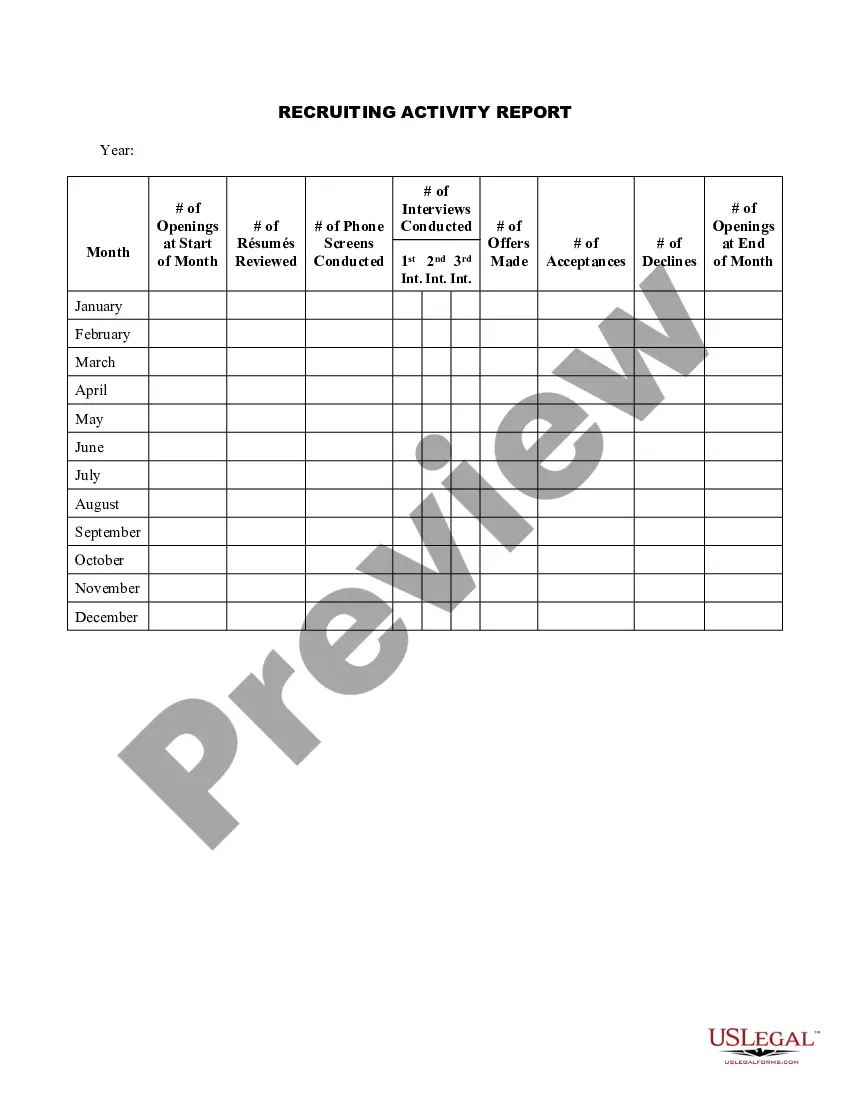
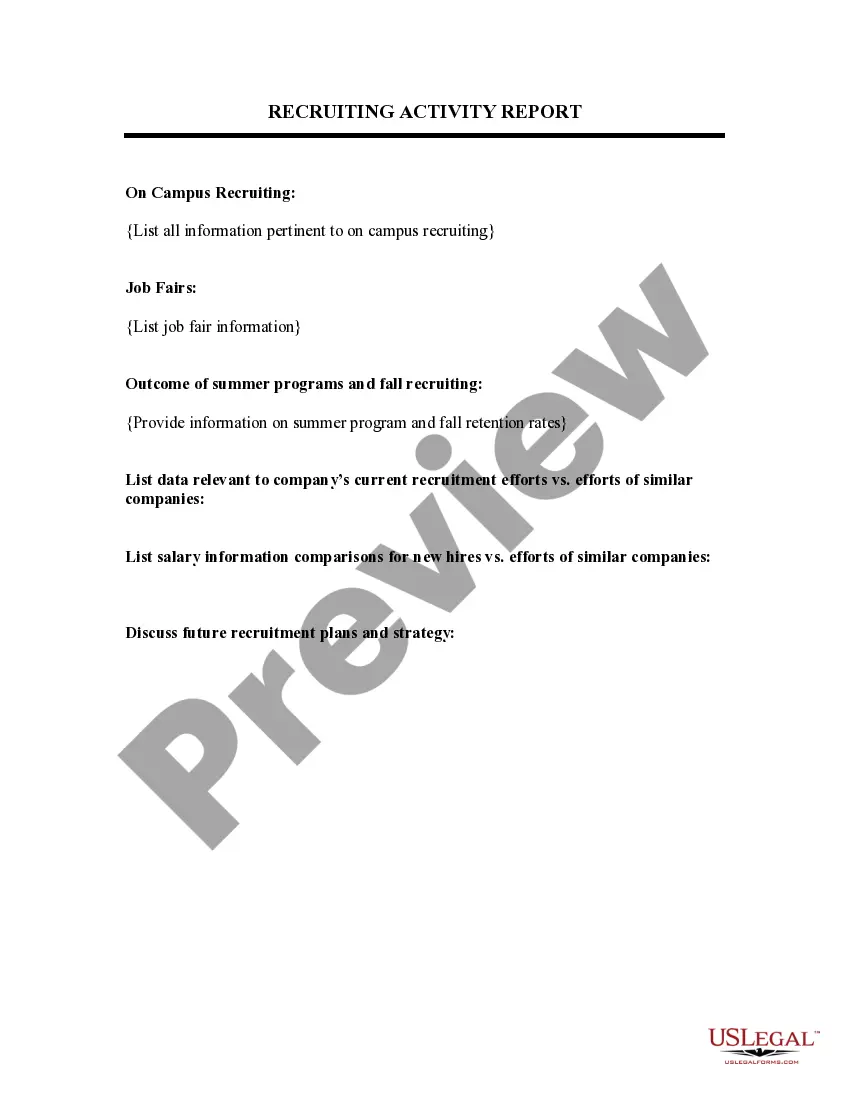
The Recruiting Activity Report - Month by Month Numbers is a vital document used to track the recruitment progress within an organization. This form allows companies to document the number of open positions at the beginning of each month, the number of interviews conducted, and the total positions filled by the end of the month. It serves as an essential tool for HR departments to evaluate their hiring strategies, making it distinct from other recruitment forms that may focus solely on individual job offers or candidate information.
What’s included in this form
- Month: Specifies the month for which the reporting is being conducted.
- Openings at Start of Month: Number of job positions available at the beginning of the month.
- Resumes Reviewed: Count of resumes evaluated for potential candidates.
- Phone Screens Conducted: Number of initial phone interviews completed.
- Interviews Conducted: Total number of in-person or virtual interviews that took place.
- Offers Made: Number of job offers extended to candidates.
- Acceptances: Total offers that were accepted by candidates.
- Declines: Count of candidates who declined job offers.
- Openings at End of Month: Total number of job openings remaining by the end of the month.

When to use this form
This form is best utilized at the end of each month to summarize the hiring activities undertaken throughout the month. It is particularly useful for companies looking to analyze trends in recruitment, adjust hiring strategies, or report on recruitment efforts during performance reviews or meetings with senior management.
Intended users of this form
- Human Resources managers and teams responsible for recruitment.
- Recruiters who track candidate interactions and hiring metrics.
- Company executives interested in understanding the overall recruitment efforts.
- Any business entity looking to improve its hiring process and report on recruitment activities.
Steps to complete this form
- Identify the specific month for which you are reporting recruitment activities.
- Enter the number of open positions at the start of that month.
- Document the total resumes reviewed over the course of the month.
- Count and record the number of phone screenings that occurred.
- Calculate the total number of interviews conducted and document that number.
- List the number of job offers made to candidates throughout the month.
- Document how many offers were accepted and how many were declined.
- Finally, provide the total number of open positions at the end of the month.
Notarization requirements for this form
In most cases, this form does not require notarization. However, some jurisdictions or signing circumstances might. US Legal Forms offers online notarization powered by Notarize, accessible 24/7 for a quick, remote process.
Get your form ready online
Our built-in tools help you complete, sign, share, and store your documents in one place.
Make edits, fill in missing information, and update formatting in US Legal Forms—just like you would in MS Word.
Download a copy, print it, send it by email, or mail it via USPS—whatever works best for your next step.
Sign and collect signatures with our SignNow integration. Send to multiple recipients, set reminders, and more. Go Premium to unlock E-Sign.
If this form requires notarization, complete it online through a secure video call—no need to meet a notary in person or wait for an appointment.
We protect your documents and personal data by following strict security and privacy standards.

Make edits, fill in missing information, and update formatting in US Legal Forms—just like you would in MS Word.

Download a copy, print it, send it by email, or mail it via USPS—whatever works best for your next step.

Sign and collect signatures with our SignNow integration. Send to multiple recipients, set reminders, and more. Go Premium to unlock E-Sign.

If this form requires notarization, complete it online through a secure video call—no need to meet a notary in person or wait for an appointment.

We protect your documents and personal data by following strict security and privacy standards.
Avoid these common issues
- Failing to accurately record the number of positions filled and remaining, leading to misleading data.
- Overlooking to include all candidates interviewed, which can impact performance evaluations.
- Not updating the report monthly, resulting in outdated metrics that hinder recruitment analysis.
Benefits of completing this form online
- Instant access to the form for timely submission.
- Easy to navigate and complete, with fields clearly defined.
- Adaptability to add notes or specific observations for future reference.
Legal use & context
- The Recruiting Activity Report must be completed accurately to ensure compliance with employment policies and recruitment procedures.
- It is a non-binding document but serves as an essential internal record for HR analytics.
Quick recap
- The form helps track recruitment progress each month.
- It is essential for assessing the effectiveness of recruiting strategies.
- Accurate completion can provide valuable insights for future hiring efforts.
Looking for another form?

Form popularity
FAQ
Time to Present/Number of Candidate Slates. Hiring Manager Feedback Timeliness. Aging of Requisitions. Present-to-Interview Ratio. Interview-to-Offer Ratio. Offer Acceptance Rate.
How do you calculate average time to fill? Calculate your company's average time to fill by adding all time to fill measurements for each position you filled in a given period (e.g. a year) and then divide by the number of roles.
Step 1: Start With Your Basic Information. Step 2: Place the Date. Step 3: Make a List of the People You Have Recruited. Step 4: Share the Resources Used. Step 5: Describe Any Problems Which Occurred. Step 6: Make Your Conclusion.
Interviews to hire. Offer acceptance rate. Candidate satisfaction. First-year turnover rate. Hiring manager satisfaction. Adverse impact.
57% Source of hire. 50% Time to hire. 42% Applicants per hire. 41% Cost per hire. 41% Candidate experience. 38% Retention. 37% Offer acceptance per hire. 36% Quality of hire.
If you have a solid recruitment sendout-to-placement ratio, then you need 10 sendouts or more per month. That would give you, on average, at least one placement per month. If the average fee for those placements is $20,000, then you would earn at least $240,000.
Total # of referrals during a certain time period or per open job requisition Page 8 6 Recruiting Metrics Cheatsheet 8 talent.linkedin.com The fill rate takes the total jobs filled by the person, team, or recruitment channel and divides the number by the total jobs assigned to that person, team, or channel to fill.
The quality-of-fill version is called the net quality score. Net quality score is simply the sum of all hires in the last year, minus those who scored in the bottom half of all employees at their first performance review. The bottom line is, best practices in quality-of-fill metrics are emerging rapidly.
Time to fill process It is measured by calculating the number of calendar days from when the job request was received (RR) until the offer was accepted by the candidate (AD) for each job filled during the measurement period. Time to fill includes positions filled both with internal and external candidates.