Minnesota Summons With Temporary Restraining Language
What this document covers
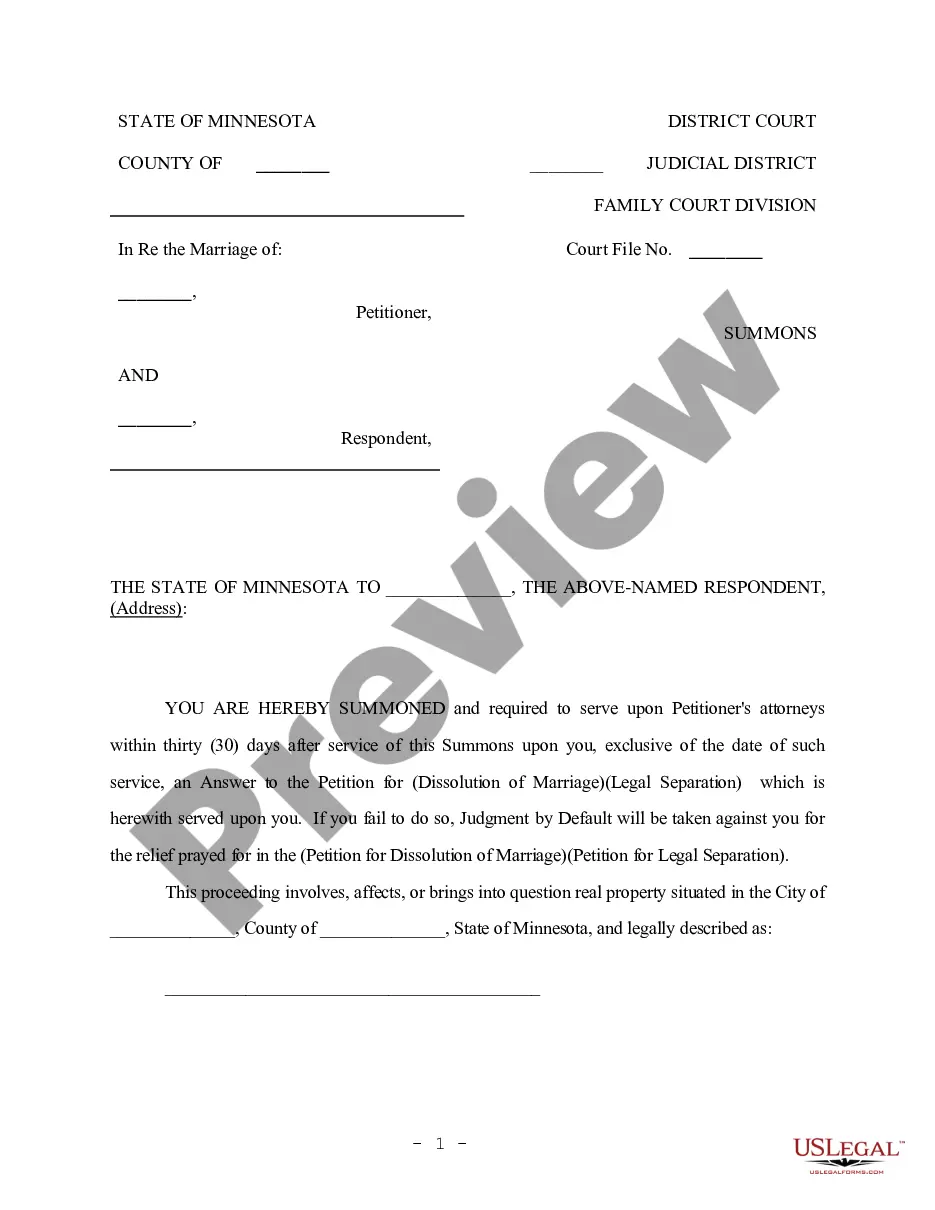
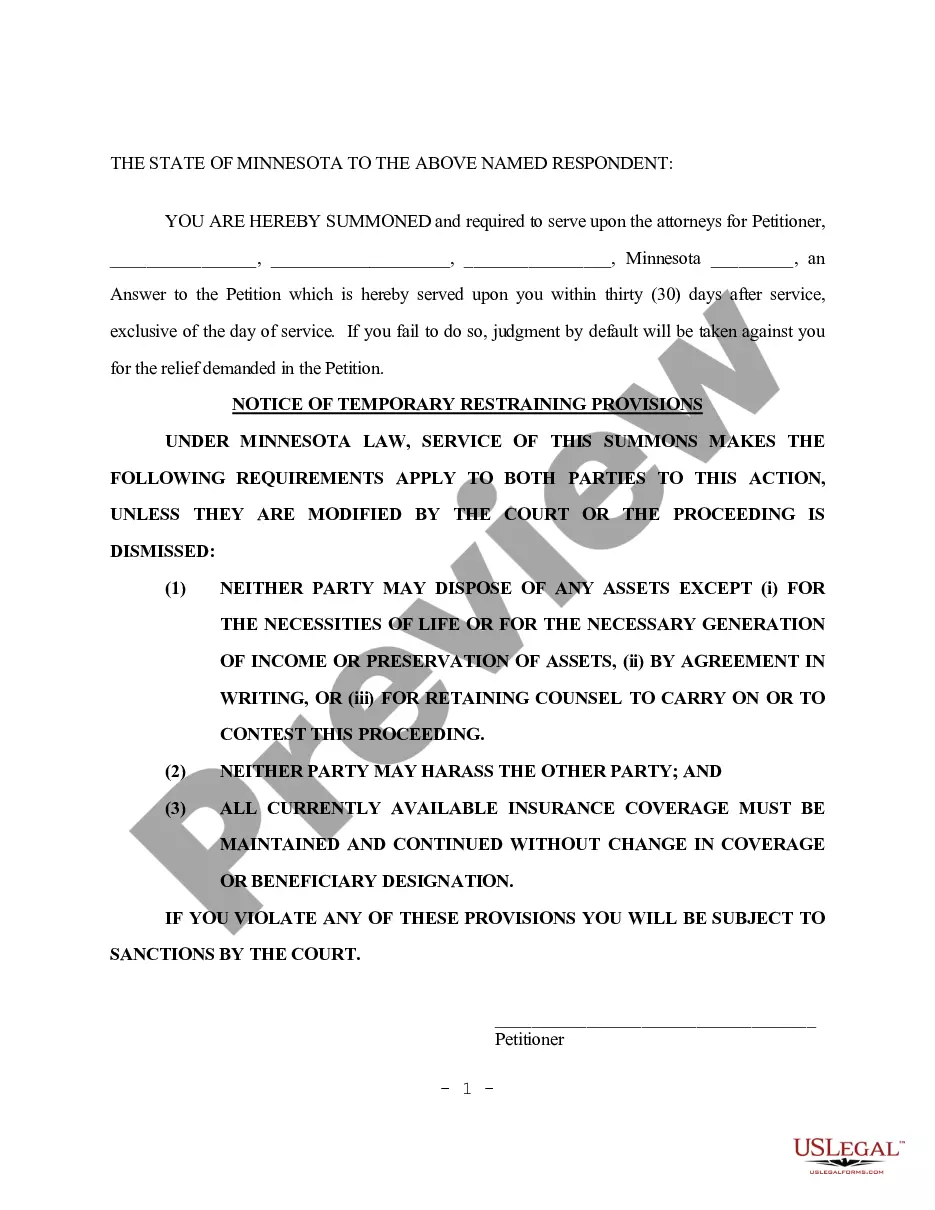
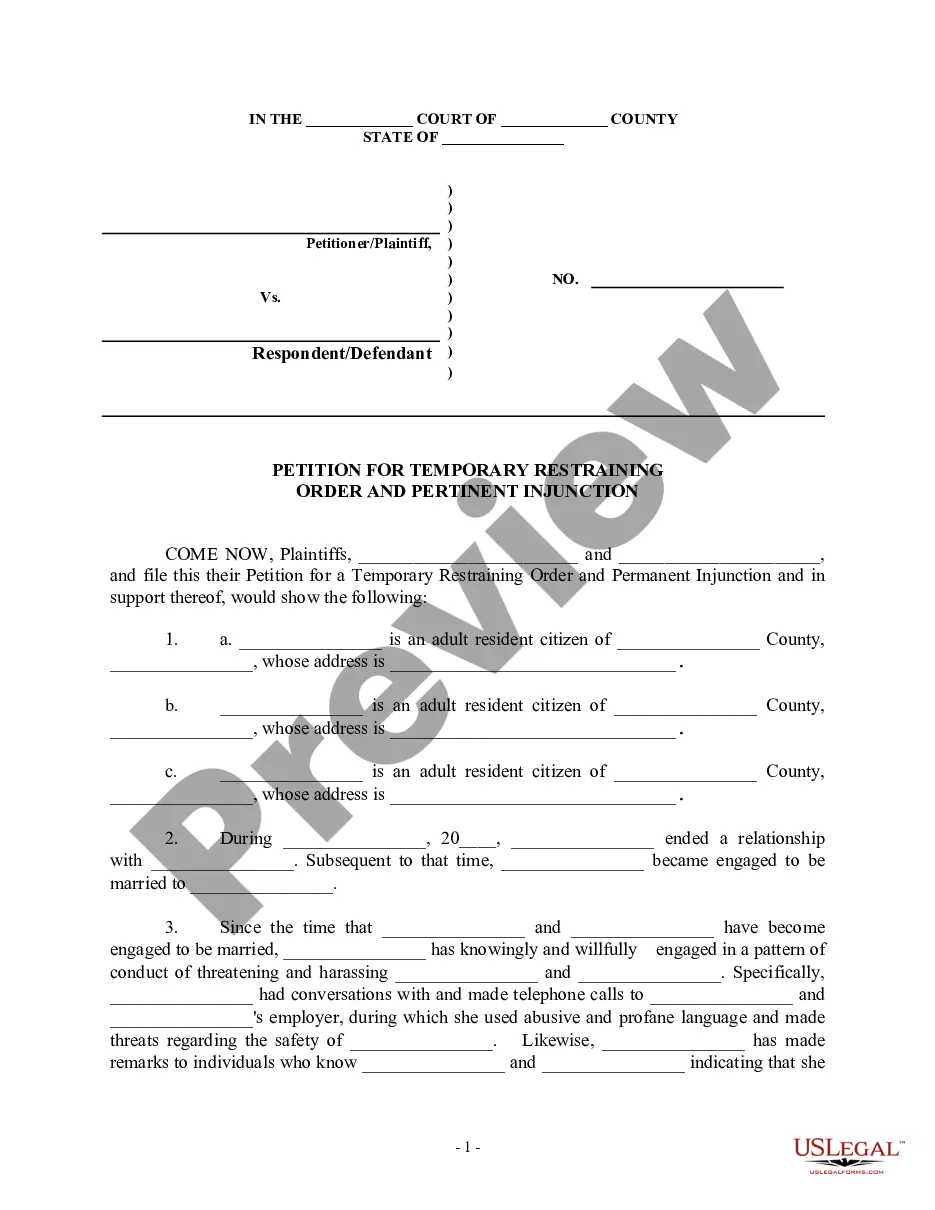
The Summons With Temporary Restraining Language is a legal document used in Minnesota divorce proceedings. It formally notifies the respondent of the petition for dissolution of marriage or legal separation and requires them to respond within thirty days. This form also includes important temporary restraining provisions to prevent either party from selling or altering significant assets during the divorce process.
Main sections of this form
- Identification of the parties involved, including the respondent's address.
- Requirement for the respondent to file an answer to the petition within thirty days.
- Notice of temporary restraining provisions applicable to both parties.
- Clarification of penalties for violating any temporary restraining provisions.
- Details regarding any real property involved in the proceedings.

Situations where this form applies
This form is essential when you are initiating a divorce or legal separation in Minnesota. It is specifically used to notify the other party of legal actions and protect assets during the proceedings. You should use this summons when submitting your petition and when you want to ensure that restraining orders are in place to maintain the status quo of your assets.
Who this form is for
- Individuals filing for divorce or legal separation in Minnesota.
- Respondents in divorce proceedings who need to be notified of the petitioner's actions.
- Legal representatives acting on behalf of petitioners or respondents in divorce cases.
How to prepare this document
- Identify the parties involved: enter the name and address of the respondent.
- Specify the type of petition by checking the relevant option (Dissolution of Marriage or Legal Separation).
- Enter the details of the real property involved, including its legal description.
- Review and understand the temporary restraining provisions listed.
- Ensure proper service of the summons is conducted within the required time frame.
Does this document require notarization?
This form does not typically require notarization unless specified by local law. It is essential to follow the legal procedures for service to ensure it is valid.
Get your form ready online
Our built-in tools help you complete, sign, share, and store your documents in one place.
Make edits, fill in missing information, and update formatting in US Legal Forms—just like you would in MS Word.
Download a copy, print it, send it by email, or mail it via USPS—whatever works best for your next step.
Sign and collect signatures with our SignNow integration. Send to multiple recipients, set reminders, and more. Go Premium to unlock E-Sign.
If this form requires notarization, complete it online through a secure video call—no need to meet a notary in person or wait for an appointment.
We protect your documents and personal data by following strict security and privacy standards.

Make edits, fill in missing information, and update formatting in US Legal Forms—just like you would in MS Word.

Download a copy, print it, send it by email, or mail it via USPS—whatever works best for your next step.

Sign and collect signatures with our SignNow integration. Send to multiple recipients, set reminders, and more. Go Premium to unlock E-Sign.

If this form requires notarization, complete it online through a secure video call—no need to meet a notary in person or wait for an appointment.

We protect your documents and personal data by following strict security and privacy standards.
Typical mistakes to avoid
- Failing to file the answer within the thirty-day timeframe.
- Not correctly identifying all parties involved in the document.
- Ignoring the temporary restraining provisions or failing to adhere to them.
- Omitting the legal description of relevant property.
Benefits of completing this form online
- Convenience of downloading and completing the form at your own pace.
- Access to attorney-drafted templates ensuring legal compliance.
- Editability allows users to customize the form to their specific circumstances.
- Accessibility to legal resources, guiding you through the process.
Quick recap
- The Summons With Temporary Restraining Language is essential for divorce proceedings in Minnesota.
- It imposes temporary restraining provisions to protect both partiesâ assets during the process.
- Respondents must be diligent in responding to the petition within thirty days.
- Proper identification of all parties and property is crucial for an effective summons.
Looking for another form?
Form popularity
FAQ
Rule 69 in Minnesota pertains to the enforcement of judgments and orders in civil cases. It serves as a guideline for how courts can enforce a ruling, including the execution of restraining orders. Familiarizing yourself with the Minnesota Summons With Temporary Restraining Language can help you understand how this rule applies to your situation. Knowing the legal framework empowers you to take informed actions regarding your case.
Yes, a restraining order can appear on a background check in Minnesota. This is important to consider, especially when applying for jobs or housing. The Minnesota Summons With Temporary Restraining Language may be part of public records, depending on the case's nature. Understanding this can help you navigate your legal rights and responsibilities more effectively.
In Minnesota, a restraining order may be granted if you face harassment, domestic abuse, or threats of violence. The Minnesota Summons With Temporary Restraining Language is essential in these cases, as it outlines the need for protection. You must demonstrate credible evidence of harm or fear of imminent harm. This legal document can help you secure your safety and peace of mind.
Rule 65.01 in Minnesota pertains to the issuance of temporary restraining orders. This rule establishes the procedures for obtaining such orders, including the requirements for filing and the grounds on which they may be granted. If you are considering a Minnesota summons with temporary restraining language, it is vital to familiarize yourself with this rule. US Legal Forms offers valuable resources to help you understand and apply this rule effectively.
Rule 4.03 in Minnesota relates to the service of process and outlines the specific methods allowed for delivering legal documents. This rule ensures that individuals receive fair notice of legal actions against them. Understanding this rule is essential when dealing with a Minnesota summons with temporary restraining language, as proper service is critical for legal proceedings. US Legal Forms can assist you in ensuring compliance with these rules.
Yes, a restraining order typically goes on your record. This can affect various aspects of your life, including employment opportunities and firearm ownership. It is crucial to understand the implications of a Minnesota summons with temporary restraining language before proceeding. Consulting legal resources or services like US Legal Forms can help you navigate this process and make informed decisions.
To serve a summons in Minnesota, you must follow specific legal procedures. Generally, you can deliver the summons personally to the individual named or, in some cases, to a responsible person at their residence. Alternatively, you may use certified mail for certain situations. Utilizing platforms like US Legal Forms can provide you with the necessary templates and guidance for serving a summons with temporary restraining language effectively.
To put a temporary restraining order in Minnesota, you must file specific documents with the court, including a Minnesota Summons With Temporary Restraining Language. Start by filling out the necessary forms, clearly stating your reasons for the restraining order. After filing, you will need to attend a court hearing where a judge will review your request and make a decision. Using a reliable resource like US Legal Forms can simplify this process, providing you with the right templates and guidance.
To win a temporary restraining order in Minnesota, you must demonstrate a clear need for protection from harm. Gather evidence that supports your claim, such as witness statements or documentation of past incidents. It is also essential to carefully follow the Minnesota Summons With Temporary Restraining Language, as this helps ensure your application meets legal requirements. Utilizing resources like USLegalForms can guide you through the process, making it easier to present a strong case.