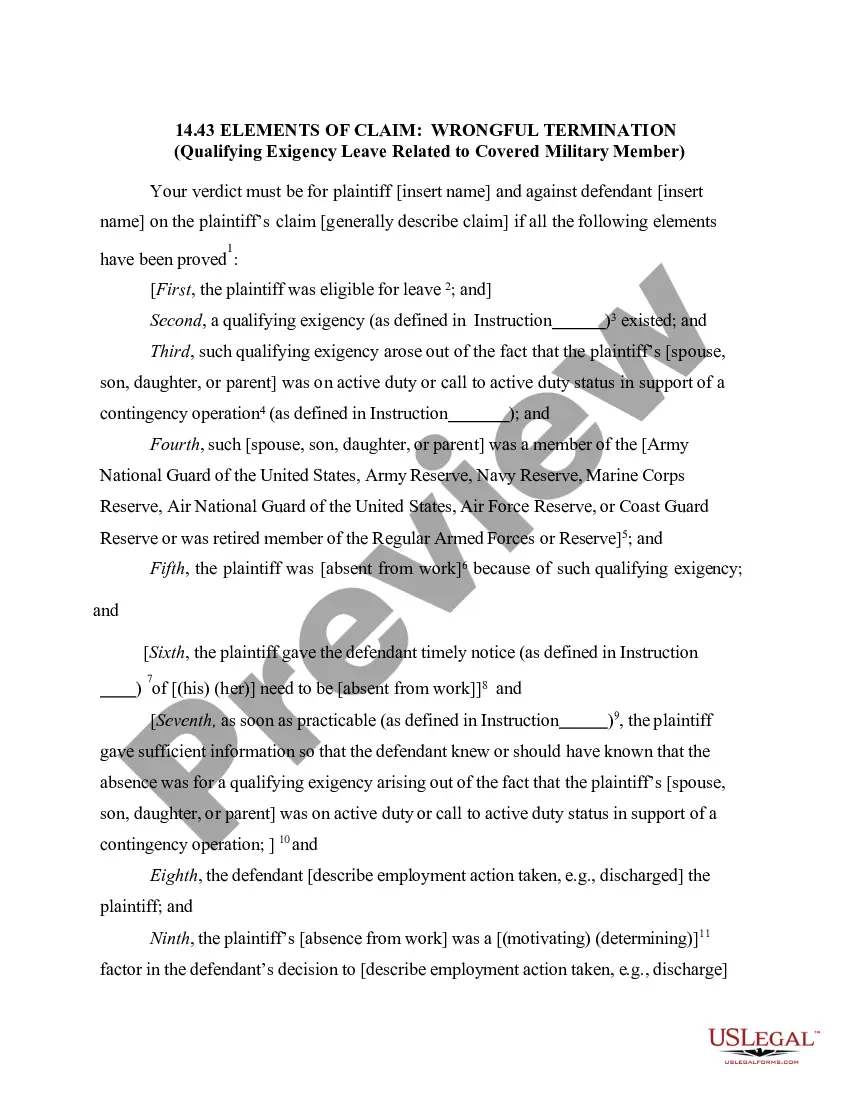
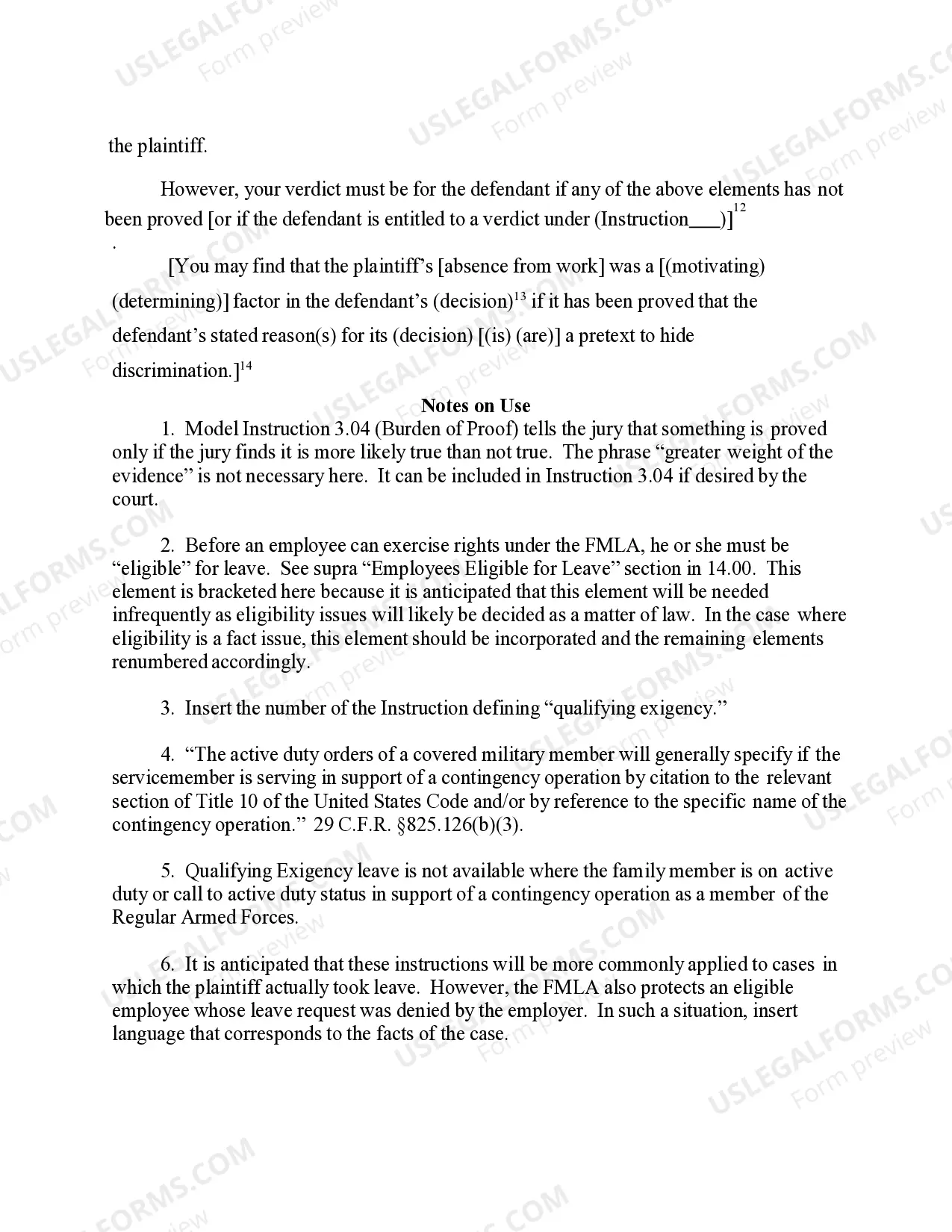
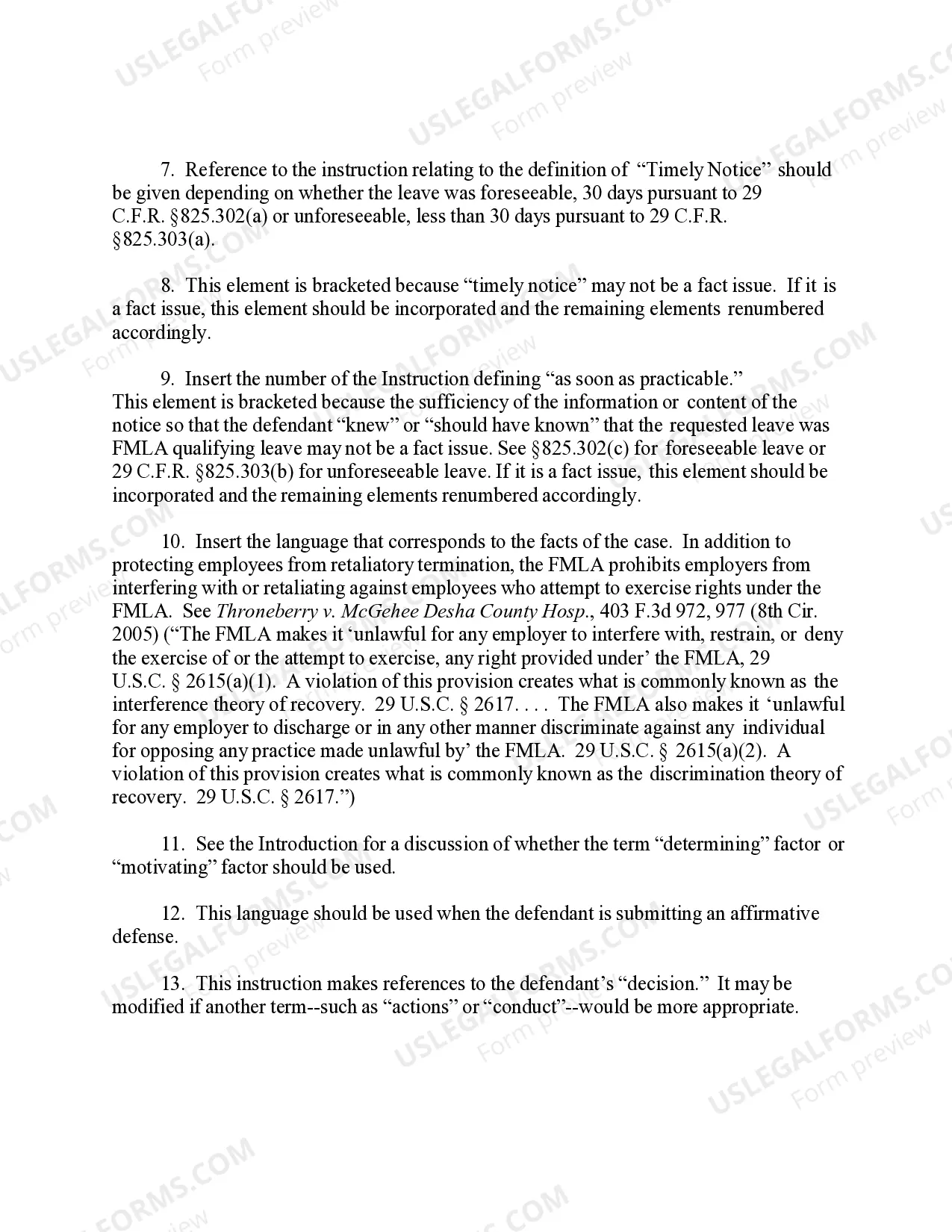
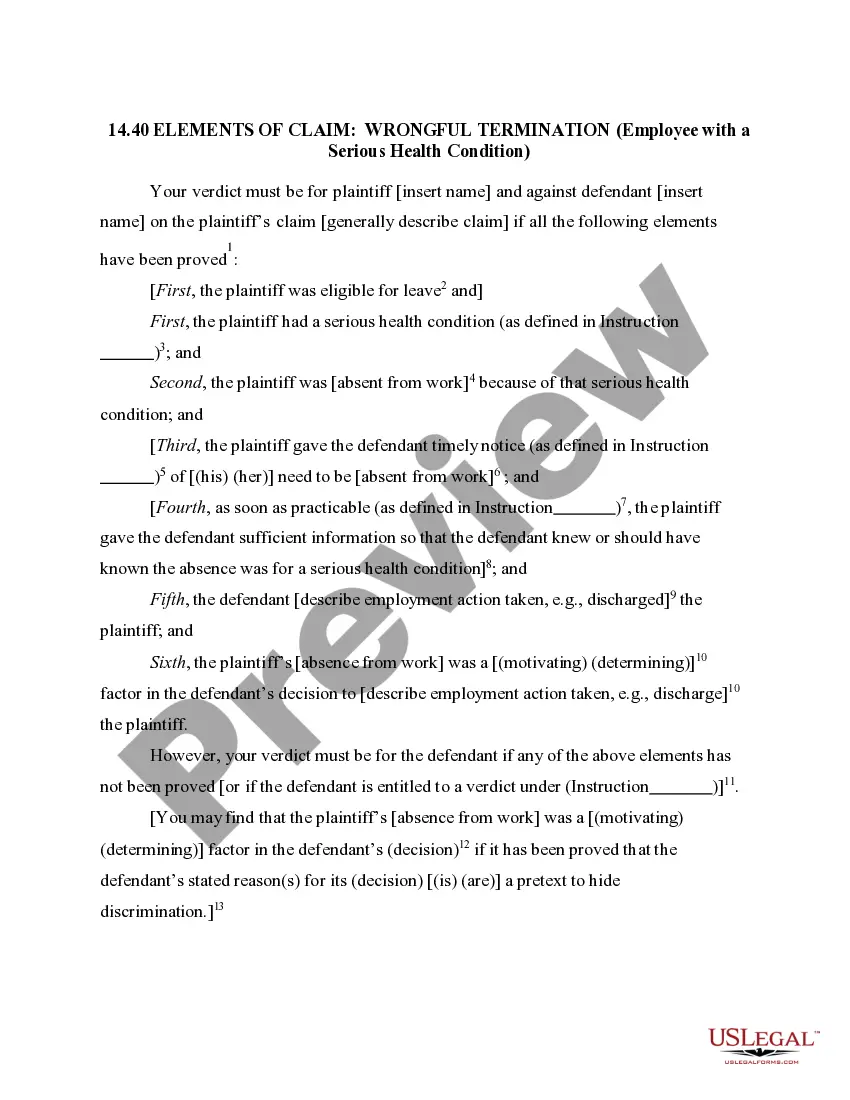
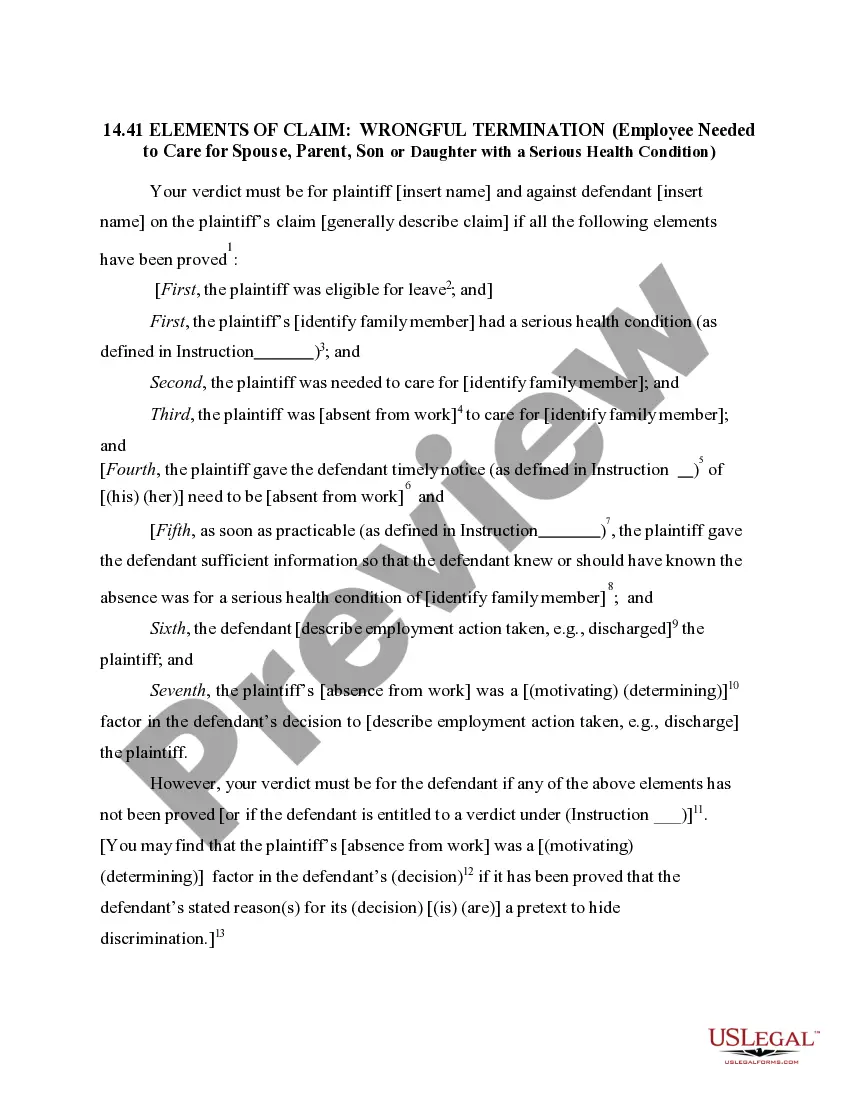
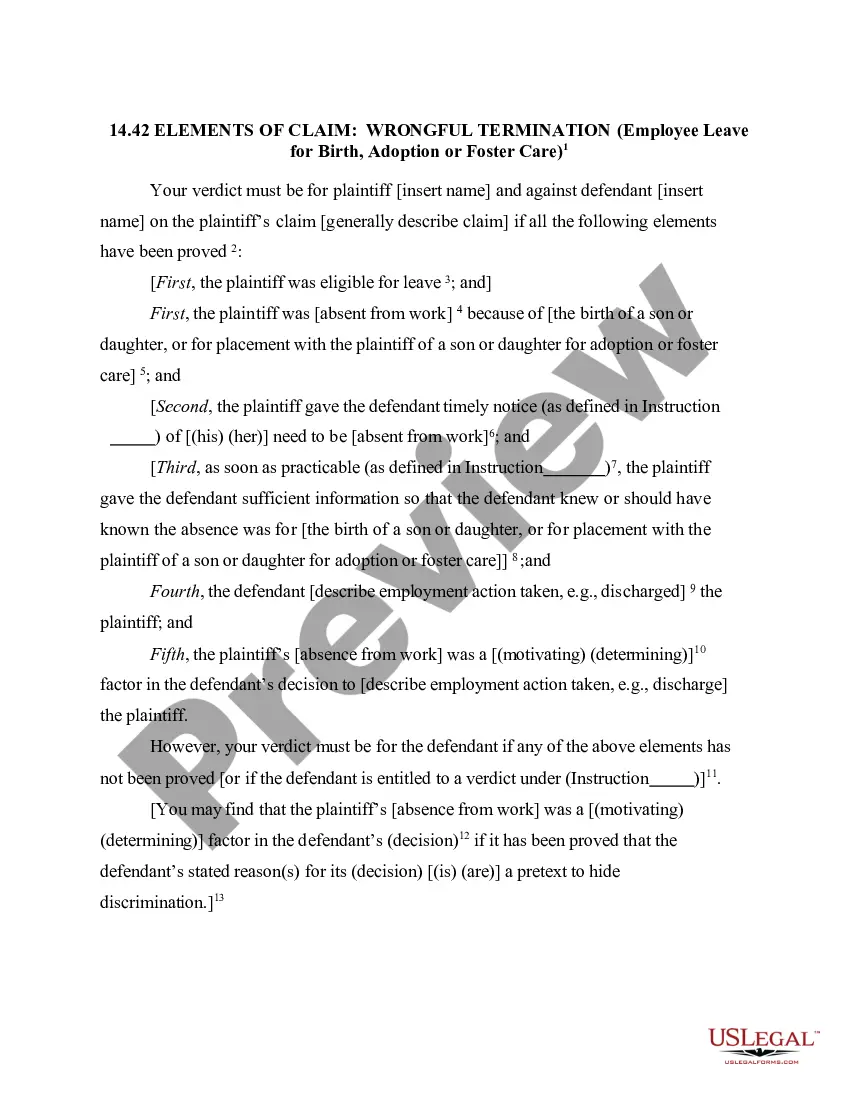
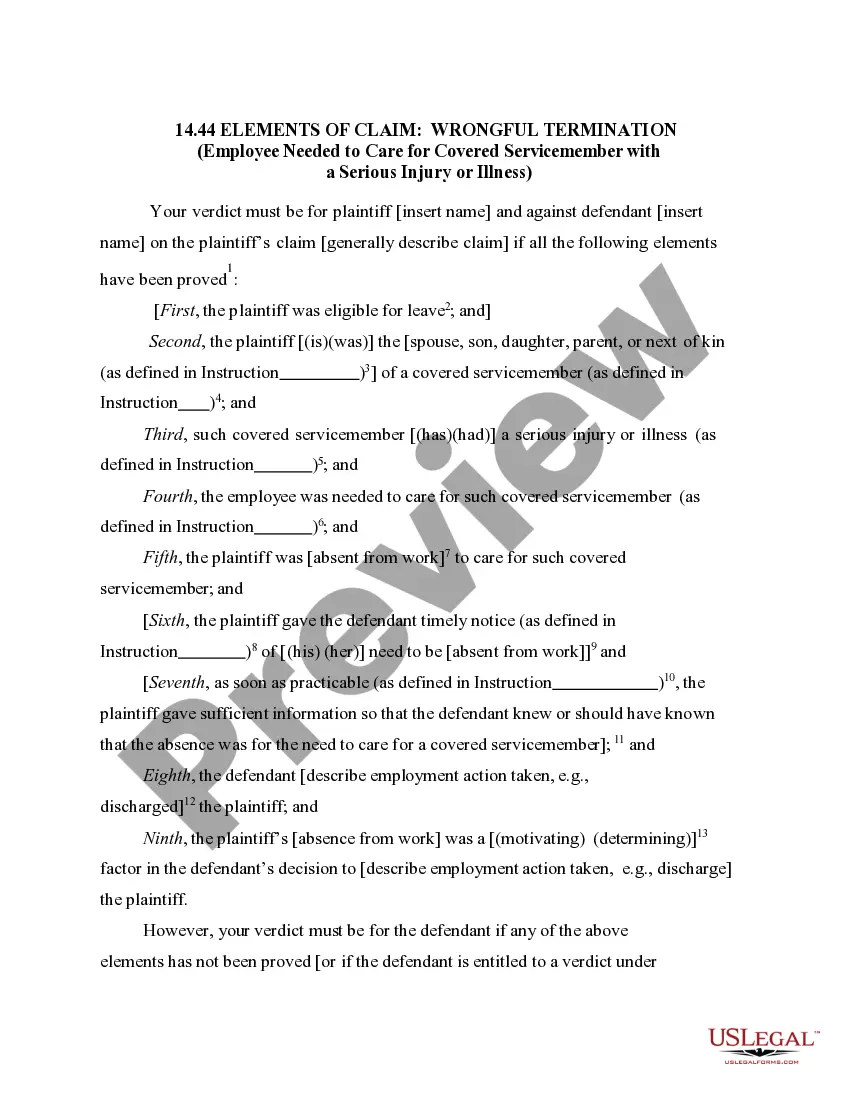
14.43 ELEMENTS OF CLAIM: WRONGFUL TERMINATION (Qualifying Exigency Leave Related to Covered Military Member)
What this document covers
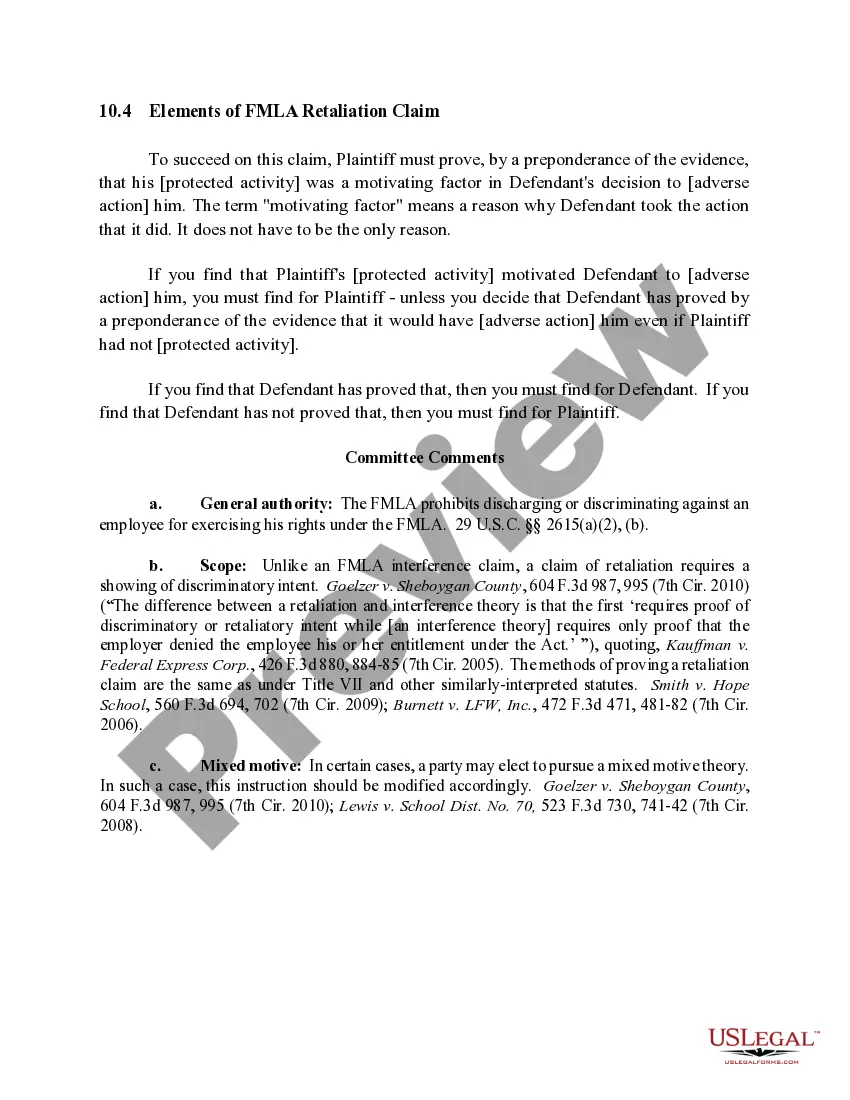
The 14.43 Elements of Claim: Wrongful Termination (Qualifying Exigency Leave Related to Covered Military Member) form is a legal document used to assert claims of wrongful termination under the Family and Medical Leave Act (FMLA) related to a qualifying exigency arising from a military family memberâs active duty status. This form outlines the necessary components to establish a claim for wrongful termination, differentiating it from other employment-related forms by its specific focus on military-related family leave scenarios.
Key parts of this document
- Eligibility for FMLA leave based on the plaintiff's relationship to a covered military member.
- Definition and criteria for a "qualifying exigency" that justifies leave.
- Required notice to the employer regarding the need for leave.
- Details regarding the employment decision made by the employer.
- Factors determining if the absence from work was a motivating factor in the employer's decision.

Common use cases
This form should be used when an employee believes they were wrongfully terminated for taking or attempting to take leave under the FMLA due to a qualifying exigency related to a family memberâs active military duty. It is particularly relevant in cases where the employeeâs notice to their employer about the leave was met with retaliation or interference.
Who needs this form
Individuals who may find this form applicable include:
- Employees who have a covered military family member on active duty.
- Those who have taken leave for qualifying exigencies but faced termination or adverse employment action.
- Workers seeking to assert their rights under the FMLA regarding military leave related to family members.
How to complete this form
- Identify the plaintiff and defendant by inserting their names.
- Detail the nature of the employment claim, specifically pertaining to wrongful termination.
- Outline the qualifying exigency and its relation to the active duty status of the military family member.
- Specify the notice provided to the employer about the absence due to the qualifying exigency.
- Include the employment action taken by the employer, such as termination or other adverse actions.
- Determine and indicate if the absence from work was a motivating factor in the employer's decision.
Notarization guidance
This form does not typically require notarization unless specified by local law. Users should review any specific legal requirements according to the jurisdiction where the claim is to be filed.
Get your form ready online
Our built-in tools help you complete, sign, share, and store your documents in one place.
Make edits, fill in missing information, and update formatting in US Legal Forms—just like you would in MS Word.
Download a copy, print it, send it by email, or mail it via USPS—whatever works best for your next step.
Sign and collect signatures with our SignNow integration. Send to multiple recipients, set reminders, and more. Go Premium to unlock E-Sign.
If this form requires notarization, complete it online through a secure video call—no need to meet a notary in person or wait for an appointment.
We protect your documents and personal data by following strict security and privacy standards.

Make edits, fill in missing information, and update formatting in US Legal Forms—just like you would in MS Word.

Download a copy, print it, send it by email, or mail it via USPS—whatever works best for your next step.

Sign and collect signatures with our SignNow integration. Send to multiple recipients, set reminders, and more. Go Premium to unlock E-Sign.

If this form requires notarization, complete it online through a secure video call—no need to meet a notary in person or wait for an appointment.

We protect your documents and personal data by following strict security and privacy standards.
Common mistakes
- Failing to document the qualifying exigency properly.
- Not providing timely notice to the employer regarding the leave.
- Misunderstanding the definition of a qualifying exigency.
- Neglecting to prove that the absence was a motivating factor in the termination.
Why use this form online
- Convenient access to the form, allowing users to fill out and download from any location.
- Editable fields to tailor the form to specific circumstances.
- Reliable source of legally drafted templates by licensed attorneys ensuring compliance with applicable laws.
Legal use & context
- The FMLA provides specific rights to eligible employees regarding military family leave.
- Retaliatory termination for taking qualifying exigency leave is prohibited under the FMLA.
- Establishing a wrongful termination claim requires proof of eligibility and adherence to notice requirements.
Quick recap
- The form is essential for employees claiming wrongful termination related to military family leave.
- Proper completion ensures that all elements of the claim are addressed.
- Understanding qualifying exigencies is crucial for compliance and successful claims.
Looking for another form?

Form popularity
FAQ
Qualifying exigencies may arise when the employee's spouse, son, daughter, or parent who is a member of the Armed Forces (including the National Guard and Reserves) and who is on covered active duty or has been notified of an impending call or order to covered active duty.
An eligible employee caring for a covered military member's child may use qualifying exigency leave to provide childcare on an urgent, immediate need basis, but not on a routine, everyday basis, where the need to provide the care arises from the active duty or call to active duty status of the covered military member.
Qualifying exigency leave, like leave for a serious health condition, is a FMLA-qualifying reason for which an eligible employee may use his or her entitlement for up to 12 workweeks of FMLA leave each year.
Military member's active duty or call to active duty status as qualifying exigency leave. Such events may include leave to spend time with a covered military member either prior to or post deployment, or to attend to household emergencies that would normally have been handled by the covered military member.
QUALIFYING EXIGENCY LEAVE ENTITLEMENTS Qualifying exigencies may arise when the employee's spouse, son, daughter, or parent who is a member of the Armed Forces (including the National Guard and Reserves) and who is on covered active duty or has been notified of an impending call or order to covered active duty.
Qualifying exigency leave, like leave for a serious health condition, is a FMLA-qualifying reason for which an eligible employee may use his or her entitlement for up to 12 workweeks of FMLA leave each year.
Qualifying exigencies arise when the spouse, son, daughter, or parent of an employee is on covered active duty in the Armed Forces, or has been notified of an impending call or order to covered active duty.