Division Order
What is this form?
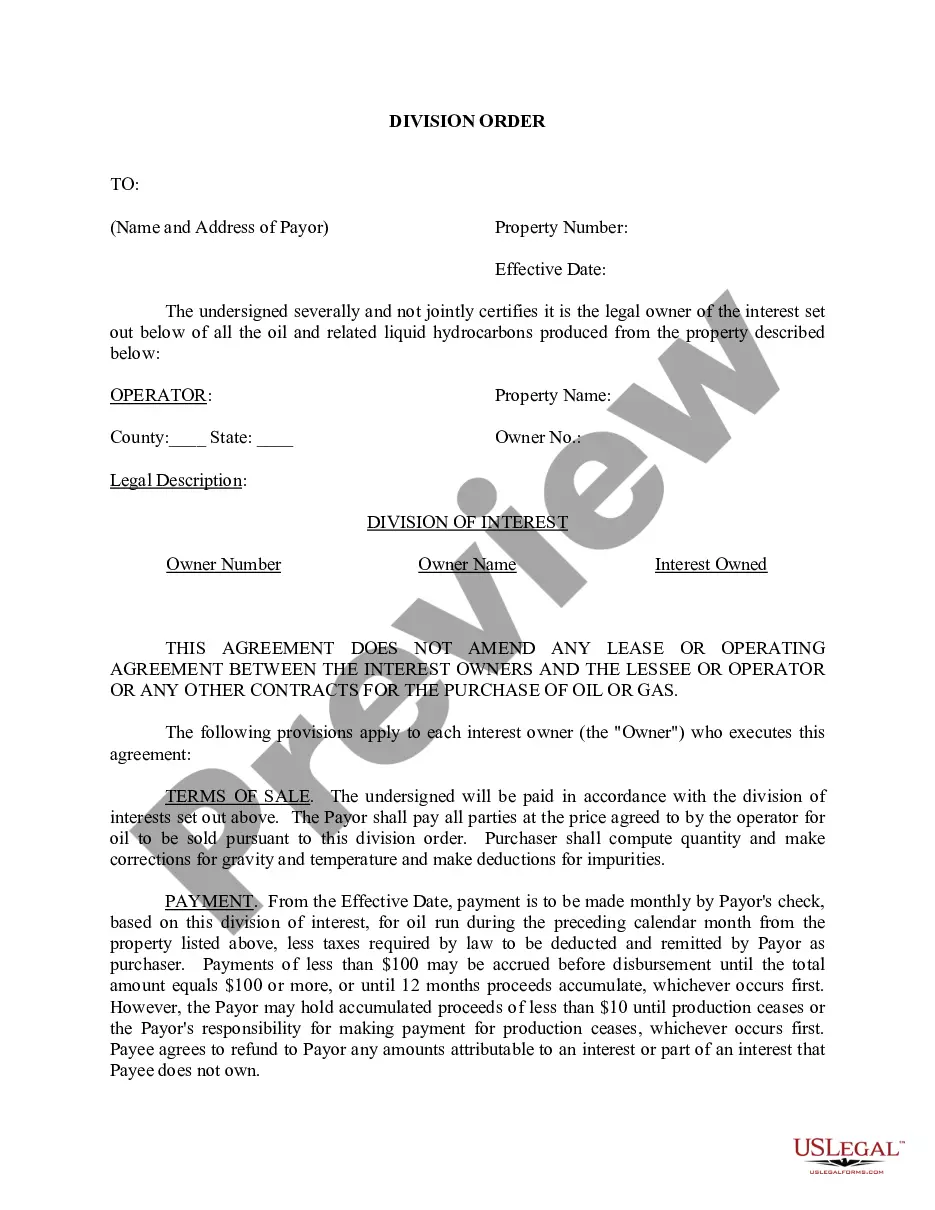
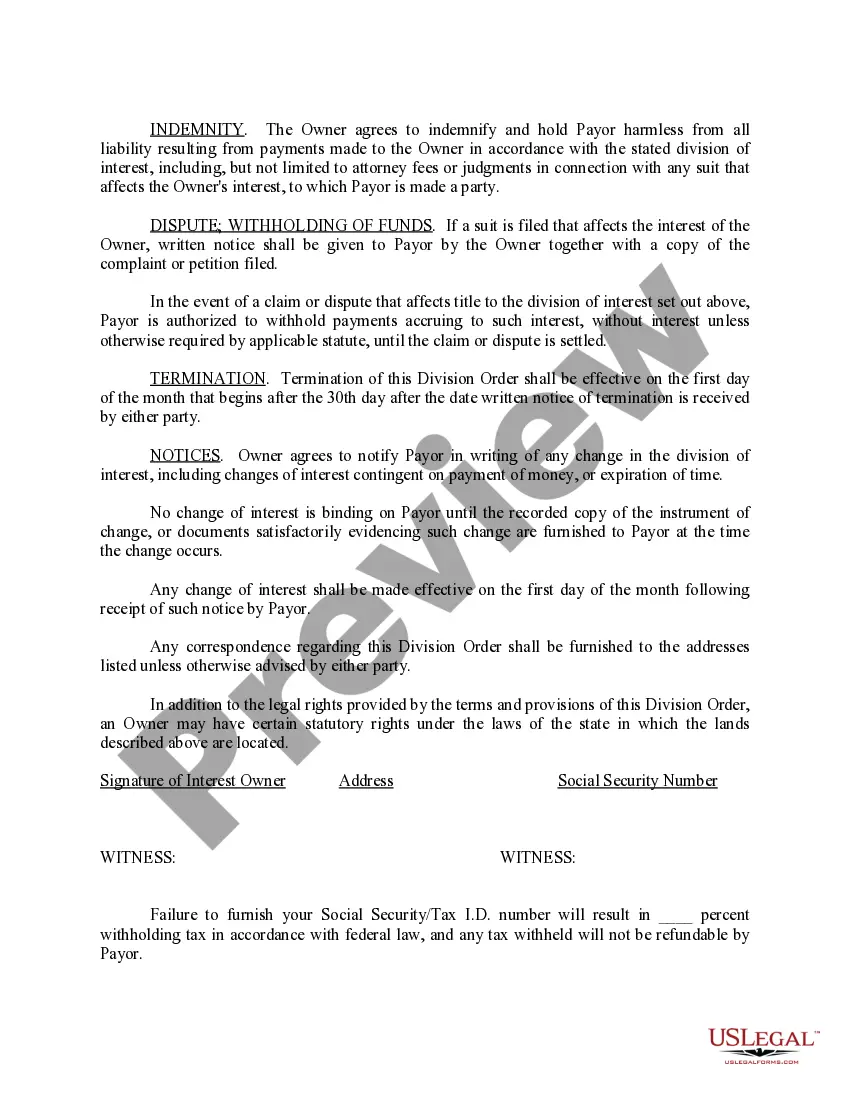
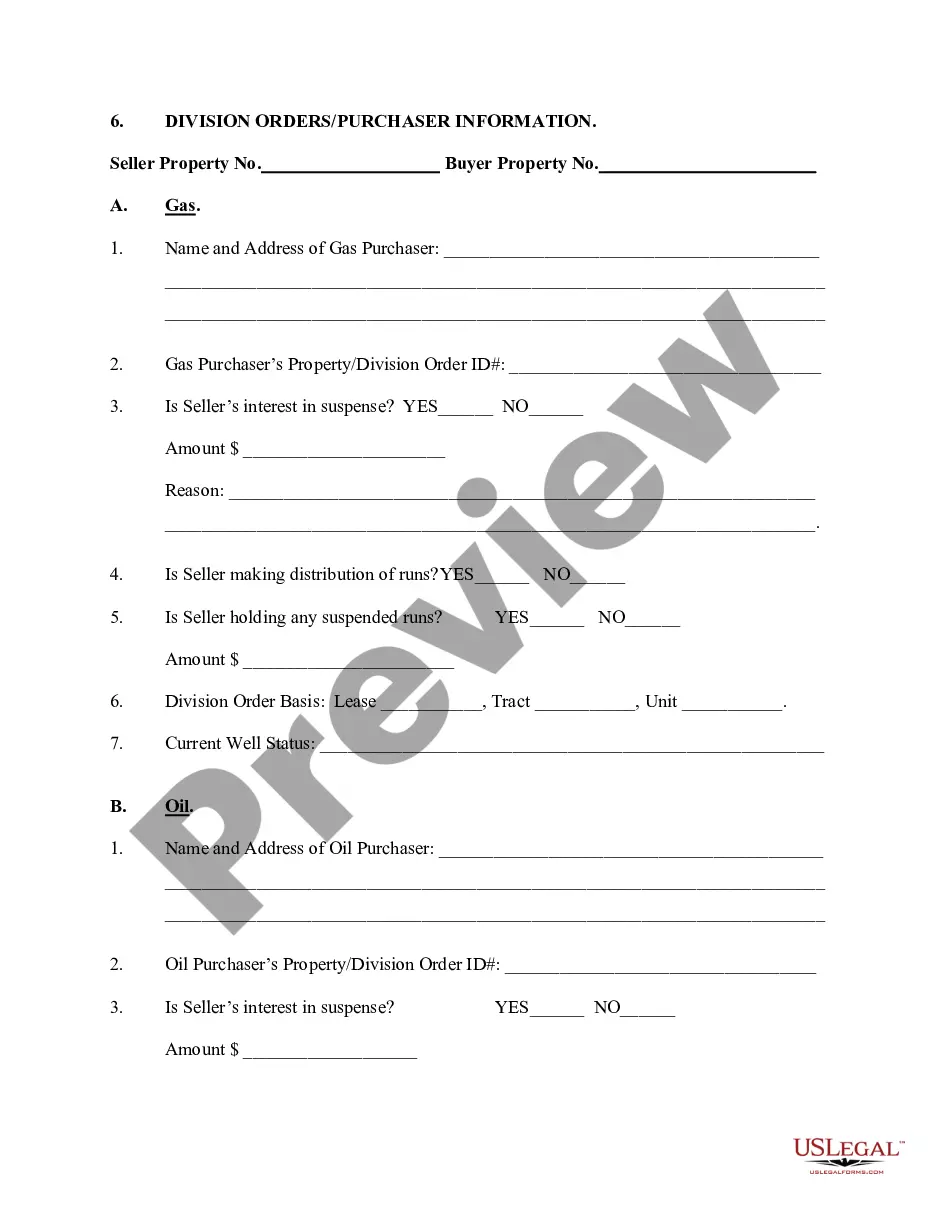
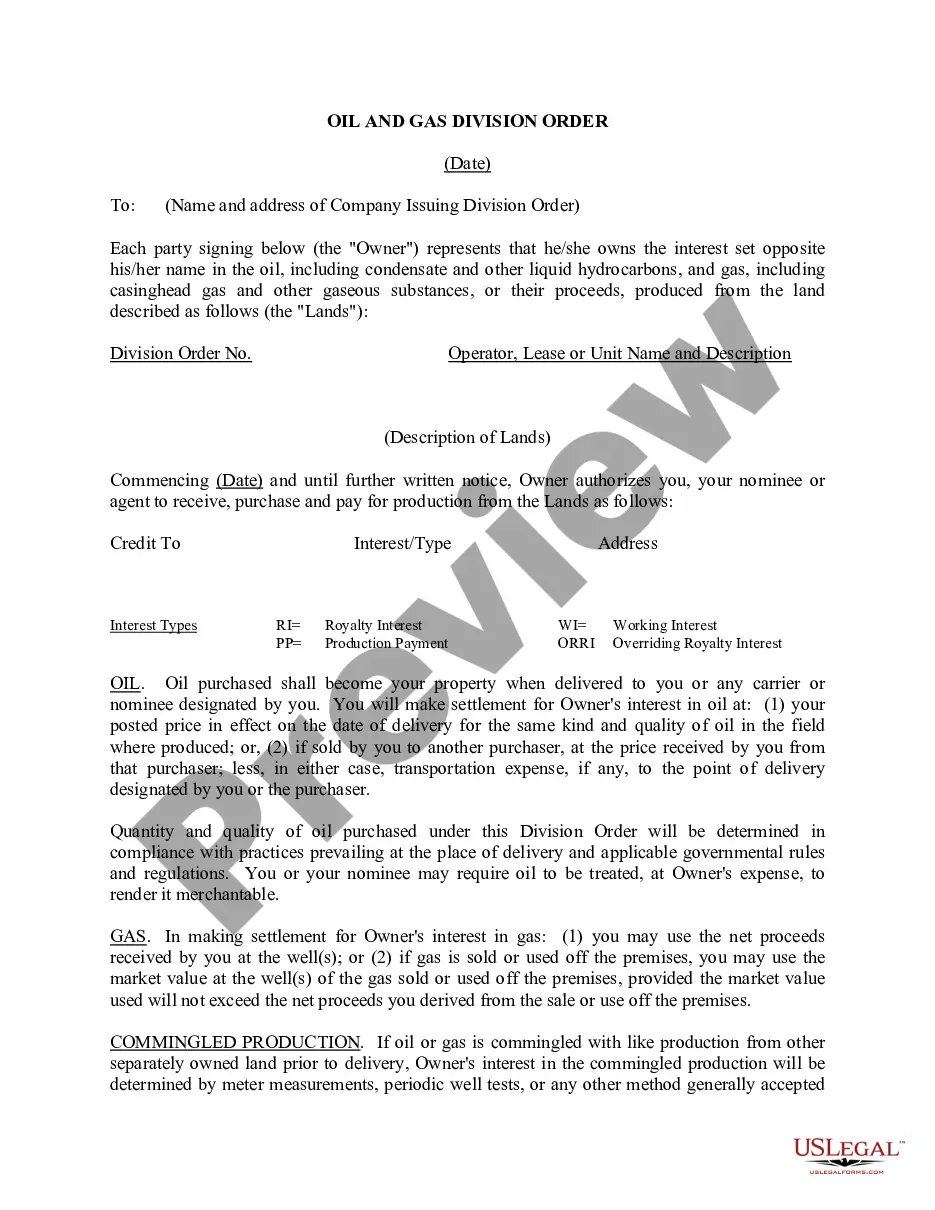
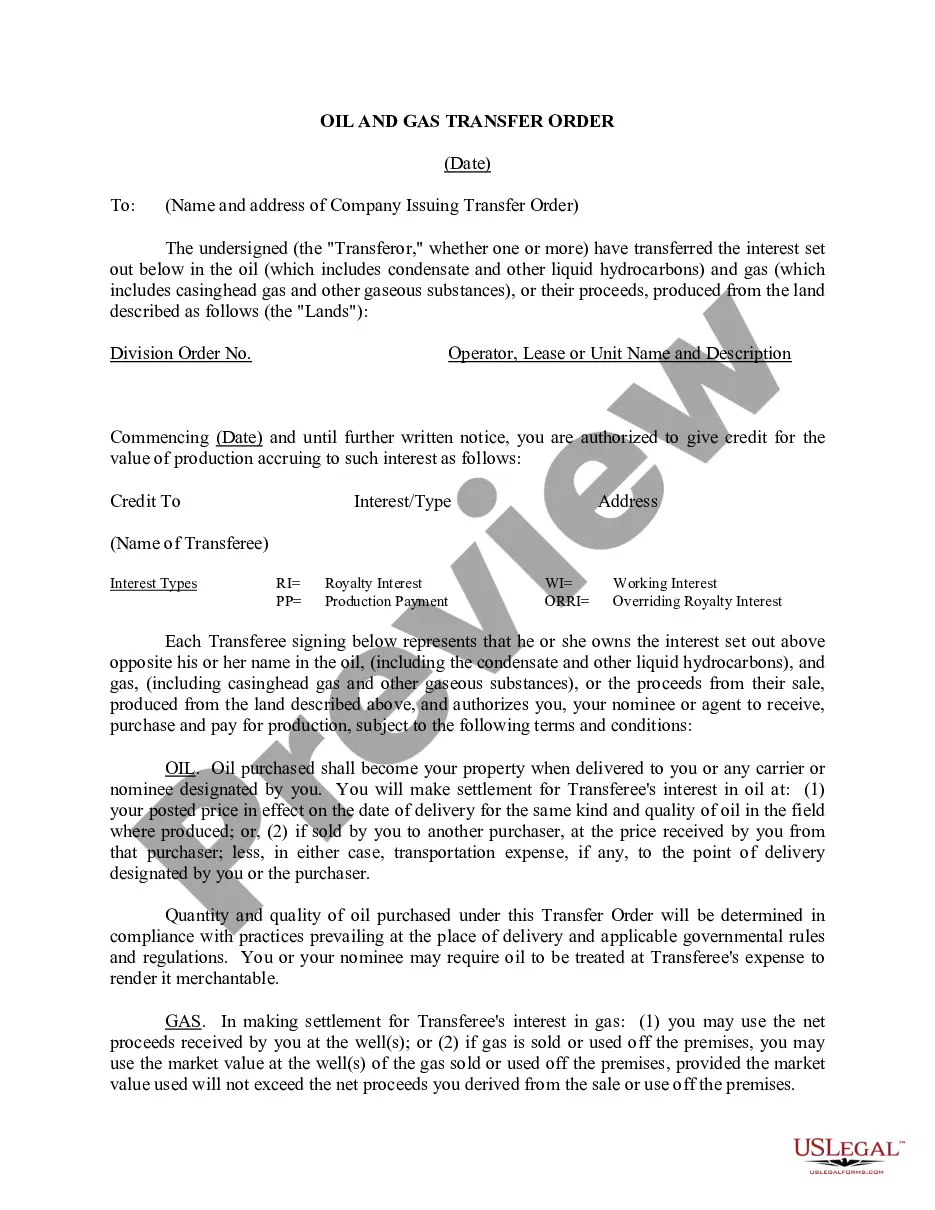
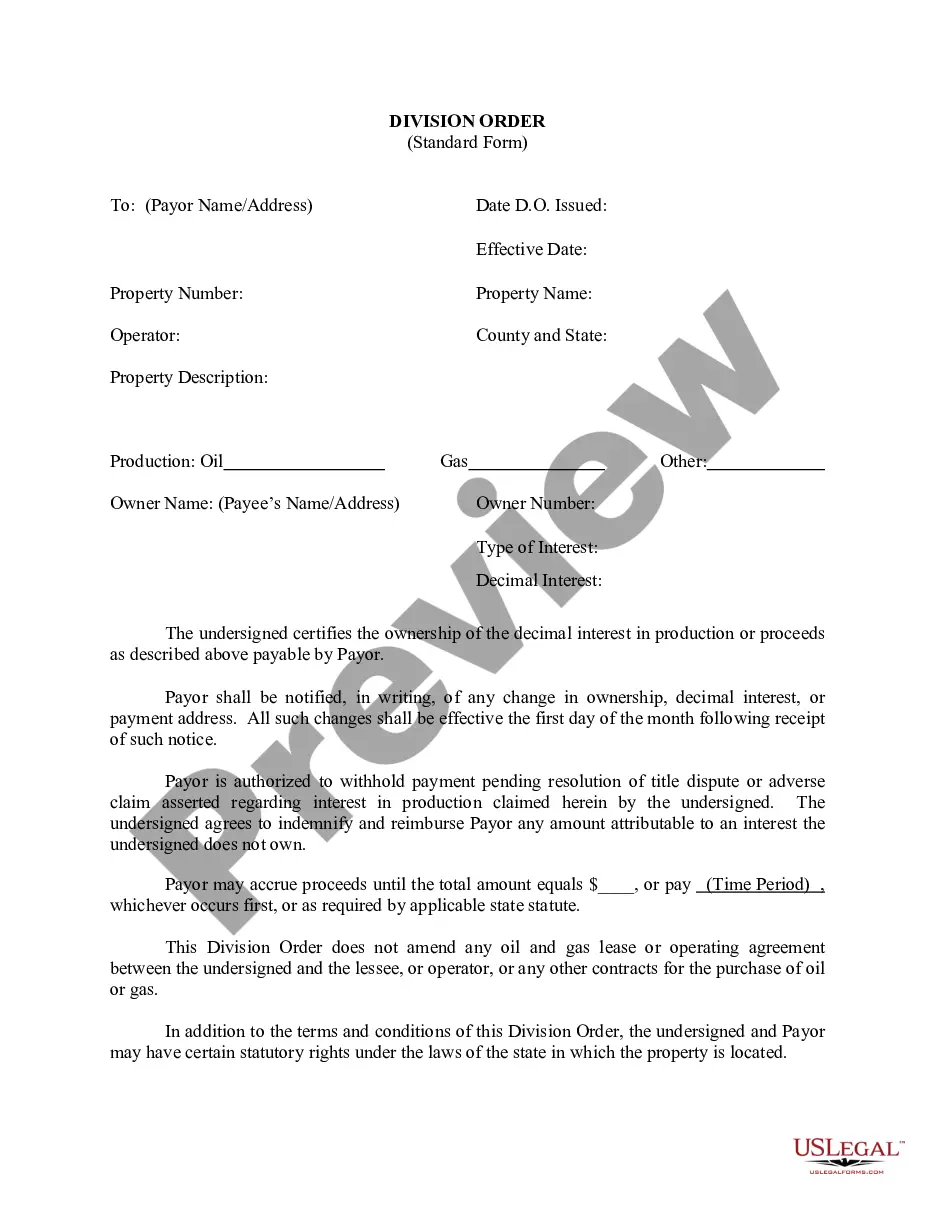
A division order is a legal document that outlines the distribution of payments among parties who own interests in oil or gas production from a specific property. It serves as a certification of ownership and ensures that payors appropriately allocate revenue based on the stated interests. This form is particularly used in the oil and gas industry to clarify payment responsibilities and ownership stakes, differentiating it from other contractual agreements related to oil and gas transactions.
What’s included in this form
- Name and address of the payor
- Property number and effective date
- Details of the legal owner and their interest in the property
- Terms of sale including pricing and payment structure
- Indemnity clause protecting payors from liabilities
- Notice requirements for changes in ownership
When this form is needed
This division order should be used when an owner of oil or gas rights needs to clarify their share of revenue from production. It is commonly employed when new ownership is established or when existing ownership changes. Any party that wishes to formalize their interest, secure payments, or uphold legal responsibilities in oil or gas production should use this form.
Who needs this form
- Landowners with interests in oil and gas production
- Operators managing oil or gas leases
- Royalty owners seeking to confirm their payment structure
- Legal professionals representing clients in the oil and gas sector
Completing this form step by step
- Identify and enter the name and address of the payor.
- Specify the property number and effective date.
- List the legal owner(s) along with their respective interests in the property.
- Fill in the payment terms based on established agreements.
- Ensure all parties sign the document to validate their consent.
Notarization guidance
Notarization is generally not required for this form. However, certain states or situations might demand it. You can complete notarization online through US Legal Forms, powered by Notarize, using a verified video call available anytime.
Get your form ready online
Our built-in tools help you complete, sign, share, and store your documents in one place.
Make edits, fill in missing information, and update formatting in US Legal Forms—just like you would in MS Word.
Download a copy, print it, send it by email, or mail it via USPS—whatever works best for your next step.
Sign and collect signatures with our SignNow integration. Send to multiple recipients, set reminders, and more. Go Premium to unlock E-Sign.
If this form requires notarization, complete it online through a secure video call—no need to meet a notary in person or wait for an appointment.
We protect your documents and personal data by following strict security and privacy standards.

Make edits, fill in missing information, and update formatting in US Legal Forms—just like you would in MS Word.

Download a copy, print it, send it by email, or mail it via USPS—whatever works best for your next step.

Sign and collect signatures with our SignNow integration. Send to multiple recipients, set reminders, and more. Go Premium to unlock E-Sign.

If this form requires notarization, complete it online through a secure video call—no need to meet a notary in person or wait for an appointment.

We protect your documents and personal data by following strict security and privacy standards.
Common mistakes
- Failing to accurately report each owner's interest in the property.
- Omitting the effective date or property number.
- Not updating the payor on changes in ownership.
- Neglecting to include signatures of all relevant parties.
Why complete this form online
- Convenience of downloading and completing the form at your own pace.
- Editable templates allow for easy updates when ownership changes.
- Reliable access to professionally drafted legal documents.
Looking for another form?
Form popularity
FAQ
Your job as a Division Order Analyst is to determine each owner's share, and distribute checks accordingly. You may work for only one company, keeping detailed records about the people who own the company's equipment and resources.
A Division Order (DO's), also known as a Division of Interest (DOI), is the instrument which details the proportional ownership of produced minerals, including oil, liquids, natural gas, etc., in a well or unitized area of production.
A Division Order (DO's), also known as a Division of Interest (DOI), is the instrument which details the proportional ownership of produced minerals, including oil, liquids, natural gas, etc., in a well or unitized area of production.
A division order is a record of your interest in a specific well. It contains your decimal interest, interest type, well number and well name. Division orders are issued to all that own an interest in a specific well after that well has achieved first sales of either oil or gas.
Your decimal interest is calculated based on your royalty interest in the tract or unit on which the well is drilled.Or, you might own a non-participating royalty equal to 1/16 of the royalty reserved in any lease of the lands in the unit (a fraction of the royalty).
Net revenue is the amount that is shared among the property owners. To determine net revenue interest, multiply the royalty interest by the owner's shared interest. For example, if you have a 5/16 royalty, your net royalty interest would be 25% multiplied by 5/16, which equals 7.8125% calculated to four decimal places.
To divide cell A2 by 5: =A2/5. To divide cell A2 by cell B2: =A2/B2. To divide multiple cells successively, type cell references separated by the division symbol. For example, to divide the number in A2 by the number in B2, and then divide the result by the number in C2, use this formula: =A2/B2/C2.
What is division? Division is repeated subtraction. It is the process of dividing a number (dividend) with another number with the same or lesser value (divisor) to find the quotient and a remainder.If the quotient is later multiplied with the divisor, we get the dividend.