Oil and Gas Division Order
About this form
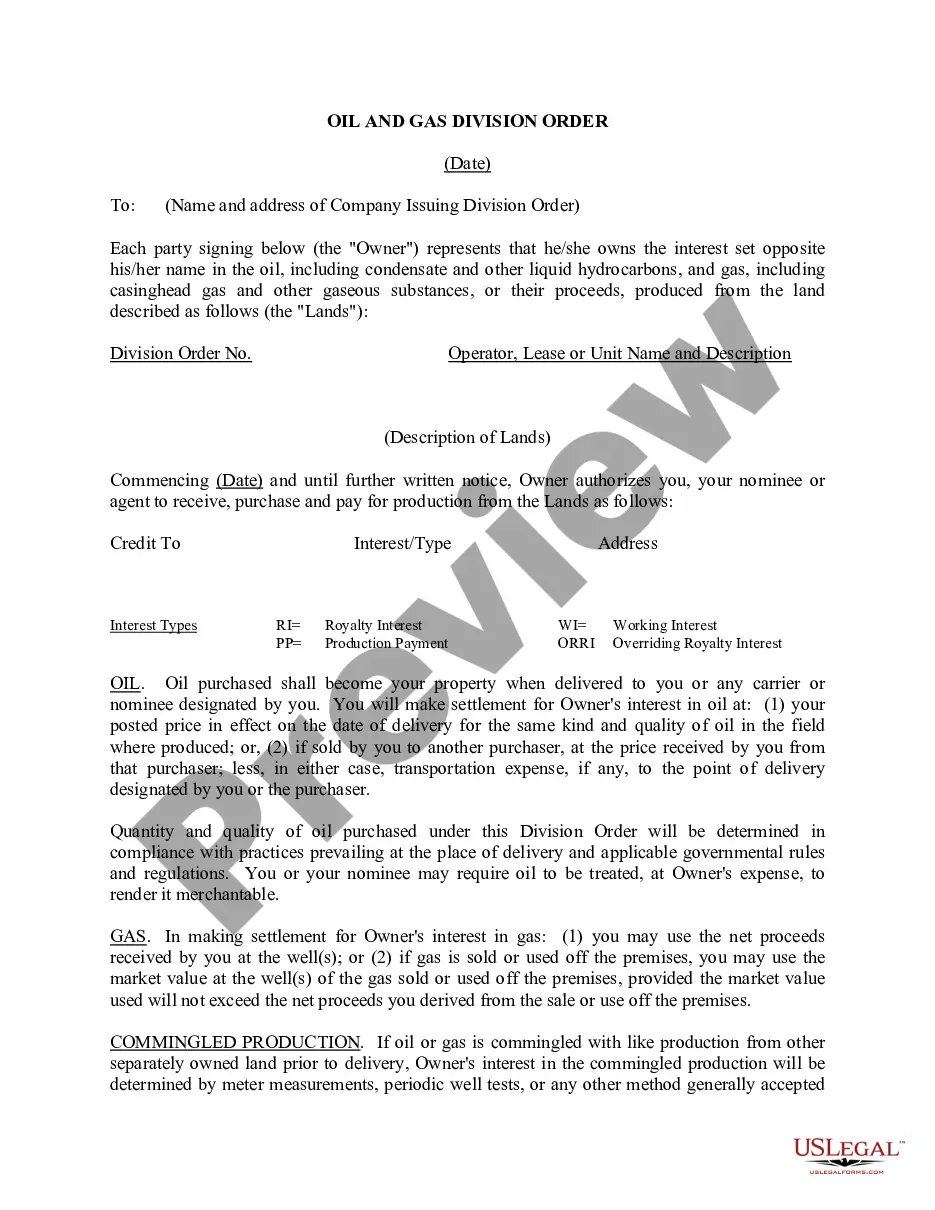
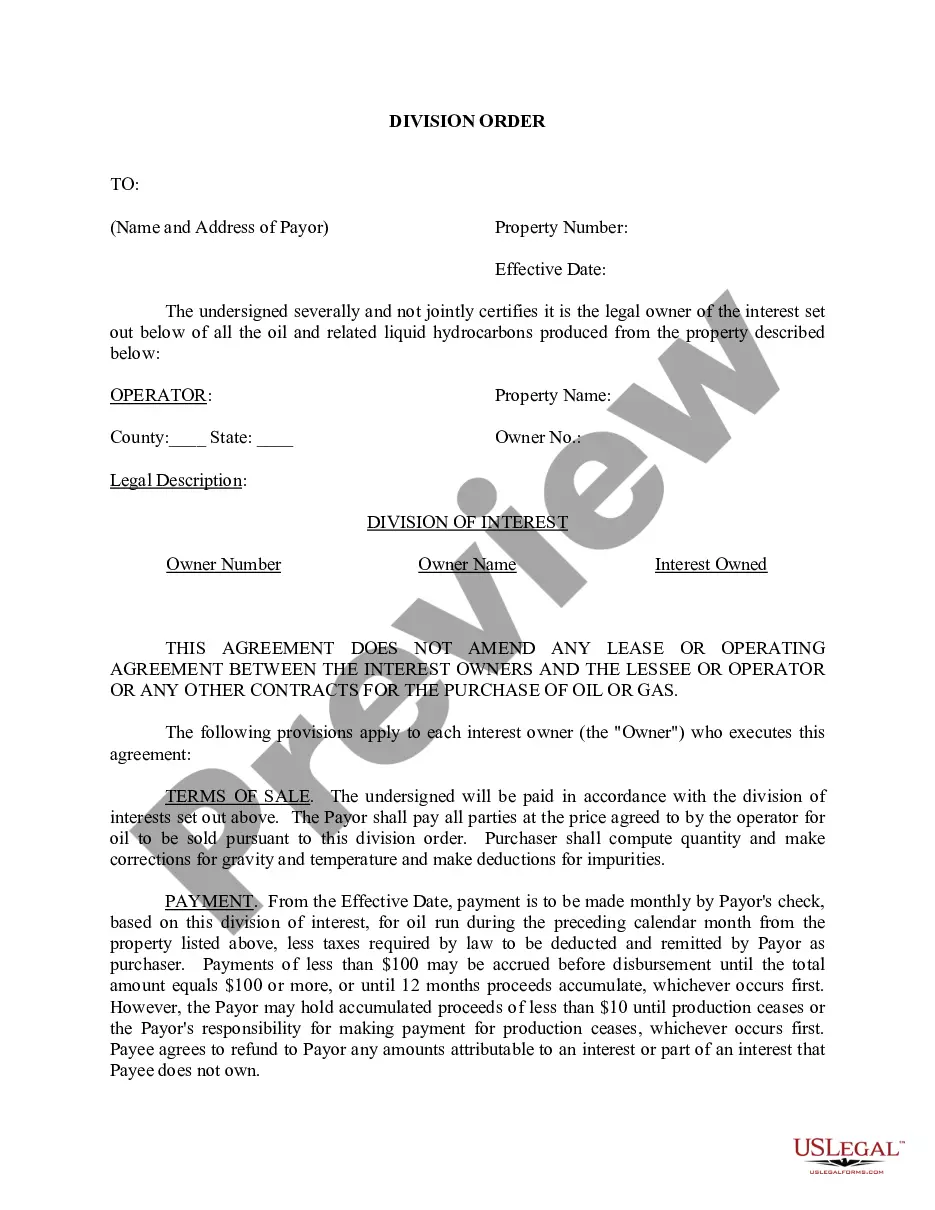
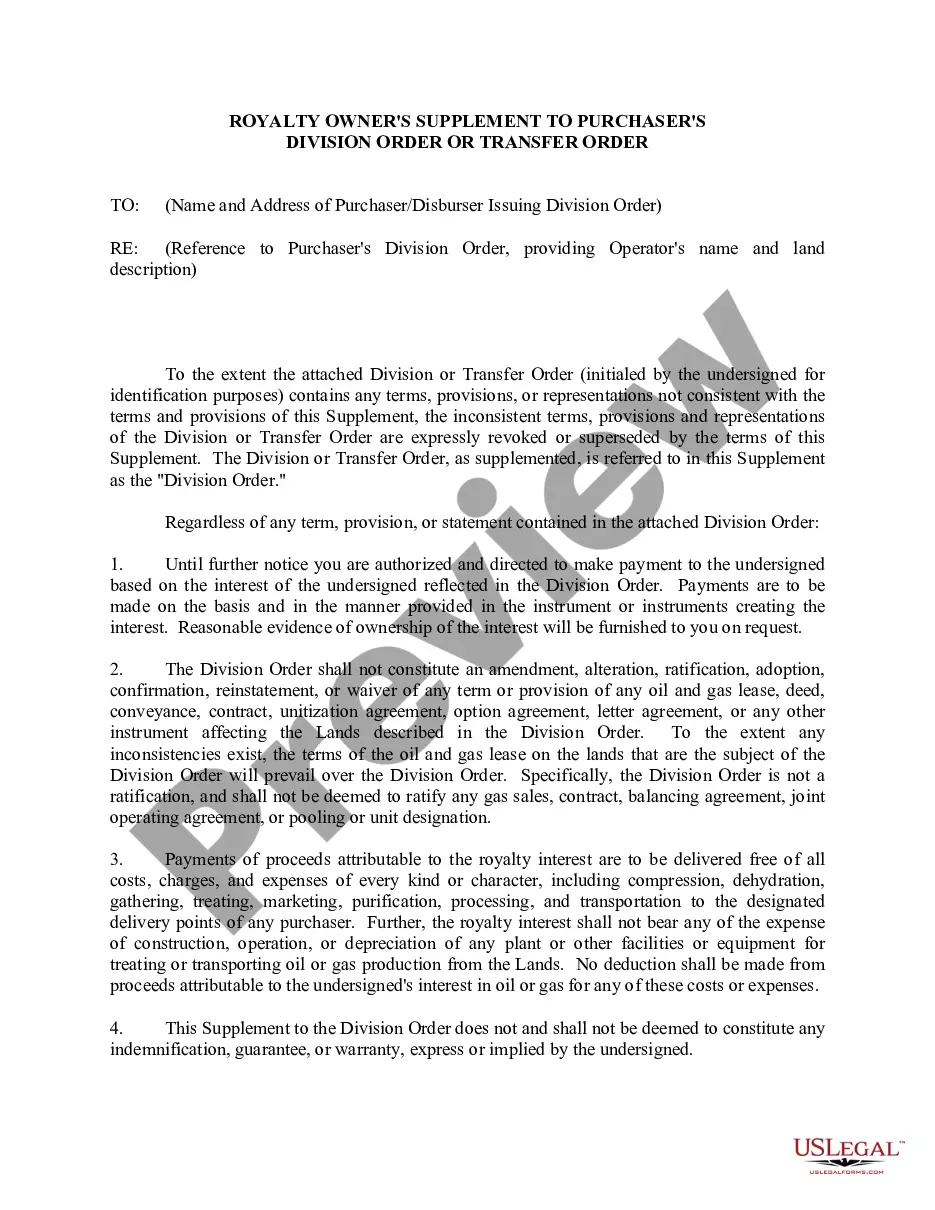
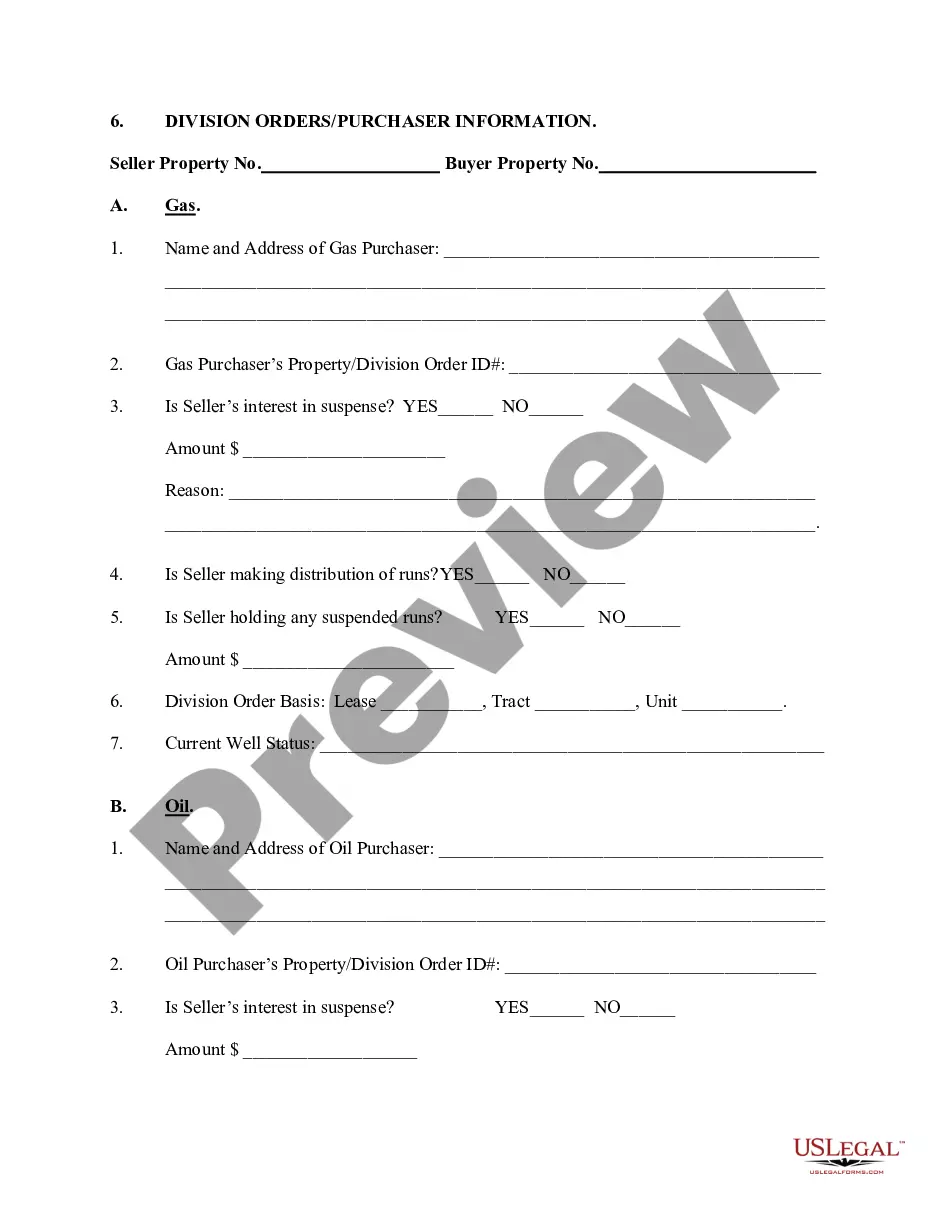
The Oil and Gas Division Order is a legal document used to authorize revenue payments from oil and gas production to interest owners. It ensures that payments are made based on the ownership interests specified by each party, distinguishing it from other contracts related to oil and gas transactions. This form streamlines the process of managing royalties and production payments, providing clear guidelines for all interested parties.
Key components of this form
- Date: The date on which the order is issued.
- Issuing Company Information: Name and address of the company that issues the division order.
- Owner Representations: Statements by the owner regarding their interest in the oil and gas produced.
- Legal Description of Property: Specific details of the land from which the production occurs.
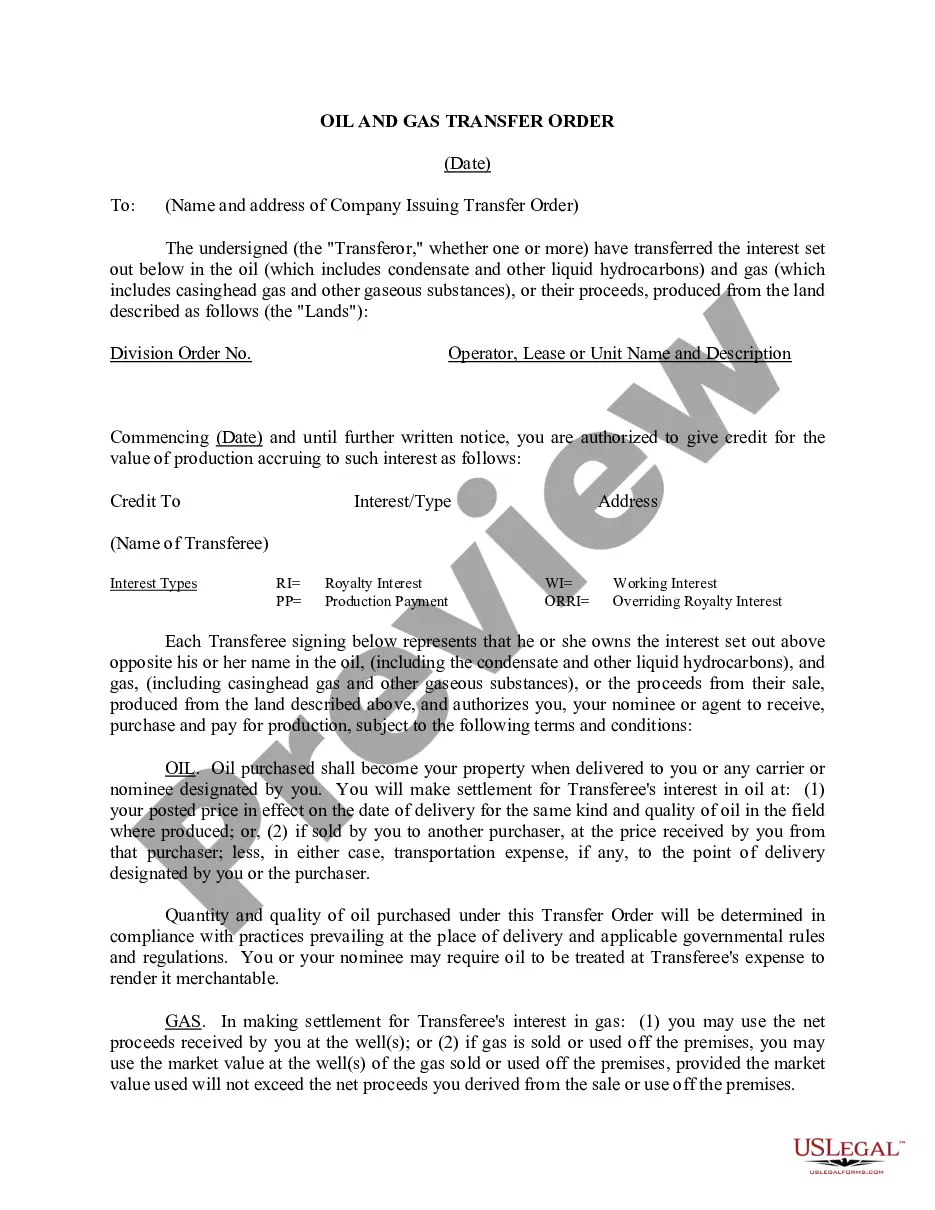
- Interest Types: Identification of the owner's specific interest in production, such as royalty interest, working interest, or overriding royalty interest.
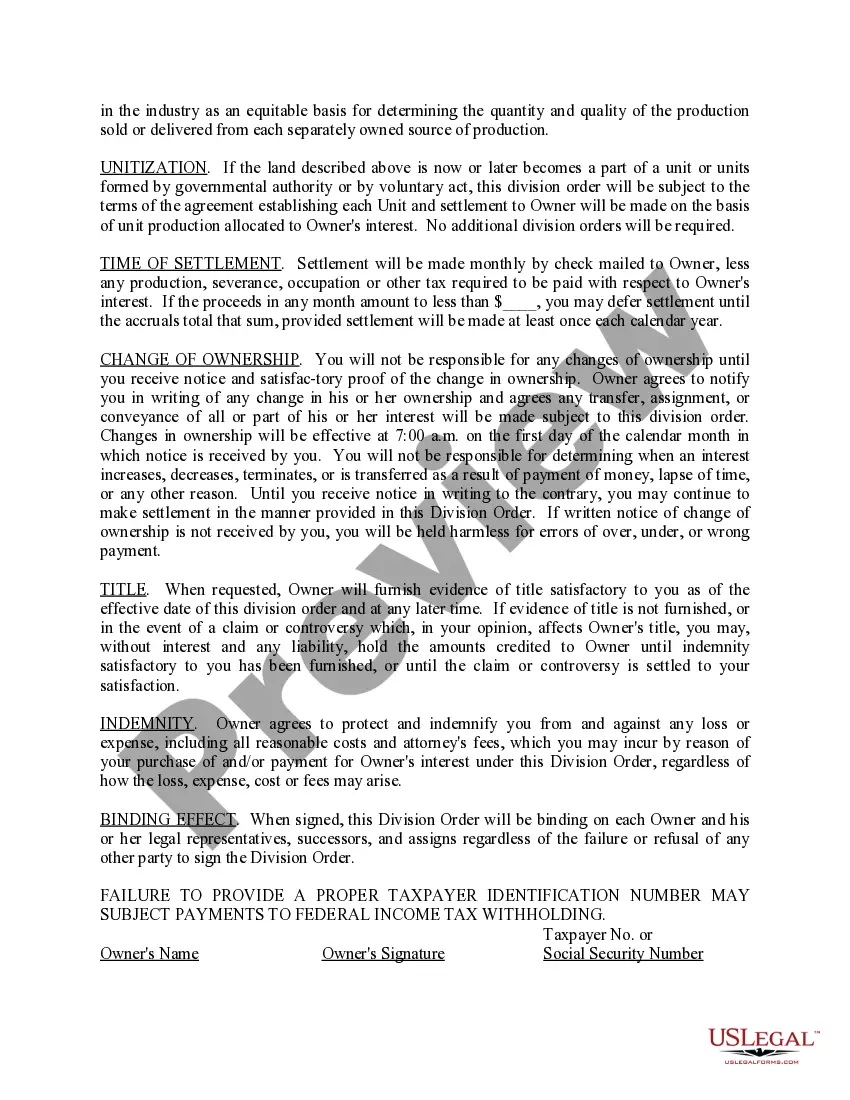
- Settlement Terms: Conditions for the payment and any tax obligations.
Common use cases
This form is essential when there is a need to delineate how revenue from oil and gas extraction is divided among interest owners. You should use the Oil and Gas Division Order when entering into agreements for the sale of production or when there is a change in ownership of interests. It is particularly useful in the context of oil and gas leases and production agreements.
Who can use this document
- Individuals or entities owning an interest in oil and gas production.
- Operators or companies managing production and requiring authorization for payment distribution.
- Landowners who have leased their land for oil and gas extraction.
- Any party involved in the sale or transfer of rights to oil and gas production proceeds.
How to complete this form
- Identify the parties involved, including the company issuing the division order and the interest owners.
- Specify the legal description of the property where the oil and gas production is taking place.
- Enter the date and the division order number for identification.
- Detail the ownership interests and types of interests held by each party.
- Include any terms for payment settlement, such as frequency and conditions for payments.
Does this document require notarization?
This form does not typically require notarization unless specified by local law. However, it is important to check any jurisdiction-specific requirements that may apply.
Get your form ready online
Our built-in tools help you complete, sign, share, and store your documents in one place.
Make edits, fill in missing information, and update formatting in US Legal Forms—just like you would in MS Word.
Download a copy, print it, send it by email, or mail it via USPS—whatever works best for your next step.
Sign and collect signatures with our SignNow integration. Send to multiple recipients, set reminders, and more. Go Premium to unlock E-Sign.
If this form requires notarization, complete it online through a secure video call—no need to meet a notary in person or wait for an appointment.
We protect your documents and personal data by following strict security and privacy standards.

Make edits, fill in missing information, and update formatting in US Legal Forms—just like you would in MS Word.

Download a copy, print it, send it by email, or mail it via USPS—whatever works best for your next step.

Sign and collect signatures with our SignNow integration. Send to multiple recipients, set reminders, and more. Go Premium to unlock E-Sign.

If this form requires notarization, complete it online through a secure video call—no need to meet a notary in person or wait for an appointment.

We protect your documents and personal data by following strict security and privacy standards.
Typical mistakes to avoid
- Failing to accurately describe the legal property, which can lead to disputes.
- Not updating the division order upon any change of ownership.
- Omitting required signatures, especially from all interest owners.
- Incorrectly specifying interest types, which could result in improper payment distributions.
Benefits of using this form online
- Quick and easy access to professionally drafted templates.
- Ability to fill out and edit the form at your convenience.
- Secure storage and easy retrieval of completed forms.
- Reducing the likelihood of errors with guided sections and clear instructions.
Main things to remember
- The Oil and Gas Division Order is crucial for managing payments among interest owners.
- It must be completed with accurate information to avoid future disputes.
- The form is applicable to various parties involved in oil and gas production.
- Online access offers convenience and reduces the risk of errors in form completion.
Looking for another form?

Form popularity
FAQ
A division order is a record of your interest in a specific well. It contains your decimal interest, interest type, well number and well name. Division orders are issued to all that own an interest in a specific well after that well has achieved first sales of either oil or gas.
Whenever oil or gas production begins, the landowner is entitled to part of the total production. A royalty is agreed upon as a percentage of the lease, minus what was reasonably used in the Lessee's production costs. The royalty is paid by the Lessee to the owner of the mineral rights, the Lessor in the Lease.
Use this formula to calculate your decimal share of royalties from the producing well: (Mineral Interest Share) times (Royalty Rate) = (Royalty Share Decimal). Example 1: (1/3 x 100% mineral interest) times (1/8 Royalty Rate) = 1/3 x 1/8 = 1/24 = 0.04166667 RI.
A royalty interest in the oil and gas industry is an interest in an oil and natural gas lease that gives the owner of the interest the right to receive a portion of the production from the leased acreage (or of the proceeds of the sale thereof), but generally does not require the owner to pay any portion of the costs
To calculate the number of net royalty acres I'm selling, I use this formula: acres in tract X % of minerals owned X 8 X royalty interest reserved in lease X fraction of royalty interest being sold. 640 acres X 25% X 8 X 1/4 X 1/2 = 160 net royalty acres.
Net revenue is the amount that is shared among the property owners. To determine net revenue interest, multiply the royalty interest by the owner's shared interest. For example, if you have a 5/16 royalty, your net royalty interest would be 25% multiplied by 5/16, which equals 7.8125% calculated to four decimal places.
To calculate your oil and gas royalties, you would first divide 50 by 1,000, and then multiply this number by . 20, then by $5,004,000 for a gross royalty of $50,040. Once you calculate your gross royalty amount, compare it to the number you see on your royalty check stubs.
A Division Order (DO's), also known as a Division of Interest (DOI), is the instrument which details the proportional ownership of produced minerals, including oil, liquids, natural gas, etc., in a well or unitized area of production.
Calculating net revenue interest formula To determine net revenue interest, multiply the royalty interest by the owner's shared interest. For example, if you have a 5/16 royalty, your net royalty interest would be 25% multiplied by 5/16, which equals 7.8125% calculated to four decimal places.