Michigan First Stipulated Order to Adjourn Trial
What this document covers
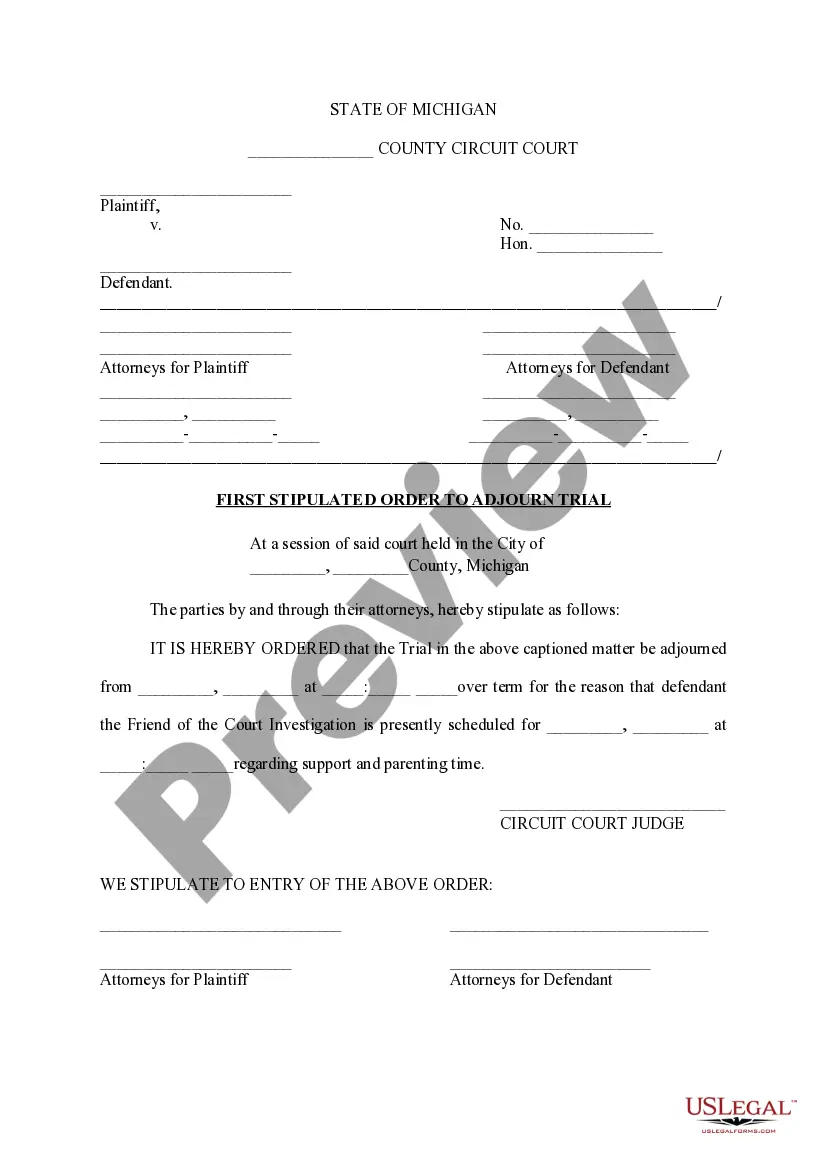
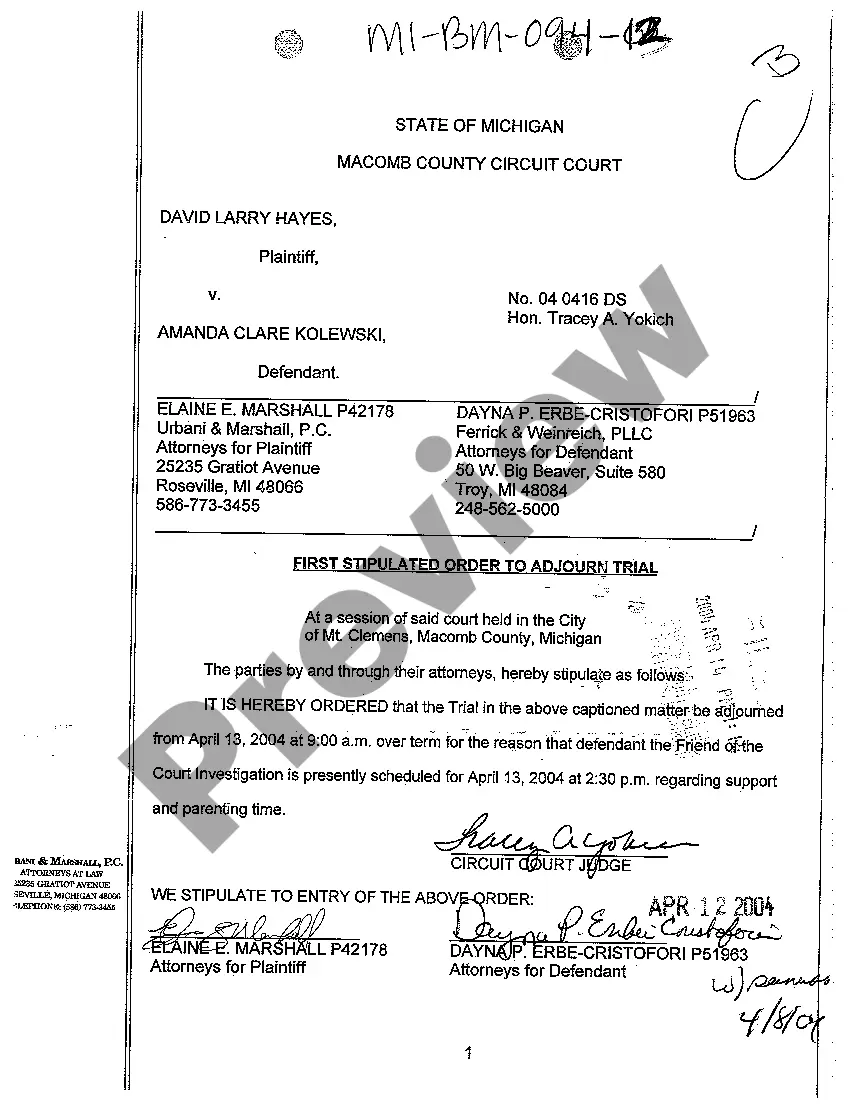
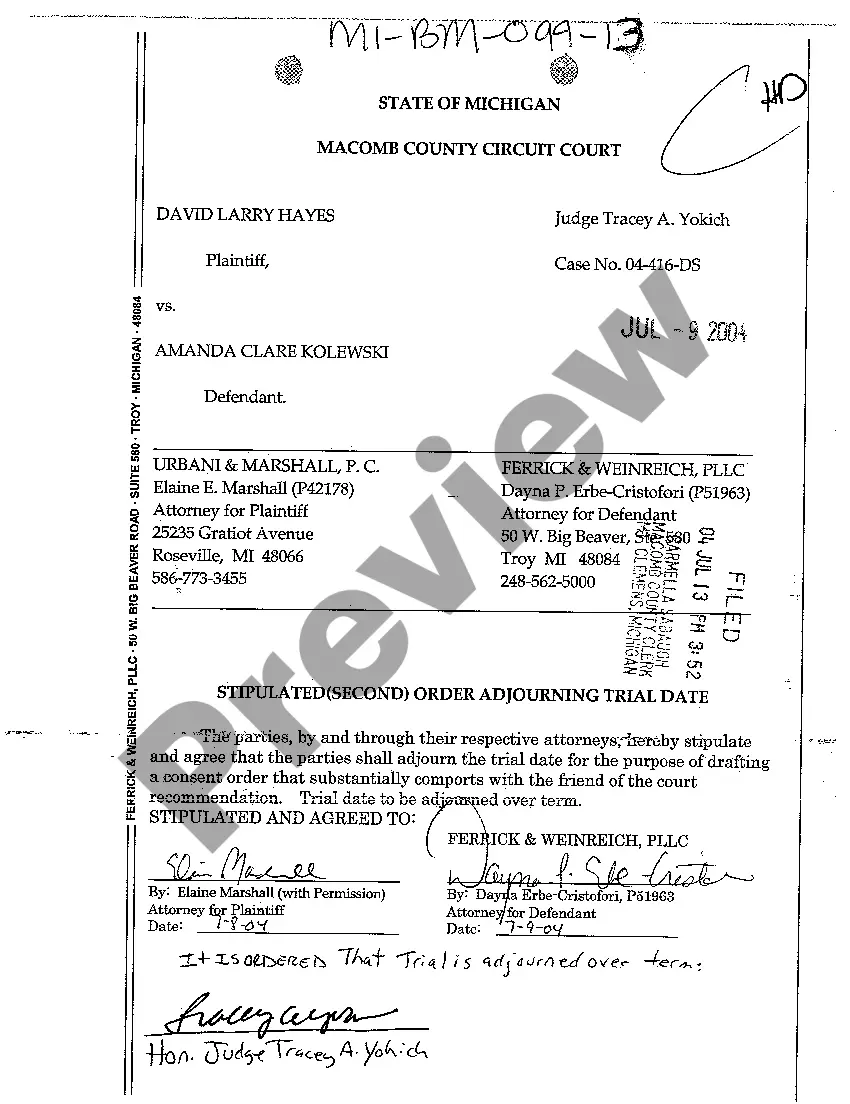
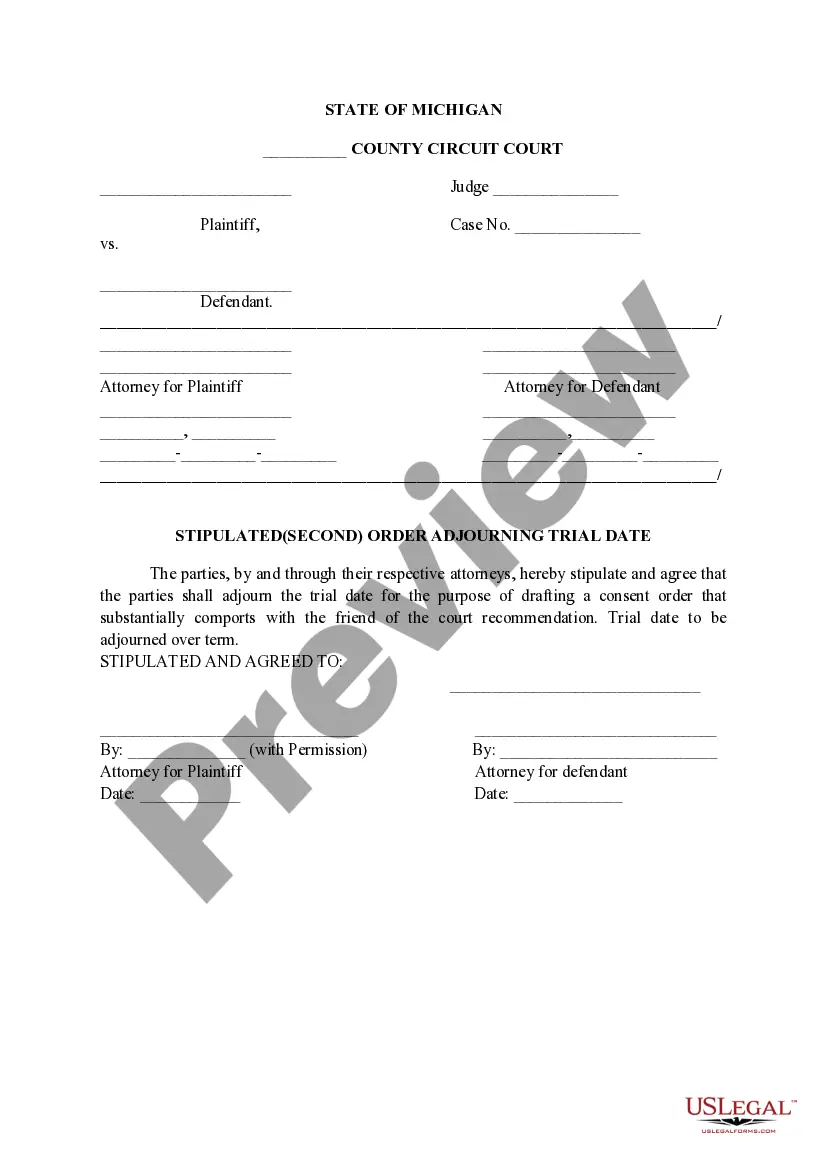
The First Stipulated Order to Adjourn Trial is a legal document that allows parties in a court case to agree on postponing their trial date. This form is particularly necessary when additional time is required for both parties to receive and review evidence, conduct investigations, or engage in legal negotiations. It differs from other court motions by specifically focusing on mutual agreement to delay proceedings rather than addressing a specific legal issue directly.
What’s included in this form
- Title and case information, including plaintiff and defendant details.
- Stipulations by both parties regarding the adjournment of the trial.
- Reason for requesting the adjournment, such as pending investigations or negotiations.
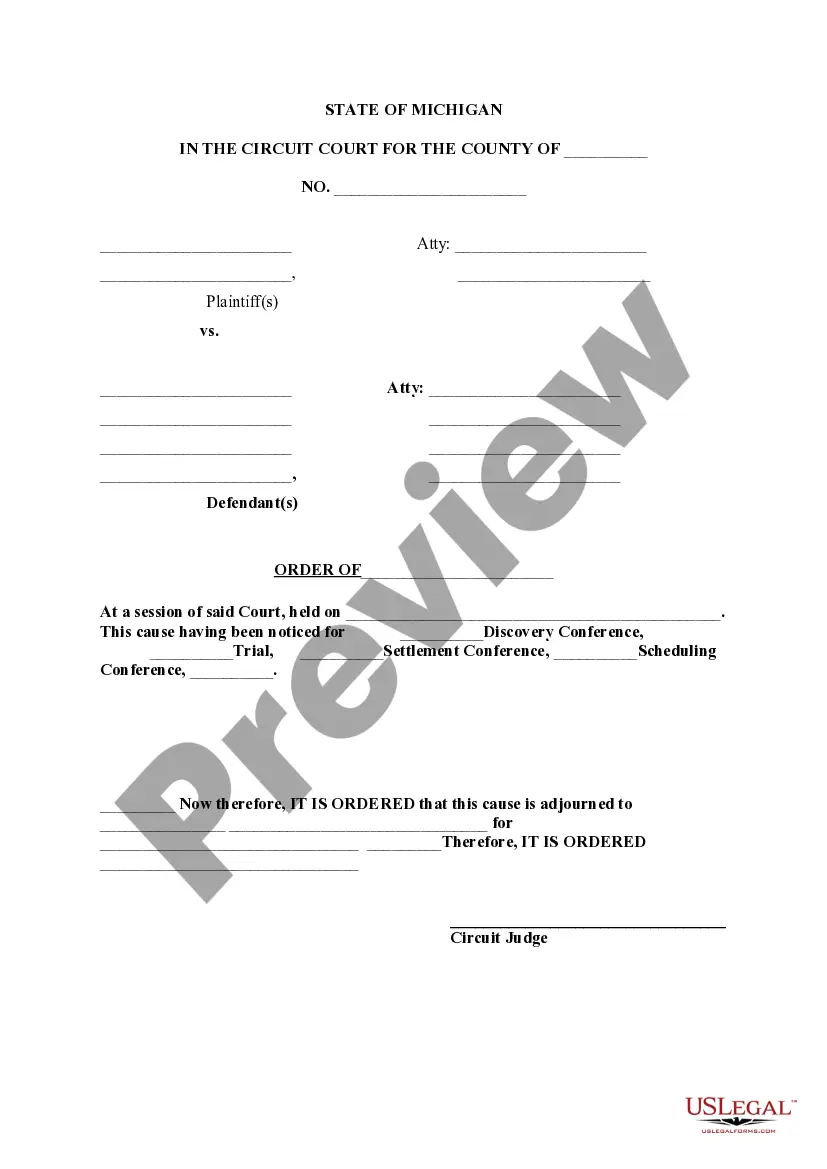
- New trial date and time as specified by the court.
- Signatures of attorneys representing both parties.
Situations where this form applies
This form should be used when both parties in a court case agree that more time is needed before proceeding to trial. Common scenarios include awaiting the completion of investigations, needing additional time to review evidence, or engaging in plea negotiations that may affect the outcome of the trial. Whenever both parties share a mutual interest in delaying the trial, this form provides a formal means to request that adjournment from the court.
Intended users of this form
- Parties involved in a legal dispute in Michigan court.
- Attorneys representing the plaintiff and defendant in a civil or criminal case.
- Individuals who agree that a delay in the trial is necessary for due process and reflection.
Completing this form step by step
- Enter the case title, including the names of the plaintiff and defendant.
- Provide the case number and the name of the presiding judge.
- Specify the original trial date and the new proposed date for the trial.
- Outline the reason for the adjournment in clear terms.
- Ensure both attorneys sign the document to indicate their agreement.
Does this document require notarization?
This form does not typically require notarization unless specified by local law. However, both parties' agreement must be documented properly to ensure its legality in court.
Get your form ready online
Our built-in tools help you complete, sign, share, and store your documents in one place.
Make edits, fill in missing information, and update formatting in US Legal Forms—just like you would in MS Word.
Download a copy, print it, send it by email, or mail it via USPS—whatever works best for your next step.
Sign and collect signatures with our SignNow integration. Send to multiple recipients, set reminders, and more. Go Premium to unlock E-Sign.
If this form requires notarization, complete it online through a secure video call—no need to meet a notary in person or wait for an appointment.
We protect your documents and personal data by following strict security and privacy standards.

Make edits, fill in missing information, and update formatting in US Legal Forms—just like you would in MS Word.

Download a copy, print it, send it by email, or mail it via USPS—whatever works best for your next step.

Sign and collect signatures with our SignNow integration. Send to multiple recipients, set reminders, and more. Go Premium to unlock E-Sign.

If this form requires notarization, complete it online through a secure video call—no need to meet a notary in person or wait for an appointment.

We protect your documents and personal data by following strict security and privacy standards.
Common mistakes
- Failing to obtain signatures from both attorneys.
- Not clearly stating the reason for the adjournment.
- Entering incorrect dates for the trial or submission.
- Neglecting to file the form with the court before the original trial date.
Benefits of completing this form online
- Convenience of downloading and filling the form from anywhere at any time.
- Editable format allows users to customize the form easily.
- Access to reliable legal templates crafted by licensed attorneys.
- Time-saving, as the form can be completed and filed promptly.
Looking for another form?



Form popularity
FAQ
A good reason for adjournment includes situations where a party requires additional time to prepare a case or has a legitimate scheduling conflict. Reasons such as illness or the unavailability of key witnesses are also acceptable. In such cases, referring to the Michigan First Stipulated Order to Adjourn Trial can provide additional support for your request and enhance its chances of approval.
A sample sentence for adjournment could be, 'I respectfully request to adjourn the trial scheduled for May 5th, 2023, due to unforeseen circumstances.' Using clear and direct language in your adjournment request strengthens your position, particularly when employing a Michigan First Stipulated Order to Adjourn Trial.
To write an adjournment petition, begin by addressing the court formally and stating your request at the very top. Clearly explain the reasons for the delay, along with any supporting facts or evidence. Utilizing a Michigan First Stipulated Order to Adjourn Trial may enhance your petition's credibility and streamline your request.
The best excuse to adjourn a court case often involves personal emergencies or significant scheduling conflicts. Examples include illness, family emergencies, or the need for more time to gather evidence. When citing reasons, it is crucial to present a solid justification, as this aligns with the principles behind the Michigan First Stipulated Order to Adjourn Trial.
To write a letter of adjournment, start with a formal address and clearly state your request to adjourn the trial. Include the case name, number, and a brief explanation of why you need to reschedule. Using a Michigan First Stipulated Order to Adjourn Trial can simplify this process, ensuring your request aligns with court requirements.
A stipulation to adjourn refers to an agreement between parties involved in a legal case to postpone a trial. This arrangement is often formalized through a legal document, known as the Michigan First Stipulated Order to Adjourn Trial. By agreeing to adjourn, both parties aim to provide additional time for necessary preparations or negotiations. Utilizing tools like USLegalForms can help you draft accurate stipulations to ensure that your legal processes run smoothly.
To file a motion to adjourn, you need to provide a written request that clearly outlines your reasons for seeking the adjournment. It is beneficial to include a Michigan First Stipulated Order to Adjourn Trial if both parties are in agreement. Supporting documentation or evidence may also strengthen your request. Ensure that your motion adheres to court guidelines to maximize the chance of approval.
The procedure for obtaining an adjournment involves preparing a motion to adjourn trial, where you articulate your reasons clearly. You may reference a Michigan First Stipulated Order to Adjourn Trial to streamline the process, indicating mutual consent if both parties agree to the adjournment. After submission, the court will assess the motion, and if accepted, issue a new trial date. Following these steps ensures a more organized approach to rescheduling your case.
The adjournment process generally begins with the filing of a motion to adjourn, often supported by a Michigan First Stipulated Order to Adjourn Trial. In this process, both parties communicate their reasons for needing more time. The court then reviews the request, and if it finds valid reasons, it grants the adjournment and schedules a new trial date. It's critical to follow proper legal channels to ensure that your request is honored.
During an adjournment, all ongoing proceedings in a case pause for a specified period. This means that the parties involved do not move forward until the next scheduled trial date arrives. With a Michigan First Stipulated Order to Adjourn Trial, the parties agree on rescheduling the trial, which helps alleviate pressure and allows for additional time to gather evidence or prepare. This process can be beneficial for ensuring that both sides have sufficient time to present their best case.