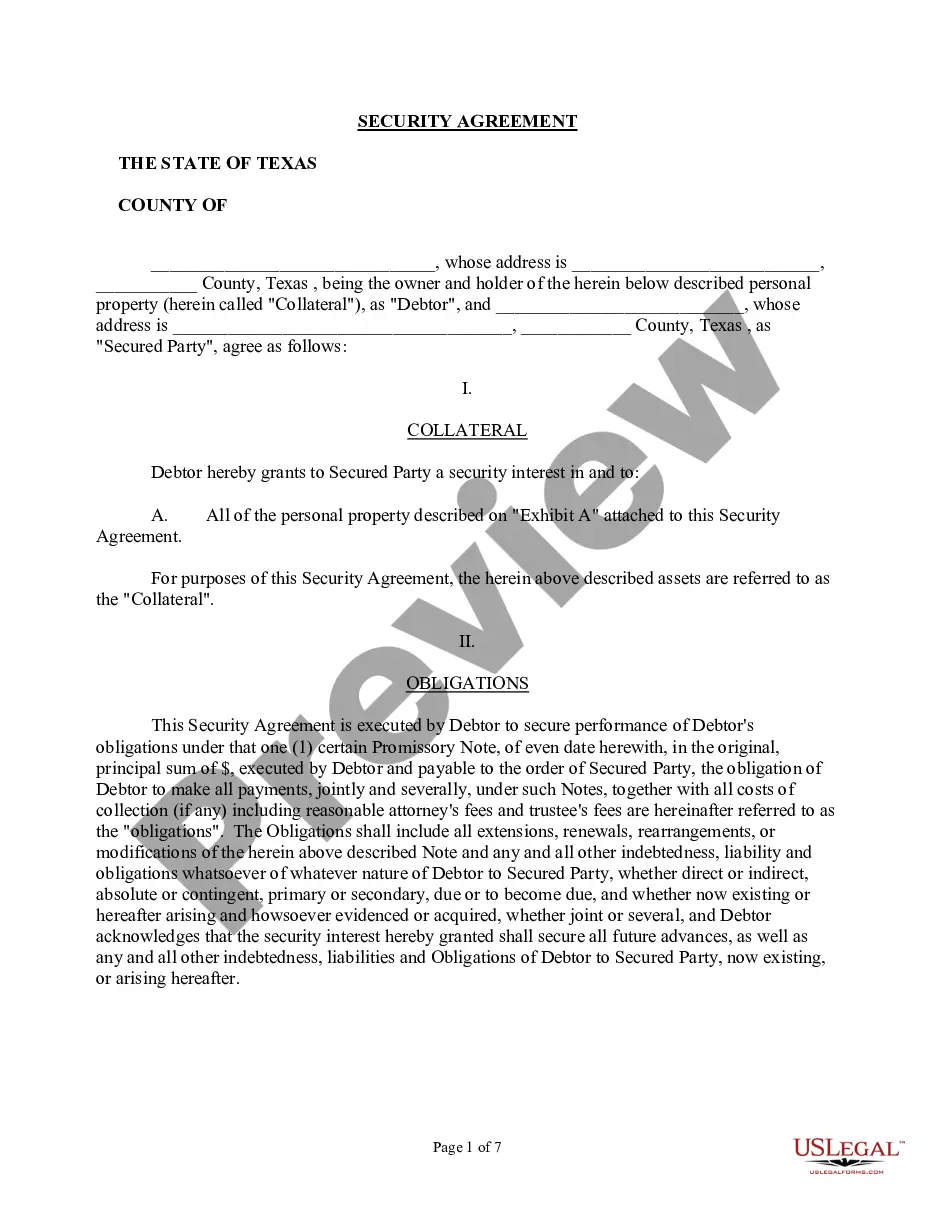
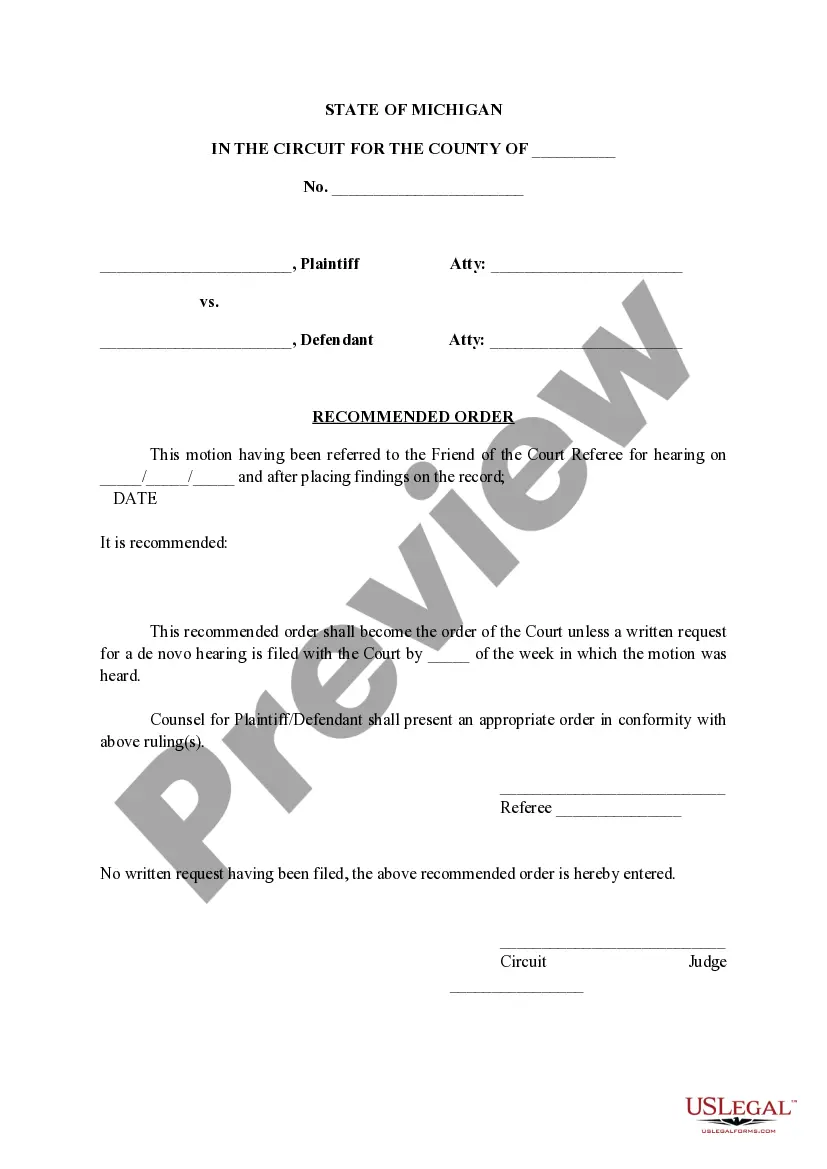
Michigan Recommended Order
What is this form?
A Recommended Order is a legal document issued by the Friend of the Court (FOC) after parties fail to reach an agreement during conciliation. This form outlines temporary custody, parenting time, and child support recommendations. It serves as a crucial step towards formalizing arrangements while both parties may still be negotiating, distinguishing it from final custody orders or agreements reached through mutual consent.
Key parts of this document
- The title identifying it as a Recommended Order.
- Details of the parties involved, including plaintiffs and defendants.
- The date of the hearing by the Friend of the Court.
- Specific recommendations for custody, parenting time, and child support.
- Information on filing for a de novo hearing to contest the recommendations.
- Signatures from the Friend of the Court referee and the circuit judge.

When to use this form
This form should be used when parties involved in a custody or support dispute cannot come to an agreement during conciliation sessions. It records the recommendations made by the Friend of the Court for temporary orders concerning custody, visitation, and child support until further decisions are made, particularly if an agreement is reached later or a hearing is requested.
Intended users of this form
This Recommended Order is intended for:
- Individuals involved in custody or child support disputes in Michigan.
- Parents seeking temporary orders while resolving ongoing legal matters.
- Legal representatives preparing to present recommendations to the court.
How to prepare this document
- Identify the parties involved in the case, including names and attorneys.
- Insert the date of the hearing conducted by the Friend of the Court.
- Document the specific recommendations regarding custody, parenting time, and child support as suggested by the referee.
- Note the deadline for any written request to contest the recommendations.
- Ensure appropriate signatures from the referee and circuit judge are obtained.
Does this form need to be notarized?
This form does not typically require notarization unless specified by local law. It is advisable to check with your attorney or the court for any specific requirements regarding notarization.
Get your form ready online
Our built-in tools help you complete, sign, share, and store your documents in one place.
Make edits, fill in missing information, and update formatting in US Legal Forms—just like you would in MS Word.
Download a copy, print it, send it by email, or mail it via USPS—whatever works best for your next step.
Sign and collect signatures with our SignNow integration. Send to multiple recipients, set reminders, and more. Go Premium to unlock E-Sign.
If this form requires notarization, complete it online through a secure video call—no need to meet a notary in person or wait for an appointment.
We protect your documents and personal data by following strict security and privacy standards.

Make edits, fill in missing information, and update formatting in US Legal Forms—just like you would in MS Word.

Download a copy, print it, send it by email, or mail it via USPS—whatever works best for your next step.

Sign and collect signatures with our SignNow integration. Send to multiple recipients, set reminders, and more. Go Premium to unlock E-Sign.

If this form requires notarization, complete it online through a secure video call—no need to meet a notary in person or wait for an appointment.

We protect your documents and personal data by following strict security and privacy standards.
Mistakes to watch out for
- Failing to provide complete and accurate information about the parties involved.
- Missing deadlines for filing requests for a de novo hearing.
- Not securing the refereeâs and judgeâs signatures before submission.
Benefits of completing this form online
- Convenience of downloading and completing the form at your own pace.
- Editability allows customization to fit specific circumstances.
- Accessibility to a reliable template drafted by licensed attorneys.
Key takeaways
- The Recommended Order is crucial for establishing temporary arrangements when parties cannot agree.
- It is tailored specifically for use within Michigan's legal framework.
- Completing this form correctly is essential to ensure the recommendations are considered by the court.
Looking for another form?


Form popularity
FAQ
Rule 2.313 in Michigan pertains to the production of documents and responses during the discovery phase of litigation. It covers the responsibilities of parties to produce evidence relevant to the case, ensuring fair access to information. Understanding the nuances of this rule can be vital, particularly in cases involving a Michigan Recommended Order, as it sets the stage for effective legal proceedings.
In Michigan, a debt generally becomes uncollectible after six years from the date of default, as outlined by the state's statute of limitations. This means that creditors have a limited window to file a lawsuit to collect debts incurred. Knowing this timeframe can be crucial when navigating issues related to a Michigan Recommended Order, as it can influence your strategy and rights related to debt collection.
The 7 day rule for orders in Michigan serves as a framework for how quickly parties must react to various legal orders. Specifically, it often dictates that responses or actions must be performed within seven calendar days. Being aware of this rule is essential, particularly in the context of a Michigan Recommended Order, as it can prevent delays and ensure timely compliance with court expectations.
The 7 day order rule in Michigan refers to a guideline that mandates actions to be taken within a seven-day period after a certain court order is issued. This rule often influences the timing of responses and compliance with court directives in various legal matters. It's important for individuals to understand how this rule applies to their situation, especially when dealing with a Michigan Recommended Order, as it can affect outcomes significantly.