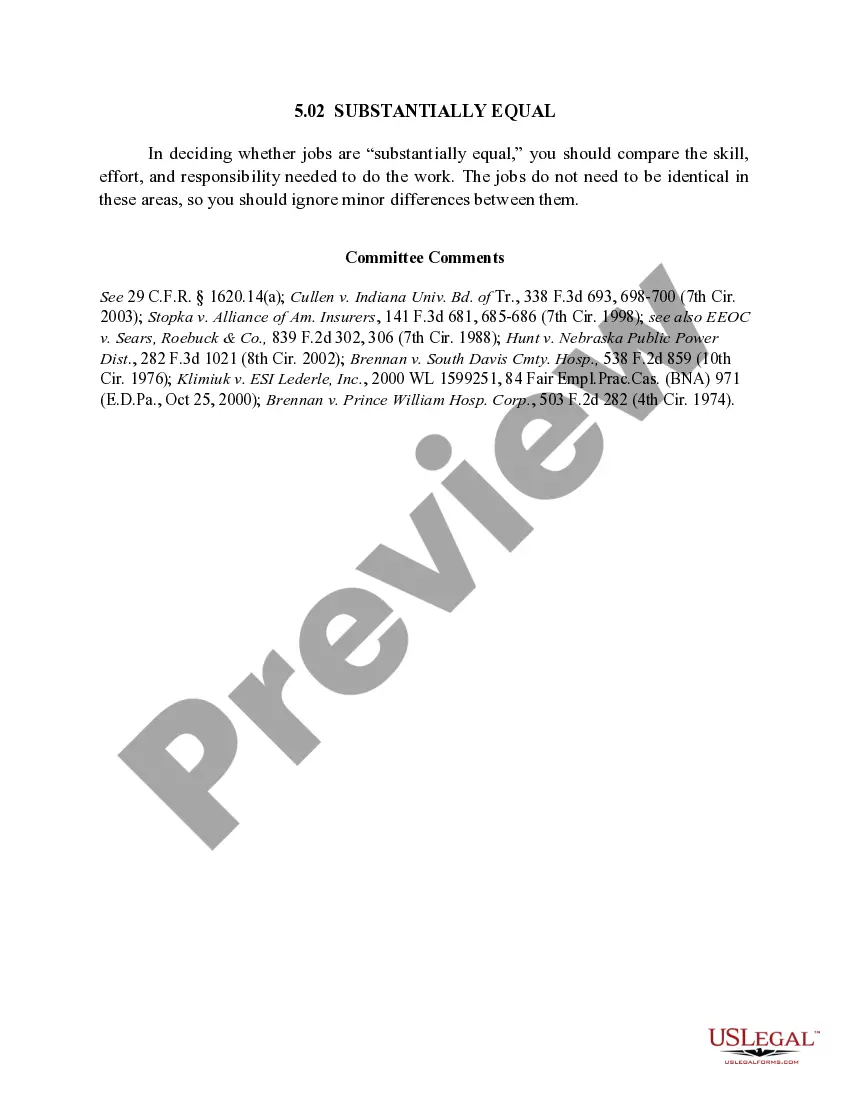
5.02 Substantially Equal
Overview of this form
The 5.02 Substantially Equal form is a legal template used to determine if two jobs are substantially equal in their skill, effort, and responsibility requirements. This form provides guidance adopted by the Federal 7th Circuit Court, focusing on an equitable evaluation of job roles rather than identical roles. It is essential for addressing issues related to pay equity and employment discrimination cases.
Key parts of this document
- Definition of "substantially equal" job roles.
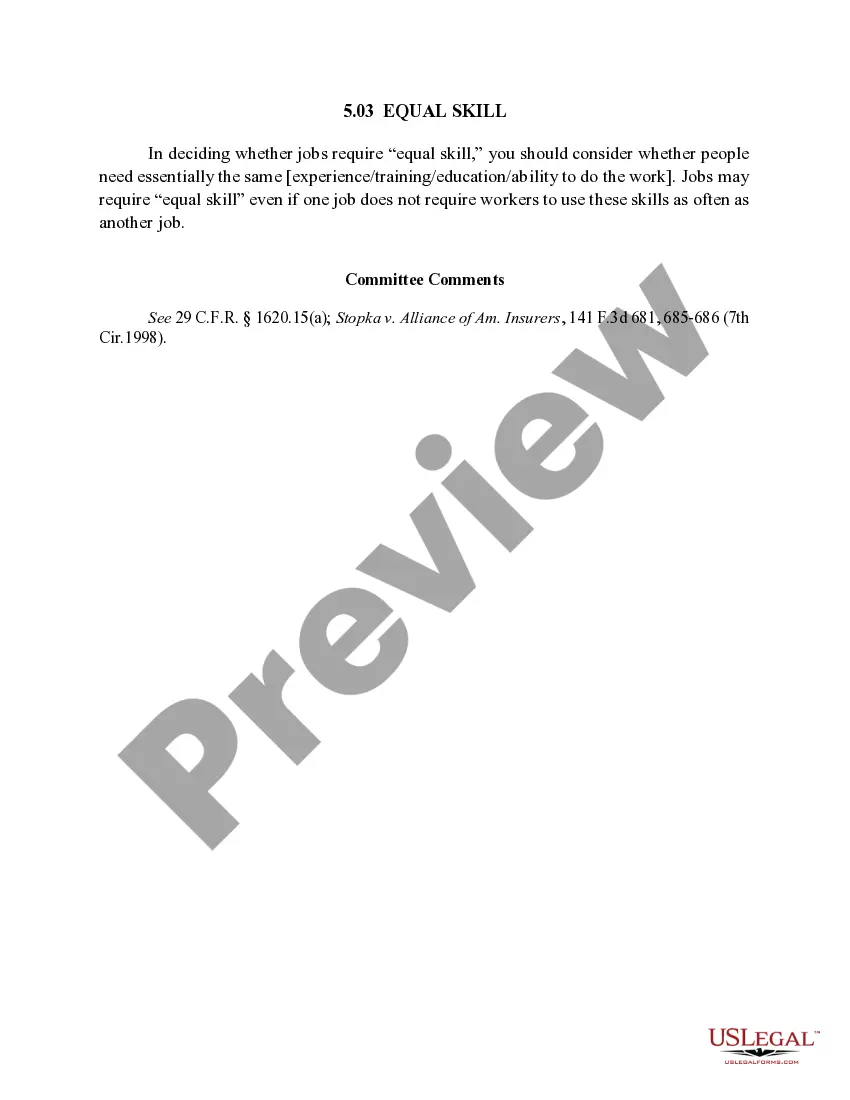
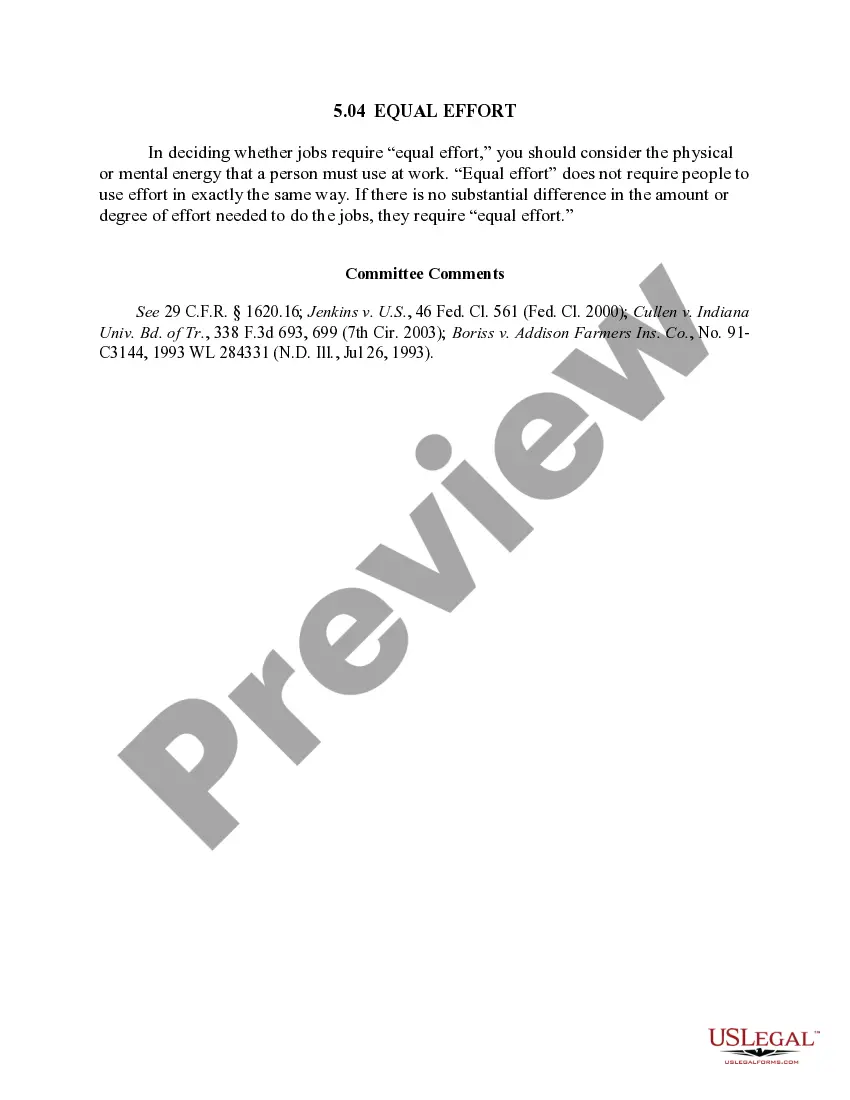
- Criteria for evaluating skill, effort, and responsibility.
- Instructions on ignoring minor job differences.
- Reference to applicable federal regulations and case law.

When to use this document
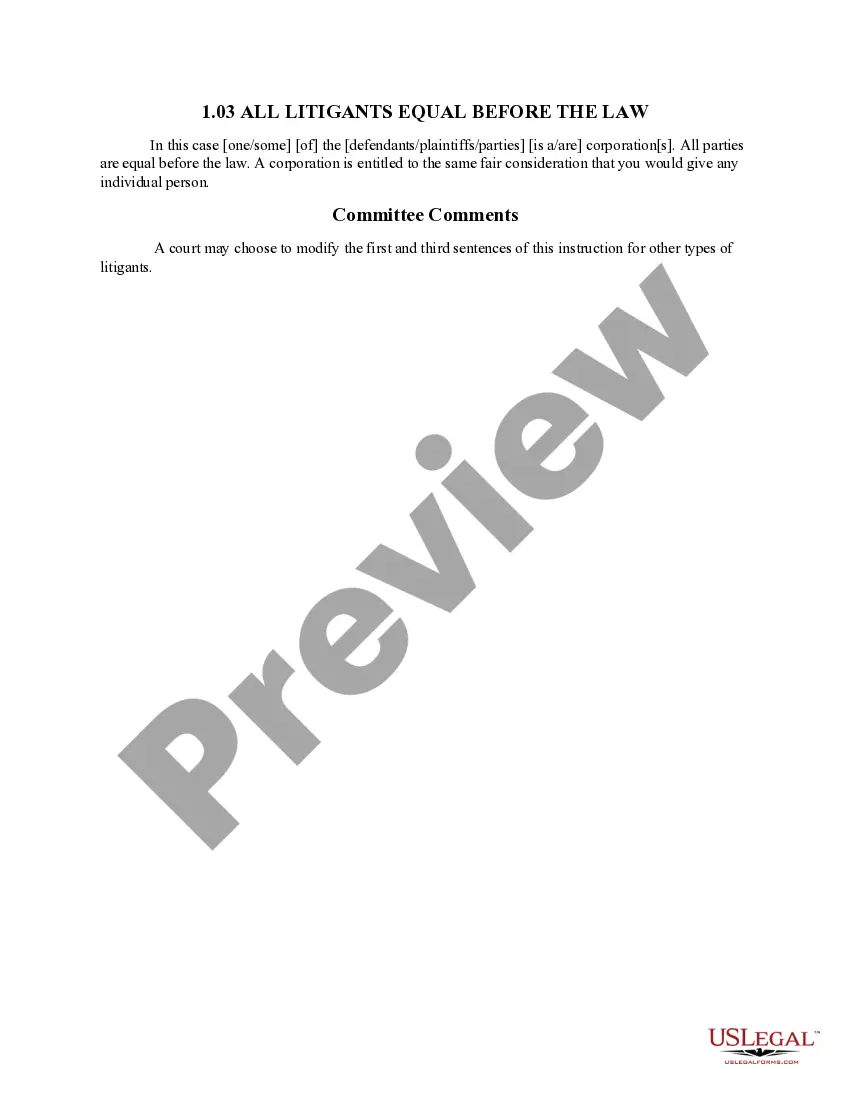
This form should be used in situations where you need to assess and compare the job roles of employees to ensure compliance with employment laws related to pay equity. It is particularly relevant in cases of wage discrimination or when conducting salary audits to address potential inequities between employees performing similar work.
Intended users of this form
Individuals or organizations that may benefit from this form include:
- Employers needing to evaluate job roles for wage equity.
- Human resources professionals conducting salary audits.
- Employees considering filing a discrimination claim.
- Legal practitioners advising clients on employment law matters.
How to prepare this document
- Identify the jobs being compared for equality.
- Evaluate the skill sets required for each job.
- Assess the effort involved in performing the job duties.
- Consider the responsibility level associated with each role.
- Document any minor differences that do not affect equal classification.
Notarization requirements for this form
This form does not typically require notarization to be legally valid. However, some jurisdictions or document types may still require it. US Legal Forms provides secure online notarization powered by Notarize, available 24/7 for added convenience.
Get your form ready online
Our built-in tools help you complete, sign, share, and store your documents in one place.
Make edits, fill in missing information, and update formatting in US Legal Forms—just like you would in MS Word.
Download a copy, print it, send it by email, or mail it via USPS—whatever works best for your next step.
Sign and collect signatures with our SignNow integration. Send to multiple recipients, set reminders, and more. Go Premium to unlock E-Sign.
If this form requires notarization, complete it online through a secure video call—no need to meet a notary in person or wait for an appointment.
We protect your documents and personal data by following strict security and privacy standards.

Make edits, fill in missing information, and update formatting in US Legal Forms—just like you would in MS Word.

Download a copy, print it, send it by email, or mail it via USPS—whatever works best for your next step.

Sign and collect signatures with our SignNow integration. Send to multiple recipients, set reminders, and more. Go Premium to unlock E-Sign.

If this form requires notarization, complete it online through a secure video call—no need to meet a notary in person or wait for an appointment.

We protect your documents and personal data by following strict security and privacy standards.
Mistakes to watch out for
- Failing to consider all factors of skill, effort, and responsibility.
- Assuming jobs must be identical rather than substantially equal.
- Overlooking relevant regulations and case law in the evaluation.
Benefits of completing this form online
- Instant access to a legally vetted document.
- Editable format allows for easy customization.
- Convenient downloading and storage options.
- High reliability due to use of standardized legal language.
Looking for another form?

Form popularity
FAQ
Item 2.01 Completion of acquisition or disposition of assets the equity in the net book value of assets or the amount paid or received for the assets upon acquisition or disposition exceeded 10% of the total assets of registrant and its consolidated subsidiaries, or.
The SEC requires public companies to disclose material information on Form 8-K within four days of a triggering event.
The SEC requires companies to file an 8-K to announce significant events relevant to shareholders. Companies have four business days to file an 8-K for most specified items. Public companies use Form 8-K as needed, unlike some other forms that must be filed annually or quarterly.
Form 8-K also provides substantial benefits to listed companies. By filing an 8-K in a timely fashion, the firm's management can meet specific disclosure requirements and avoid insider trading allegations. Companies may also use Form 8-K to notify investors of any events that they consider to be important.
In providing the disclosure required by this Item, identify the changes to the payment priorities, flow of funds or asset-backed securities as a result. Disclosure is required under this Item whether or not the registrant is a party to the transaction agreement that results in the occurrence identified.
A material definitive agreement is a document that provides for duties enforceable against a company or rights enforceable against a company that are material. In addition, certain milestones must be met for a material definitive agreement to be enforceable, such as third-party approvals and due diligence.
Item 2.01 Completion of Acquisition or Disposition of Assets It requires disclosure if a company, or any of its majority-owned subsidiaries, has acquired or disposed of a significant amount of assets, otherwise than in the ordinary course of business.