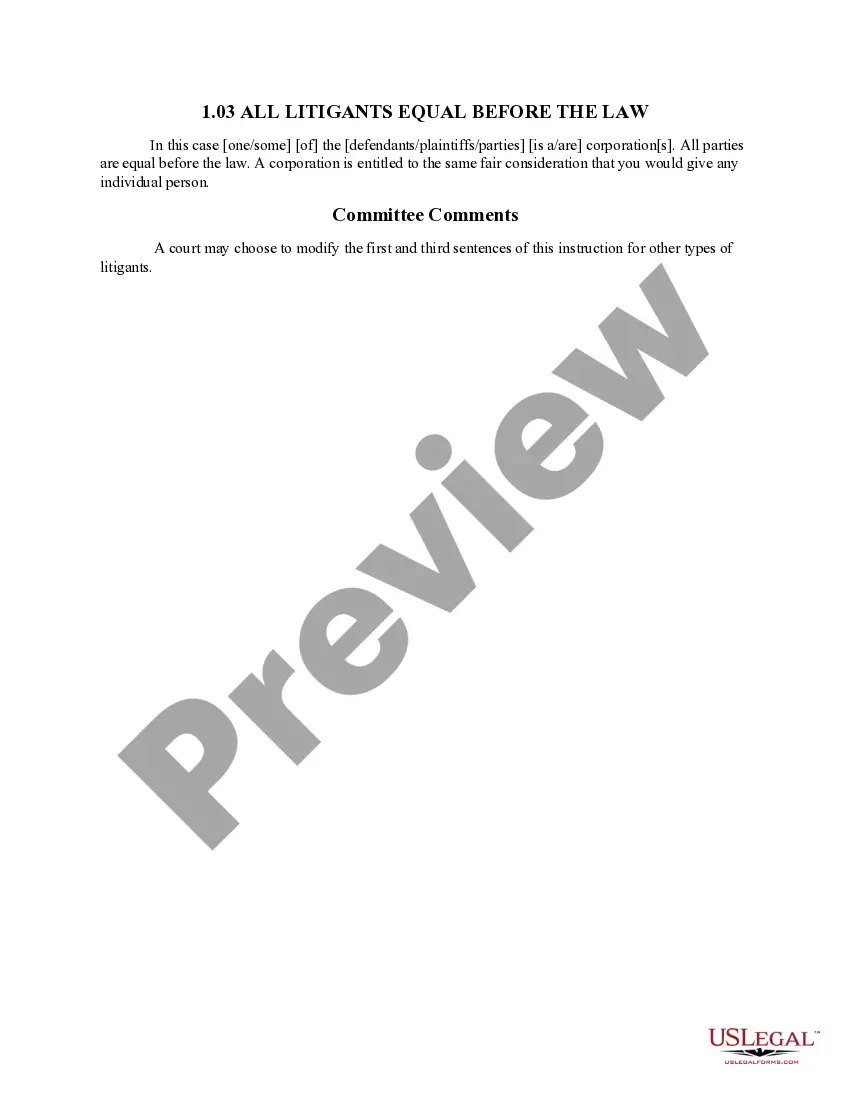
1.03 All Litigants Equal before the law
What is this form?
The "All Litigants Equal Before the Law" form is a standard jury instruction utilized in federal court cases, specifically adopted by the Federal 7th Circuit Court. This important legal form ensures that all parties involved in litigation, including corporations, receive equal consideration under the law. It emphasizes the principle of fairness and equality in legal proceedings, providing clarity on how jurors should treat different litigants. Unlike other jury instructions, this form specifically addresses the treatment of corporations as equal to individuals in a legal context.
Form components explained
- Instruction stating that all parties, including corporations, are equal before the law.
- Emphasis on fair consideration given to corporations as if they were individuals.
- Committee comments that suggest modification possibilities for different litigants.
When to use this form
This form should be used during a trial where there are multiple parties, including at least one corporation. It serves to instruct jurors about their obligations regarding impartiality and fairness, particularly in cases where corporate entities are involved. If you are a judge or attorney preparing jury instructions, this document is essential for ensuring that jurors understand their role in treating all litigants equally.
Who should use this form
- Judges requiring standardized jury instructions for cases with corporate litigants.
- Attorneys preparing for jury trials that involve corporate and individual parties.
- Legal professionals looking to ensure fair treatment of all litigants in court.
Completing this form step by step
- Identify the parties involved in the case, noting if any are corporations.
- Review the instruction to make sure it encompasses all relevant litigants.
- Incorporate the wording as appropriate for your case and courtroom standards.
- Provide the jury with clear instructions based on the established equality before the law principle.
Notarization guidance
This form does not typically require notarization to be legally valid. However, some jurisdictions or document types may still require it. US Legal Forms provides secure online notarization powered by Notarize, available 24/7 for added convenience.
Get your form ready online
Our built-in tools help you complete, sign, share, and store your documents in one place.
Make edits, fill in missing information, and update formatting in US Legal Forms—just like you would in MS Word.
Download a copy, print it, send it by email, or mail it via USPS—whatever works best for your next step.
Sign and collect signatures with our SignNow integration. Send to multiple recipients, set reminders, and more. Go Premium to unlock E-Sign.
If this form requires notarization, complete it online through a secure video call—no need to meet a notary in person or wait for an appointment.
We protect your documents and personal data by following strict security and privacy standards.

Make edits, fill in missing information, and update formatting in US Legal Forms—just like you would in MS Word.

Download a copy, print it, send it by email, or mail it via USPS—whatever works best for your next step.

Sign and collect signatures with our SignNow integration. Send to multiple recipients, set reminders, and more. Go Premium to unlock E-Sign.

If this form requires notarization, complete it online through a secure video call—no need to meet a notary in person or wait for an appointment.

We protect your documents and personal data by following strict security and privacy standards.
Common mistakes to avoid
- Failing to modify the instruction to address the specific types of litigants in the case.
- Assuming that jurors understand the implications of corporate equality without further explanation.
- Omitting key details that clarify how jurors should treat different types of parties.
Why use this form online
- Convenience of downloading and accessing the form from anywhere.
- Editability allows users to customize instructions to meet specific case needs.
- Reliability as each form is drafted by licensed attorneys to ensure legal compliance.
Legal use & context
- This form is recognized by the Federal 7th Circuit Court as a valid jury instruction.
- Instructs jurors to treat all litigants equally, reinforcing the principle of fairness in legal proceedings.
- Utilized in various cases involving both individuals and corporate entities, ensuring uniformity in jury instructions.
Summary of main points
- This form emphasizes the equality of all litigants, including corporations, under the law.
- It is an essential instruction for jurors during trials involving diverse parties.
- Accessible and customizable, this form meets federal legal standards and reinforces fairness.
Looking for another form?

Form popularity
FAQ
The attorney whose name, address, and telephone number appear on the cover of a document presented for filing is considered counsel of record. If the name of more than one attorney is shown on the cover of the document, the attorney who is counsel of record shall be clearly identified.
A lawyer is required to give an honest opinion about the actual consequences that appear likely to result from a client's conduct. The fact that a client uses advice in a course of action that is criminal or fraudulent does not, of itself, make a lawyer a party to the course of action.
1.05. RIGHTS OF ACCUSED. In all criminal prosecutions the accused shall have a speedy public trial by an impartial jury. He shall have the right to demand the nature and cause of the accusation against him, and to have a copy thereof.
Rule 5.03(b) of the Texas Rules of Evidence and Rule 5.03(b) of the Texas Rules of Criminal Evidence provide for a privilege with respect to "confidential communications" between client and lawyer.
Considerations Governing Review on Writ of Certiorari. Review on a writ of certiorari is not a matter of right, but of judicial discretion. A petition for a writ of certiorari will be granted only for compelling reasons.
Rule 9 - Electronic Filing of Documents (a) Electronic Filing Required. Unless exempt as provided in paragraph (c), all documents in civil cases shall be electronically filed with the clerk of court using an electronic filing system approved by the Supreme Court of Illinois. (b)Personal Identity Information.
Rule 8 - Case and Document Accessibility (a) All cases and documents are presumed to be accessible by the court and the clerk.
Interlocutory Transfer without Ruling. (1) The supreme court may, in its discretion, decline to accept an interlocutory transfer of a question of law without ruling by a trial court or by an administrative agency.