New Media Relations Policy
Overview of this form
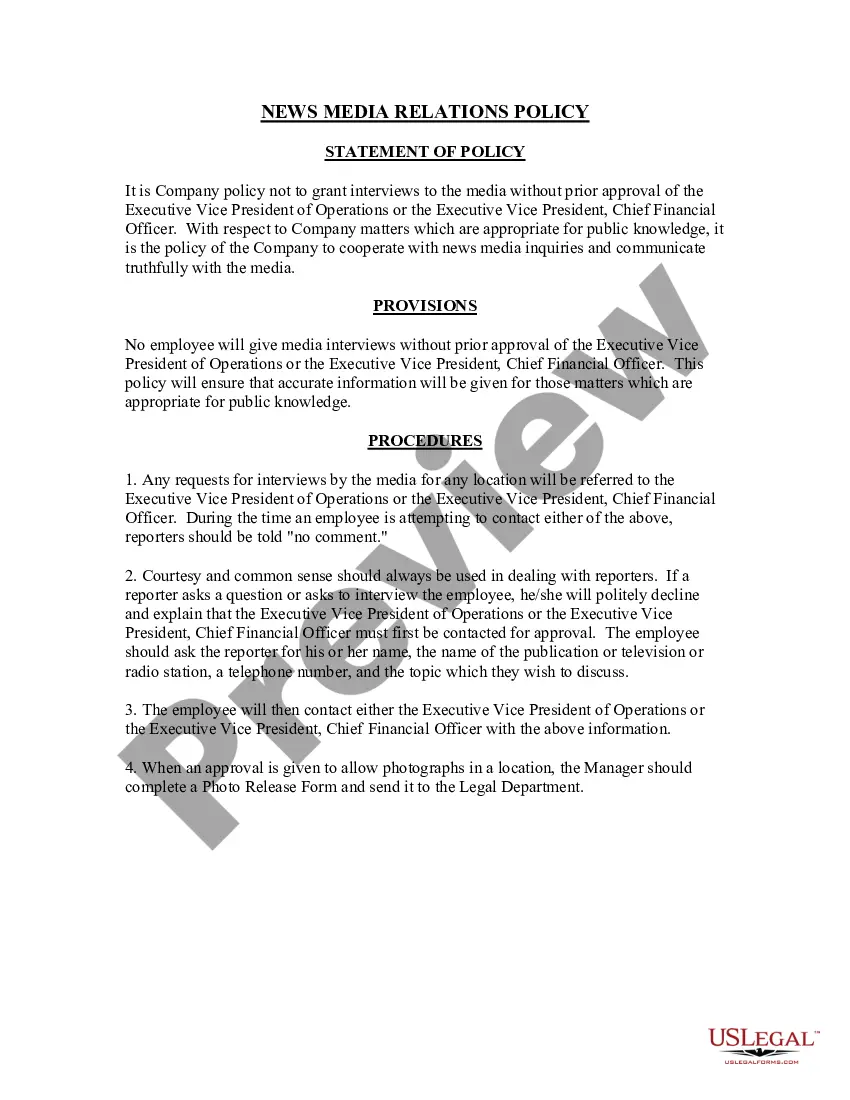
The New Media Relations Policy is a guiding document for employees on how to appropriately handle interactions with the news media. Its main purpose is to ensure that all communications with the media are coordinated through designated executives, maintaining the integrity and consistency of information shared with the public. This form differs from other corporate policies by focusing specifically on media interactions and approval processes for interviews and statements.
What’s included in this form
- Statement of policy outlining the requirement for executive approval before granting media interviews.
- Provisions detailing the responsibilities of employees in dealing with media inquiries.
- Clear procedures for referring media requests to designated executives.
- Instructions on handling requests for photographs and completing a Photo Release Form.
When to use this form
This form is useful in various scenarios, including when an employee receives an unexpected media inquiry or is approached for an interview. It serves as a reference to inform employees about whom to contact for approval, thus ensuring that accurate and authorized information is communicated to the media.
Who should use this form
- All employees who may interact with media representatives.
- Management personnel responsible for overseeing company communications.
- Executives, particularly the Executive Vice President of Operations and the Chief Financial Officer, who have final approval authority.
How to complete this form
- Identify the employee who has received the media inquiry.
- Ensure that the employee knows to decline any interview requests without prior approval.
- Collect essential information from the reporter, including their name, publication, contact details, and the topic of inquiry.
- Directly pass this information to the Executive Vice President of Operations or the Chief Financial Officer for further action.
- If approved for photographs, complete a Photo Release Form and send it to the Legal Department.
Is notarization required?
This form does not typically require notarization unless specified by local law. It is vital to ensure that employees adhere to the policy without needing witnessing or notarization for internal procedures.
Get your form ready online
Our built-in tools help you complete, sign, share, and store your documents in one place.
Make edits, fill in missing information, and update formatting in US Legal Forms—just like you would in MS Word.
Download a copy, print it, send it by email, or mail it via USPS—whatever works best for your next step.
Sign and collect signatures with our SignNow integration. Send to multiple recipients, set reminders, and more. Go Premium to unlock E-Sign.
If this form requires notarization, complete it online through a secure video call—no need to meet a notary in person or wait for an appointment.
We protect your documents and personal data by following strict security and privacy standards.

Make edits, fill in missing information, and update formatting in US Legal Forms—just like you would in MS Word.

Download a copy, print it, send it by email, or mail it via USPS—whatever works best for your next step.

Sign and collect signatures with our SignNow integration. Send to multiple recipients, set reminders, and more. Go Premium to unlock E-Sign.

If this form requires notarization, complete it online through a secure video call—no need to meet a notary in person or wait for an appointment.

We protect your documents and personal data by following strict security and privacy standards.
Typical mistakes to avoid
- Failing to refer media requests to the appropriate executives.
- Providing information to the media without proper authorization.
- Not collecting sufficient details from reporters, which may hinder proper communication.
Benefits of using this form online
- Easy access to the latest policy updates and templates created by licensed attorneys.
- The ability to download and customize the form to fit your company's specific needs.
- Convenient storage and documentation of employee acknowledgments and approvals.
Legal use & context
- This policy serves as a critical framework for managing company communications and mitigating legal risks associated with media interactions.
- Implementing this policy can help safeguard the companyâs reputation by ensuring only authorized personnel speak to the media.
- Violations of this policy may result in disciplinary action, as maintaining control over company messaging is essential for legal protection.
Key takeaways
- The New Media Relations Policy regulates how employees interact with the media to provide accurate information.
- All media inquiries must be referred to designated executives for approval.
- Proper handling of media requests is critical to uphold the companyâs public image and legal standing.
Looking for another form?


Form popularity
FAQ
Media relations refers to the mutually beneficial relationship between journalists and public relations professionals. One of the biggest benefits for journalists is the easy access to story ideas and sources.
Step 1 Set goals for your social media plan. Step 2 Decide which networks to focus on. Step 3 Nail your client's branding and voice. Step 4 Plan content and create a social media schedule. Step 5 Engage with fans and followers. Step 6 Monitor and measure your results. Step 7 Adjust your plan.
The first step to effective media relations is shaking off the notion that editors and reporters are the enemy.
Research/situation analysis. Objectives. Implementation. Evaluation. Investment.
Lay Out Your Brand Positioning Goals. Identify the Outlets That Reach Your Audience. Create Strategic, High-Quality Content. Carefully Craft Your Pitches. Develop (And Use) a Distribution Plan. Keep Your Network Organized. Don't Neglect Your Content Marketing.
Step 1: Define Your Objective. Define and write down your objectives. Step 2: Establish Clear Goals. Step 3: Identify Your Target Market. Step 4: Research Opportunities. Step 5: Create a Schedule. Step 6: Measure Your Progress.
By definition, media relations strategy is the calculated deployment of media to tell an organization's story. It is the process of figuring out a message and distributing it to the right media sources so that you can reach your target market.
Launch of a new product/service. Initiation of new factories/offices. Financial results. Organization sponsored events or awards. Launch of organization promotional campaigns. Recent disasters, strikes or organizational closures. Awards/accolades for the company. Visits from company dignitaries/celebrities.