Work Hours and Reporting Policy
What is this form?
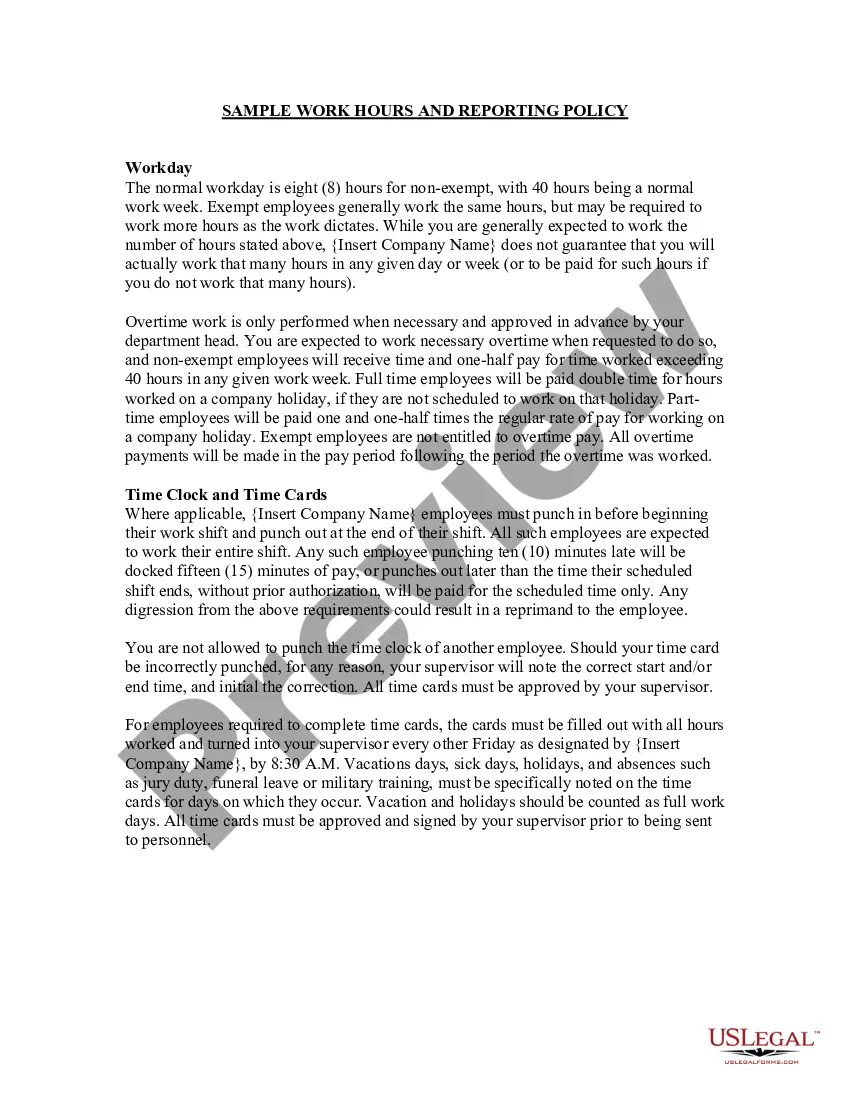
The Work Hours and Reporting Policy form outlines the expectations regarding employee work hours and reporting procedures within a company. This document serves as a crucial reference for employees, detailing both mandated work hours and the procedures for reporting time worked. It is tailored specifically to clarify how policies apply during a regular work week and the handling of overtime, differing from other employee policy forms that may address broader employment policies or benefits.
Key components of this form
- Normal workday and workweek definitions for both non-exempt and exempt employees.
- Overtime work stipulations, including approval and payment rates for non-exempt employees.
- Time clock and time card procedures, including punch-in/out expectations and penalties for tardiness.
- Guidelines for submitting time cards, including specific notations for vacations and absences.
- Approval requirements for time cards before submission to personnel.
Common use cases
This form should be used by employers to establish clear expectations regarding work hours and reporting for their employees. It is particularly important when onboarding new employees, during policy updates, or when addressing compliance with labor regulations. This form ensures that employees understand their responsibilities regarding work hours and the process to report their time accurately.
Who this form is for
This form is intended for:
- Employers looking to clarify work hours and reporting procedures for employees.
- Human resources professionals responsible for implementing workplace policies.
- Managers overseeing non-exempt and exempt employees who are required to track their work hours.
Steps to complete this form
- Insert your company's name in all designated areas of the form.
- Clearly define the normal work hours and workweek for both non-exempt and exempt employees.
- Detail the overtime approval process and payment structure.
- Establish the time clock procedures and consequences for not adhering to these rules.
- Specify the submission procedures for time cards and ensure clarity about what should be noted on them.
Does this document require notarization?
This form does not typically require notarization unless specified by local law. Ensure that the completed form is reviewed and understood by all relevant parties before implementation.
Get your form ready online
Our built-in tools help you complete, sign, share, and store your documents in one place.
Make edits, fill in missing information, and update formatting in US Legal Forms—just like you would in MS Word.
Download a copy, print it, send it by email, or mail it via USPS—whatever works best for your next step.
Sign and collect signatures with our SignNow integration. Send to multiple recipients, set reminders, and more. Go Premium to unlock E-Sign.
If this form requires notarization, complete it online through a secure video call—no need to meet a notary in person or wait for an appointment.
We protect your documents and personal data by following strict security and privacy standards.

Make edits, fill in missing information, and update formatting in US Legal Forms—just like you would in MS Word.

Download a copy, print it, send it by email, or mail it via USPS—whatever works best for your next step.

Sign and collect signatures with our SignNow integration. Send to multiple recipients, set reminders, and more. Go Premium to unlock E-Sign.

If this form requires notarization, complete it online through a secure video call—no need to meet a notary in person or wait for an appointment.

We protect your documents and personal data by following strict security and privacy standards.
Common mistakes
- Failing to designate the company name in the appropriate sections of the form.
- Not specifying the full range of reporting procedures for time cards.
- Inadequately explaining overtime conditions which can lead to misunderstandings.
Advantages of online completion
- Convenience of accessing the form anytime and anywhere across devices.
- Editability allows employers to tailor the policy to their specific needs.
- Reliable templates created by licensed attorneys ensure legal soundness and compliance.
Legal use & context
- This work hours and reporting policy form is a vital tool for establishing clear employee expectations.
- Use of this form can help protect the company in cases of disputes over work hours and compensation.
- Ensure compliance with federal and state labor laws to avoid legal repercussions.
Summary of main points
- The Work Hours and Reporting Policy outlines essential work expectations for employees.
- Clear communication of policies can minimize misunderstandings and disputes.
- Regular updates and reviews of the policy can enhance compliance and employee satisfaction.
Looking for another form?

Form popularity
FAQ
Working 12+ hours a day may seem like a big sacrifice at first (and it is), but if the work is leading to a situation where you can work fewer hours or have more flexibility in your working day (such as by setting up your own company) down the road, then it's so very worth it.
You have a standard working week of 40 hours (eight hours a day).
According to the Bureau of Labor Statistics, the average American works 8.8 hours every day. Yet a study of nearly 2,000 full-time office workers revealed that most people aren't working for most of the time they're at work. The most popular unproductive activities listed were: Reading news websites--1 hour, 5 minutes.
Working HoursThe Malaysian Employment Act defines the workweek as 48 hours, with a maximum of eight working hours per day and six working days per week. There are special restrictions, considered to be protection provisions, for women in the industrial or agricultural sector.
The Fair Labor Standards Act (FLSA) states that any work over 40 hours in a 168 hour period is counted as overtime, since the average American work week is 40 hours - that's eight hours per day for five days a week.
It shall be the duty of every employer to provide each of his employees a rest period of not less than twenty-four (24) consecutive hours after every six (6) consecutive normal work days.
Working Hours in India: As per the Factories Act 1948, every adult (a person who has completed 18 years of age) cannot work for more than 48 hours in a week and not more than 9 hours in a day. According to Section 51 of the Act, the spread over should not exceed 10-1/2 hours.
Where an employer doesn't keep the records required by law, the employee's burden of proof is lightened. In such a case, an employee can establish the number of weekly hours worked based simply on his own testimony or affidavit indicating his recollection of the estimated hours worked.
Employees should be having their hours logged accurately. When hours are logged and reported, it reflects accurate time card reporting. These hours are then used to process invoicing and or payroll. If anything is incorrect then it can harm the company's profitability.