Hospital Audit Program
Overview of this form
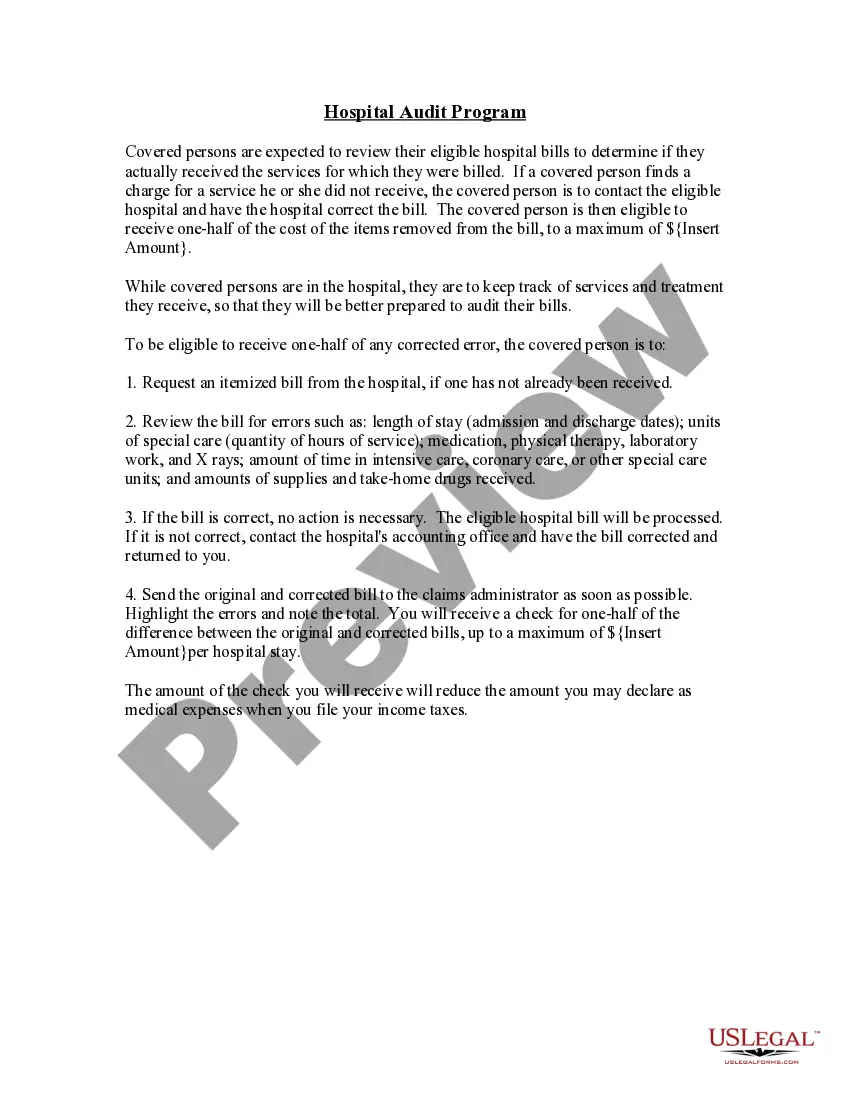
The Hospital Audit Program is a legal form that outlines the procedure for reviewing hospital bills to ensure that patients only pay for the services they actually received. This form is essential for patients who want to dispute charges for services not rendered and to potentially recover a percentage of the amount overpaid. Unlike other billing dispute forms, this program specifically guides patients on how to conduct an audit of their hospital bills, making it easier for them to navigate the complex billing system in healthcare.
Form components explained
- Instructions for obtaining an itemized bill from the hospital.
- Steps to identify errors related to services billed, such as dates of admission, medications, and treatments.
- The process for contacting the hospitalâs accounting office to correct discrepancies.
- Details on how to submit the original and corrected bill to the claims administrator.
- Information regarding the maximum reimbursement amount for overcharges.
When to use this document
This form should be used whenever a patient receives a hospital bill that requires verification of services. It is particularly useful in situations where patients suspect they have been charged for services they did not receive or if there are discrepancies in the billing details, such as incorrect dates or unauthorized treatments.
Who this form is for
- Patients who have received hospital services and want to ensure accurate billing.
- Individuals disputing charges on their hospital bills.
- Covered persons seeking reimbursement for billing errors according to hospital audit policies.
Instructions for completing this form
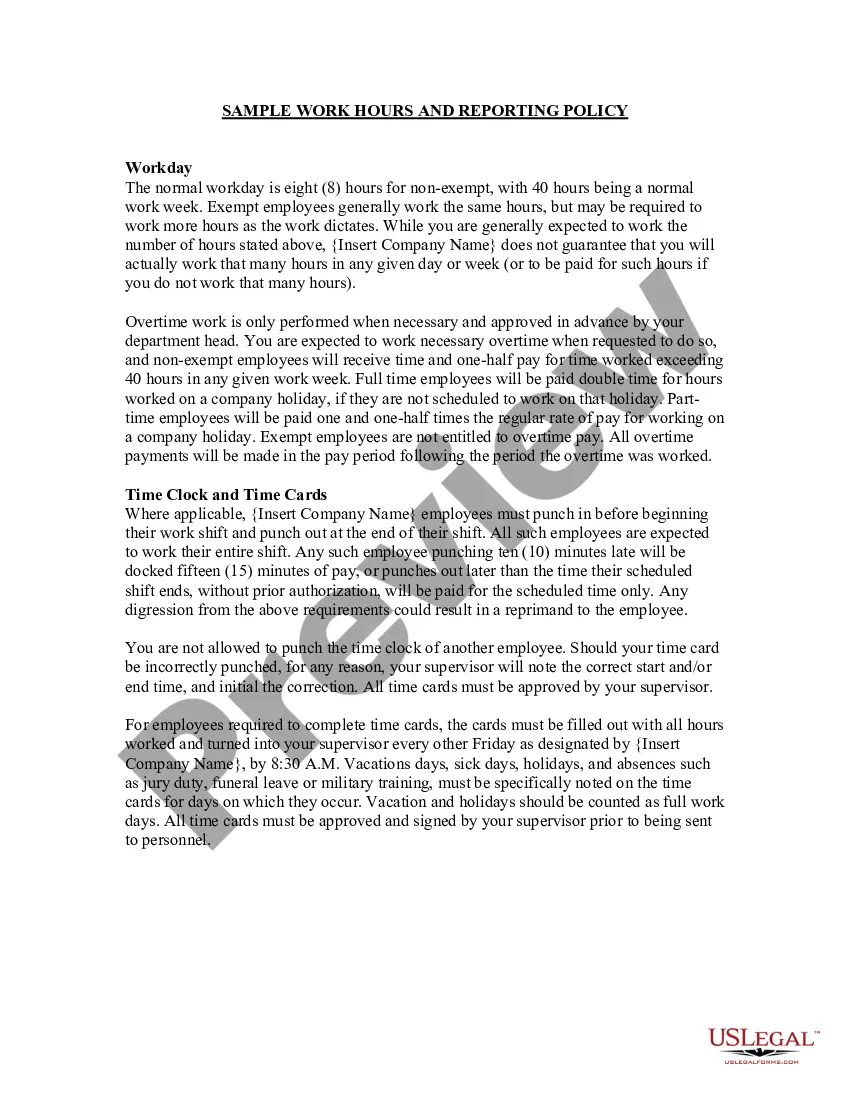
- Request an itemized bill from the hospital if one has not been received.
- Review the itemized bill thoroughly for any errors or discrepancies.
- Contact the hospitalâs accounting office to correct any identified errors.
- Submit both the original and corrected bill to the claims administrator, highlighting errors and noting total amounts.
- Await reimbursement of half the difference between the original and corrected bills, up to the specified limit.
Does this document require notarization?
This form does not typically require notarization unless specified by local law.
Get your form ready online
Our built-in tools help you complete, sign, share, and store your documents in one place.
Make edits, fill in missing information, and update formatting in US Legal Forms—just like you would in MS Word.
Download a copy, print it, send it by email, or mail it via USPS—whatever works best for your next step.
Sign and collect signatures with our SignNow integration. Send to multiple recipients, set reminders, and more. Go Premium to unlock E-Sign.
If this form requires notarization, complete it online through a secure video call—no need to meet a notary in person or wait for an appointment.
We protect your documents and personal data by following strict security and privacy standards.

Make edits, fill in missing information, and update formatting in US Legal Forms—just like you would in MS Word.

Download a copy, print it, send it by email, or mail it via USPS—whatever works best for your next step.

Sign and collect signatures with our SignNow integration. Send to multiple recipients, set reminders, and more. Go Premium to unlock E-Sign.

If this form requires notarization, complete it online through a secure video call—no need to meet a notary in person or wait for an appointment.

We protect your documents and personal data by following strict security and privacy standards.
Typical mistakes to avoid
- Not requesting an itemized bill before reviewing charges.
- Failing to keep personal records of services received during the hospital stay.
- Not following up with the hospital after submitting the corrected bill.
- Overlooking deadlines for submitting billing disputes to the claims administrator.
Why use this form online
- Convenient access to downloadable and editable templates.
- Guidance on auditing hospital bills based on established legal practices.
- Secure and efficient process to navigate billing errors.
- Simple language makes it easy for patients with little legal knowledge to use.
Legal use & context
- This form helps patients legally dispute hospital charges through an established audit process.
- Ensures that individuals understand their rights regarding hospital billing practices.
- Enhances accountability in the hospital billing system by encouraging errors to be reported.
Summary of main points
- The Hospital Audit Program form is essential for ensuring accurate hospital billing.
- Covered persons can receive financial compensation for billing errors found.
- Careful documentation of services received aids in effective bill auditing.
Looking for another form?


Form popularity
FAQ
Pre-Planning. Planning. Fieldwork. Reporting. Corrective Action.
The simple meaning of qualified audit report is that the accounting information that presents in the financial statements is not correct.In the qualified audit report, there is a qualified audit opinion that expresses by auditors and stating the reason why the qualified opinion is expressed.
There are four types of audit reports: and unqualified opinion, a qualified opinion, and adverse opinion, and a disclaimer of opinion.
Internal audit is a process that evaluates an organization's operations, governing policies, risk management and quality control practices. The finery of an internal audit is the fact that it is done by an independent and unbiased organization outside of the management team of the organization being audited.
There are four types of audit reports issued by auditors on financial statements.Those audit reports included the Unqualified Audit Report (Clean Audit Report), Qualified Audit Report, Disclaimer Audit Report, and Adverse Audit Report. The following are the detail of audit reports.
There are three main types of audits: external audits, internal audits, and Internal Revenue Service (IRS) audits. External audits are commonly performed by Certified Public Accounting (CPA) firms and result in an auditor's opinion which is included in the audit report.
An Auditor should check the bill book, bill register and copy of bills. It should be verified that bills are prepared properly according to visit charges of doctors, medicine, stay charges, room rent, etc. Bills should be verified with the fees/charges structure.
Unqualified opinion-clean report. Qualified opinion-qualified report. Disclaimer of opinion-disclaimer report. Adverse opinion-adverse audit report.