Memorandum
About this form
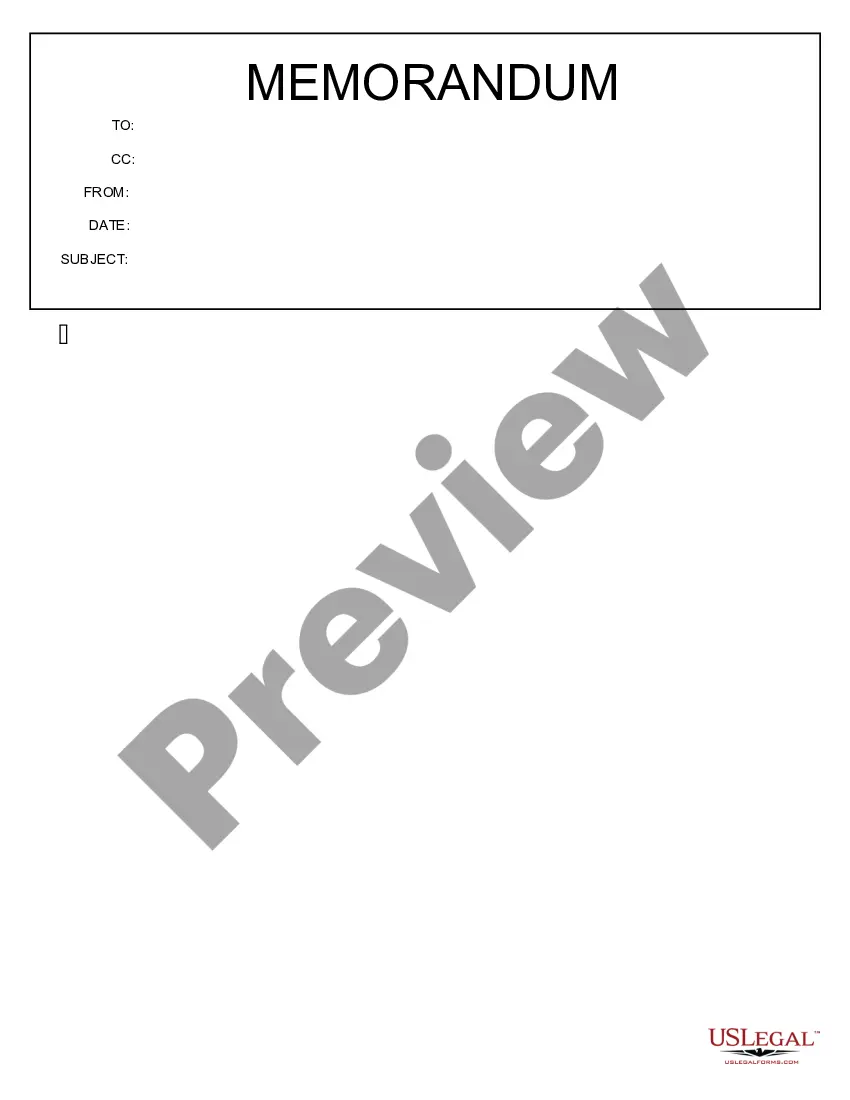
A memorandum is a written document used in business contexts to communicate information, proposals, or decisions. Unlike formal reports or contracts, a memorandum is less structured and typically used for internal purposes. This form allows users to draft a memorandum easily using Adobe Acrobat or Word, enabling them to fill in the necessary fields without hassle.
Main sections of this form
- Date of the memorandum.
- Names and titles of the sender and recipients.
- Subject line to summarize the content.
- Body of the memorandum for detailed information.
- Closing remarks or action items.
Common use cases
This form is useful when you need to convey important information within an organization, such as updates on projects, policy changes, or meeting summaries. It serves as a quick reference for team members and ensures clarity of communication.
Who should use this form
This memorandum form is intended for:
- Business professionals needing to share updates or decisions.
- Managers communicating with their teams.
- Employees who need to document internal communications.
Steps to complete this form
- Enter the date at the top of the memorandum.
- Fill in the names and titles of the sender and recipients.
- Specify the subject line to provide a clear summary of the content.
- Write the body of the memorandum, outlining key information or proposals.
- Include any closing remarks and a call to action if applicable.
Notarization guidance
Notarization is generally not required for this form. However, certain states or situations might demand it. You can complete notarization online through US Legal Forms, powered by Notarize, using a verified video call available anytime.
Get your form ready online
Our built-in tools help you complete, sign, share, and store your documents in one place.
Make edits, fill in missing information, and update formatting in US Legal Forms—just like you would in MS Word.
Download a copy, print it, send it by email, or mail it via USPS—whatever works best for your next step.
Sign and collect signatures with our SignNow integration. Send to multiple recipients, set reminders, and more. Go Premium to unlock E-Sign.
If this form requires notarization, complete it online through a secure video call—no need to meet a notary in person or wait for an appointment.
We protect your documents and personal data by following strict security and privacy standards.

Make edits, fill in missing information, and update formatting in US Legal Forms—just like you would in MS Word.

Download a copy, print it, send it by email, or mail it via USPS—whatever works best for your next step.

Sign and collect signatures with our SignNow integration. Send to multiple recipients, set reminders, and more. Go Premium to unlock E-Sign.

If this form requires notarization, complete it online through a secure video call—no need to meet a notary in person or wait for an appointment.

We protect your documents and personal data by following strict security and privacy standards.
Mistakes to watch out for
- Failing to include a subject line.
- Neglecting to proofread for grammatical errors.
- Omitting the date, which is crucial for record-keeping.
Why use this form online
- Convenient access to templates anytime, anywhere.
- Edit the document easily in Adobe Acrobat or Word.
- Save and download for future reference or distribution.
Legal use & context
- Memoranda serve as an informal yet essential method of business communication.
- While not legally binding, a well-drafted memorandum can provide a record of decisions and communications.
What to keep in mind
- A memorandum is a practical tool for internal communication in a business setting.
- Use this form to ensure clarity and effective communication among team members.
- Be sure to proofread and provide clear action items when necessary.
Looking for another form?

Form popularity
FAQ
Memorandum is popularly known as memo.Memos are the written internal communication means for exchanging information relating to day-to-day functions within the organizations. According to Lesikar and pettit, Memorandum is a form of letters written inside the business.
A memo (or memorandum, meaning reminder) is normally used for communicating policies, procedures, or related official business within an organization.
Type # 2. Confirmation Memo: Type # 3. Periodic Report Memo: Type # 4. Ideas and Suggestions Memo: Type # 5. Informal Study Results Memo:
A memo consists of two parts: the identifying information at the top, and the message itself. At the top, identify for whom the memo has been written, who is sending it, the subject, and the date. The subject line serves as the memo's title.
A memorandum is a form of official interdepartmental communication that is used to convey essential decisions or information. A memorandum is thought to be a step below a formal letter and often contains details needed for specific meetings, projects, policies or others.
A memorandum or memo for short is a way of communication that is also recorded for posterity. Memos are usually issued when vital changes have been made to a company's policy or one of its projects. A memorandum definition and example can be seen in the image below: Image will be uploaded soon
There are four types of memos you might have to write, each with its own organizational format: information, problem-solving, persuasion, and internal memo proposal. More informal in appearance and tone than a letter, a memo is set up in a special format.
The Difference between a Email and a Memo is a Email opens with a To, From, Subject Line, Carbon Copy (CC), and in some circumstances a Bcc. A Memo is quite similar to a Email.A Email always closes with the information from whoever is sending the email. While a Memo usually omits a closing and never uses a signature.
2. Use a memo when you are writing a message built to last. If your communication is a detailed proposal, a significant report, a serious recommendation, a technical explanation, meeting minutes, a new policy, or something else that readers will consult more than once, make it a memo.