Sample Letter for Employment Discrimination - Wrongful Discharge
Understanding this form
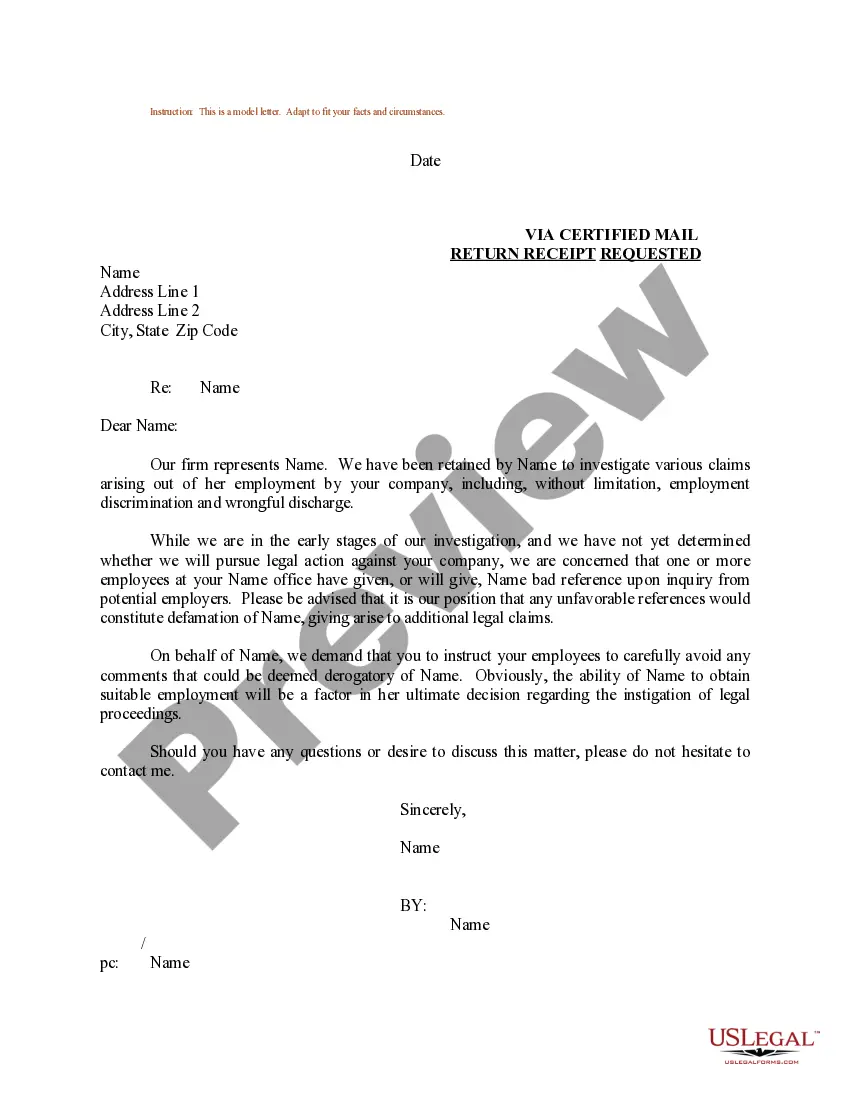
This Sample Letter for Employment Discrimination - Wrongful Discharge is a formal communication template that serves as a precursor to potential legal actions regarding employment-related disputes. It is specifically designed to notify an employer about allegations of wrongful discharge and discrimination, while also safeguarding the employee's reputation from potentially defamatory references. This form differs from other legal forms in its focus on pre-litigation communication and the need to address concerns with potential future references from employers.
Key parts of this document
- Date section for official documentation.
- Recipient's name and address for proper delivery.
- Salutation directing the letter to the appropriate party.
- Introduction stating the representation and nature of the claims.
- Statement regarding concerns over bad references and defamation.
- Demand for instruction to avoid derogatory remarks.
- Closing statement inviting communication for further discussions.
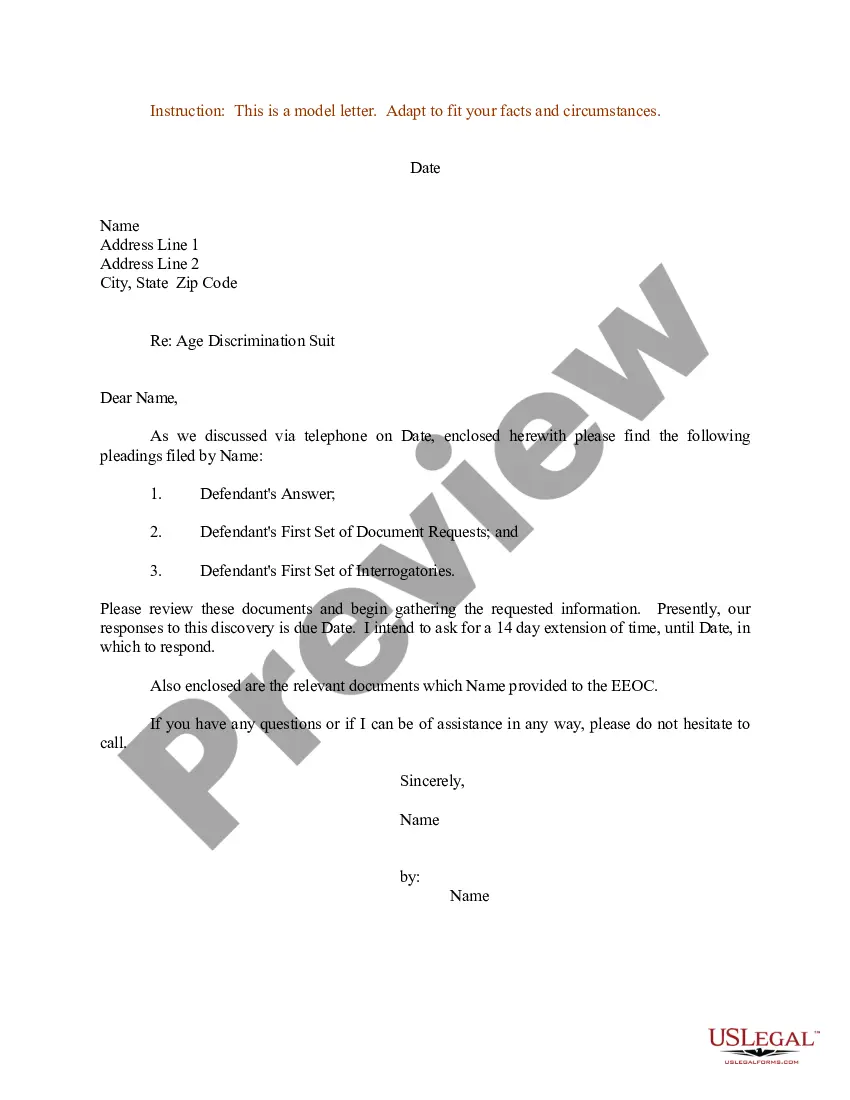
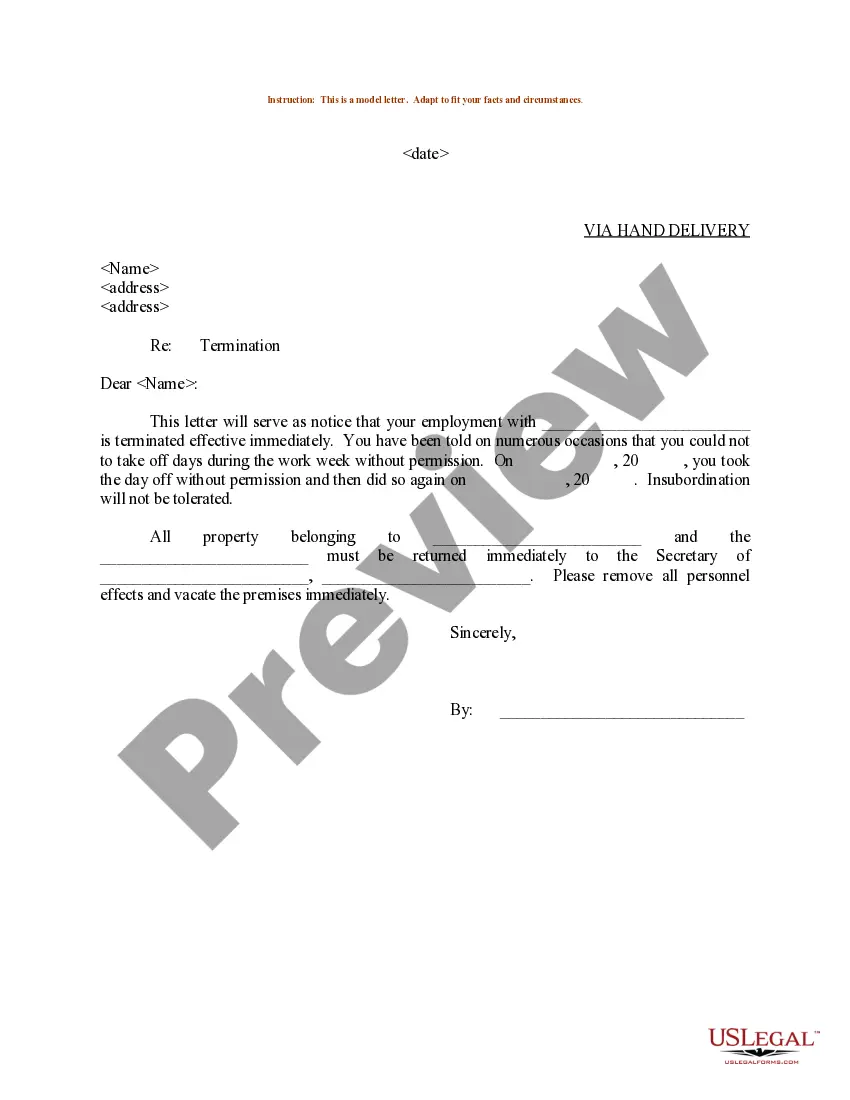
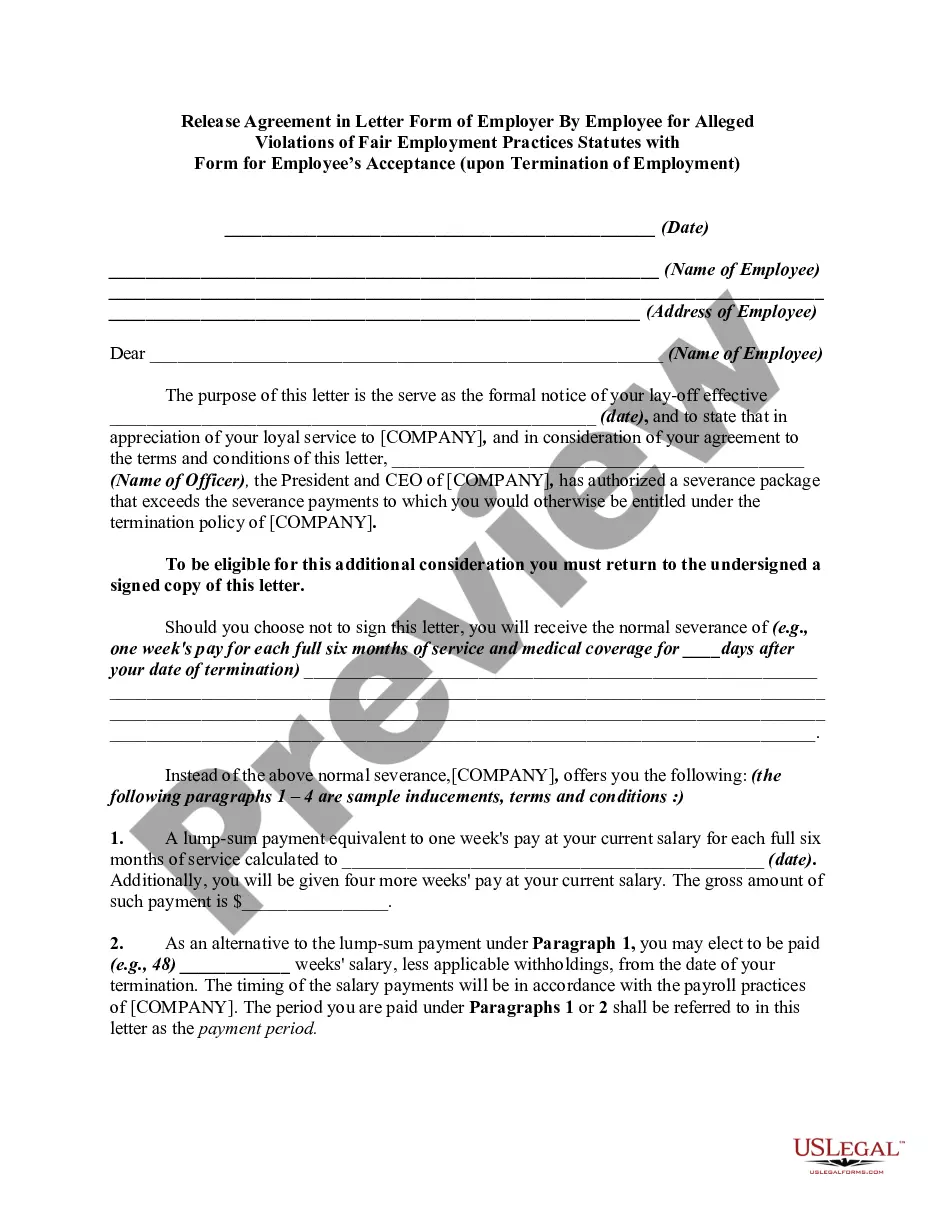
Common use cases
This form should be used when an employee suspects they have been wrongfully terminated based on discrimination and wants to formally notify their employer of their concerns. It is suitable in cases where the employee anticipates potential legal action but aims to resolve the issue amicably by addressing reference-related challenges before proceeding with litigation.
Who this form is for
- Employees who believe they have been discriminated against in the workplace.
- Individuals who have been wrongfully discharged from their job.
- Employees considering legal action related to employment issues.
- Legal representatives seeking a template for client communication.
How to prepare this document
- Enter the date at the top of the letter.
- Fill in the name and address of the recipient.
- Specify the subject of the letter, mentioning the employee's name.
- Provide a brief introduction stating your representation and the nature of claims.
- Clearly outline your concerns regarding potential bad references.
- End with a request for communication and include your contact details.
Does this form need to be notarized?
This form does not typically require notarization unless specified by local law. However, it is recommended to keep a record of the communication for your files.
Get your form ready online
Our built-in tools help you complete, sign, share, and store your documents in one place.
Make edits, fill in missing information, and update formatting in US Legal Forms—just like you would in MS Word.
Download a copy, print it, send it by email, or mail it via USPS—whatever works best for your next step.
Sign and collect signatures with our SignNow integration. Send to multiple recipients, set reminders, and more. Go Premium to unlock E-Sign.
If this form requires notarization, complete it online through a secure video call—no need to meet a notary in person or wait for an appointment.
We protect your documents and personal data by following strict security and privacy standards.

Make edits, fill in missing information, and update formatting in US Legal Forms—just like you would in MS Word.

Download a copy, print it, send it by email, or mail it via USPS—whatever works best for your next step.

Sign and collect signatures with our SignNow integration. Send to multiple recipients, set reminders, and more. Go Premium to unlock E-Sign.

If this form requires notarization, complete it online through a secure video call—no need to meet a notary in person or wait for an appointment.

We protect your documents and personal data by following strict security and privacy standards.
Common mistakes to avoid
- Failing to address the letter to the correct individual or department.
- Not providing adequate details about the claims or concerns.
- Leaving out contact information for follow-up communication.
- Using overly complex language that may confuse the reader.
Benefits of using this form online
- Immediate access to a professionally drafted template.
- Ability to customize the letter to fit specific needs.
- Convenient download options for future reference and use.
- Ensures clarity and professionalism in legal communications.
Quick recap
- The Sample Letter for Employment Discrimination - Wrongful Discharge addresses potential defamation issues during employment transitions.
- It is a proactive measure to protect an individual's job-seeking opportunities.
- Using clear communication with former employers can help mitigate complications in legal claims.
Looking for another form?
Form popularity
FAQ
This form serves as a formal pre-litigation letter template to notify an employer of alleged wrongful discharge tied to discrimination, while addressing potential defamatory references. It guides you through essential elements—date, recipient, salutation, and an introduction stating representation and the claims—and invites discussion before pursuing legal action.
This form guides you through drafting a formal letter to assert wrongful discharge tied to discrimination, using the included sections for date, recipient, and a clear introduction that states representation and the claims. It also covers addressing potential bad references and defamation, and it invites further discussion before any litigation.
This form acts as a pre-litigation notice to alert an employer to alleged wrongful discharge based on discrimination. It uses an introduction that states representation and the nature of the claims, and includes a note about bad references and defamation, signaling careful, factual language before any legal action.
This form emphasizes avoiding derogatory remarks and defamation. It includes a section about concerns over bad references and defamation and instructs the user to keep the letter factual and professional, focusing on the claims and remedies rather than insults, while following the date, recipient, salutation, and closing components.
This form is a template for reporting alleged discrimination and wrongful termination in a pre-litigation letter, rather than a general list of termination examples. It directs the user to introduce representation and the claims, and to address potential references, ensuring the letter remains factual and objective as a starting point for discussions.
This form’s key difference is its pre-litigation focus and its explicit treatment of wrongful discharge tied to discrimination, plus a dedicated note about bad references and defamation. Unlike a generic termination letter, it provides a structured date, recipient, introduction, and closing to prompt discussion before any lawsuit.