Checklist - When Should You Fire an Employee
About this form
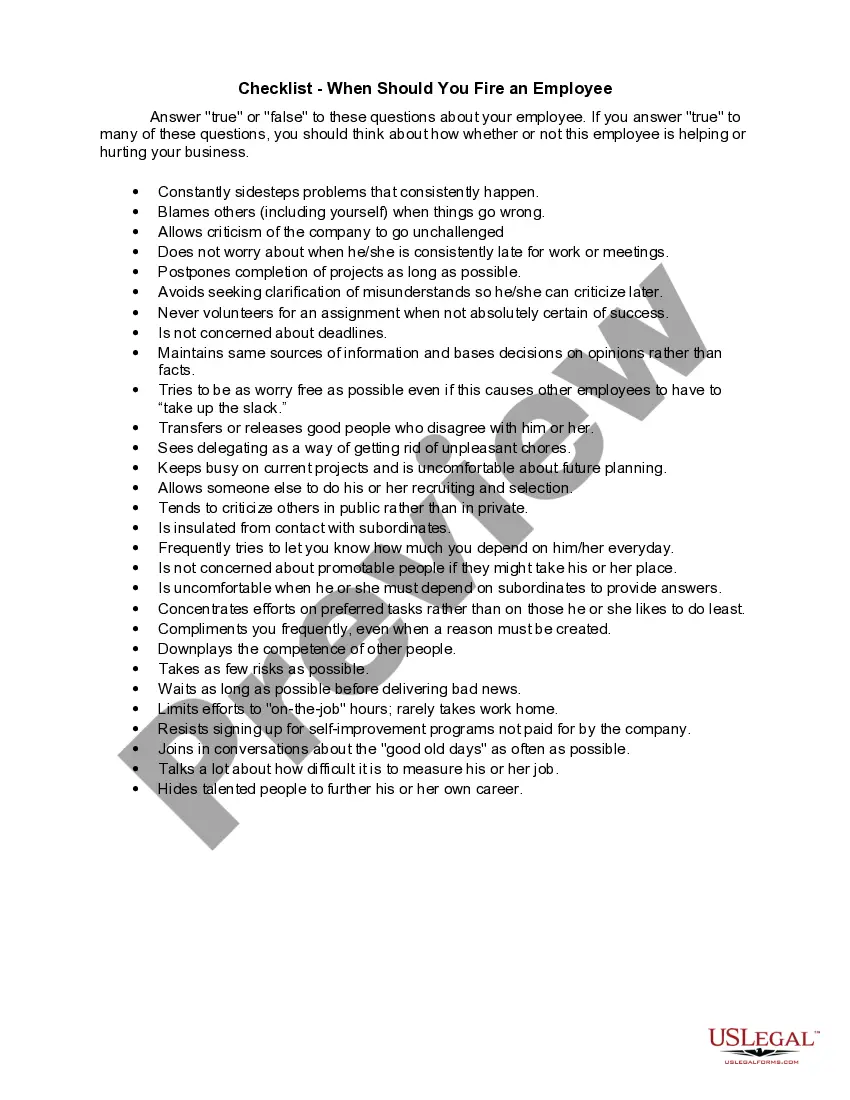
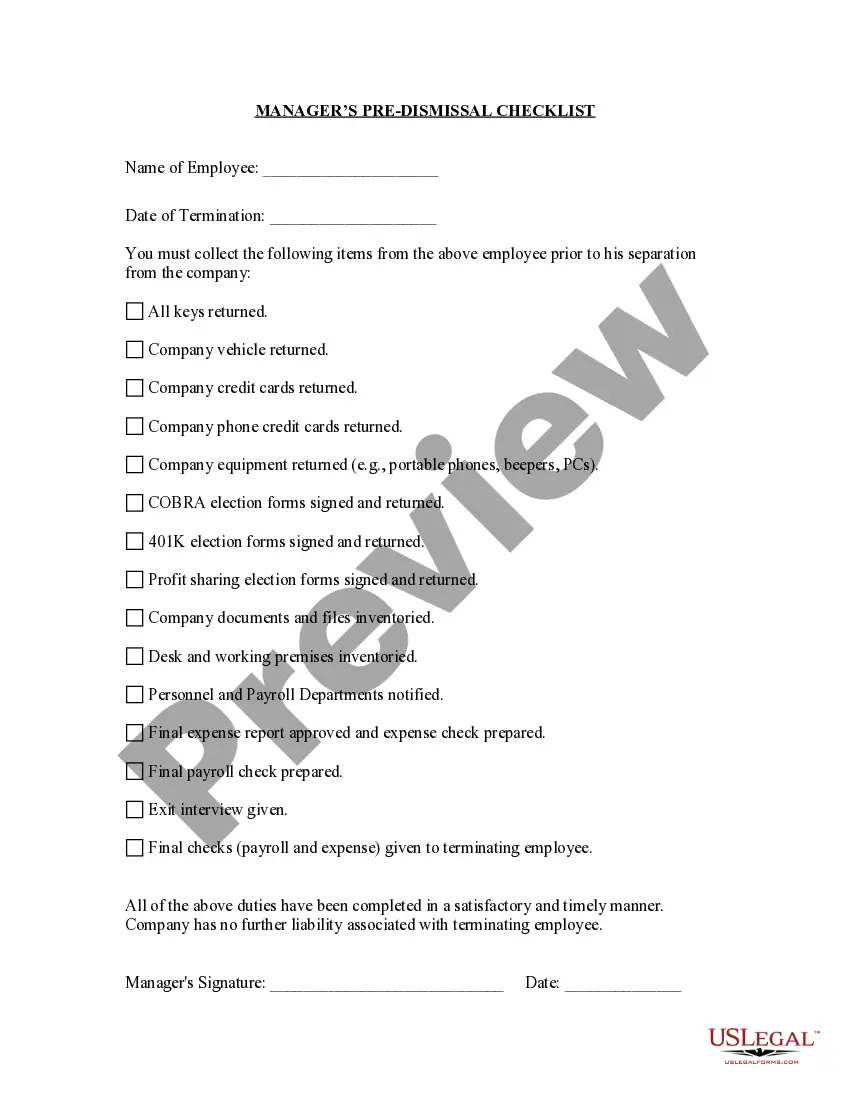
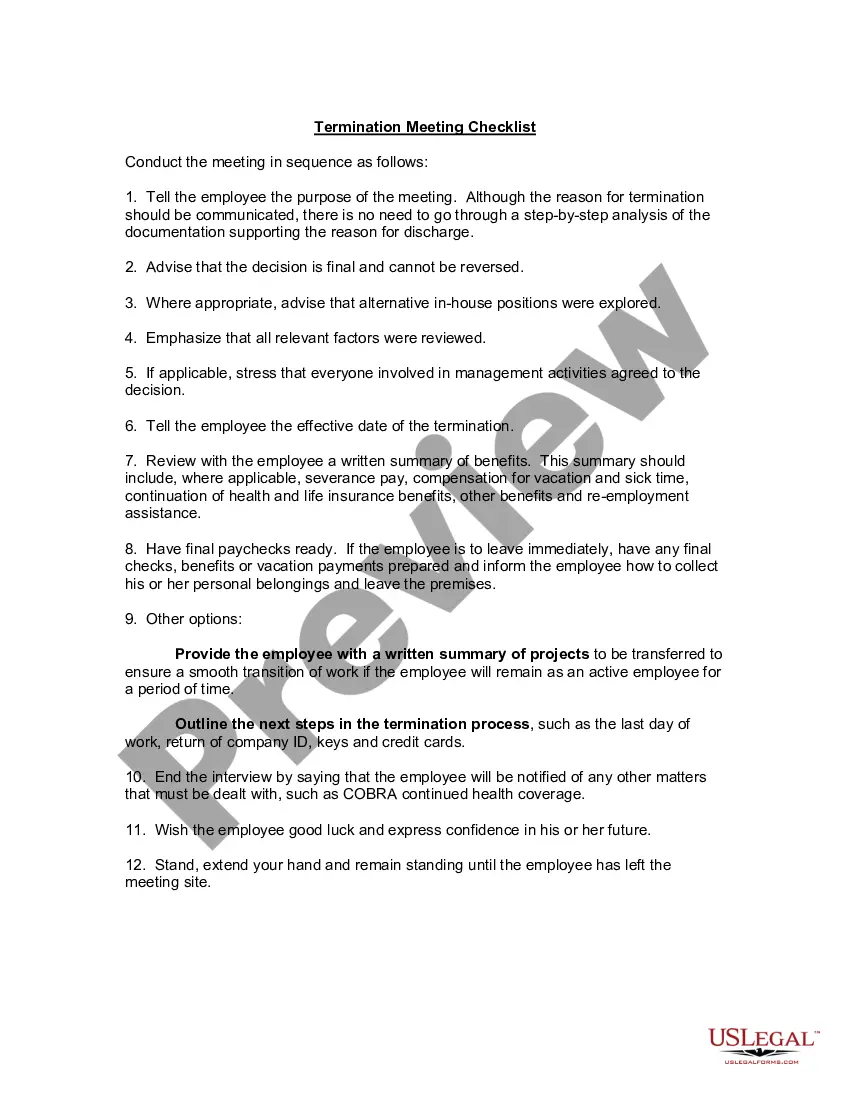
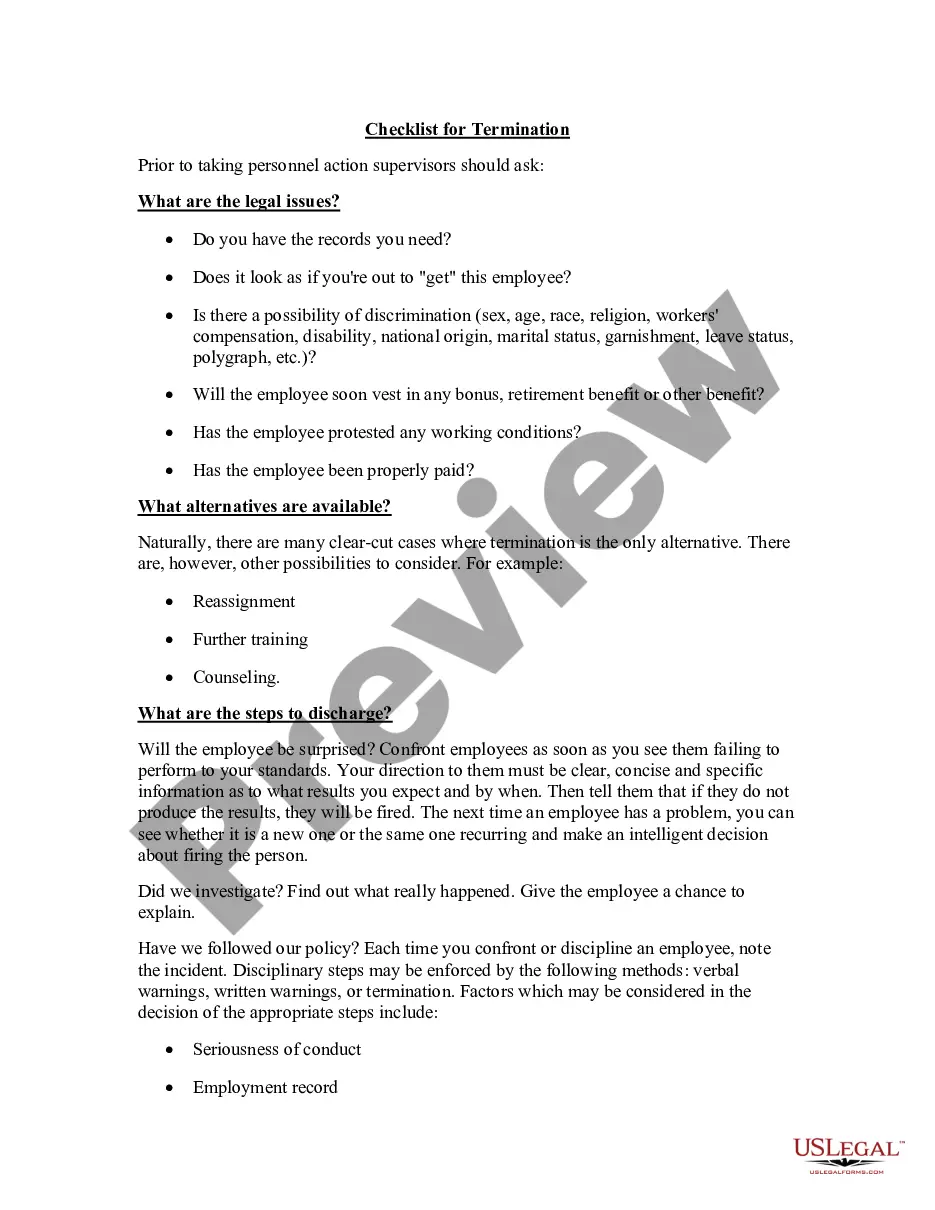
The Checklist - When Should You Fire an Employee is a tool designed to assist employers in evaluating the performance and contributions of their employees. This checklist focuses on various behavioral and performance indicators that may signal whether an employee is negatively affecting the workplace. Unlike other termination forms that document the legal processes of firing an employee, this checklist provides a preliminary assessment to guide decision-making regarding employee retention or dismissal.
Key parts of this document
- A series of yes/no questions about employee behavior and performance.
- Indicators of potentially detrimental attitudes or actions within the workplace.
- Guidance to reflect on the employee's impact on team dynamics and productivity.
- An assessment of how the employee handles responsibilities and feedback.
- Considerations about the employeeâs interactions with peers and superiors.
Situations where this form applies
This checklist can be used in various situations including when an employee consistently underperforms, fails to meet deadlines, or exhibits negative behavior that disrupts the workplace. It serves as a thoughtful approach to assess the overall contribution of an employee before making the critical decision to terminate their employment. Additionally, it can be useful during performance reviews or when addressing specific performance issues.
Who this form is for
- Human resources professionals seeking to evaluate employee performance.
- Managers and supervisors responsible for team performance.
- Business owners aiming to maintain a productive work environment.
- Team leads wanting to ensure a fair assessment of team members.
How to complete this form
- Begin by listing the employee's name and role within the organization.
- Answer each question with a "true" or "false" response based on your observations.
- Count the number of "true" answers to gauge the employee's overall impact.
- Reflect on any patterns or significant issues indicated by your responses.
- Make notes on specific incidents or behaviors that relate to the checklist items.
Does this document require notarization?
Notarization is generally not required for this form. However, certain states or situations might demand it. You can complete notarization online through US Legal Forms, powered by Notarize, using a verified video call available anytime.
Get your form ready online
Our built-in tools help you complete, sign, share, and store your documents in one place.
Make edits, fill in missing information, and update formatting in US Legal Forms—just like you would in MS Word.
Download a copy, print it, send it by email, or mail it via USPS—whatever works best for your next step.
Sign and collect signatures with our SignNow integration. Send to multiple recipients, set reminders, and more. Go Premium to unlock E-Sign.
If this form requires notarization, complete it online through a secure video call—no need to meet a notary in person or wait for an appointment.
We protect your documents and personal data by following strict security and privacy standards.

Make edits, fill in missing information, and update formatting in US Legal Forms—just like you would in MS Word.

Download a copy, print it, send it by email, or mail it via USPS—whatever works best for your next step.

Sign and collect signatures with our SignNow integration. Send to multiple recipients, set reminders, and more. Go Premium to unlock E-Sign.

If this form requires notarization, complete it online through a secure video call—no need to meet a notary in person or wait for an appointment.

We protect your documents and personal data by following strict security and privacy standards.
Common mistakes
- Relying solely on the checklist without considering other performance metrics.
- Ignoring context and specific circumstances affecting the employee's behavior.
- Failing to document supporting evidence for assessment outcomes.
- Using the checklist as the only basis for termination without further investigation.
Why complete this form online
- Immediate access to a comprehensive checklist that is easy to download and print.
- Ability to customize the checklist to better fit your organization's needs.
- Convenience of filling out the form from anywhere at any time.
- Reliability and security of having attorney-drafted content to support decision-making.
Summary of main points
- The Checklist - When Should You Fire an Employee helps evaluate employee performance.
- This form is not a final decision-maker but a preliminary assessment tool.
- Use it to identify patterns in employee behavior that may require further evaluation.
- Consider local laws and additional documentation when making employment decisions.
Looking for another form?

Form popularity
FAQ
Review your employee handbook and its firing policies. Document violations. Investigate grounds for termination. Be brief and factual (but don't sugarcoat it). Fulfill all legal requirements.
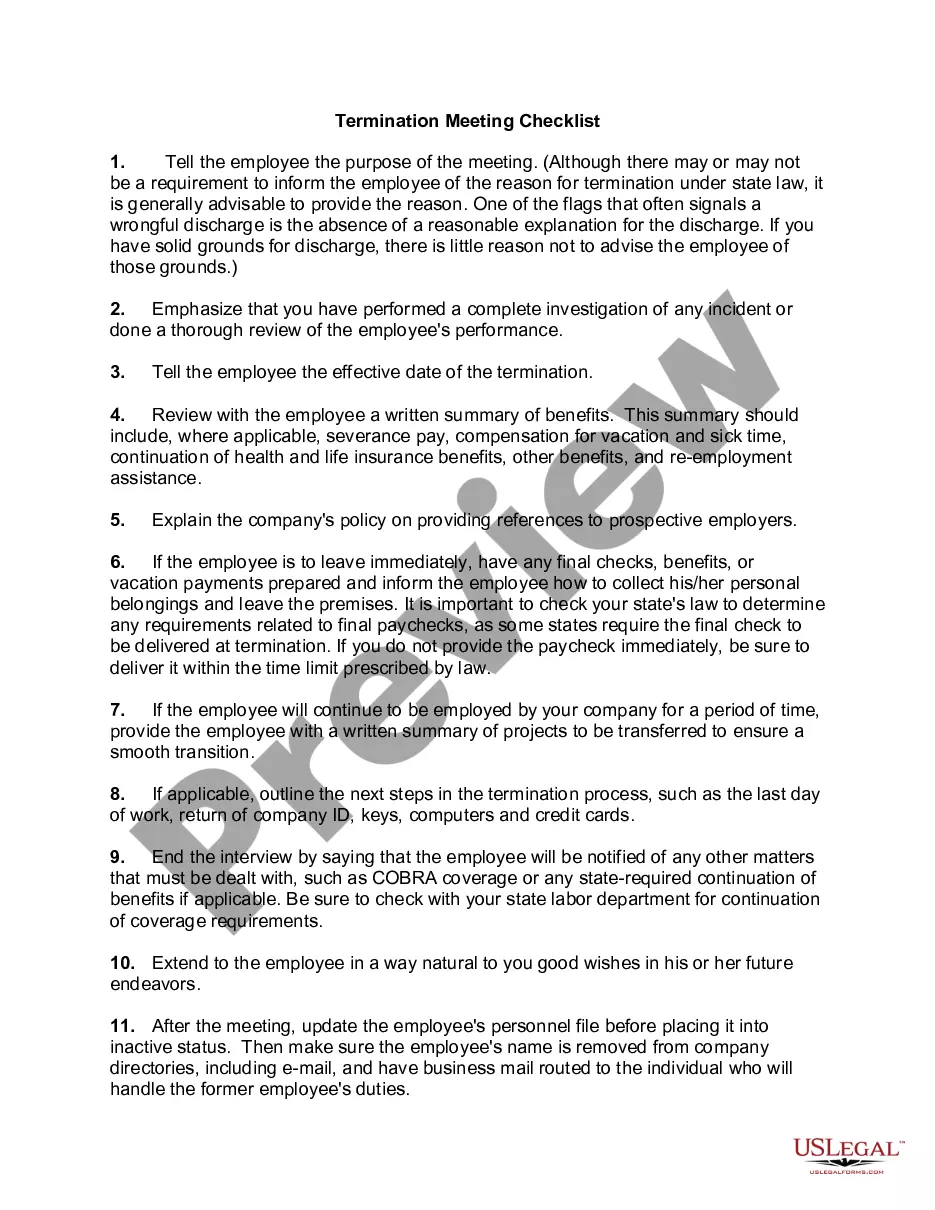
The file should have an employee termination checklist form to be followed and basic details of the employee such as name, department, position as well as important details such as the reason for termination, last day of work and the name of the person handling their file.
Termination letter due to layoffs/downsizing. Termination letter for cause (misconduct/performance/attendance, etc.) Termination of business contract.
The words you use to terminate an employee should be simple and to-the-point. Don't waffle. Go somewhere private and then lead with the punch line, says Glickman. She suggests you begin by saying, I have some bad news for you.
The employer must provide the employee with his or her final paycheck during the termination meeting.In addition, make sure to provide the employee with all documentation regarding applicable benefits (including retirement benefits and insurance/COBRA information, if applicable) and unemployment benefits.
Identify and Document the Issues. Coach Employees to Rectify the Issue. Create a Performance Improvement Plan. Terminate the Employee. Have HR Conduct an Exit Interview.
You can be fired at any time for any reason, which means an employer can wait years to terminate you. There is no time limit at all.
Incompetence, including lack of productivity or poor quality of work. Insubordination and related issues such as dishonesty or breaking company rules. Attendance issues, such as frequent absences or chronic tardiness. Theft or other criminal behavior including revealing trade secrets.
End the meeting on the most positive note possible. Wish the employee good luck and shake his or her hand. If you can honestly say something positive about the employee's tenure at the company, by all means do so.