Guarantor - Consignor Notice Required by FTC on certain Transactions
What is this form?
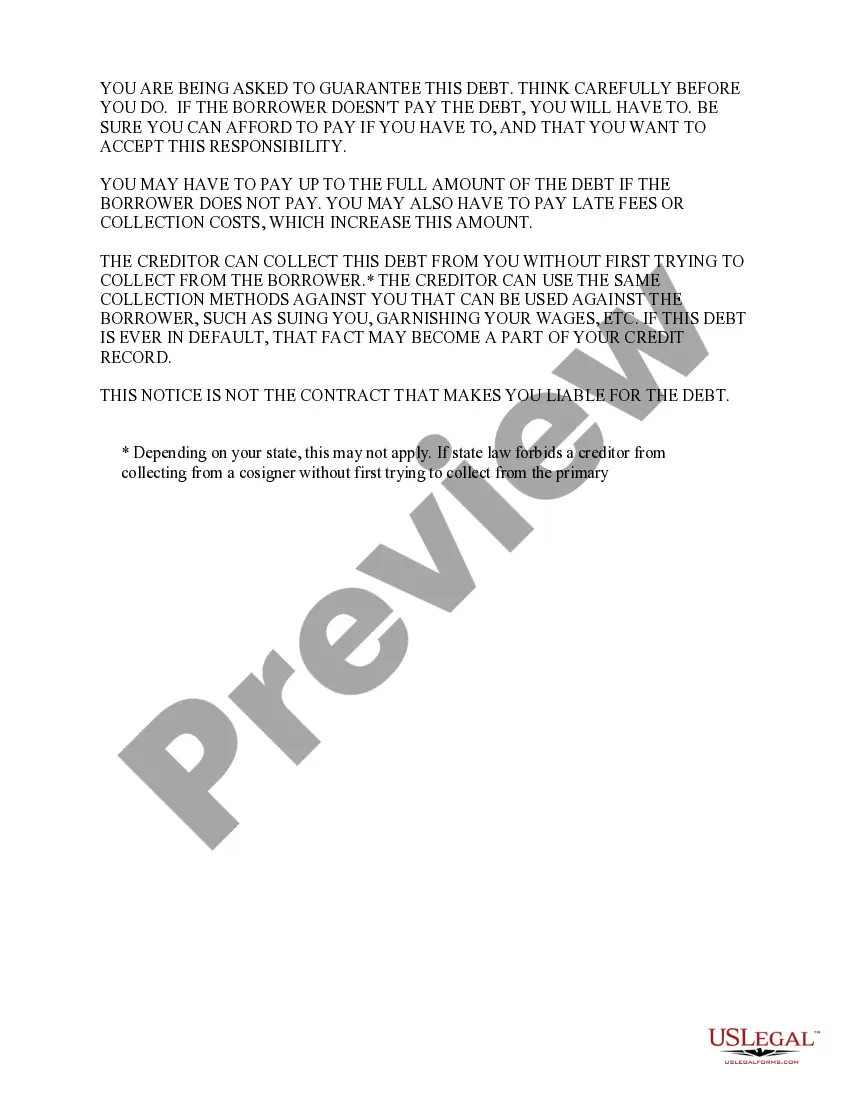
The Guarantor - Consignor Notice Required by FTC on Certain Transactions is a legal document that informs individuals agreeing to cosign a loan of their obligations. This form is specifically mandated for consumer credit contracts offered by finance companies, retailers, and credit unions, with the exception of real estate purchases. This notice explains the responsibilities a guarantor undertakes and serves as an important cautionary tool for those considering cosigning a debt.
Form components explained
- Warning about potential financial liability if the borrower defaults.
- Clarification that the creditor can directly pursue the guarantor for payment.
- Information on additional costs such as late fees or collection expenses.
- Notification that an unpaid debt may impact the guarantor's credit record.
- Note that this notice is separate from the contract that creates the liability.
When to use this form
This form is needed when an individual agrees to cosign a loan or credit agreement for someone else, thus guaranteeing payment if the primary borrower fails to meet their obligations. It is typically used in various consumer credit situations, such as financing a vehicle, purchasing furniture, or taking out personal loans, where a creditor requires a cosigner to secure the loan.
Who can use this document
- Individuals who are considering cosigning a loan or debt.
- Guarantors who need a clear explanation of their financial responsibilities.
- Borrowers who require a cosigner to enhance their chances of loan approval.
Instructions for completing this form
- Review the notice thoroughly to understand your responsibilities as a guarantor.
- Enter the names of all parties involved: the primary borrower and the guarantor.
- Specify the terms of the debt obligation, including the amount and nature of the credit.
- Sign and date the notice to acknowledge your understanding and acceptance of the terms.
- Keep a copy for your records after completion.
Does this document require notarization?
This form does not typically require notarization unless specified by local law. It is advisable to check your state's regulations to confirm.
Get your form ready online
Our built-in tools help you complete, sign, share, and store your documents in one place.
Make edits, fill in missing information, and update formatting in US Legal Forms—just like you would in MS Word.
Download a copy, print it, send it by email, or mail it via USPS—whatever works best for your next step.
Sign and collect signatures with our SignNow integration. Send to multiple recipients, set reminders, and more. Go Premium to unlock E-Sign.
If this form requires notarization, complete it online through a secure video call—no need to meet a notary in person or wait for an appointment.
We protect your documents and personal data by following strict security and privacy standards.

Make edits, fill in missing information, and update formatting in US Legal Forms—just like you would in MS Word.

Download a copy, print it, send it by email, or mail it via USPS—whatever works best for your next step.

Sign and collect signatures with our SignNow integration. Send to multiple recipients, set reminders, and more. Go Premium to unlock E-Sign.

If this form requires notarization, complete it online through a secure video call—no need to meet a notary in person or wait for an appointment.

We protect your documents and personal data by following strict security and privacy standards.
Common mistakes
- Not reading the notice carefully to understand the full extent of financial liability.
- Assuming cosigning does not affect personal credit scores.
- Failing to consider personal financial stability before agreeing to cosign.
- Not asking questions if unclear about specific terms in the notice.
Benefits of using this form online
- Convenient access to the legally drafted form from any location.
- Easy to edit and customize to fit specific situations.
- Reliability of documents created by licensed attorneys.
- Immediate download allows for prompt action when needed.
Legal use & context
- The notice is designed to ensure that cosigners are aware of their obligations and potential risks involved.
- Failure to provide this notice may result in legal consequences for the creditor.
- It helps protect the rights of the guarantor by clearly laying out the terms associated with cosigning.
What to keep in mind
- This form is essential for anyone who intends to cosign a loan or credit agreement.
- The guarantor must be aware of the potential financial obligations and risks involved.
- Reviewing the notice carefully is necessary to understand its legal implications.
Looking for another form?

Form popularity
FAQ
The FTC's authority covers for-profit entities such as mortgage companies, mortgage brokers, creditors, and debt collectors but not banks, savings and loan institutions, and federal credit unions.
The FTC enforces federal consumer protection laws that prevent fraud, deception and unfair business practices.The FTC administers a wide variety of laws and regulations, including the Federal Trade Commission Act, Telemarketing Sale Rule, Identity Theft Act, Fair Credit Reporting Act, and Clayton Act.
Section 5(a) of the Federal Trade Commission Act (FTC Act) (15 USC §45) prohibits unfair or deceptive acts or practices in or affecting commerce. This prohibition applies to all persons engaged in commerce, including banks.The legal standards for unfairness and deception are independent of each other.
The FTC is administered by a five-member commission. Each commissioner is appointed by the President for a seven-year term with the advice and consent of the Senate.
Q14(b)-1: Timing of cosigner notice. At what point in the transaction must the cosigner notice be given? A: The cosigner notice must be given to the cosigner before the cosigner becomes obligated on the transaction.
Yes. Many materials, such as records related to Commission organization procedures, industry guidance, rulemaking, adjudicative proceedings, consent agreements, and investigations are already publicly available on the FTC's website.
Section 5(a) of the Federal Trade Commission Act (FTC Act) (15 USC §45) prohibits unfair or deceptive acts or practices in or affecting commerce. This prohibition applies to all persons engaged in commerce, including banks.
No more than three Commissioners can be of the same political party. The President chooses one Commissioner to act as Chairman. The FTC shares jurisdiction over federal civil antitrust enforcement in the United States with the Antitrust Division of the U.S. Department of Justice.
The FTC enforces federal consumer protection laws that prevent fraud, deception and unfair business practices. The Commission also enforces federal antitrust laws that prohibit anticompetitive mergers and other business practices that could lead to higher prices, fewer choices, or less innovation.