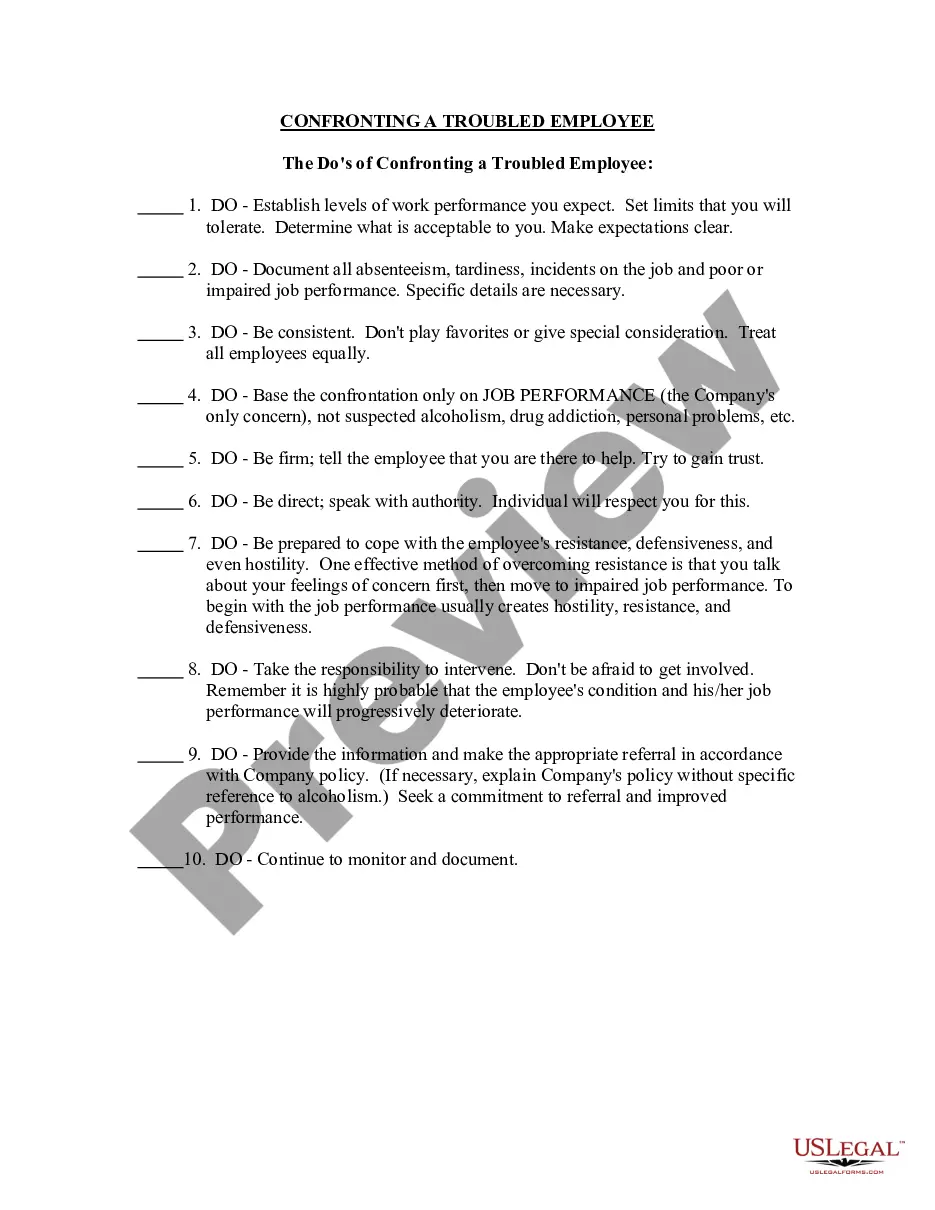
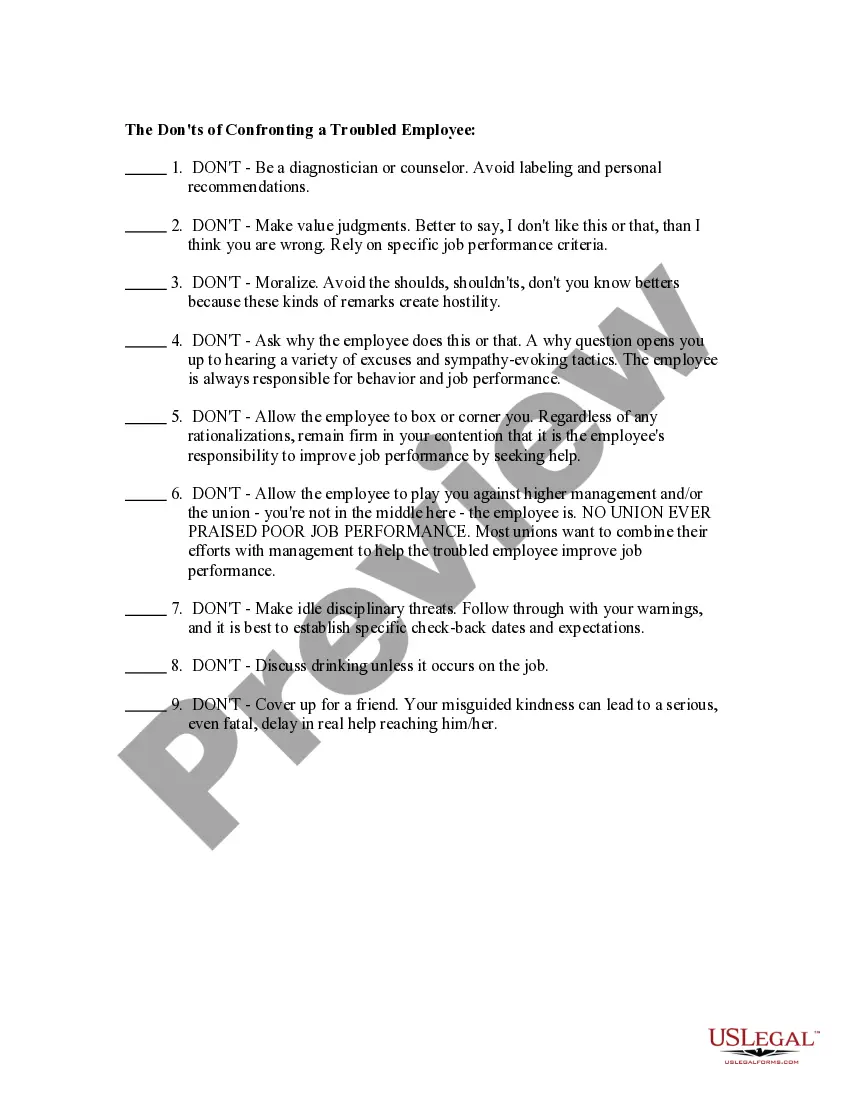
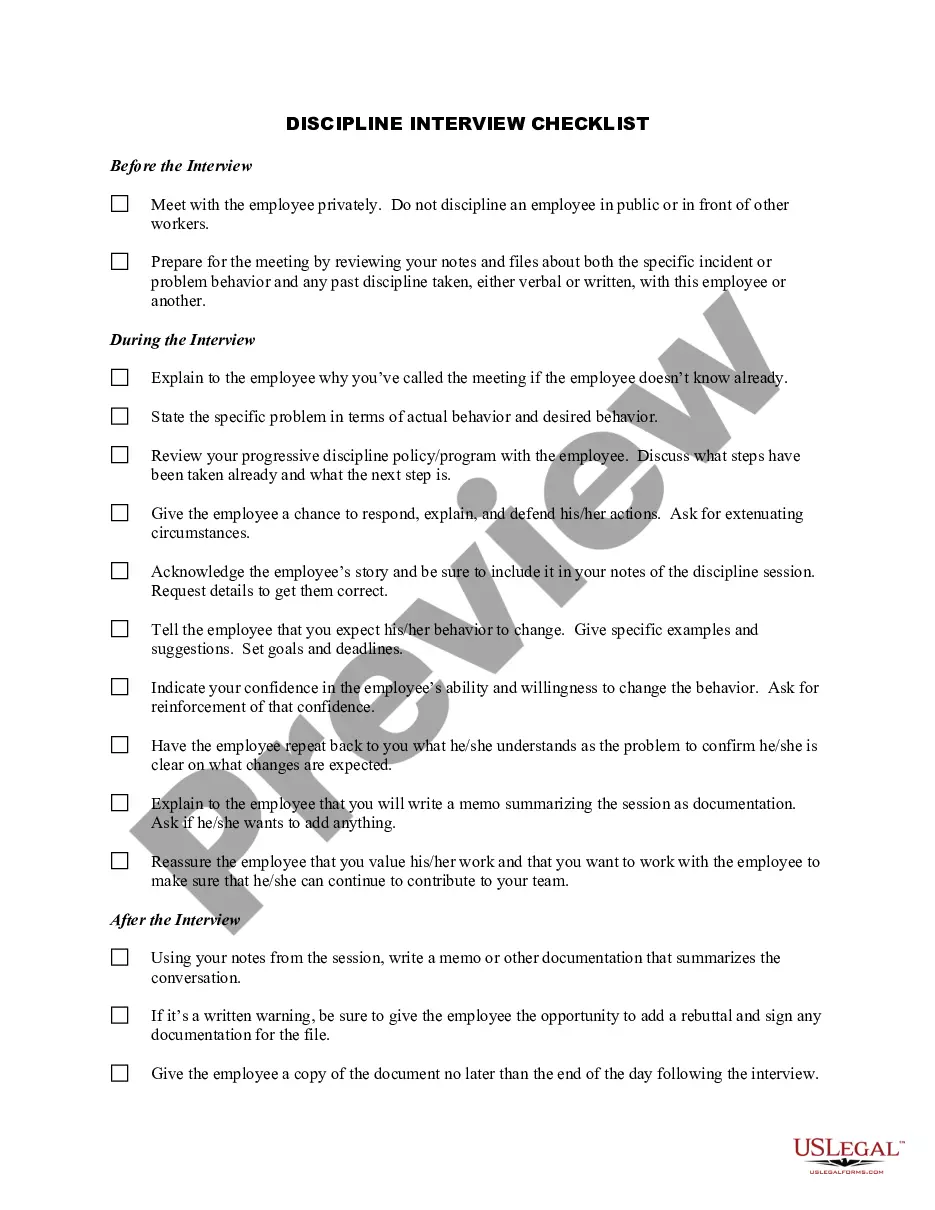
Confronting a Troubled Employee Checklist
About this form
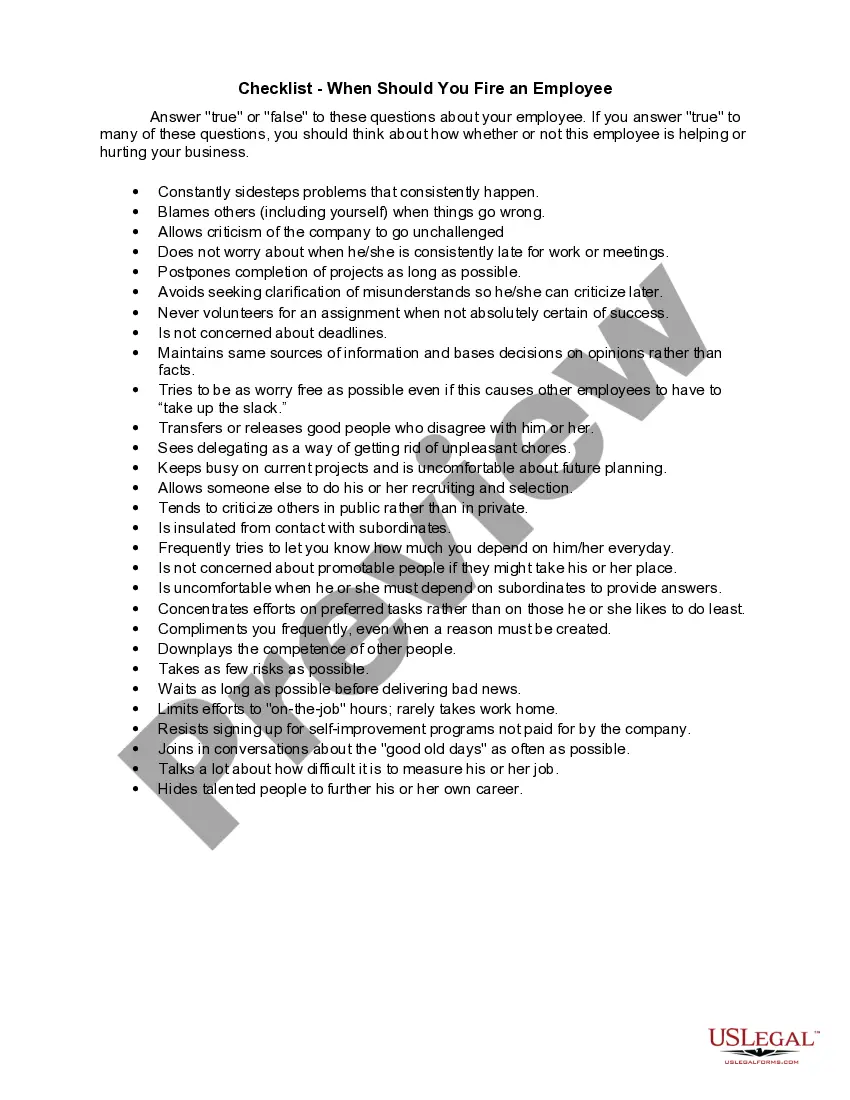
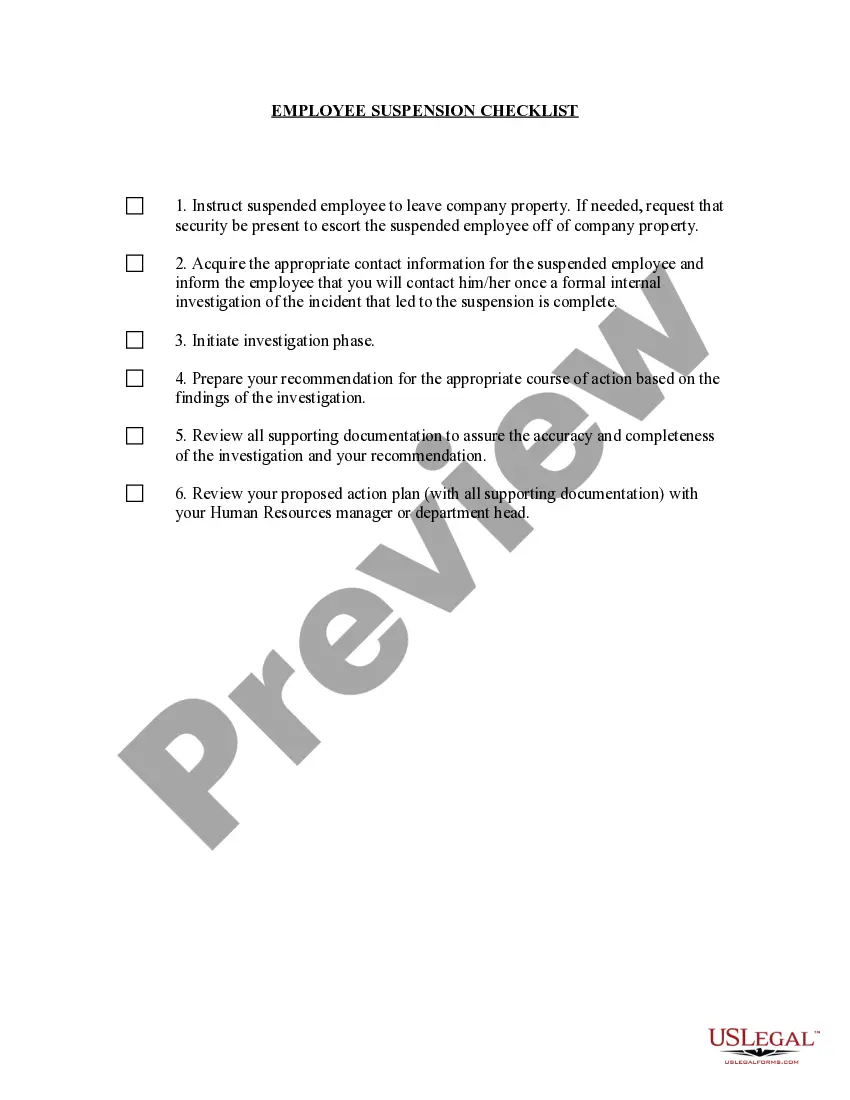
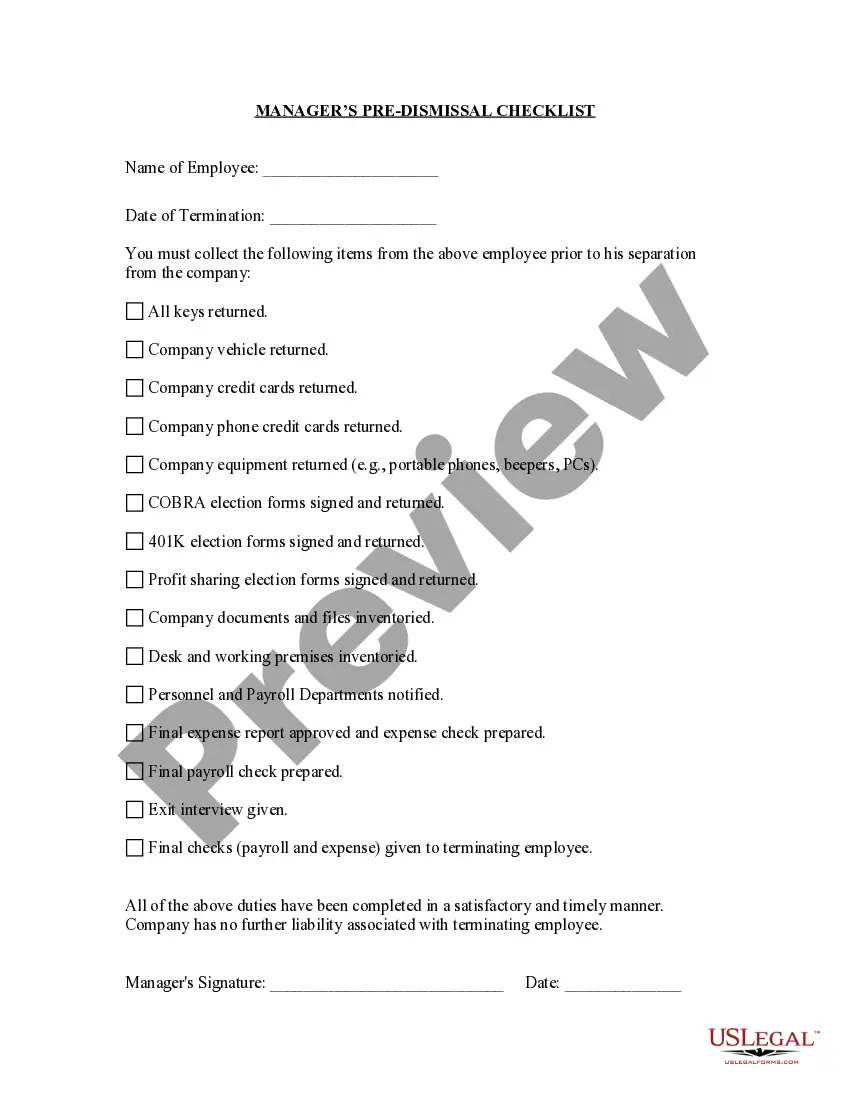
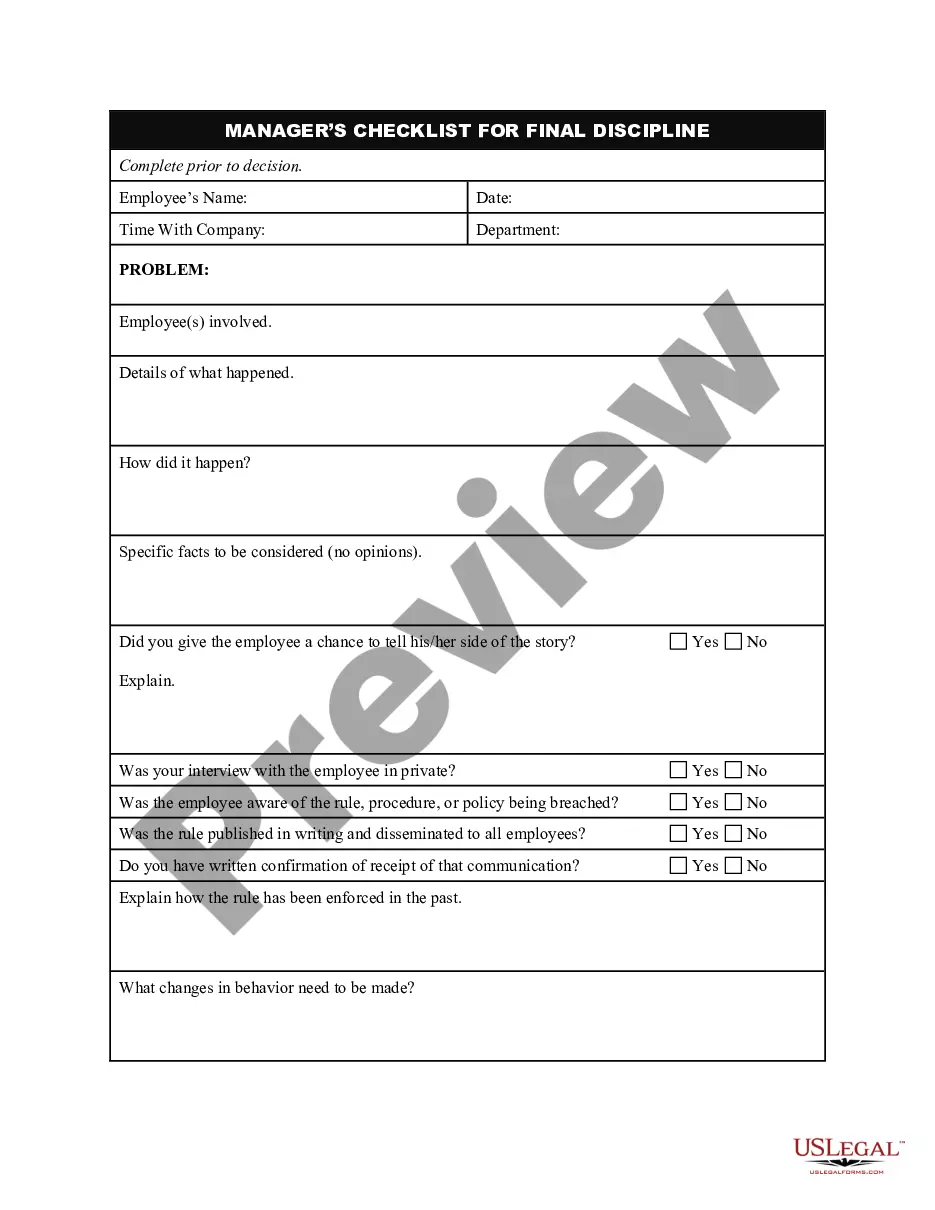
The Confronting a Troubled Employee Checklist is a helpful tool designed for management to guide them in addressing performance or behavioral issues with employees. This checklist outlines essential do's and don'ts, ensuring that managers approach the conversation with care and professionalism. Unlike other HR forms, this checklist focuses specifically on navigating difficult employee relations and improving workplace dynamics.
Form components explained
- Guidelines for initiating the conversation with the employee.
- Advice on creating a comfortable and respectful environment.
- Do's and don'ts for effective communication.
- Ways to document the meeting and follow-up actions.
- Suggestions for providing support and resources to the employee.
Common use cases
This checklist is essential when managers need to confront an employee who is struggling with performance issues, exhibiting problematic behavior, or showing signs of personal trouble that may affect work. It helps to ensure that the confrontation is handled appropriately and minimizes the risk of escalation or misunderstandings.
Who needs this form
- Managers and supervisors seeking to address employee performance issues.
- Human resources professionals involved in employee relations.
- Team leaders wanting to provide constructive feedback effectively.
- Any decision-maker responsible for maintaining a healthy workplace culture.
Completing this form step by step
- Identify the employee you need to confront.
- Review the checklist for recommended communication strategies.
- Plan the meeting time and location to ensure privacy.
- Prepare any documentation or examples you need to discuss.
- Conduct the meeting, following the guidelines provided in the checklist.
Is notarization required?
In most cases, this form does not require notarization. However, some jurisdictions or signing circumstances might. US Legal Forms offers online notarization powered by Notarize, accessible 24/7 for a quick, remote process.
Get your form ready online
Our built-in tools help you complete, sign, share, and store your documents in one place.
Make edits, fill in missing information, and update formatting in US Legal Forms—just like you would in MS Word.
Download a copy, print it, send it by email, or mail it via USPS—whatever works best for your next step.
Sign and collect signatures with our SignNow integration. Send to multiple recipients, set reminders, and more. Go Premium to unlock E-Sign.
If this form requires notarization, complete it online through a secure video call—no need to meet a notary in person or wait for an appointment.
We protect your documents and personal data by following strict security and privacy standards.

Make edits, fill in missing information, and update formatting in US Legal Forms—just like you would in MS Word.

Download a copy, print it, send it by email, or mail it via USPS—whatever works best for your next step.

Sign and collect signatures with our SignNow integration. Send to multiple recipients, set reminders, and more. Go Premium to unlock E-Sign.

If this form requires notarization, complete it online through a secure video call—no need to meet a notary in person or wait for an appointment.

We protect your documents and personal data by following strict security and privacy standards.
Common mistakes
- Failing to listen to the employee's perspective during the conversation.
- Using accusatory language rather than constructive feedback.
- Not preparing adequately for the meeting or discussion.
- Overlooking the importance of follow-up after the initial conversation.
Benefits of using this form online
- Easy access to a structured checklist that can be downloaded anytime.
- Convenience of filling it out and customizing it to your needs.
- Reliable guidance sourced from licensed attorneys to ensure best practices.
Legal use & context
- This checklist helps ensure that confrontations are conducted legally and ethically.
- There are protections in place for employees, and this form helps navigate those complexities.
- Using this checklist may support compliance with workplace policies and procedures.
What to keep in mind
- The checklist serves as a roadmap for effectively confronting troubled employees.
- Clear communication is vital to a successful resolution.
- Preparation is key to managing difficult discussions.
- Utilizing this form can prevent common pitfalls in employee confrontations.
Looking for another form?
Form popularity
FAQ
Have a thoughtful discussion in private. Be prepared for pushback. Document everything. Offer constructive feedback in public. Comment on the behavior, not the character. Continue to grow as a manager.
Critique Behavior, Not People. Listen to Feedback. Give Clear Direction. Document Problematic Behavior. Consult the HR Department. Work Together Toward a Solution. Write Down Expectations. Set Specific Consequences.
Focus on results and productivity, do not make it personal. The employee needs to know that you are not personally attacking them, so try to use phrases like I am bringing this up because it is important you address this problem to be successful in your job role. Focus on the positive.
Constant lack of clarity around projects. Different employees receiving different messages. Passive-aggressive communication. Failure to listen. Constant off-hours communication.
State the issue clearly. It's difficult to talk about poor performance with employees, but avoiding the problem will only prolong the tough discussion. Be employee specific. Listen. Use timelines and goal setting. Reward improvement. Have a plan of action if there's no improvement. Know when to let go.
Toxic employees come in an appalling array of annoying forms. They're destructive, distracting and draining. Like a cancer sapping the energy of those around them, they cripple their coworkers' morale, performance and productivity.
Have a thoughtful discussion in private. Be prepared for pushback. Document everything. Offer constructive feedback in public. Comment on the behavior, not the character. Continue to grow as a manager.
Be confident with your concerns. It can be easy to stop ourselves raising concerns by minimising their importance. Focus on the behaviour. Let the person know that it is their behaviour that is upsetting or concerning you. Be clear and specific. Listen. Respond calmly.
Listen. Often, when an employee is difficult we stop paying attention to what's actually going on. Give clear, behavioral feedback. Document. Be consistent. Set consequences if things don't change. Work through the company's processes. Don't poison the well. Manage your self-talk.