Louisiana Statement of the Defendant Refusing Plea Bargain
What this document covers
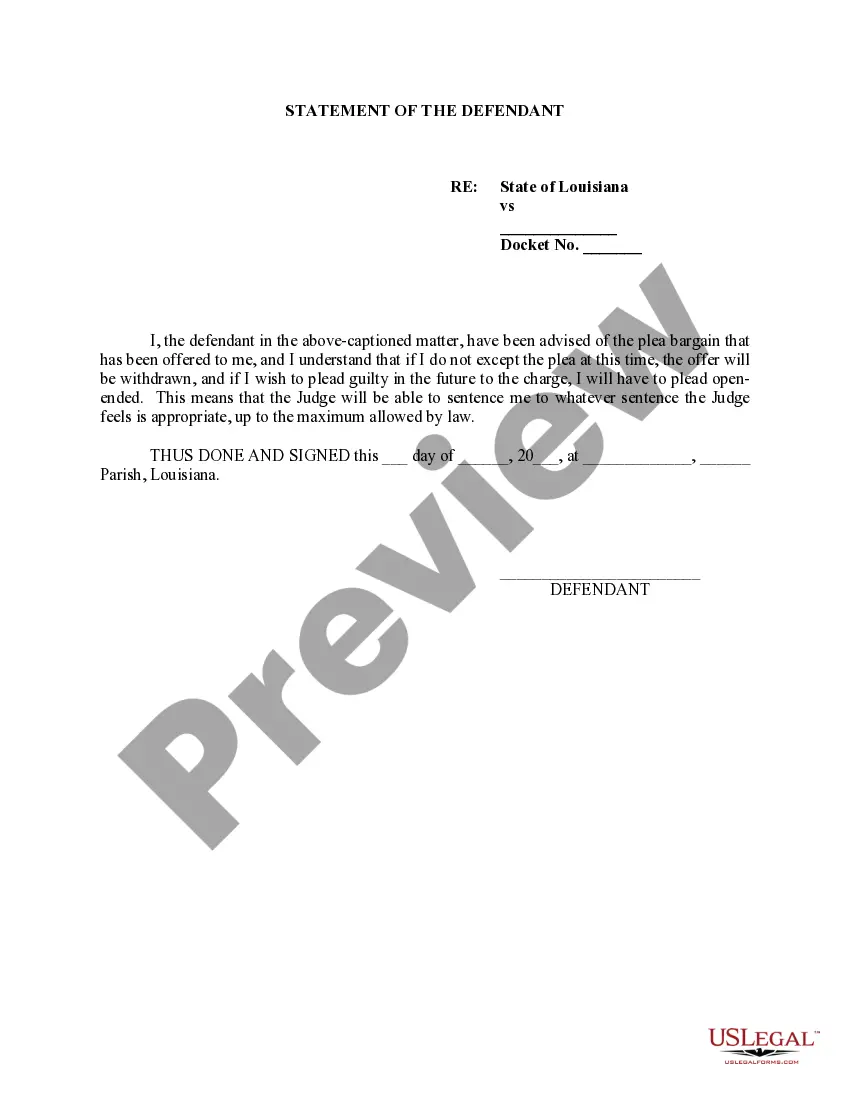
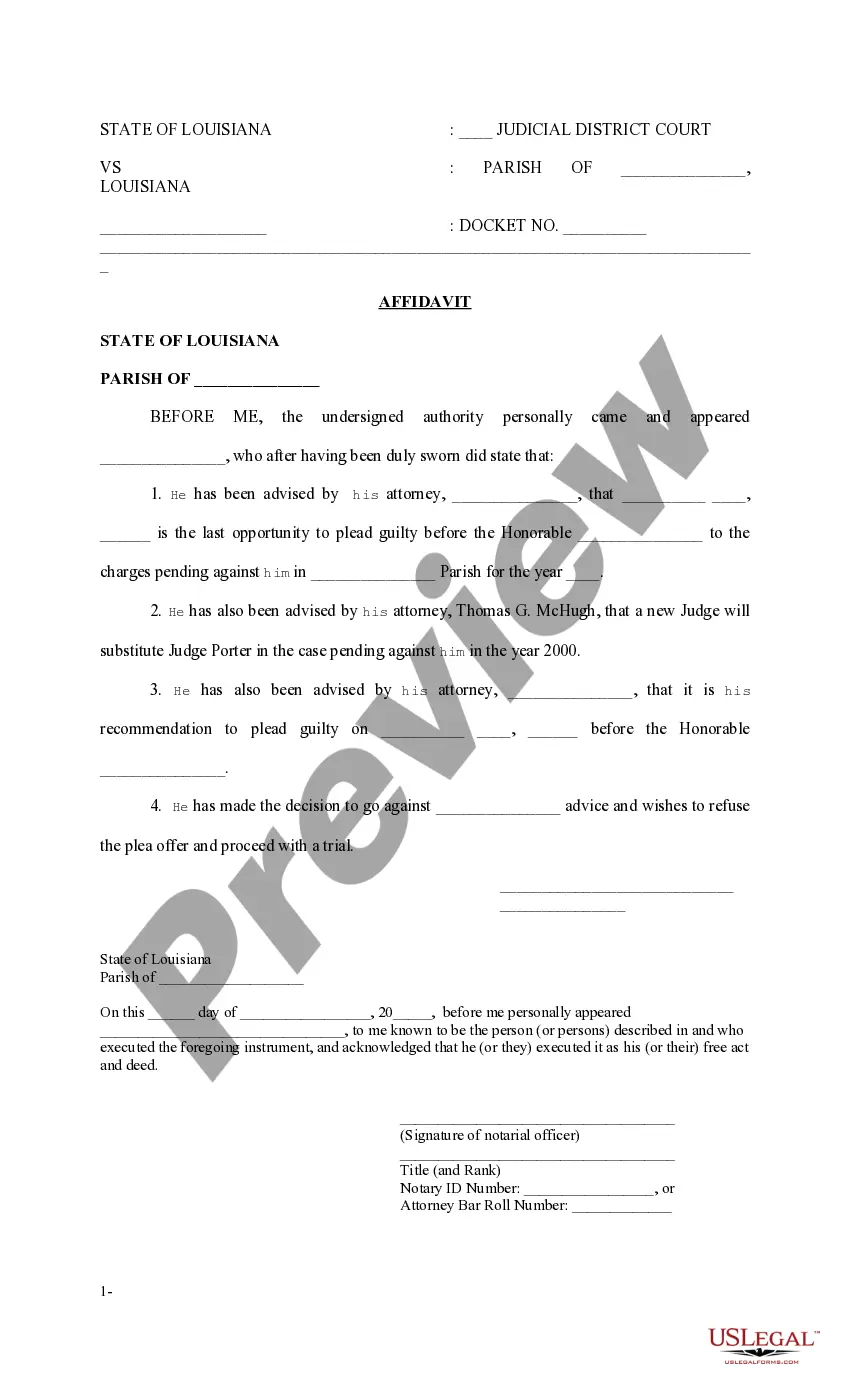
The Statement of the Defendant Refusing Plea Bargain is a legal document that allows a defendant to formally decline a plea bargain offered by the prosecution. By using this form, the defendant acknowledges their understanding of the plea agreement, including the potential consequences of refusing the offer, such as facing a harsher sentence if they choose to plead guilty later. This form is critical for documenting a defendant's decision-making process and protecting their rights during legal proceedings.
Main sections of this form
- The name of the court and case details, including the docket number.
- A declaration by the defendant stating they have been advised of the plea bargain.
- An acknowledgment of understanding the consequences of refusing the plea bargain.
- A declaration of the defendant's intention regarding their plea.
- Signature line for the defendant to affirm their statement.
When to use this document
This form is used when a defendant is presented with a plea bargain but decides not to accept it. It is essential in situations where the defendant wants to ensure there is a formal record of their decision to decline the plea offer. This can be crucial if the case proceeds to trial and the defendant later wishes to plead guilty without a plea deal.
Who can use this document
This form is intended for:
- Defendants in criminal cases who have received a plea bargain offer.
- Individuals who are aware of the legal consequences of refusing the plea bargain.
- Anyone needing to formally document their refusal of a plea offer for legal records.
Steps to complete this form
- Enter the name of the court and case details at the top of the form.
- Provide the docket number associated with your case.
- Read the provided statement carefully to ensure you understand your rights.
- Sign and date the form to confirm your refusal of the plea bargain.
- Indicate the parish in which the statement is made.
Notarization guidance
Notarization is generally not required for this form. However, certain states or situations might demand it. You can complete notarization online through US Legal Forms, powered by Notarize, using a verified video call available anytime.
Get your form ready online
Our built-in tools help you complete, sign, share, and store your documents in one place.
Make edits, fill in missing information, and update formatting in US Legal Forms—just like you would in MS Word.
Download a copy, print it, send it by email, or mail it via USPS—whatever works best for your next step.
Sign and collect signatures with our SignNow integration. Send to multiple recipients, set reminders, and more. Go Premium to unlock E-Sign.
If this form requires notarization, complete it online through a secure video call—no need to meet a notary in person or wait for an appointment.
We protect your documents and personal data by following strict security and privacy standards.

Make edits, fill in missing information, and update formatting in US Legal Forms—just like you would in MS Word.

Download a copy, print it, send it by email, or mail it via USPS—whatever works best for your next step.

Sign and collect signatures with our SignNow integration. Send to multiple recipients, set reminders, and more. Go Premium to unlock E-Sign.

If this form requires notarization, complete it online through a secure video call—no need to meet a notary in person or wait for an appointment.

We protect your documents and personal data by following strict security and privacy standards.
Common mistakes
- Failing to enter the docket number correctly.
- Not signing and dating the form, which can make it invalid.
- Leaving out the court's name or other essential information.
Benefits of using this form online
- Convenient access to accurate and up-to-date legal forms.
- Ability to easily edit and customize the form to fit your specific situation.
- Reliable in meeting the legal requirements for your case.
Looking for another form?
Form popularity
FAQ
When a defendant enters a guilty plea under a plea bargain, withdrawing it can be challenging. Courts usually require strong justification for any withdrawal, particularly if the plea was knowingly and voluntarily made. The Louisiana Statement of the Defendant Refusing Plea Bargain highlights the importance of considering long-term consequences before agreeing to a plea. It is vital to discuss your situation with legal counsel to understand your options.
Once the judge accepts the defendant's guilty or no contest plea and enters a conviction, that judge can't later overturn the plea agreement.If the defendant doesn't satisfy the conditions, the judge can reject the plea and resentence the defendant.
If you don't plea then the case either gets dismissed or you go to trial. Don't count on the dismissal unless you really believe the People's case is very very weak and they know it.
Advantages. Here are a few of the advantages for criminal defendants who accept a plea bargain: Lighter Sentence. Reduced Charge. The Case Is Over. Disadvantages. Avoiding Problems with Prosecution's Case. No Not Guilty Result. Possibility of Coercion.
In addition, a guilty plea May haunt you for the rest of your life because it may result in a guilty finding that cannot be expunged from your record. In addition, if you're found guilty and placed on a period of Probation, and during that period of probation you violate, you could be facing substantial jail time.
There are important disadvantages to plea bargaining as well: Defendants are sometimes pressured into waiving the constitutional right to trial.The defendant gives up the right to a potentially vindicating not guilty verdict. Negotiating a plea bargain might lead to poor case investigation and preparation.
United States, 397 U.S. 742 (1970) has held that plea bargaining is constitutional. The Supreme Court, however, has held that defendants' guilty pleas must be voluntary, and that defendants may only plead guilty if they know the consequences of doing so.
The judge has the authority to accept or reject a plea bargain. They will consider the nature of the charges and the defendant's criminal history, if any, as well as the circumstances surrounding the case.
Having a guilty plea or a no contest plea on the record will look better than having a conviction after a trial. This is partly because the defendant likely will plead guilty or no contest to a lesser level of offense or to fewer offenses.Often, a plea bargain involves reducing a felony to a misdemeanor.
The primary disadvantage of plea bargaining is that it can still put innocent people in jail. To counter this issue, California voters passed Proposition 8 in 1982 to limit when plea bargaining could occur so that people who were innocent didn't feel like they needed to gamble with going to trial.