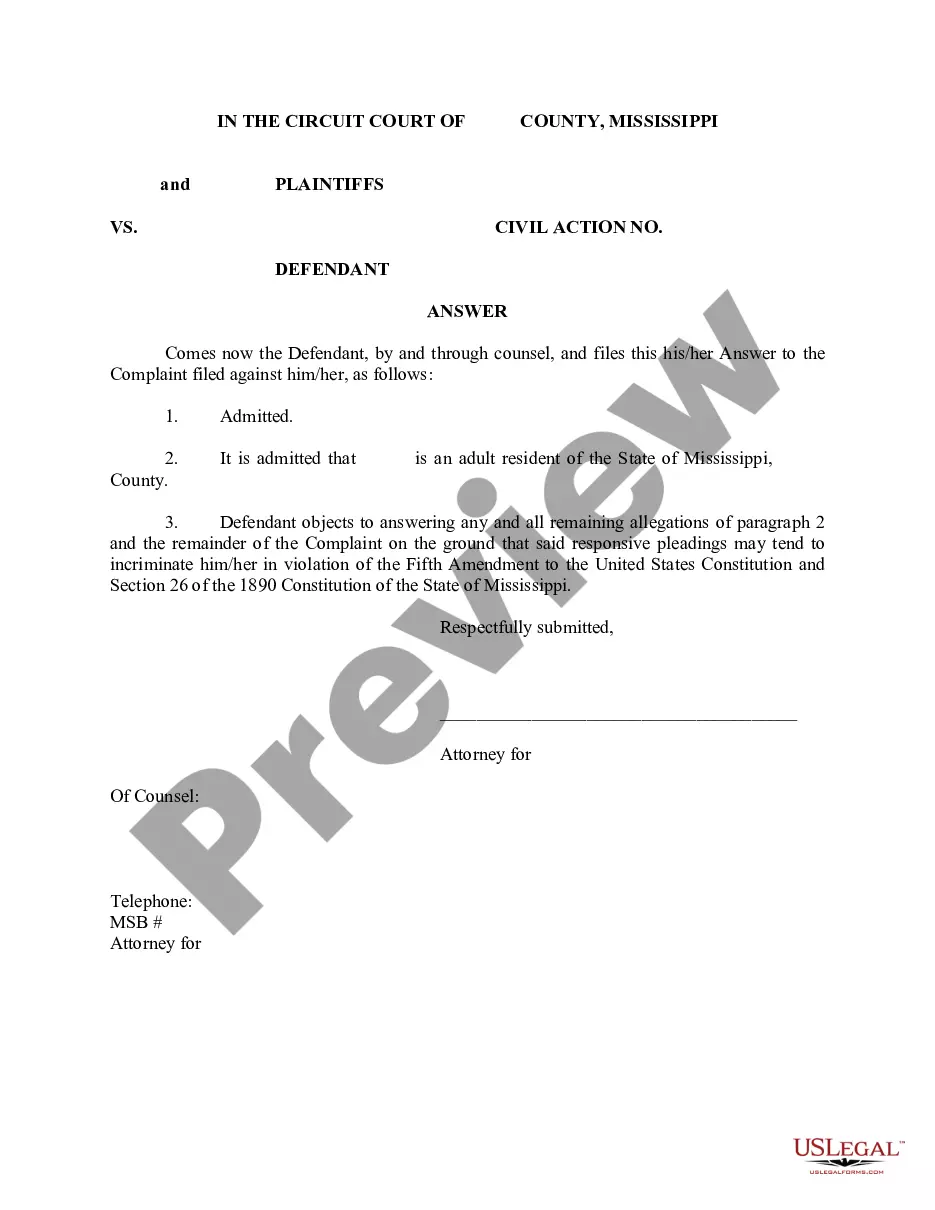
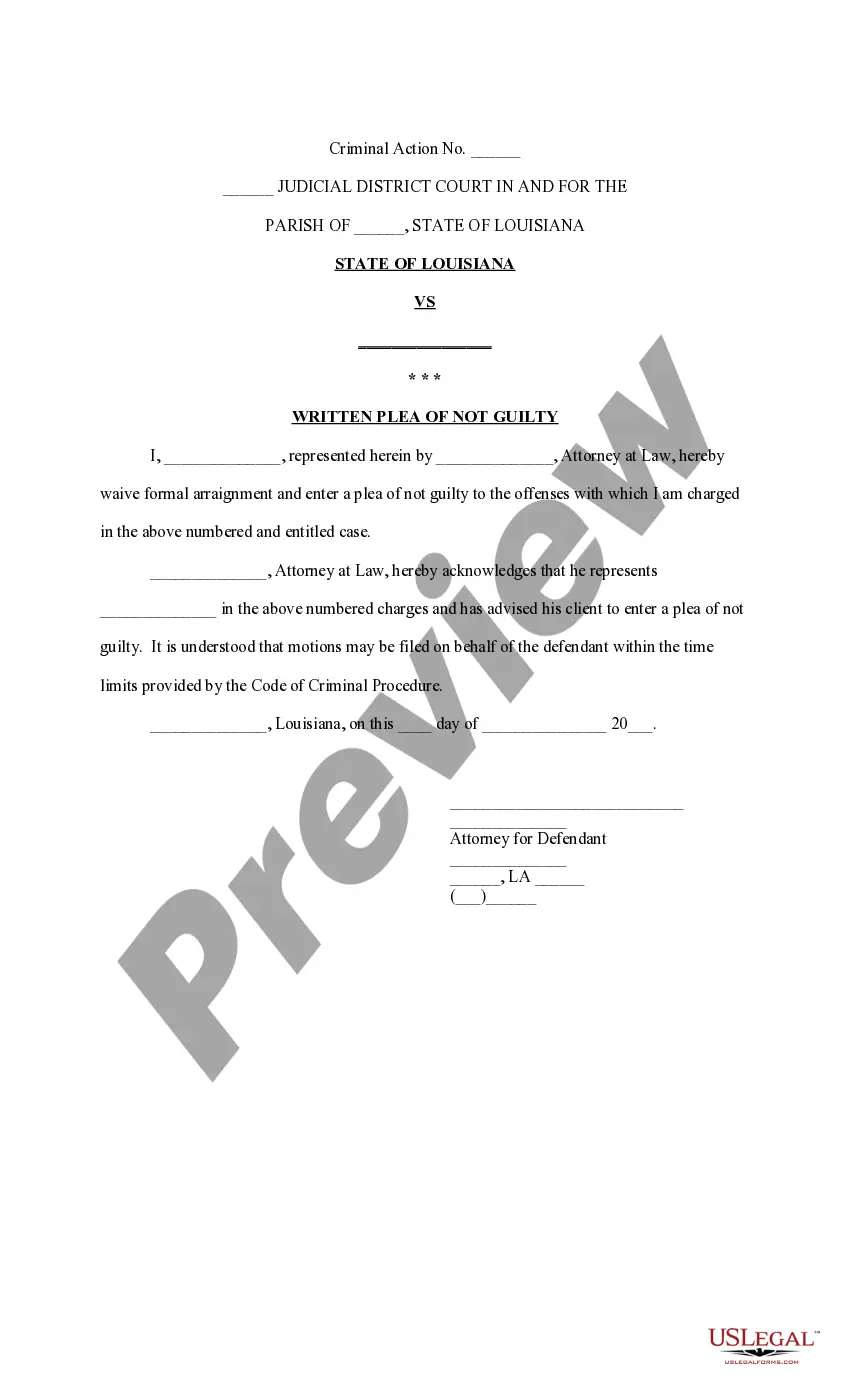
Louisiana Written Plea of Not Guilty
What this document covers
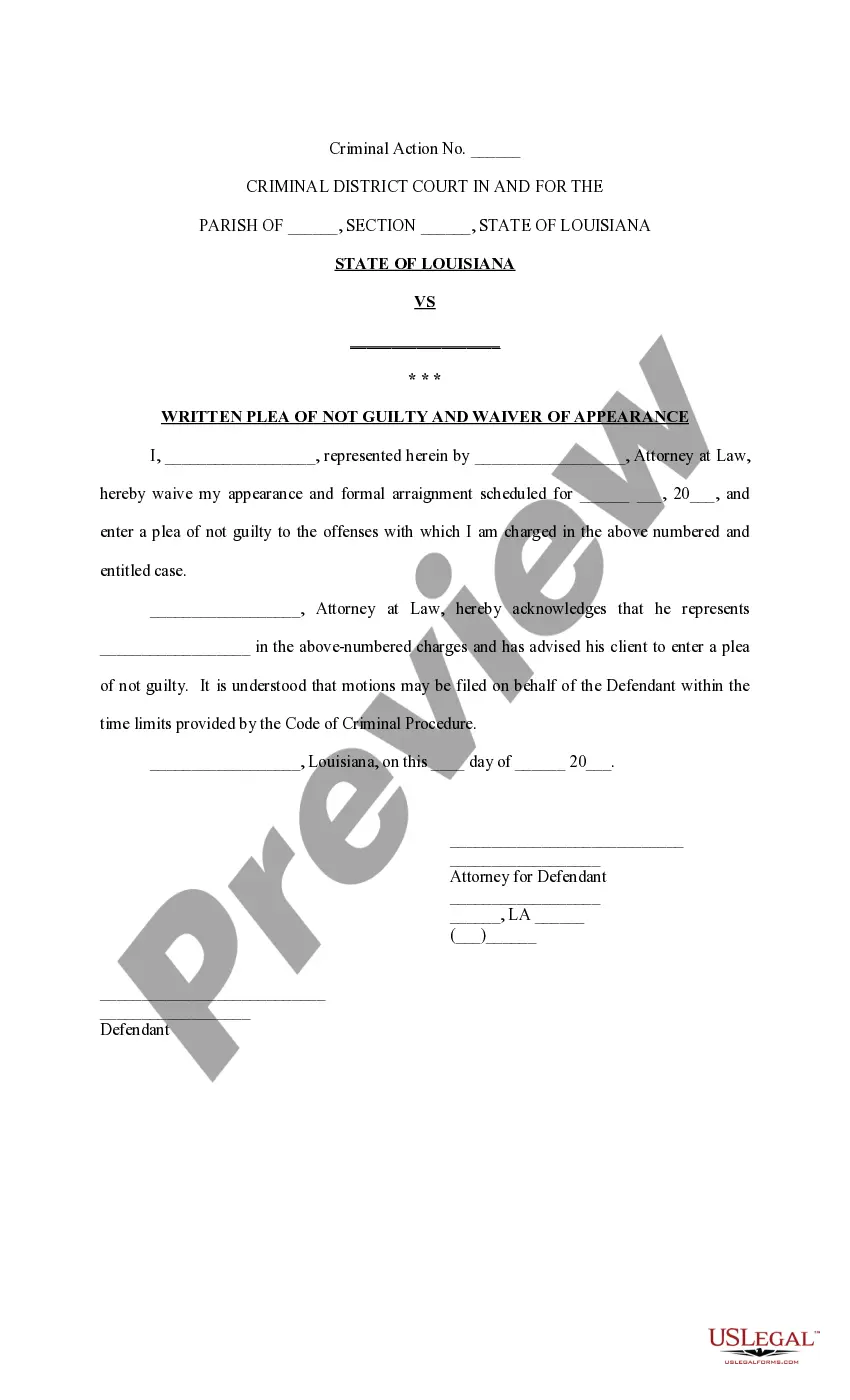
The Written Plea of Not Guilty is a legal document that allows a defendant to formally state their intention to plead not guilty in a criminal proceeding. Filed by the defense attorney, this form waives the need for a formal arraignment, enabling the case to proceed without the defendant's presence. This form is critical for individuals accused of a crime who wish to contest the charges against them, differentiating it from other plea documents that might admit guilt or involve different procedural contexts.
Key components of this form
- Criminal Action Number: Identifies the specific case.
- Judicial District Court: Indicates the court handling the case.
- Defendant's Information: Includes the name of the defendant and their attorney.
- Plea Statement: Formally states the plea of not guilty.
- Attorney's Acknowledgment: Confirms that the attorney has advised the defendant on their plea.
- Filing Date: Specifies the date when the document is filed.
When to use this form
This form should be used when a defendant has been charged with a criminal offense and wishes to enter a not guilty plea. It is appropriate in cases where the defendant, after consulting their attorney, decides to contest the charges through legal representation without needing to appear personally at the arraignment. Common scenarios include misdemeanor charges, felony charges, or situations where the defendant seeks to establish their innocence in a court of law.
Who should use this form
- Defendants facing criminal charges who wish to plead not guilty.
- Defense attorneys representing clients in criminal cases.
- Individuals looking for a structured and legally-compliant way to communicate their plea in court.
Instructions for completing this form
- Enter the criminal action number at the top of the form.
- Provide the name of the judicial district court and relevant parish.
- Fill in the defendant's name and the name of their attorney.
- Clearly state the plea of not guilty in the designated section.
- Sign the document and add the date of signing.
- Ensure all fields are complete before filing with the court.
Notarization guidance
In most cases, this form does not require notarization. However, some jurisdictions or signing circumstances might. US Legal Forms offers online notarization powered by Notarize, accessible 24/7 for a quick, remote process.
Get your form ready online
Our built-in tools help you complete, sign, share, and store your documents in one place.
Make edits, fill in missing information, and update formatting in US Legal Forms—just like you would in MS Word.
Download a copy, print it, send it by email, or mail it via USPS—whatever works best for your next step.
Sign and collect signatures with our SignNow integration. Send to multiple recipients, set reminders, and more. Go Premium to unlock E-Sign.
If this form requires notarization, complete it online through a secure video call—no need to meet a notary in person or wait for an appointment.
We protect your documents and personal data by following strict security and privacy standards.

Make edits, fill in missing information, and update formatting in US Legal Forms—just like you would in MS Word.

Download a copy, print it, send it by email, or mail it via USPS—whatever works best for your next step.

Sign and collect signatures with our SignNow integration. Send to multiple recipients, set reminders, and more. Go Premium to unlock E-Sign.

If this form requires notarization, complete it online through a secure video call—no need to meet a notary in person or wait for an appointment.

We protect your documents and personal data by following strict security and privacy standards.
Common mistakes
- Failing to include the criminal action number.
- Not signing the form, which can invalidate the plea.
- Leaving fields blank or misrepresenting the defendant's information.
- Not adhering to the filing deadlines outlined in the local jurisdiction.
Why complete this form online
- Convenient access anywhere with an internet connection.
- Editable templates allow for personalized details.
- Streamlined filing process saves time.
- Ensures compliance with legal requirements for form completion.
Quick recap
- The Written Plea of Not Guilty allows defendants to contest charges without appearing at arraignment.
- This form must be tailored according to Louisiana's legal standards.
- Accurate completion is essential to avoid delays or legal complications.
- Utilizing an online form can enhance convenience and efficiency.
Looking for another form?

Form popularity
FAQ
Writing a plea involves clearly stating your position regarding the charges against you. For a Louisiana Written Plea of Not Guilty, you need to outline your intent to contest the charges. Include relevant case details and ensure your statement is signed and dated. Using a professional platform like uslegalforms can provide you with the necessary templates and guidance.
No Contest (Nolo Contendere) One option available to a defendant who cannot admit guilt is to negotiate an agreement that allows the defendant to plead no contest instead of guilty. If you plead no contest, you do not admit guilt or claim you are innocent.
When you plead not guilty, you and your lawyer have more time to review your case, analyze the strength of the evidence against you, and determine if there are any weakness in the prosecution's case.On the other hand, if you plead not guilty, your lawyer can negotiate a favorable plea bargain on your behalf.
A plea of not guilty means you believe you have not violated the law. When you plead not guilty, the Judge will set a date for trial.You may represent yourself at trial. If you plead not guilty and later decide to change your plea to guilty, you must reappear in court before the Judge in order to do so.
What happens if I plead not guilty? Pleading not guilty means that you say you didn't do the crime, or that you had a reasonable excuse for doing so. The court will then have a trial to decide whether you did.You may get a longer sentence after conviction at a trial than if you pleaded guilty.
Your plea isn't sworn testimony, so perjury doesn't apply. Pleading not guilty is just a formal way of saying, "Prove it" to the prosecution.
There are three types of pleas in court: guilty, not guilty, and no contest.
There are 4 types of pleas a person can enter into at an arraignment: not guilty, guilty, nolo contendere and not guilty by reason of insanity.
An Alford plea (also called a Kennedy plea in West Virginia, an Alford guilty plea and the Alford doctrine), in United States law, is a guilty plea in criminal court, whereby a defendant in a criminal case does not admit to the criminal act and asserts innocence.
Pleading Not Guilty at an Arraignment By pleading not guilty, the criminal defendant buys time. This gives his or her defense lawyer the opportunity to review the case and to assert all possible defenses. The criminal defense lawyer may explain the defendant's rights.