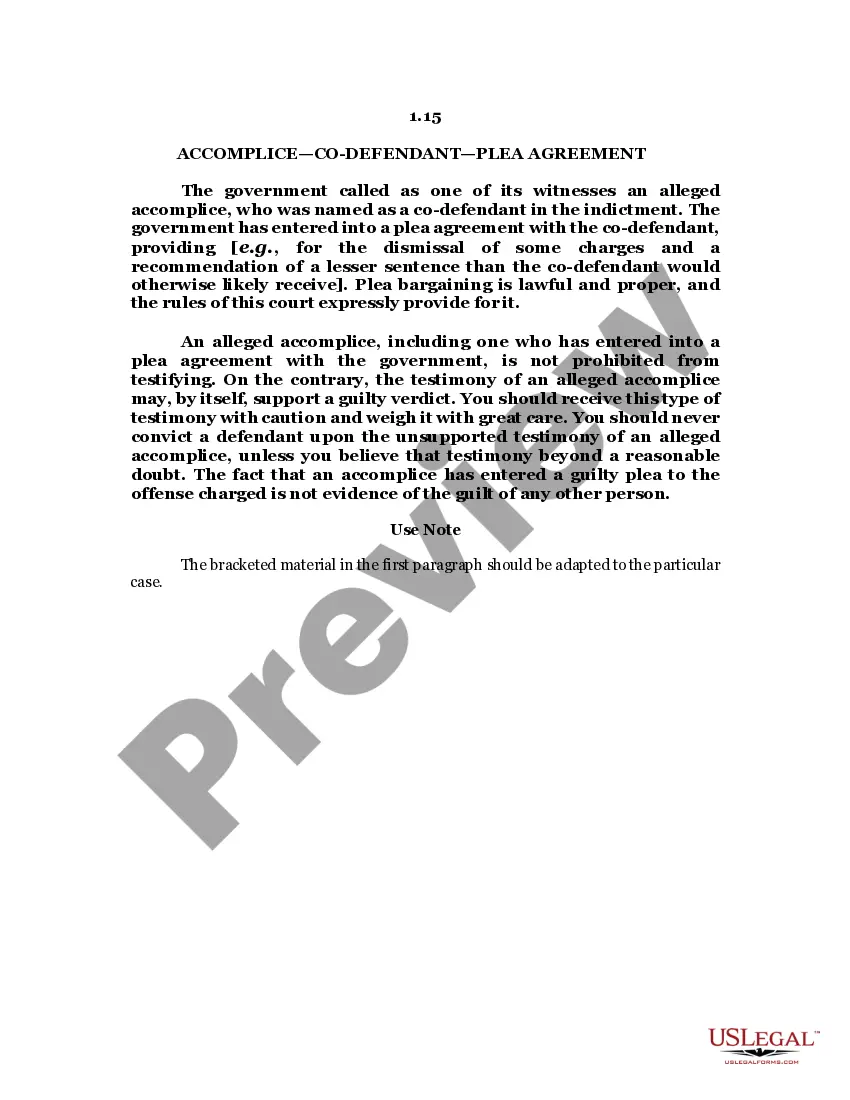
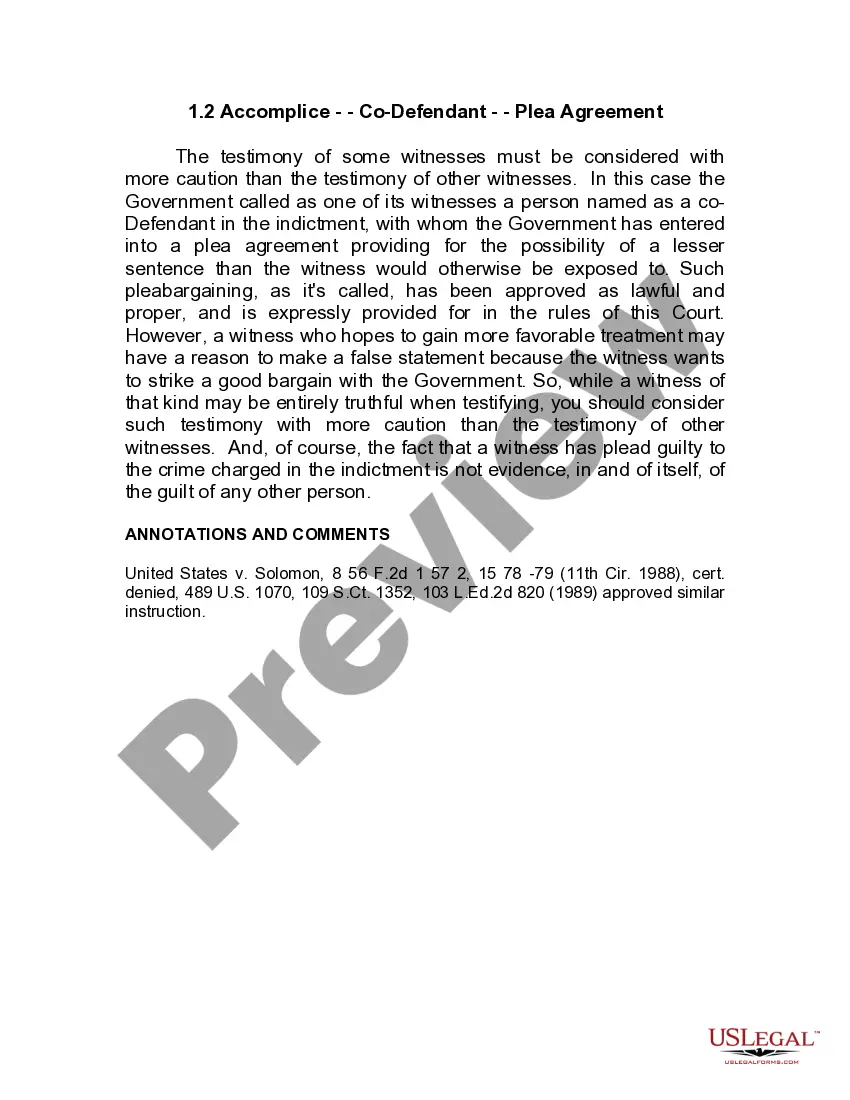
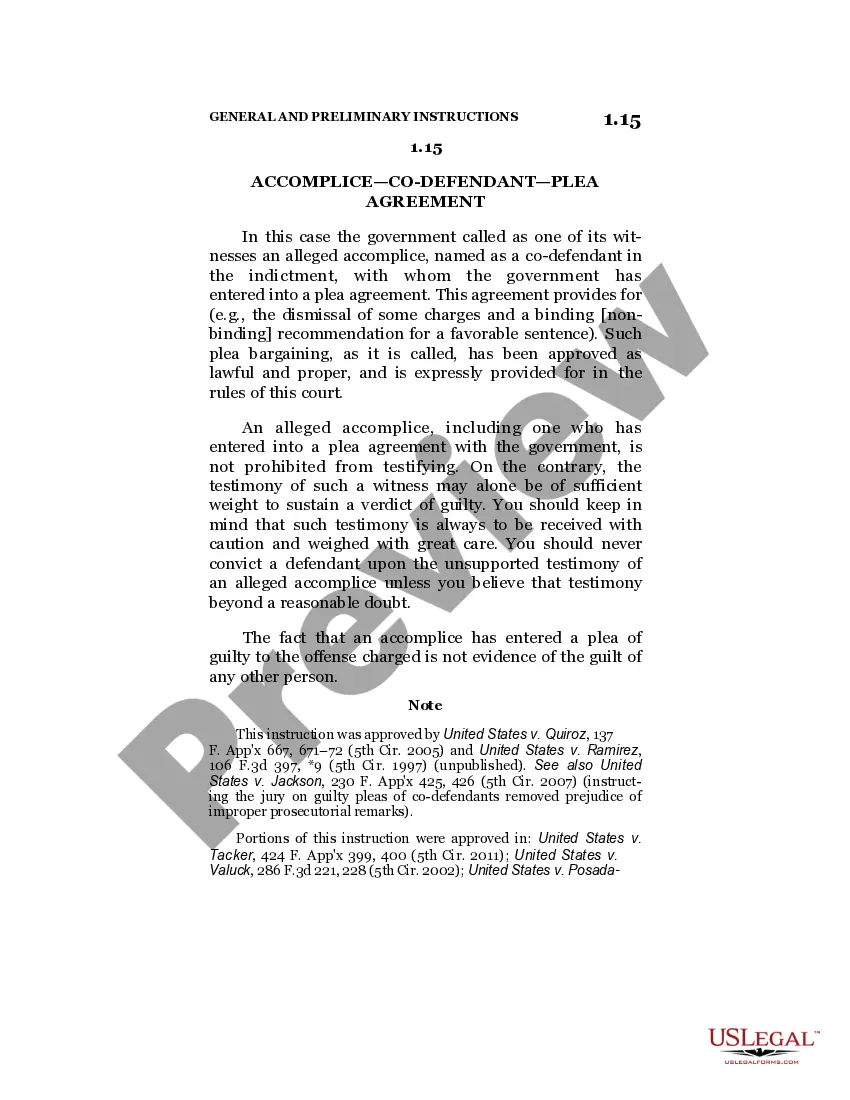
ACCOMPLICE-CO-DEFENDANT-PLEA AGREEMENT
Overview of this form
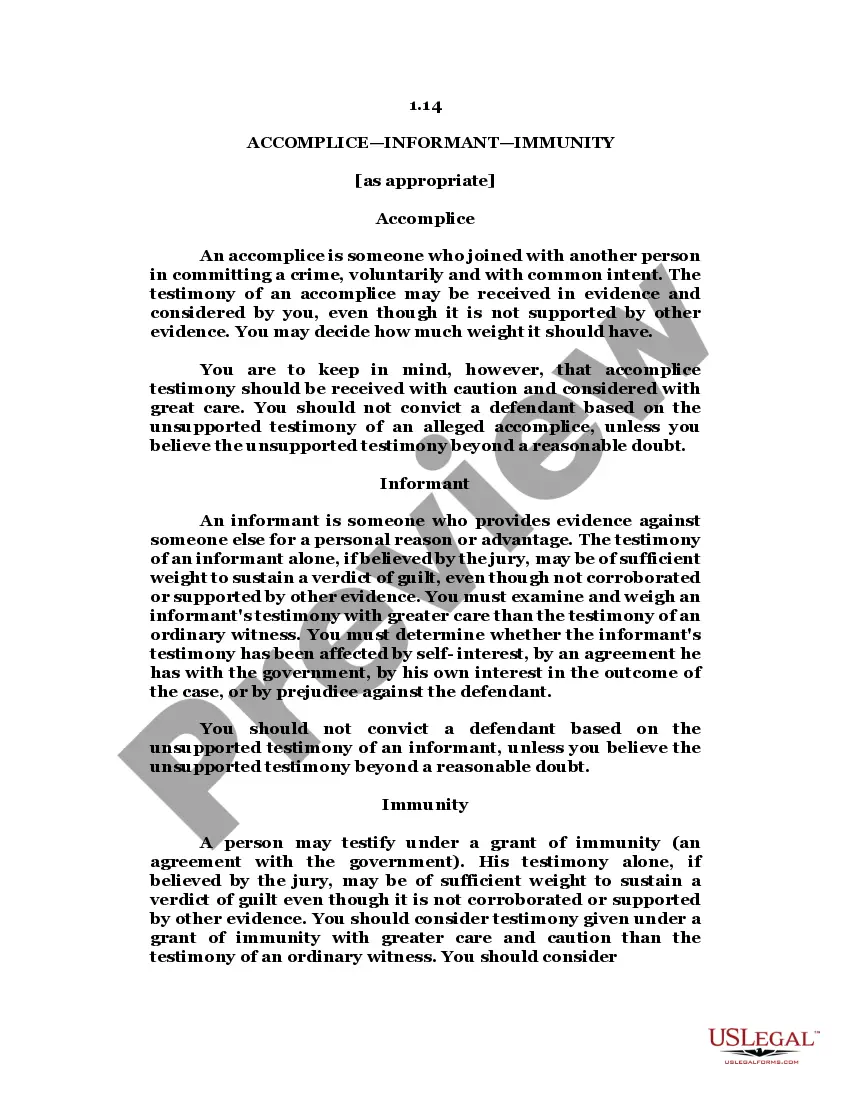
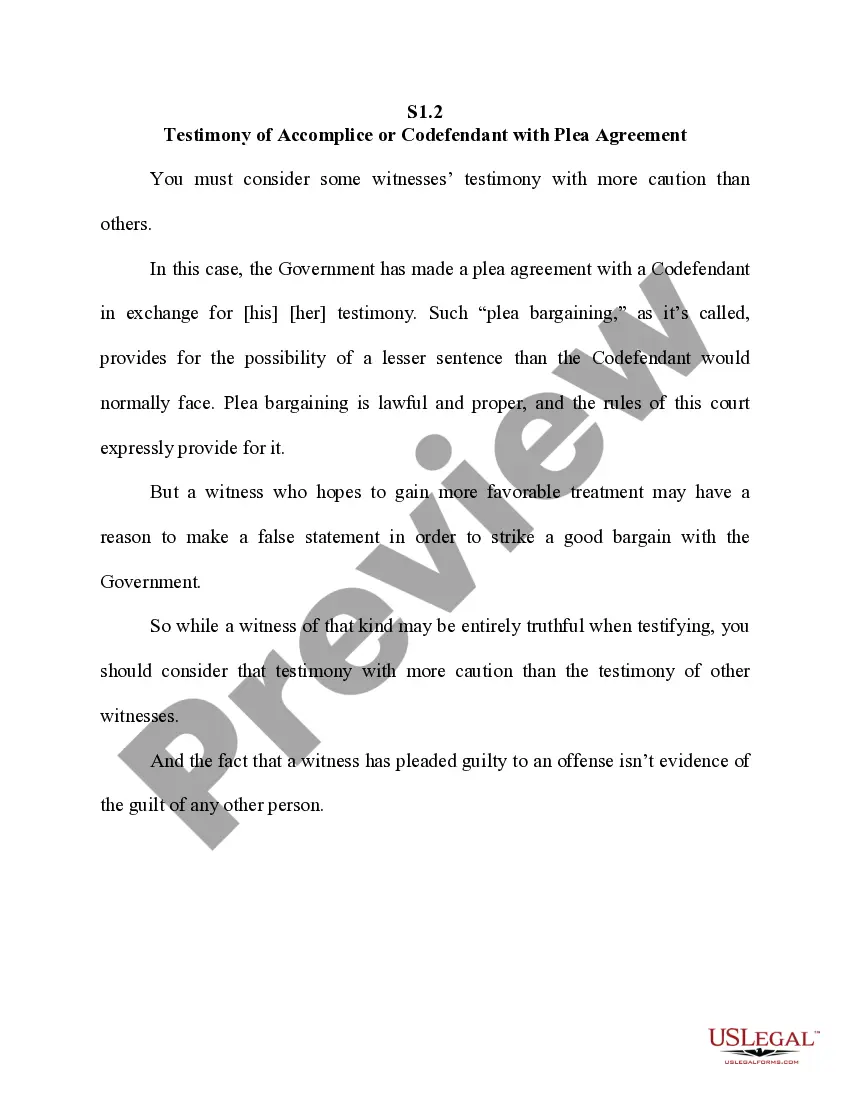
The Accomplice-Co-Defendant-Plea Agreement is a legal document used in criminal cases where an alleged accomplice enters into a plea agreement with the government. This form outlines the terms of the agreement, such as the dismissal of certain charges and recommendations for a lesser sentence. It plays a critical role in plea bargaining, allowing defendants to potentially reduce their sentences in exchange for testimony or cooperation while ensuring that the witnesses' statements are carefully evaluated in court.
Key parts of this document
- Description of the charges dismissed as part of the plea agreement.
- Recommendation for a lesser sentence for the co-defendant.
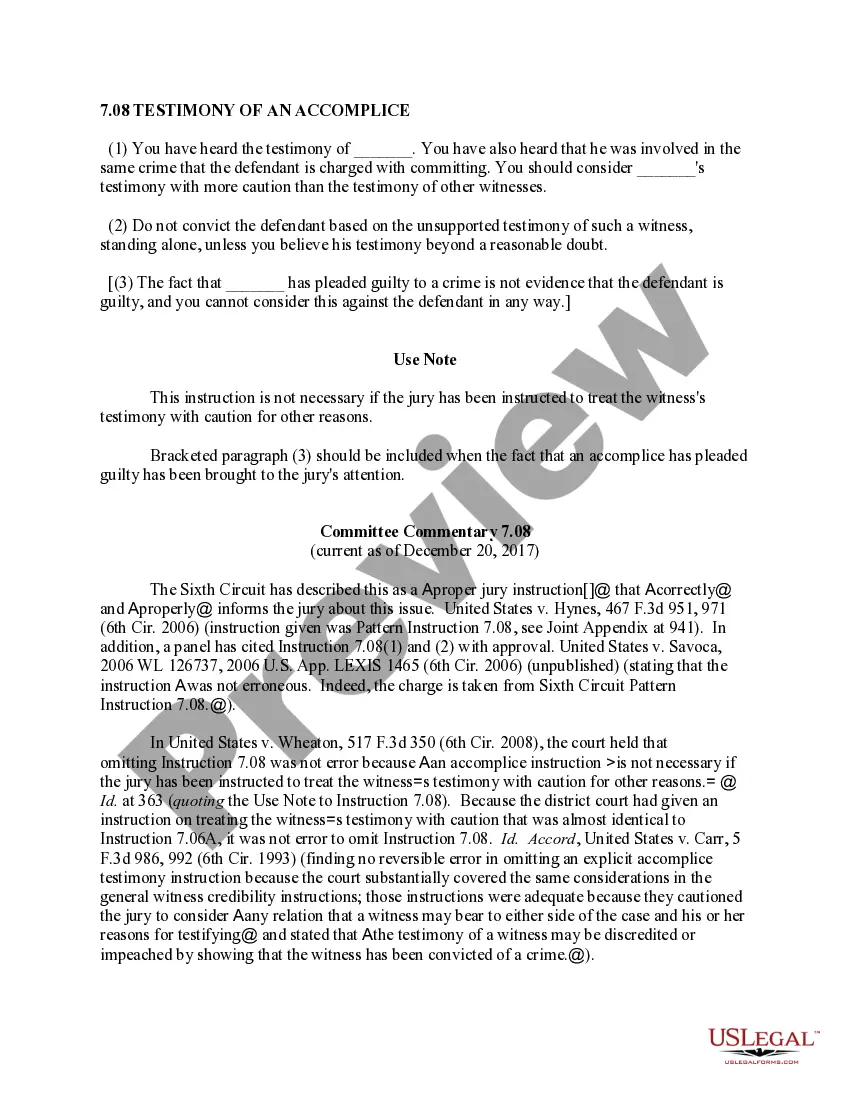
- Guidelines on the admissibility of the accomplice's testimony in court.
- Emphasis on evaluating the testimony with caution and beyond reasonable doubt.
Situations where this form applies
This form is used in scenarios where an individual is facing criminal charges and wishes to enter into a plea agreement as an accomplice or co-defendant. It is relevant when the government seeks cooperation from a defendant in exchange for favorable treatment, such as reduced charges or a lighter sentence. This form should be used when preparing for court proceedings and ensuring that the terms are clearly outlined and understood by all parties involved.
Who should use this form
- Accused individuals who are considering a plea agreement.
- Defense attorneys representing co-defendants or accomplices.
- The government or legal prosecutors involved in plea bargaining.
Instructions for completing this form
- Identify the parties involved in the plea agreement.
- Specify the charges that are being dismissed as part of the agreement.
- Outline the terms of the recommendation for a lesser sentence.
- Ensure clear statements on the admissibility of the accomplice's testimony.
- Review the entire agreement for comprehension and accuracy before signing.
Does this document require notarization?
This form does not typically require notarization to be legally valid. However, some jurisdictions or document types may still require it. US Legal Forms provides secure online notarization powered by Notarize, available 24/7 for added convenience.
Get your form ready online
Our built-in tools help you complete, sign, share, and store your documents in one place.
Make edits, fill in missing information, and update formatting in US Legal Forms—just like you would in MS Word.
Download a copy, print it, send it by email, or mail it via USPS—whatever works best for your next step.
Sign and collect signatures with our SignNow integration. Send to multiple recipients, set reminders, and more. Go Premium to unlock E-Sign.
If this form requires notarization, complete it online through a secure video call—no need to meet a notary in person or wait for an appointment.
We protect your documents and personal data by following strict security and privacy standards.

Make edits, fill in missing information, and update formatting in US Legal Forms—just like you would in MS Word.

Download a copy, print it, send it by email, or mail it via USPS—whatever works best for your next step.

Sign and collect signatures with our SignNow integration. Send to multiple recipients, set reminders, and more. Go Premium to unlock E-Sign.

If this form requires notarization, complete it online through a secure video call—no need to meet a notary in person or wait for an appointment.

We protect your documents and personal data by following strict security and privacy standards.
Avoid these common issues
- Failing to adapt the bracketed language to the specific case.
- Neglecting to fully understand the implications of the plea agreement.
- Inadequate review and explanation of the testimony's significance.
Why complete this form online
- Convenient access to legally vetted templates anytime, anywhere.
- Easy customization to fit specific case details and jurisdictional requirements.
- Time-saving compared to drafting from scratch or consulting multiple sources.
Legal use & context
- Plea agreements are legally recognized and can significantly impact sentencing outcomes.
- Testimony from an accomplice should be considered carefully, as it can be pivotal in convictions.
- Ensure compliance with jurisdictional guidelines to avoid legal complications.
Summary of main points
- The Accomplice-Co-Defendant-Plea Agreement outlines terms that can benefit both the accused and the state.
- Completing this form requires accurate details regarding charges and implications.
- Careful attention must be paid to the testimony of the accomplice, which carries significant weight in legal proceedings.
Looking for another form?


Form popularity
FAQ
When you're arrested with someone else that means you have a co-defendant. At your first appearance the judge is likely to tell you that you aren't allowed any contact with your co-defendant. That means you can't talk to one another or be around each other.
A joint trial of codefendants (also known as "joinder") occurs when a judge merges the cases of two or more defendants. Joint trials happen when the issues in the defendants' cases overlap enough to make a single trial both fair and more efficient.
A codefendant is one of multiple defendants jointly sued in the same civil action or formally accused of committing the same crime. For instance, if A sues B and C, B and C are codefendants.
1. A defendant may not be convicted of any offense upon the testimony of an accomplice unsupported by corroborative evidence tending to connect the defendant with the commission of such offense. The corroborative evidence need not, by itself, prove that a crime was committed or that the defendant is guilty.
It can be difficult for an attorney to represent both codefendants competently and diligently as required. The American Bar Association advises against representing co-defendants, but there is no general law forbidding it.
When to Sever Trials. A defendant generally does not have a right to a separate trial upon request, except in some narrow situations such as death penalty cases. However, a defendant can ask a judge to sever a joint trial if proceeding jointly would jeopardize their right to a fair trial.
Yes, co-defendants in drug cases may receive different sentences. When two people are charged and convicted of the same crime, the maximum penalty they are facing may be the same, but the actual sentence each receives can vary greatly.
Yes. Generally, courts will make sure that all those involved in a drug incident will be prosecuted together. That means that you would typically find out who the co-defendants are in your case very early on. That can be important information.