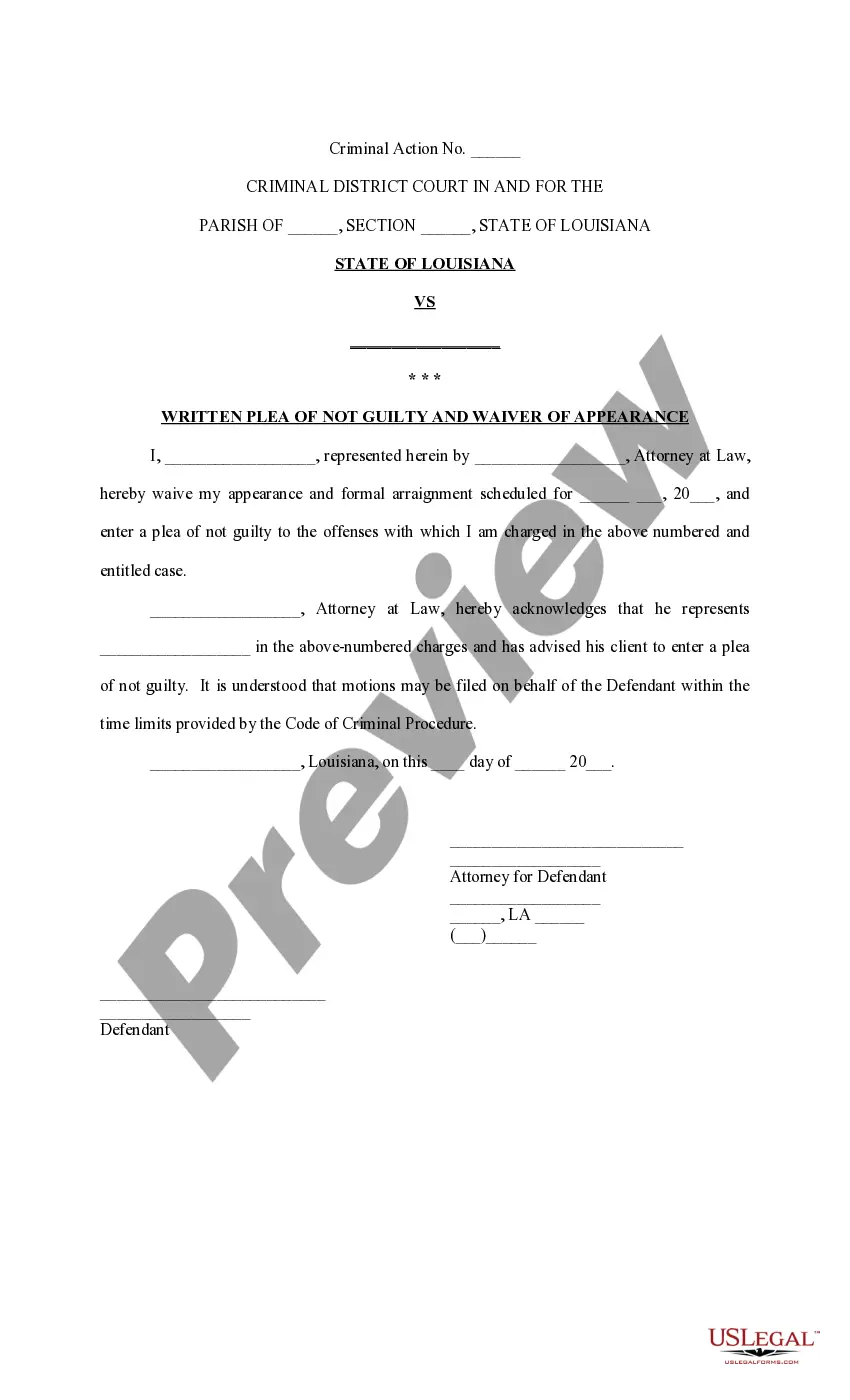
Louisiana Written Plea of Not Guilty and Waiver of Appearance
What this document covers
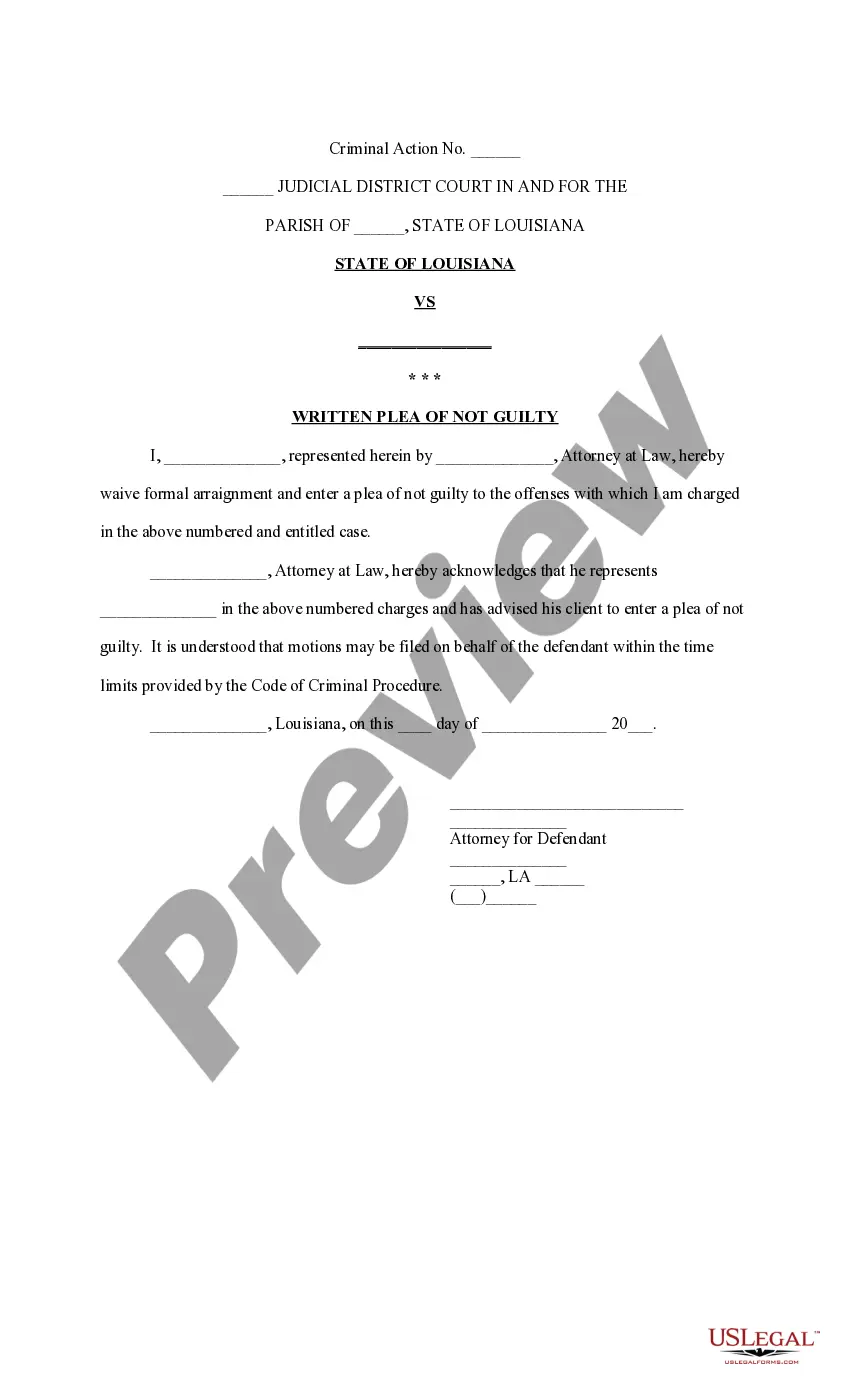
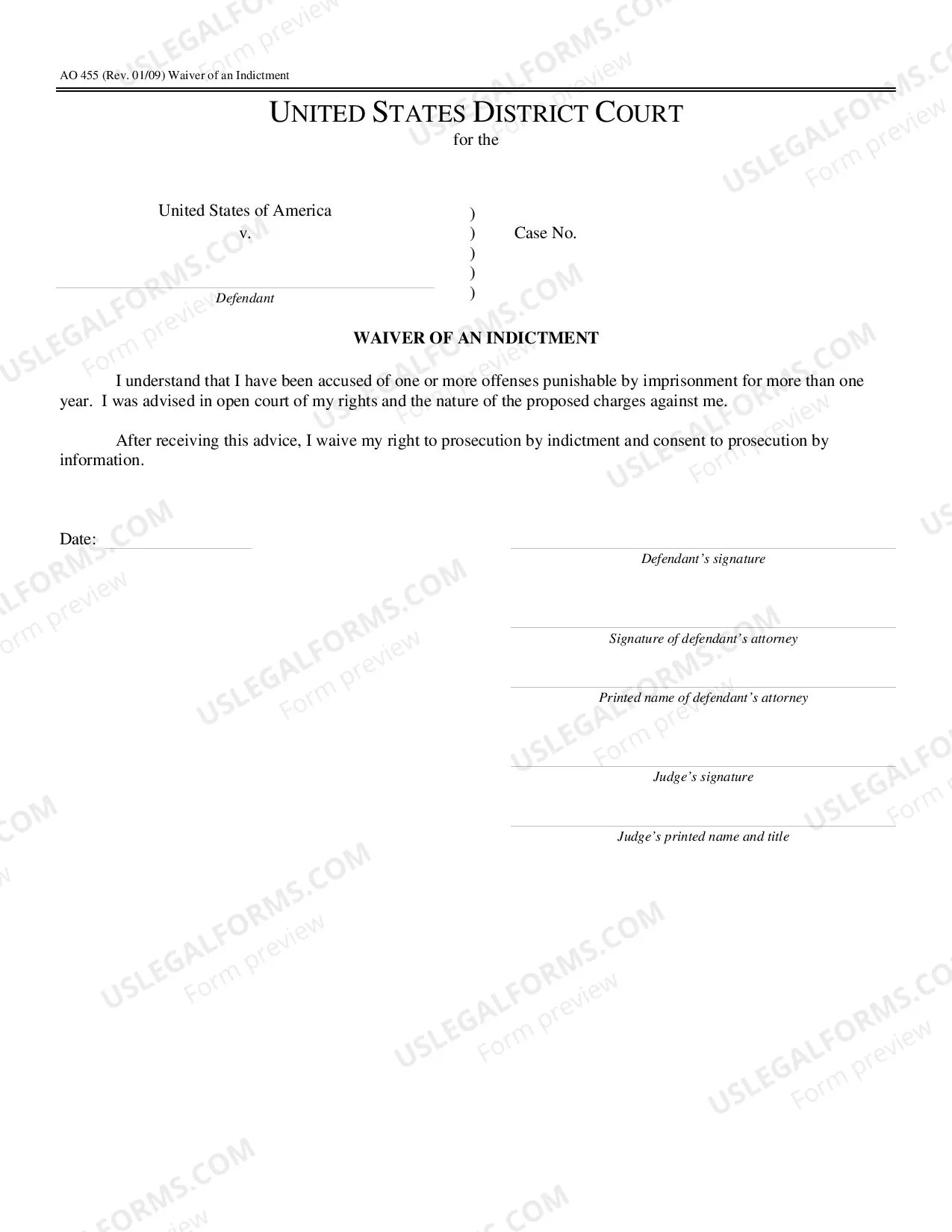
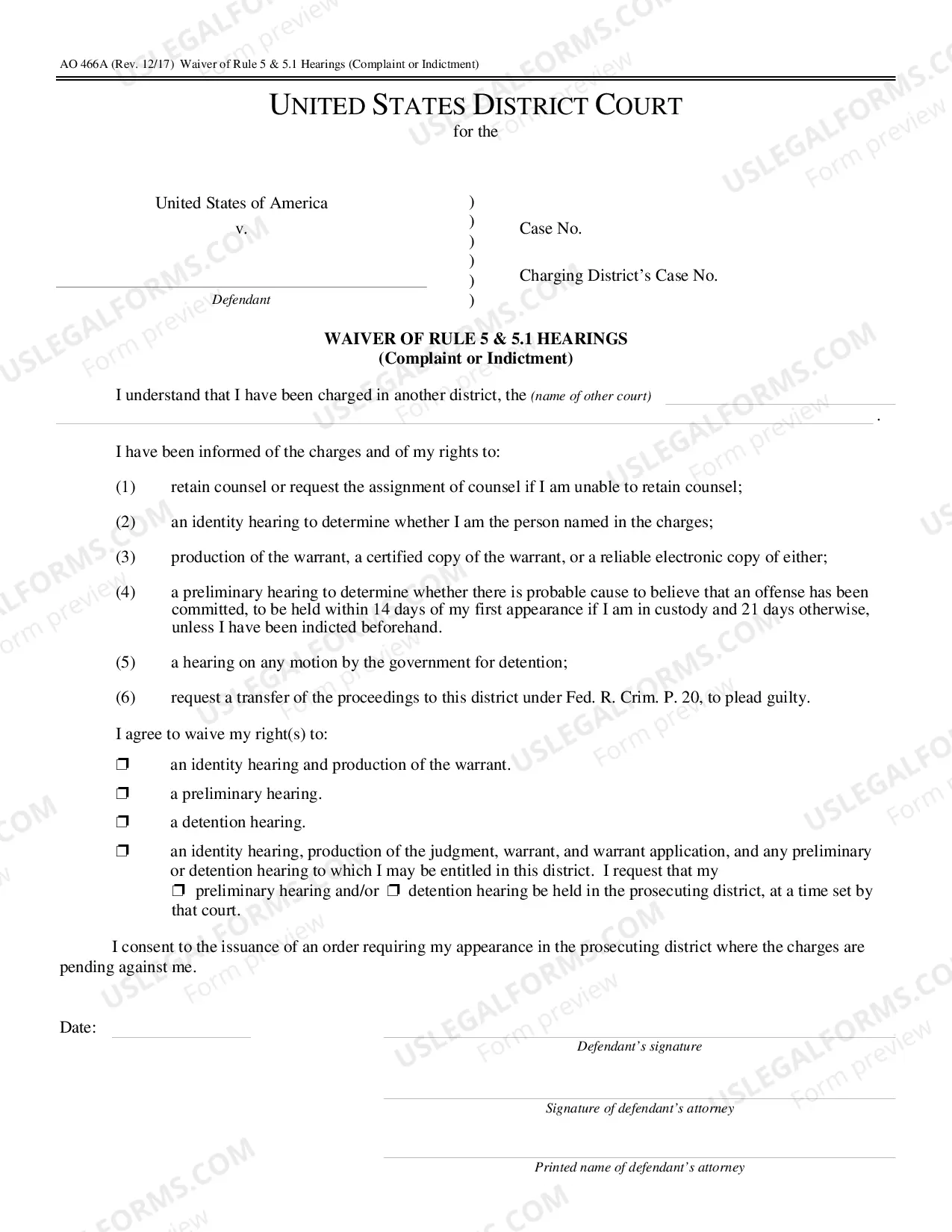
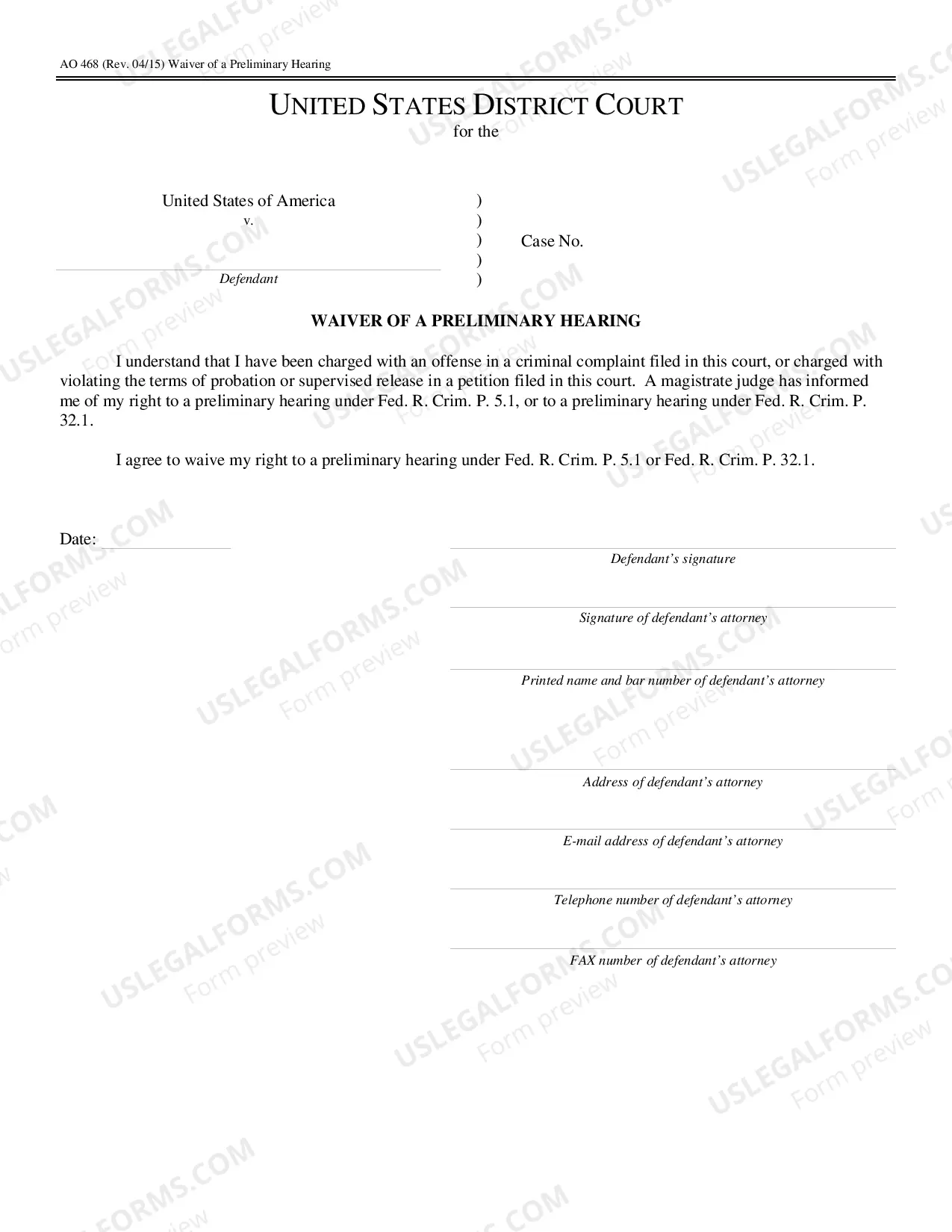
The Written Plea of Not Guilty and Waiver of Appearance is a legal document used in criminal proceedings. It allows a defendant to formally enter a plea of not guilty without being present in court for arraignment. This form is significant as it streamlines the legal process by enabling the defense counsel to act on behalf of their client, ensuring the defendant's rights are maintained while not requiring their physical presence at the proceedings.
Key parts of this document
- Criminal action number to identify the specific case.
- Details of the court where the case is filed.
- Defendantâs name and acknowledgment of representation by an attorney.
- Date of the scheduled arraignment being waived.
- Statements regarding the plea of not guilty and understanding of motion possibilities.
- Signatures of both the attorney and the defendant.
Common use cases
This form should be used when a defendant is charged with a criminal offense but chooses to waive their right to appear at the formal arraignment. It is particularly useful for defendants who are represented by an attorney and wish to expedite the legal process by entering a not guilty plea without needing to be physically present in court.
Who needs this form
- Defendants who have legal representation.
- Individuals charged with a criminal offense who want to plead not guilty.
- Defense attorneys filing on behalf of their clients in Louisiana.
Completing this form step by step
- Fill in the criminal action number at the top of the form.
- Identify the correct district court where the case is being filed.
- Enter the defendant's name and the attorney's name in the specified fields.
- State the date of the scheduled arraignment that is being waived.
- Have the attorney sign the form, followed by the defendantâs signature.
Does this document require notarization?
This form does not typically require notarization unless specified by local law. However, it is advisable to check local regulations to ensure compliance.
Get your form ready online
Our built-in tools help you complete, sign, share, and store your documents in one place.
Make edits, fill in missing information, and update formatting in US Legal Forms—just like you would in MS Word.
Download a copy, print it, send it by email, or mail it via USPS—whatever works best for your next step.
Sign and collect signatures with our SignNow integration. Send to multiple recipients, set reminders, and more. Go Premium to unlock E-Sign.
If this form requires notarization, complete it online through a secure video call—no need to meet a notary in person or wait for an appointment.
We protect your documents and personal data by following strict security and privacy standards.
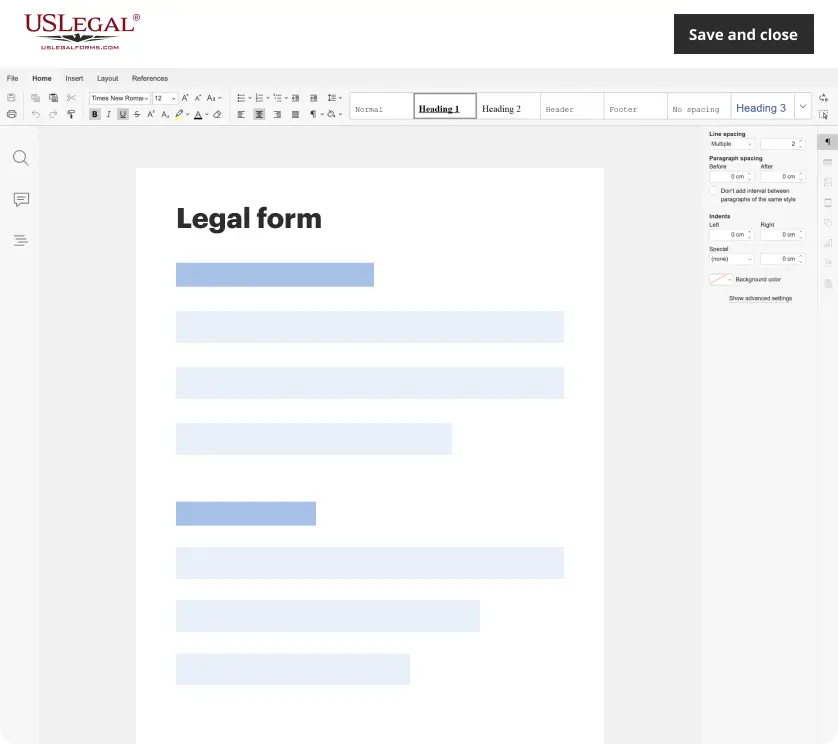
Make edits, fill in missing information, and update formatting in US Legal Forms—just like you would in MS Word.
Download a copy, print it, send it by email, or mail it via USPS—whatever works best for your next step.
Sign and collect signatures with our SignNow integration. Send to multiple recipients, set reminders, and more. Go Premium to unlock E-Sign.

If this form requires notarization, complete it online through a secure video call—no need to meet a notary in person or wait for an appointment.
We protect your documents and personal data by following strict security and privacy standards.
Mistakes to watch out for
- Failing to include the criminal action number, which is essential for case identification.
- Not having both the attorney and the defendant sign the form.
- Incorrectly filling out court details or case information.
Advantages of online completion
- Convenient access to a legally vetted document whenever needed.
- Editability allows users to fill in their specific information easily.
- Reliable and secure format ensuring compliance with legal standards.
Looking for another form?
Form popularity
FAQ
Plea Bargaining: Areas of Negotiation Discusses the three main areas of negotiations involving plea bargains:charge bargaining,sentence bargaining, and fact bargaining.
Plea bargaining does require defendants to waive three rights protected by the Fifth and Sixth Amendments: the right to a jury trial, the right against self-incrimination, and the right to confront witnesses.
If you felt compelled to plead guilty to a crime that you did not commit or that you entered an invalid guilty plea, you may still have options. California law gives you the option of withdrawing your guilty plea, appealing your conviction, pursuing a writ of habeas corpus, or petitioning the CDCR for a resentencing
A defendant can typically withdraw a guilty plea that a judge hasn't yet accepted. Also, defendants who have pleaded but not yet been sentenced can sometimes get out of their deals, particularly when the judge rejects the negotiated agreement pursuant to which the defendant pleaded.
The constitutional rights that a defendant waives by pleading guilty or no contest are: The right to a jury trial, guaranteed by the Sixth Amendment; The right to confront witnesses, guaranteed by the Sixth Amendment; and, The right against self-incrimination, guaranteed by the Fifth Amendment.
The defendant agrees to plead guilty or no contest (nolo contendere in Latin) to a crime in exchange for the prosecution dropping some of the charges, reducing the crime charged to a lesser crime, and/or agreeing to a certain sentence. If the defendant pleads guilty, the law requires that he do so honestly.
A waiver is the voluntary relinquishment or surrender of some known right or privilege.When the right to hold a person liable through a lawsuit is waived, the waiver may be called an exculpatory clause, liability waiver, legal release, or hold harmless clause.
Once the judge accepts the defendant's guilty or no contest plea and enters a conviction, that judge can't later overturn the plea agreement.If the defendant doesn't satisfy the conditions, the judge can reject the plea and resentence the defendant.
Know and understand the rights that they are waiving (giving up) by pleading guilty, including (1) the right to counsel if unrepresented, (2) the right to a jury trial, (3) the right not to incriminate themselves, and (4) the right to confront and cross-examine their accusers.