Mississippi Certificate of Compliance with Rule 11(b)(1)
About this form
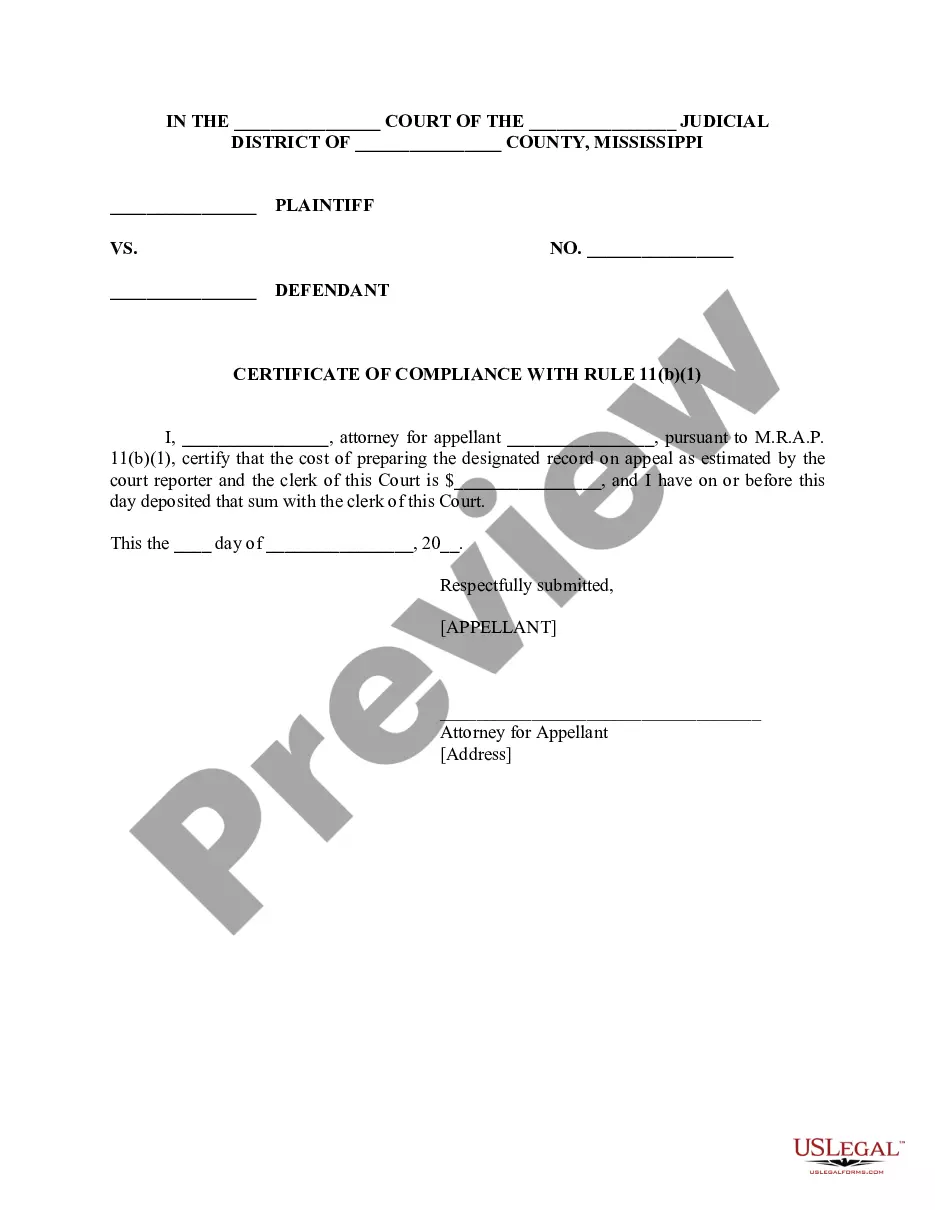
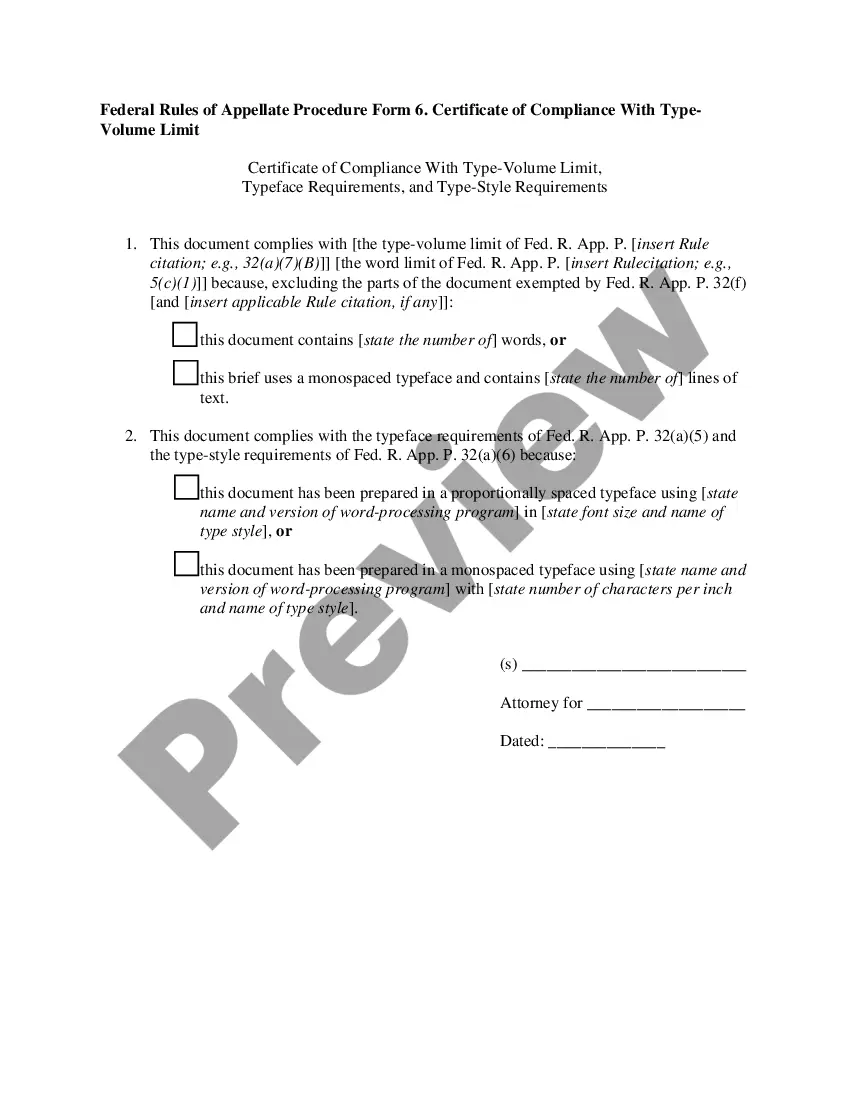
The Certificate of Compliance with Rule 11(b)(1) is a legal document filed by an attorney representing the appellant in an appeal case. This form certifies that the attorney has paid the required costs for preparing the designated record on appeal as estimated by the court reporter and clerk. This ensures compliance with the applicable rules of appellate procedure, distinguishing it from other legal forms related to case filings.
What’s included in this form
- Identification of the district and county where the case is filed.
- Names of the plaintiff and defendant involved in the case.
- Certification statement confirming payment of costs for record preparation.
- Signature of the attorney representing the appellant.
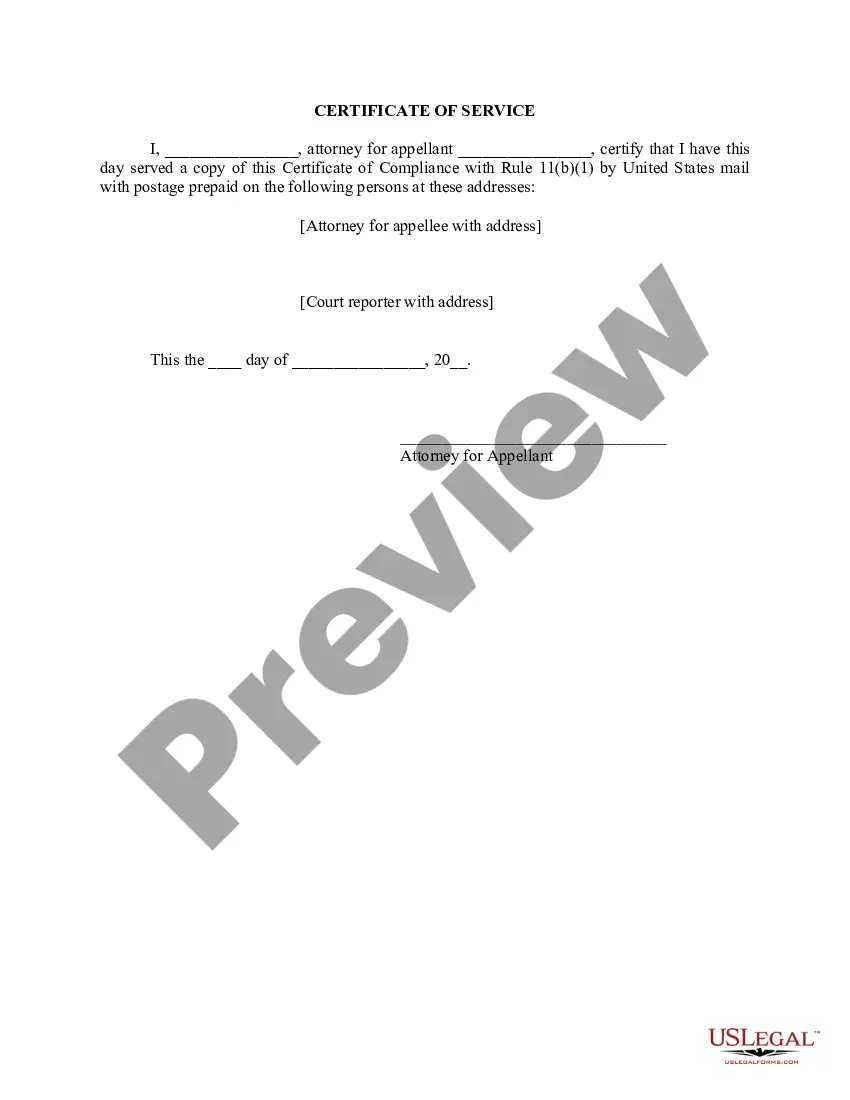
- Certificate of service section to confirm distribution to other relevant parties.
Common use cases
This form should be used in appellate cases to certify that the costs associated with preparing the record on appeal have been paid. It is typically required before proceeding with the appeal, ensuring that all procedural obligations related to filing are met.
Intended users of this form
- Attorneys representing appellants in an appeal case.
- Legal practitioners involved in appellate procedure.
- Individuals appointed as representatives in matters requiring appeals.
Completing this form step by step
- Identify the district and county where the case is filed.
- Fill in the names of the plaintiff and defendant in the case.
- Specify the total amount of costs for preparing the designated record on appeal.
- Include the date of the submission and sign the form as the appellant's attorney.
- Complete the certificate of service by providing names and addresses of all parties served.
Notarization requirements for this form
Notarization is not commonly needed for this form. However, certain documents or local rules may make it necessary. Our notarization service, powered by Notarize, allows you to finalize it securely online anytime, day or night.
Avoid these common issues
- Failing to accurately estimate and pay the preparation costs.
- Not signing the form before submitting it to the court.
- Omitting relevant parties from the certificate of service section.
Why complete this form online
- Immediate access to a professionally drafted legal document.
- Easy editing and customization to fit specific case needs.
- Convenient download options in multiple formats, like Word and Rich Text.
State law considerations
This form is specifically designed for use in Mississippi appellate cases, adhering to the state's legal rules and requirements regarding record preparation fees.
Form popularity
FAQ
Rule 11 refers to Federal Rule of Civil Procedure 11.Rule 11 is intended to make sure that when an attorney or a party submits a legal document to the Court in a civil litigation, he believes in good-faith that the document is truthful, supported by the law, and is being submitted for an appropriate purpose.
As ruled in ExxonMobil Corp. v. Valence Operating Co., a party may revoke their consent to a Rule 11 agreement at any time before rendition of judgment. However, even then, a court is not precluded from enforcing a Rule 11 agreement once the agreement has been repudiated by one of the parties.
Federal Rule of Civil Procedure 11 provides that a district court may sanction attorneys or parties who submit pleadings for an improper purpose or that contain frivolous arguments or arguments that have no evidentiary support.
Essentially, Rule 11 agreements are contracts related to litigation. However, the agreement can be revoked and is only enforceable through a separate breach-of-contract action.
Rule 11 of the Texas Rules of Civil Procedure lets lawyers and parties to any lawsuit enter into a written agreement on any subject matter of the lawsuit.
Most of the time, the parties or lawyers in a lawsuit broker their own Rule 11 agreements. Other times, Rule 11 agreements will be reached at the behest of the court. Regardless, after the agreement has been negotiated, papered, and filed with the court, the parties are bound.
Rule 11(c)(3) Order. When imposing sanctions, the court shall describe the conduct . . . Simply, the court must outline what you did wrong so that you (and an appellate court) know what violation the court has determined you have committed. Rule 11 does not apply to discovery.