Agreement between Joint Patent Holders with Title of one Holder Assigned
About this form
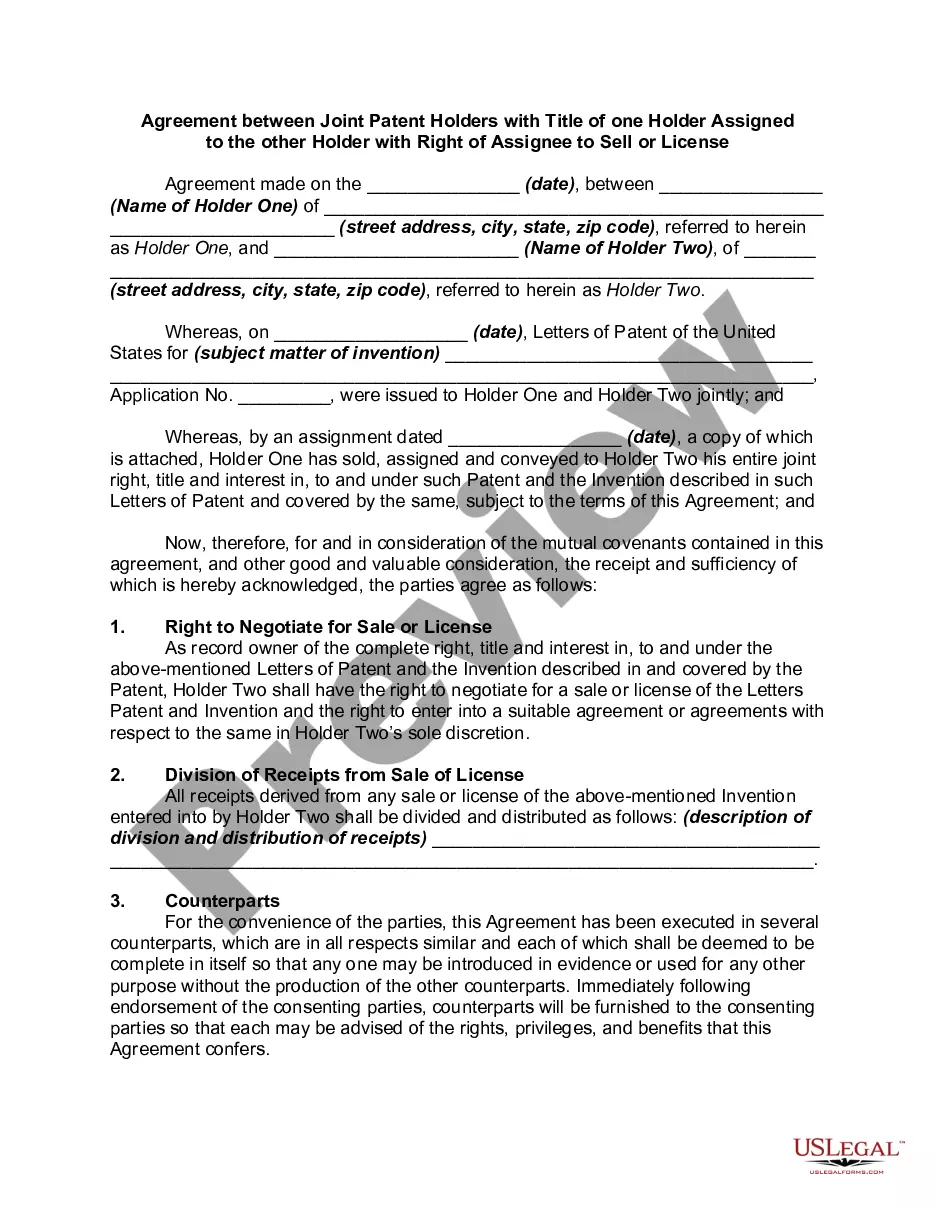
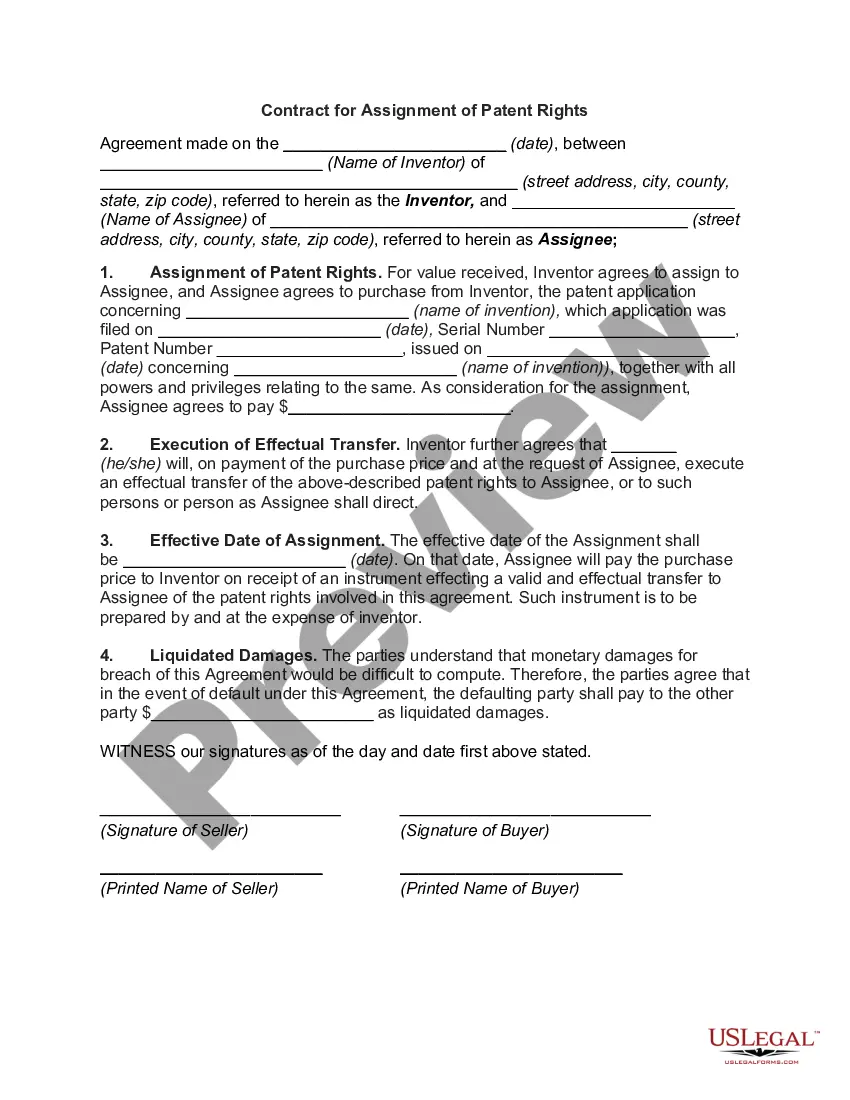
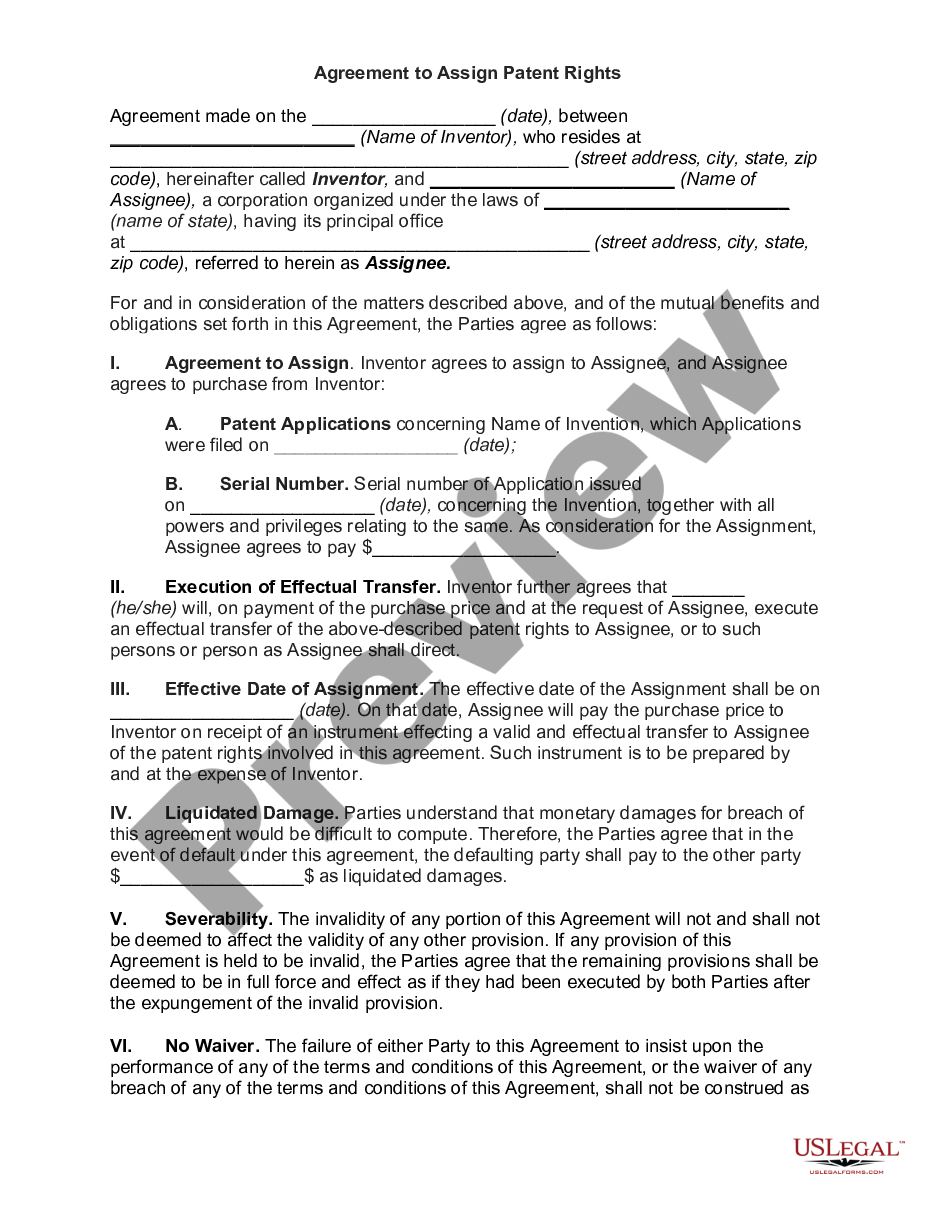
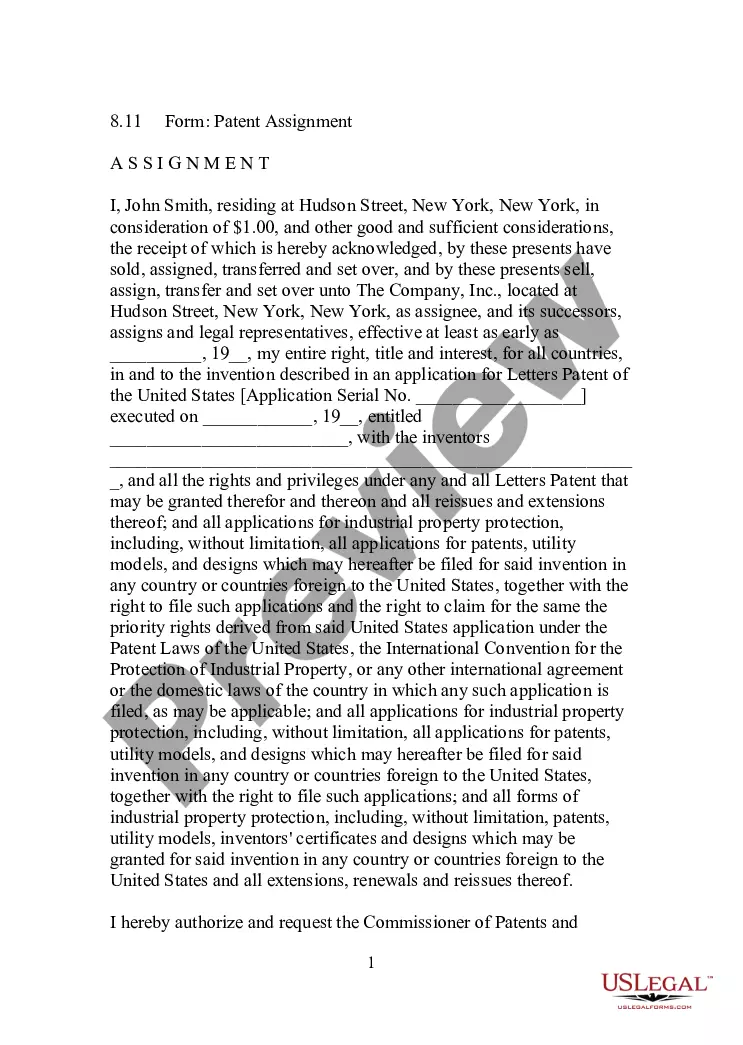
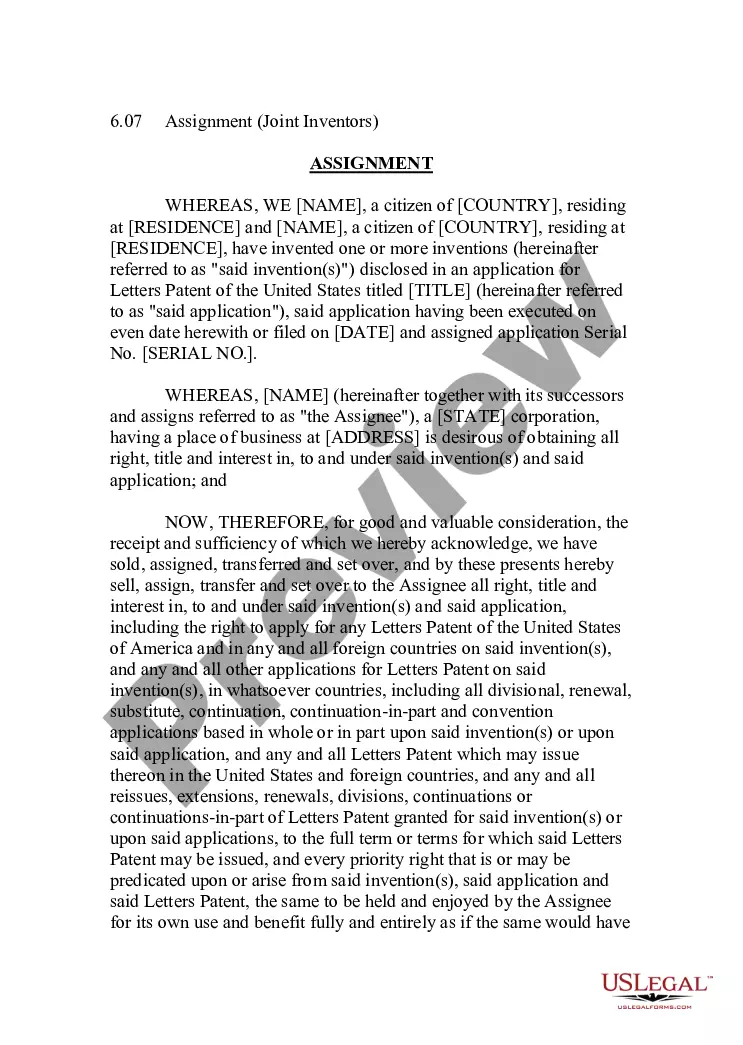
The Agreement between Joint Patent Holders with Title of One Holder Assigned is a legal document that outlines the rights and responsibilities of two individuals who jointly hold a patent. This agreement specifies the terms under which one holder assigns their rights to the other, clarifying ownership and management of the related invention. It facilitates smoother negotiation for licensing or sale of the patent and helps avoid disputes over ownership and profit distribution.
Form components explained
- Details of the patent holders, including names and addresses.
- Date of the original patent issuance and assignment.
- Rights assigned by one patent holder to the other for negotiation and licensing.
- Division of proceeds from any sale or licensing of the patent.
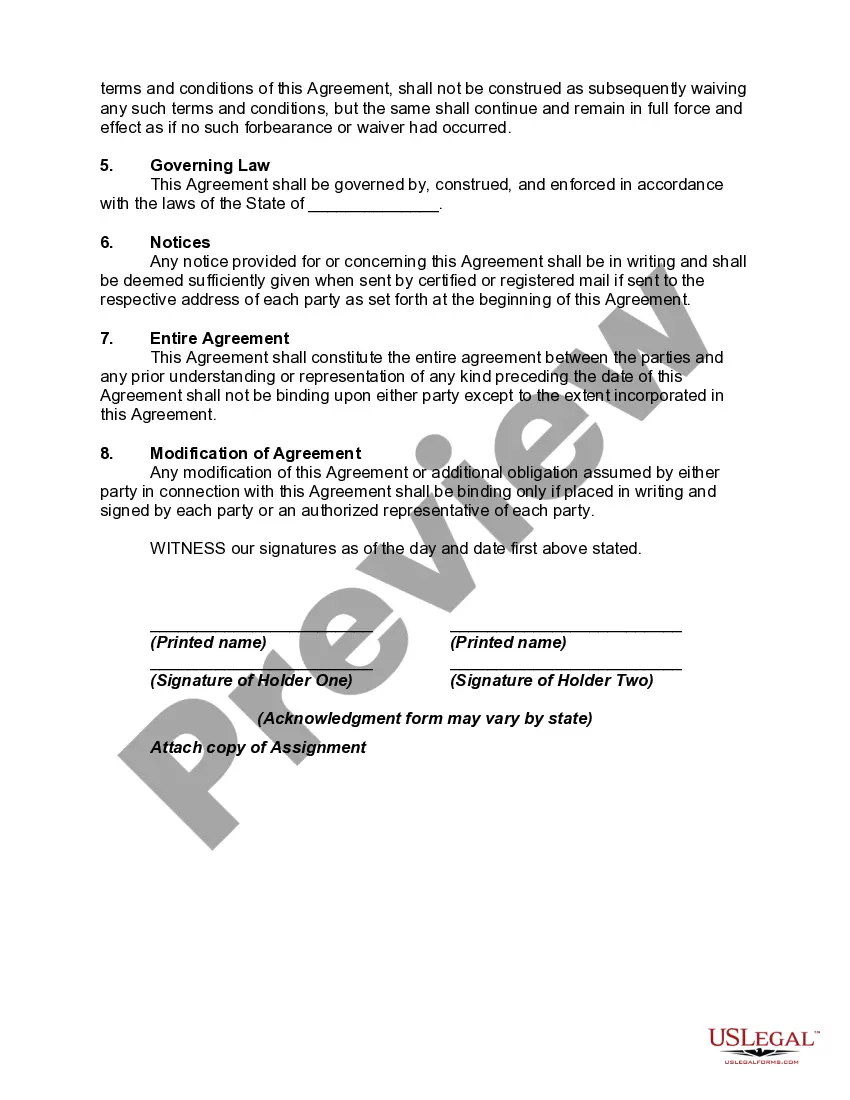
- Governing law to specify which state's regulations apply.
- Provisions for modifications and entire agreement clauses.
When to use this document
This form is necessary when two inventors jointly own a patent, and one inventor wishes to transfer their rights to the other. It is used to ensure clarity in ownership and to set terms for any future sales or licenses of the patented invention. Consider using this form when preparing for potential commercialization of your patent or if any changes in ownership occur.
Who needs this form
- Inventors who jointly own a patent.
- Any holder of a patent who wants to assign rights to a partner.
- Individuals or entities planning to negotiate licensing agreements for a patent.
- Legal professionals assisting clients in patent law.
How to complete this form
- Identify the parties involved by entering the names and addresses of the patent holders.
- Insert the date of the agreement and the date of the original patent issuance.
- Specify the subject matter of the invention and any relevant application numbers.
- Detail the division of proceeds from any sale or licensing arrangements.
- Ensure all parties sign the document, and consider whether notarization is needed.
Does this document require notarization?
This form usually doesn’t need to be notarized. However, local laws or specific transactions may require it. Our online notarization service, powered by Notarize, lets you complete it remotely through a secure video session, available 24/7.
Get your form ready online
Our built-in tools help you complete, sign, share, and store your documents in one place.
Make edits, fill in missing information, and update formatting in US Legal Forms—just like you would in MS Word.
Download a copy, print it, send it by email, or mail it via USPS—whatever works best for your next step.
Sign and collect signatures with our SignNow integration. Send to multiple recipients, set reminders, and more. Go Premium to unlock E-Sign.
If this form requires notarization, complete it online through a secure video call—no need to meet a notary in person or wait for an appointment.
We protect your documents and personal data by following strict security and privacy standards.

Make edits, fill in missing information, and update formatting in US Legal Forms—just like you would in MS Word.

Download a copy, print it, send it by email, or mail it via USPS—whatever works best for your next step.

Sign and collect signatures with our SignNow integration. Send to multiple recipients, set reminders, and more. Go Premium to unlock E-Sign.

If this form requires notarization, complete it online through a secure video call—no need to meet a notary in person or wait for an appointment.

We protect your documents and personal data by following strict security and privacy standards.
Common mistakes to avoid
- Failing to provide accurate names and addresses of the patent holders.
- Not clearly specifying the rights being assigned, including the exact nature of the invention and patent.
- Neglecting to detail the distribution of proceeds from sales or licenses.
- Not signing the agreement or forgetting to have both parties sign.
Why use this form online
- Convenient access to a legally sound agreement, drafted by licensed attorneys.
- Editable templates that allow customization to fit specific needs.
- Secure and efficient electronic delivery of documents.
Legal use & context
- This agreement serves as a legally binding document to enforce rights and obligations between joint patent holders.
- It clarifies ownership and helps prevent legal disputes in the future.
- Properly executing this form ensures that patent rights are enforceable under state law.
Key takeaways
- The agreement is essential for joint patent holders wishing to assign rights.
- Clarity in the division of proceeds can prevent future disputes.
- Ensure all information is accurately filled out, and the form is properly signed.
- This form can be customized for different states but requires careful review of local laws.
Looking for another form?
Form popularity
FAQ
A joint ownership agreement enables owners of property to describe how they will purchase, finance, maintain, and potentially sell it. It is similar to many other types of contracts in that it defines the rights and responsibilities of each party.
Start at uspto.gov/patft. Next, under the heading Related USPTO Services, click on Tools to Help Searching by Patent Classification. You can now start searching. Patent searches may also be done at google.com/patents and at a number of other free sites.
Even without an agreement or a contract in place, ownership of certain intellectual property rights can be determined by common law precedent. Ownership of intellectual property can be owned by one entity, typically the creator, in the form of Sole Ownership.
Joint ownership means that two or more people are the legal owners of the property. Usually, joint owners are liable for the whole of the payments for any joint loans secured on the property, and decisions about the property are made by all the joint owners.
A patent assignment is an agreement where one entity (the assignor) transfers all or part of their right, title and interest in a patent or application to another entity (the assignee).
The invention must be statutory (subject matter eligible) The invention must be new. The invention must be useful. The invention must be non-obvious.
During examination of a pending patent application or after the patent is granted, the owner of the patent may change: 1) the original owner may transfer ownership to another entity or party, through an "assignment;" or 2) the original owner may retain ownership but change its name.
Legal Assignment: An assignment (or an agreement to assign) of an existing patent is a legal assignment, where the assignee may enter his name as the patent owner. A patent which is created by deed can only be assigned by a deed. A legal assignee entitled as the proprietor of the patent acquires all rights thereof.